

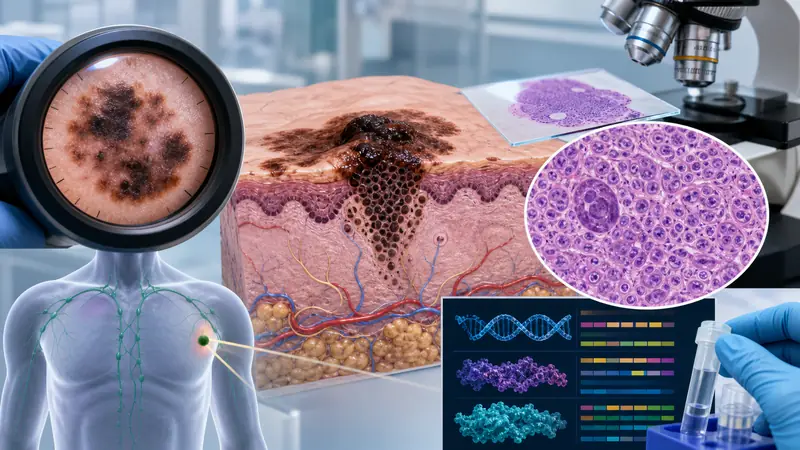
Melanoma Is More Than One Disease
Most melanomas begin in the skin, but melanocytes also occur in the eye and mucosal tissues. Cutaneous melanomas include superficial-spreading, nodular, lentigo-maligna, desmoplastic and other patterns. Acral melanoma begins on palms, soles or beneath nails and is not necessarily caused by ultraviolet exposure. Mucosal melanoma begins in sites such as the nasal passages, mouth, anorectal area or genital tract. Uveal melanoma begins inside the eye and follows a distinct treatment pathway.
A changing pigmented lesion can be remembered by ABCDE: asymmetry, border irregularity, color variation, diameter and evolution. Some melanomas are pink, red or skin-colored rather than dark. A new, changing, bleeding or persistently unusual lesion needs prompt dermatologic evaluation; supplements should never be used as a substitute for biopsy.
Skin-Based Disease
Wide excision is the foundation for localized melanoma. Thickness, ulceration, mitotic activity, margins and lymph-node status help determine stage and additional treatment.
Different Sites, Different Mutation Patterns
These rarer melanomas may be diagnosed later and can have KIT or other alterations. Surgery, systemic therapy, radiation and clinical trials require site-specific expertise.
Melanoma of the Eye
Eye-preserving radiation or surgery may treat the primary tumor. Metastatic uveal melanoma is biologically different from skin melanoma and often involves the liver.
Melanoma Without an Identified Starting Lesion
Expert pathology, complete skin and eye evaluation, imaging and molecular findings help confirm the diagnosis and guide treatment.
Depth, Ulceration, Nodes and Molecular Findings All Matter
A complete pathology report should identify Breslow thickness, ulceration, mitotic rate when reported, margins, histologic subtype, microsatellites and other relevant features. For appropriate clinically node-negative tumors—commonly those at least 0.8 mm thick or with higher-risk features—sentinel lymph-node biopsy may provide important staging information and is ideally planned with the definitive wide excision.
Imaging is chosen by stage and symptoms. BRAF V600 testing is important for advanced cutaneous melanoma and may also guide adjuvant treatment. Broader testing can identify NRAS, KIT, NF1 or other findings that affect clinical-trial or treatment discussions. Uveal melanoma requires separate ocular and molecular risk assessment; HLA-A*02:01 testing matters when considering tebentafusp for unresectable or metastatic disease.
Timing Matters Before the First Major Treatment
Natural strategies can support the person while timely biopsy, excision and specialist review clarify the strongest plan for localized melanoma. Surgery can cure many localized melanomas, and some clinical trials or neoadjuvant immune approaches are available only before surgery or another systemic treatment begins.
Surgery, Immunotherapy, Targeted Treatment and Cellular Therapy Can All Have Roles
Localized melanoma is generally treated with wide local excision, with sentinel-node evaluation when indicated. Higher-risk resected stage II or III disease may be considered for adjuvant anti–PD-1 immunotherapy, and BRAF V600-positive stage III melanoma may have a BRAF/MEK-targeted option. Selected patients with clinically evident resectable stage III disease may discuss treatment before surgery.
Unresectable or metastatic melanoma may be treated with anti–PD-1 therapy alone, dual checkpoint blockade targeting PD-1 plus CTLA-4 or LAG-3, BRAF/MEK inhibitors for BRAF V600-positive tumors, local or radiation approaches for selected sites, tumor-infiltrating lymphocyte therapy after prior treatment, and clinical trials. The best sequence depends on disease pace, symptoms, brain or liver involvement, mutation status, autoimmune history, prior response and the person’s priorities.
Early-Stage Disease
Confirm pathology, achieve appropriate surgical margins, consider sentinel-node biopsy and create a dermatologic surveillance plan.
Resected High-Risk Disease
Review recurrence risk, adjuvant or neoadjuvant options, BRAF status, side effects, fertility and surveillance.
Advanced Cutaneous Melanoma
Choose among immune, targeted, local, radiation, cellular and clinical-trial strategies based on biology and clinical urgency.
Uveal or Mucosal Melanoma
Seek subtype-specific expertise because drug response, mutation patterns, local treatment and trial options differ from common skin melanoma.
Support the Immune-Treated Patient Without Guessing at Immune Stimulation

An individualized integrative plan may address:
- Protein, calories, hydration and weight stability
- Safe aerobic and resistance activity for fatigue and function
- Sleep, anxiety, fear of recurrence and body-image concerns
- Nausea, bowel changes, itching, pain and neuropathy
- Skin protection without complete inactivity outdoors
- Bone, heart and metabolic health during survivorship
- Recovery around surgery, radiation or cellular therapy
- Every herb, extract, vitamin and supplement being used
Natural and supportive care can be positive and active when it is connected to a defined goal. Food-based nutrition, appropriately dosed exercise, sleep support, mindfulness, counseling, relaxation training and acupuncture for selected symptoms may help maintain function and quality of life. These strategies should complement—not replace—melanoma-directed treatment.
Natural Products Can Affect Immune, Targeted and Surgical Treatment
Checkpoint inhibitors intentionally alter immune regulation. Concentrated “immune-boosting” products are not automatically helpful and may be inappropriate for someone with immune toxicity, an autoimmune condition, organ transplant or immunosuppressive treatment. BRAF and MEK inhibitors can interact with medicines and botanicals through drug-metabolism pathways and may affect fever, heart function, skin, liver and eyes.
Sunridge’s approach is selective: define the purpose, verify ingredients and dose, review the melanoma treatment and timing, screen for bleeding, metabolic, immune and organ toxicity, introduce changes deliberately, and monitor symptoms and laboratory trends. A product that is reasonable during survivorship may not be appropriate during surgery, combination immunotherapy or cellular therapy.
Before Surgery
Review bleeding risk, anesthesia interactions, wound healing, nutrition and which supplements should be paused.
During Checkpoint Immunotherapy
Coordinate new symptoms quickly and avoid self-treating suspected immune toxicity with unreviewed products.
With BRAF/MEK Therapy
Track fever, rash, eye symptoms, heart function and liver tests, and screen grapefruit, St. John’s wort and concentrated extracts.
Around TIL Therapy
Follow the cellular-therapy team’s rules for supplements, infection prevention, conditioning chemotherapy and recovery.
What We Review
Helpful records include dermatology notes, the original biopsy and wide-excision pathology, Breslow thickness, ulceration, margins, sentinel-node results, mutation testing, stage, imaging reports and images, operative and radiation notes, and the complete systemic-treatment timeline with response and toxicity.
Please include CBC, kidney, liver, thyroid and endocrine testing, autoimmune or transplant history, current skin and neurologic symptoms, and every prescription, nonprescription medicine, herb and supplement. We also want to understand nutrition, activity, sleep, sun exposure, emotional health, support at home and the outcomes that matter most to the patient.
Questions About Integrative Melanoma Care
Do you work with both early and advanced melanoma?
Yes, for adults. The plan must account for melanoma subtype, pathology, stage, mutation results, surgery, prior treatment, symptoms and the goal of care.
Can natural therapies cure melanoma?
No natural therapy has been proven to replace complete surgical removal or effective systemic treatment. Integrative care may support strength, symptoms and quality of life while we explain what is supported, what is uncertain and where delay could be dangerous.
Should every melanoma be tested for BRAF?
BRAF V600 testing is especially important for advanced cutaneous melanoma and can also affect adjuvant decisions in resected stage III disease. The appropriate molecular panel varies by subtype and stage.
Can I come while receiving immunotherapy or targeted treatment?
Potentially. Many people seek integrative support during active therapy. The plan must account for immune toxicity, drug metabolism, organ function, symptoms and the timing of each intervention.
What if melanoma has spread to the brain or liver?
Important options may still exist, but rapid multidisciplinary review is needed. Systemic therapy, stereotactic radiation, surgery, liver-directed procedures for selected uveal melanoma and clinical trials may be considered.
Will you coordinate with my dermatologist and oncology team?
Yes. Coordination is important because surgery, surveillance, immune toxicity, molecular treatment, radiation and supportive therapies affect one another.
References
- National Cancer Institute. Melanoma Treatment (PDQ®)—Health Professional Version.
- National Cancer Institute. Melanoma Treatment—Patient Version.
- National Cancer Institute. Advances in Melanoma and Other Skin Cancers Research.
- National Cancer Institute. Intraocular (Uveal) Melanoma Treatment (PDQ®).
- National Cancer Institute. Melanoma Clinical Trials.
- U.S. Food and Drug Administration. Lifileucel for unresectable or metastatic melanoma.
- U.S. Food and Drug Administration. Tebentafusp for HLA-A*02:01-positive uveal melanoma.
- Physical activity and exercise in patients with melanoma: systematic review.
- Health-related quality of life among melanoma survivors: systematic review.
- National Cancer Institute. Cancer Therapy Interactions With Foods and Dietary Supplements (PDQ®).
- National Cancer Institute. Diets, Supplements, and Cancer.
This page is educational and does not replace diagnosis or treatment advice from a qualified dermatologist, surgical oncologist, medical oncologist, radiation oncologist, ocular oncologist or cellular-therapy team. Treatment outcomes cannot be guaranteed.