


Can advanced alternative medicine for autoimmune disease complement prescribed care without adding avoidable risk or false hope? It’s a reasonable question when symptoms and treatment decisions feel complicated, and online claims can be difficult to verify. Complementary approaches may be worth discussing, but they shouldn’t be assumed safe or used to replace prescribed treatment.
A thoughtful plan starts with your diagnosis, current therapies, and health priorities. You deserve clear explanations of what an approach is intended to do, what evidence supports it, and how potential risks or interactions will be reviewed.
This article explains what integrative and alternative medicine can mean in autoimmune care and how to assess options with a critical, practical lens. You’ll learn what to ask about evidence, safety, and clinician qualifications, and how to prepare for a conversation with your medical team. The aim is not to choose between conventional and complementary care, but to consider whether a proposed approach can be responsibly coordinated with the care you already receive.
Key Takeaways
- Learn how integrative, complementary, and alternative care differ, and why autoimmune treatment needs to be considered condition by condition.
- Use a structured evaluation process that considers your diagnosis, medical history, current medications, goals, and follow-up plan.
- Assess advanced alternative medicine for autoimmune disease by looking at evidence for the specific therapy and condition, along with potential risks and uncertainties.
- Prepare focused questions about a therapy’s purpose, supporting evidence, safety, and alternatives. Tell every clinician involved in your care what you’re taking or trying.
- Understand how Sunridge Medical describes its individualized approach, and what to clarify about therapy selection, monitoring, and coordination with your existing care team.
What Does Advanced Alternative Medicine for Autoimmune Disease Mean?
Advanced alternative medicine for autoimmune disease is a broad, nonstandardized term for approaches intended to support or address autoimmune health outside conventional treatment alone. The term itself does not establish that a therapy is effective, safe, or curative. A careful evaluation considers each approach in the context of your diagnosis and existing medical care.
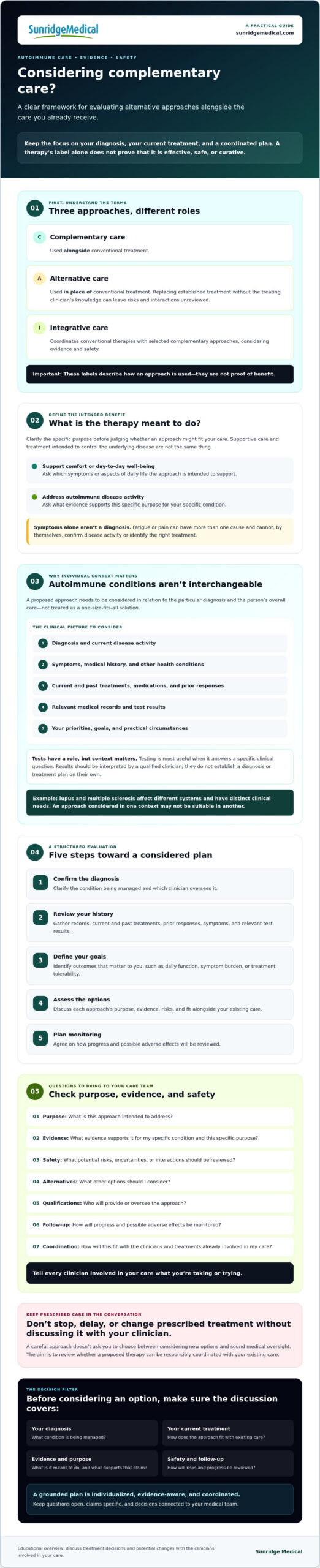
The terms describe different relationships to conventional medicine. Complementary care is used alongside conventional treatment. Alternative care is used in place of it. Integrative care coordinates conventional therapies with selected complementary approaches, considering their evidence and safety. These labels can help clarify intent, but they are not proof of benefit. A foundational overview of evaluating alternative therapies also underscores why claims need scrutiny.
It’s useful to distinguish supportive care from treatment intended to control the underlying disease. An approach may aim to support comfort or day-to-day well-being without treating autoimmune activity itself. Clarify whether a therapy is intended to affect the disease, ease a symptom, or support general health, and ask what evidence supports that specific purpose.
How does integrative care differ from alternative-only care?
Integrative care considers conventional treatment alongside carefully selected supportive approaches, with the goal of coordinating decisions rather than creating competing plans. Alternative-only care, by contrast, may involve replacing established treatment without the treating clinician’s knowledge. That can leave important risks and interactions unreviewed. Don’t stop, delay, or change prescribed treatment without discussing it with your clinician.
Why does the specific autoimmune diagnosis matter?
Autoimmune diseases aren’t interchangeable. Lupus and multiple sclerosis, for example, affect different systems and have distinct clinical needs, so an approach considered in one context may not be suitable in another. Symptoms can also have more than one cause. Fatigue or pain alone can’t confirm disease activity or identify the right treatment. Medical evaluation helps guide decisions based on your diagnosis, symptoms, history, and overall care plan.
Before considering an option, ask what it is intended to address, what evidence supports it for your specific condition, and how it fits with your current treatment. A coordinated discussion with the clinicians involved in your care can help distinguish reasonable supportive measures from unproven claims, without asking you to choose between openness to new options and sound medical oversight.
How Are Advanced Autoimmune Care Plans Evaluated and Personalized?
A useful care plan is built around a clear clinical picture, not a single test or a preset protocol. For people considering advanced alternative medicine for autoimmune disease, personalization means reviewing what is already known, defining what they hope to address, and deciding in advance how any proposed change will be assessed.
What should an individualized evaluation include?
An evaluation should connect your diagnosis and current disease activity with your treatment history, symptoms, relevant medical records, medications, and other health conditions. Test results can contribute to that picture, but they don’t establish a diagnosis or determine a treatment plan on their own. Testing is most useful when it answers a specific clinical question, and a qualified clinician should interpret the results in context.
A structured discussion can follow five steps:
- Confirm the diagnosis. Clarify the condition being managed and which clinician oversees it.
- Review your history. Gather records, current and past treatments, prior responses, symptoms, and relevant test results.
- Define your goals. Identify outcomes that matter to you, such as daily function, symptom burden, or treatment tolerability.
- Assess options. Discuss the purpose, evidence, risks, and fit of each proposed approach alongside your existing care.
- Plan monitoring. Agree on how progress and possible adverse effects will be reviewed.
Your preferences and practical circumstances belong in the conversation, too. A plan is more workable when it considers your priorities, ability to follow it, and concerns about treatment burden. If a specialist is already managing your condition, coordinate before adding an intervention or changing treatment. Resources such as Johns Hopkins Medicine’s Complementary and Alternative Medicine overview can help you identify topics to discuss, but individual suitability still needs clinical review.
How should progress and changing needs be monitored?
Before starting something new, agree on what you’ll track and when you’ll review it. Depending on your goal and diagnosis, that might include a symptom or function measure, treatment tolerability, and disease-specific indicators selected by your clinical team. Keep a record of what you try and when, so the team can distinguish a possible change from the ordinary ups and downs of symptoms.
Reassessment gives the plan direction. If the agreed measure doesn’t improve, side effects arise, or your health needs change, discuss whether to continue, adjust, or discontinue the approach. Patients exploring individualized autoimmune disease management can ask Sunridge Medical how proposed therapies are selected, monitored, and coordinated with existing clinicians.
How Can You Compare Evidence, Safety, and Treatment Claims?
Evaluate a proposed therapy for the specific condition and outcome it claims to address. Evidence strength depends on the therapy, the autoimmune disease, the outcome measured, and the quality and amount of available research. A result in a laboratory or an early study is not the same as demonstrated benefit for patients. Testimonials can describe personal experiences, but they can’t establish that a therapy caused an improvement or will work for someone else.
| Category | How to think about it | Questions to ask |
|---|---|---|
| Established treatment | Supported by condition-specific clinical evidence and used to manage the disease under medical guidance. | What outcome is expected, and how will benefits and risks be monitored? |
| Supportive care | May address comfort or aspects of well-being, but shouldn’t be assumed to control the underlying autoimmune disease. | What is the specific goal, and could it affect current treatment? |
| Unproven or poorly studied approach | Evidence may be limited, indirect, or not specific to the condition or claimed outcome. | What is known about safety, and what uncertainty remains? |
What makes a treatment claim more or less credible?
Look for human research in people with the same condition that measures an outcome that matters to patients. Give more weight to evidence reviewed in current guidance from relevant medical organizations and authoritative sources such as the National Institutes of Health (NIH), the National Center for Complementary and Integrative Health (NCCIH), and the U.S. Food and Drug Administration (FDA). Be cautious when a claim relies mainly on a proposed mechanism, a testimonial, or a small early study but is presented as settled fact.
Red flags include guaranteed cures, pressure to stop prescribed medication, or claims that dismiss all conventional care. These statements leave little room for uncertainty or individual differences. Ask who conducted the research, whether it applies to your diagnosis, and whether the person recommending the therapy can explain its risks as clearly as its proposed benefits.
Can supplements or IV therapies interact with autoimmune treatment?
They can carry risks, and some may affect other treatments or be unsuitable for particular health circumstances. Every proposed therapy needs an interaction and risk review before you begin it, including supplements and therapies given by infusion. Share a complete, current list of medicines, supplements, and other therapies with every clinician involved in your care. Don’t stop or change prescribed treatment on your own.
For a separate overview, see this IV therapy for autoimmune disease guide. It’s informational, not a recommendation that IV therapy is appropriate for you. A careful approach to advanced alternative medicine for autoimmune disease keeps claims, evidence, and individual safety in view before a decision is made.
What Questions Should You Ask Before Trying an Alternative Therapy?
A clear conversation can help you understand what a therapy is meant to do, what remains uncertain, and how it fits with your existing care. Use the questions below to guide a discussion, not as a substitute for advice based on your diagnosis and medical history. For advanced alternative medicine for autoimmune disease, recommendations should be specific to the condition and coordinated with the clinicians involved in your care.
Questions to ask about evidence, risks, and oversight
Ask for a direct explanation of the evidence and safety profile, including what is known and what is not. Clarify who will oversee the plan and communicate with your other clinicians.
- What evidence supports this therapy for my specific diagnosis and the outcome I’m hoping to achieve?
- Is the evidence based on human research in people with my condition, or on early studies, a proposed mechanism, or personal accounts?
- What risks or interactions are known, including with my prescriptions, supplements, or other treatments?
- Are there health circumstances or medications that could make this approach unsuitable for me?
- Who is responsible for monitoring the therapy, and how will information be shared with my established specialist or other clinicians?
- What are the qualifications and scope of practice of the person recommending or providing it?
A trustworthy discussion should make room for uncertainty. Be cautious if someone promises a cure, pressures you to stop prescribed medication, or discourages you from involving your existing care team. You’re entitled to understand the rationale, risks, and alternatives before deciding.
Questions to ask about goals and follow-up
Agree on a practical way to judge whether the approach is helping. Goals might relate to a symptom, daily function, or treatment tolerability, but they should be realistic and relevant to your diagnosis. Set a review point before starting so you know when the plan will be reassessed.
- What specific change are we aiming for, and how will we track it?
- When will we review progress, and which findings would prompt reassessment?
- What should I do if symptoms worsen or I notice an unexpected effect?
- If I don’t experience meaningful benefit, how will we decide whether to adjust or stop the approach?
- What other options could I consider, including continuing my current care without adding this therapy?
Write down the answers and share a complete list of everything you take or try with every clinician involved. To discuss these considerations in the context of individualized autoimmune disease management, contact Sunridge Medical about your care options.
How Does Sunridge Medical Approach Individualized Autoimmune Care?
Sunridge Medical describes its autoimmune disease management approach as combining conventional therapies with research-based alternative treatments and individualized care planning. The intent is to consider a person’s needs as a whole while keeping proposed options grounded in a discussion of evidence, safety, and existing medical care. This does not mean every approach is appropriate for every diagnosis or that alternative treatments should replace prescribed therapies.
For anyone considering advanced alternative medicine for autoimmune disease, the key question is how a proposed option fits your particular clinical picture. Suitability depends on your diagnosis, medical history, current treatment, health priorities, and clinician assessment. Ask what evidence supports each option for your condition and intended goal, what risks or uncertainties are known, and how progress would be reviewed. A responsible plan should leave room to decline an option or reconsider it as your needs change.
What should a first conversation clarify?
Use an initial discussion to understand how your diagnosis, current treatment, prior experiences, and individual goals would inform care planning. Ask how proposed therapies are selected, what evidence supports them, what monitoring is planned, and how coordination with your established clinicians may work. You can also confirm which services are currently offered and verify the credentials and role of the clinician who would oversee your care.
Clear answers matter. If a therapy is suggested, you should be able to understand its intended purpose and how its potential benefits and risks will be considered alongside your existing care. Details can change, so confirm current information directly with the clinic rather than relying on a general description of integrative medicine.
How can patients take a careful next step?
Prepare for a conversation by gathering your diagnosis information, a current medication and supplement list, relevant medical records or test results, and a short list of questions. Consider writing down your priorities, such as a symptom or daily activity you hope to address. This preparation can make the discussion more specific, but it doesn’t replace diagnosis-specific medical advice or determine which treatment is right for you.
Continue working with your established specialist while you explore additional options. Before agreeing to a change, ask how it will be evaluated and monitored, what would prompt reassessment, and how your other clinicians can stay informed. To discuss whether Sunridge Medical’s approach may fit your needs, contact Sunridge Medical with questions about its current autoimmune services, evidence review, safety considerations, and coordination with your existing care team.
Make Your Next Autoimmune Care Decision With Confidence
Evaluating advanced alternative medicine for autoimmune disease starts with your specific diagnosis, current care, and goals. Look beyond broad claims: ask what evidence supports a proposed therapy for your condition, what risks or interactions need review, and how progress will be monitored. Keep your established clinicians informed, and don’t change prescribed treatment without their guidance.
Sunridge Medical lists autoimmune disease management among its services and describes an approach that combines conventional therapies with research-based alternative treatments. The practice, founded in 2003, is led by Medical Director Dr. Steven S. Isaacman. Whether its approach may fit your needs depends on your individual circumstances, so use a conversation to clarify how options are selected, assessed for safety, and coordinated with your existing care.
Contact Sunridge Medical to discuss your care questions. Bring your questions and current treatment information, and take the time you need to make an informed decision. A thoughtful, collaborative next step can help you move forward with greater clarity.
Frequently Asked Questions
Is alternative medicine effective for autoimmune disease?
Effectiveness depends on the specific approach, diagnosis, and outcome being considered. Some supportive practices may help with aspects of well-being, while evidence for other interventions may be limited or uncertain. Ask whether research supports the therapy for your condition and the goal you have in mind, and discuss potential risks with your treating clinician. No alternative approach should be presented as a guaranteed cure or a replacement for appropriate medical care.
Can alternative treatments replace medication for autoimmune disease?
Don’t stop, reduce, or replace prescribed medication without first discussing it with the clinician responsible for your care. A sudden treatment change may affect disease control or create other risks. If you’re concerned about side effects or feel your current treatment isn’t meeting your needs, tell your care team. They can discuss possible adjustments, alternatives, and supportive approaches that may be appropriate alongside your existing plan.
How do I know whether an autoimmune treatment claim is trustworthy?
Look for evidence relevant to your specific diagnosis and the outcome being claimed, and ask whether it comes from research in people or only early laboratory studies. Be cautious of guaranteed cures, pressure to stop prescribed care, or claims that one therapy works for every condition. A qualified clinician should explain what remains uncertain, potential risks and interactions, and how any proposed approach would be monitored.
Can supplements interact with autoimmune medications?
Yes. Supplements can carry risks and may interact with prescription medicines or other therapies. The potential for interaction depends on the specific product, amount, your health, and your treatment plan. Share the full names and amounts of all supplements with your clinician and pharmacist before starting, stopping, or changing them. A product described as “natural” isn’t automatically safe or appropriate for your circumstances.
What happens if an alternative therapy makes my symptoms worse?
Contact the clinician overseeing your care and explain what therapy you used, when you started it, what symptoms changed, and whether anything else in your treatment changed. Seek urgent medical attention if symptoms feel severe or worsen rapidly. Don’t continue using a therapy you suspect may be causing harm without professional advice. Your care team can help assess what happened and advise on stopping it and arranging appropriate follow-up.
How should I choose an integrative autoimmune care provider?
Ask about experience with your diagnosis, evidence for proposed options, possible interactions, and coordination with your established clinicians. Clarify who monitors your progress, what outcomes are tracked, and when the plan will be reassessed. Sunridge Medical lists autoimmune disease management and describes combining conventional therapies with research-based alternative treatments. Founded in 2003, the practice is led by Medical Director Dr. Steven S. Isaacman. Verify current services and clinician credentials directly.
Can integrative care be used alongside conventional autoimmune treatment?
In some cases, supportive approaches may be considered alongside conventional treatment, but suitability depends on your diagnosis, health history, and current care. Tell every clinician involved about proposed treatments so they can review potential risks, interactions, and monitoring needs. Integrative care should support coordinated decisions, not create conflicting plans or delay appropriate evaluation. Don’t change prescribed treatment without first discussing it with the clinician responsible for your care.