


What if supporting your whole health didn’t mean choosing between complementary care and prescribed treatment? A holistic approach to ulcerative colitis can bring nutrition, stress management, and emotional well-being into the conversation while keeping evidence-based medical care at its center.
If symptoms continue or advice about diets and supplements seems contradictory, it’s understandable to look for a more complete plan. Whole-person support may help address daily challenges and quality of life, but diet alone can’t control ulcerative colitis. Complementary approaches are not a reason to stop medication or step away from gastroenterology care.
This guide explains what holistic support can and can’t do, how to assess options such as dietary changes, probiotics, and mindfulness, and what to discuss with your gastroenterologist before making changes. It also offers a practical way to weigh evidence, potential risks, and how each option fits alongside your current treatment.
Key Takeaways
- A holistic approach to ulcerative colitis adds whole-person support to appropriate medical care. It isn’t a substitute for treatment or gastroenterology follow-up.
- Ulcerative colitis differs from Crohn’s disease, and treatment decisions depend on individual clinical assessment.
- A symptom record that includes bowel patterns, food tolerance, sleep, and medication changes can make care conversations more focused.
- Assess complementary options by their evidence, potential risks, and whether their claims go beyond symptom support.
- Before adding a therapy or changing medication, discuss your goals with your gastroenterologist and ask how providers will coordinate your care.
What a Holistic Approach to Ulcerative Colitis Means
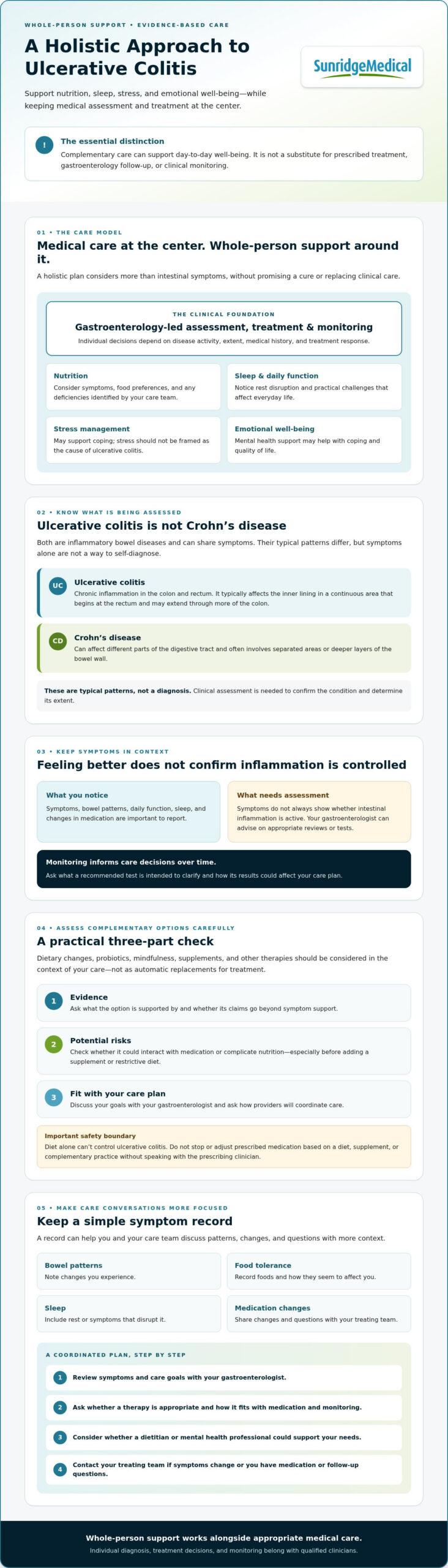
A holistic approach to ulcerative colitis considers more than intestinal symptoms. It brings nutrition, sleep, stress, daily function, and emotional well-being into care planning alongside appropriate medical treatment and monitoring. The aim is to support the person living with the condition, not to replace clinical care or promise a cure.
Ulcerative colitis is one type of inflammatory bowel disease (IBD). It isn’t Crohn’s disease, although the conditions can share symptoms and require careful clinical assessment. An overview of ulcerative colitis can explain the condition’s general features, but individual diagnosis and treatment decisions belong with qualified clinicians.
How ulcerative colitis differs from other inflammatory bowel diseases
Ulcerative colitis causes chronic inflammation in the colon and rectum. It typically affects the inner lining in a continuous area that begins at the rectum and may extend through more of the colon. Crohn’s disease can affect different parts of the digestive tract and often involves separated areas or deeper layers of the bowel wall. These are typical patterns, not a way to self-diagnose. Symptoms and disease activity vary, so clinicians use appropriate assessment to confirm the diagnosis and determine its extent.
What whole-person care can, and cannot, do
Whole-person support may help someone manage practical challenges, maintain nutrition, cope with stress, and improve day-to-day well-being. These goals matter, but they’re distinct from controlling inflammation in the bowel. A person may feel better while inflammation remains active, so symptom changes alone can’t confirm that the disease is controlled. Discuss changes and ongoing concerns with your gastroenterology team, which can advise whether further assessment is needed.
Complementary care means support alongside appropriate standard medical care, not instead of it. That distinction is central to a safe holistic approach to ulcerative colitis. Don’t stop or adjust prescribed medication based on a diet, supplement, or other complementary practice without speaking with the prescribing clinician. A coordinated plan can account for individual needs while keeping disease management and follow-up grounded in medical assessment.
How Medical Treatment and Whole-Person Support Fit Together
A coordinated plan starts with gastroenterology-led assessment. Your treating clinician considers how much of the colon is affected, current disease activity, your medical history, and how you’ve responded to treatment. Those details shape decisions about medication and follow-up. Support for nutrition, sleep, stress, and emotional well-being can complement that plan, but it shouldn’t determine whether prescribed treatment is changed.
Ulcerative colitis also calls for ongoing assessment, not just attention to how you feel day to day. Symptoms are important to report, yet they don’t always show whether intestinal inflammation is active. Your gastroenterologist can advise which reviews or tests are appropriate and how often monitoring should occur. If symptoms change or you have questions about medication or follow-up, contact your treating team rather than making adjustments on your own.
The role of medical monitoring in ulcerative colitis
Think of monitoring as a way to inform care decisions over time. At appointments, share changes in symptoms, bowel patterns, daily function, and medication use. Your clinician may consider this history alongside an examination and tests to assess disease activity. Ask what each recommended test is intended to clarify and how the results could affect your care plan.
Supportive care beyond medication
Supportive care should reflect your circumstances, not follow a packaged regimen. Nutrition guidance may take account of current symptoms, food preferences, and any deficiencies identified by your care team. Sleep support might focus on routines or on discussing symptoms that disrupt rest. Stress-management practices and mental health support may help with coping and quality of life. Stress shouldn’t be presented as the cause of ulcerative colitis or as a substitute for managing inflammation.
Before adding a supplement, restrictive diet, or other complementary therapy, ask your gastroenterologist whether it’s appropriate for you and whether it could interact with medication or complicate your nutrition. Depending on your needs, you could also ask your clinician whether support from a dietitian or mental health professional would be useful.
A holistic approach to ulcerative colitis works best when supportive choices fit around medical assessment and agreed treatment goals. Sunridge Medical describes its care for complex chronic and autoimmune conditions as individualized and integrative, but its listed services don’t confirm ulcerative-colitis-specific care. If you’re exploring its alternative health medicine for chronic illness guide, ask the clinic directly whether its services are appropriate for your diagnosis and how any care would coordinate with your gastroenterologist.
Can Complementary Therapies Help Ulcerative Colitis Safely?
Complementary therapies may have a place in a broader care plan, but “holistic” shouldn’t mean stopping prescribed medication or replacing gastroenterology care. A therapy intended to support comfort, coping, or general well-being has a different goal from one claimed to control intestinal inflammation, induce remission, or cure ulcerative colitis. Those stronger claims require reliable evidence specific to the disease, not just a plausible explanation or a personal success story.
Evidence varies by therapy and by the outcome studied. Early research can be worth discussing, but it doesn’t automatically show that a treatment is effective or safe for you. Before trying an option, look for well-designed human studies in people with ulcerative colitis, then ask your treating clinician how the evidence applies to your diagnosis, current disease activity, and medications.
How to assess a treatment claim
Check whether the evidence concerns ulcerative colitis specifically or a different condition, and distinguish preliminary findings from established clinical guidance. Testimonials can describe one person’s experience, but they can’t establish that a therapy caused an improvement or will work for others. Be cautious of promises to cure the disease, replace medication, or guarantee remission. Ask what outcome the therapy is intended to support and how that outcome would be assessed.
Questions to ask before adding supplements or therapies
Bring the complete ingredient list and disclose every supplement, infusion, and over-the-counter product you use or are considering. Supplement safety depends on your medications, health history, ingredients, and appropriate clinical review. Ask your treating clinician:
- Could this interact with my medication or affect my condition?
- What side effects should I watch for, and what monitoring is appropriate?
- Is the evidence specific to ulcerative colitis, and what are its limitations?
- How will we know whether this is helping, and when should I follow up?
Don’t start or stop a therapy without discussing its role and risks with your care team. Be especially cautious of a provider who advises stopping prescribed treatment without involving the clinician responsible for it. A provider should be willing to explain the evidence, disclose ingredients and risks, and coordinate with your gastroenterologist.
A careful holistic approach to ulcerative colitis makes room for supportive options without overstating what they can do. Sunridge Medical describes its broader care for complex chronic and autoimmune conditions as individualized and integrative, but its listed services don’t confirm UC-specific treatment. If you’re considering its individualized care approach, confirm directly whether it’s appropriate for your diagnosis and how coordination with your gastroenterologist would work.
Build a Practical, Coordinated Ulcerative Colitis Care Plan
A useful plan turns broad intentions into shared decisions. In a holistic approach to ulcerative colitis, you and your care team can agree on what you’re trying to improve, how progress will be reviewed, and which supportive options fit alongside medical treatment. Keep the process manageable: clarify your priorities, record relevant patterns, review possible changes with clinicians, and agree on follow-up.
A brief diary can make appointments more focused. Record symptoms and bowel patterns, foods you tolerate, sleep, and any medication changes. Note when a change occurs and whether it continues, rather than drawing conclusions from a single day. This record may reveal patterns to discuss, but it can’t establish whether inflammation is active or replace clinical assessment.
Prepare for a conversation with your care team
Bring an up-to-date medication and supplement list, recent test information you have, and the concerns that matter most to you. You might ask: Which outcomes are realistic for my situation? How will we monitor progress? What should I do if symptoms change? Ask your gastroenterologist whether nutrition guidance or mental health support could address your needs, and who to contact if you’re unsure about a new symptom.
Before the appointment, choose a few priorities, such as improving sleep, understanding food tolerance, or discussing persistent symptoms. This helps your clinician connect supportive goals with your medical plan. Ask for clear instructions about which changes need prompt medical attention and where to seek care, based on your history.
Coordinate clinicians and evaluate progress
If more than one clinician is involved, clarify who coordinates your care and how relevant treatment information will be shared. With your permission, make sure each provider knows about prescribed medications, supplements, and therapies recommended by others. This helps ensure that decisions take your full care picture into account.
At follow-up, review your diary alongside clinician-directed monitoring, not in isolation. Discuss what has changed, what hasn’t, and whether a planned adjustment should continue. Avoid changing medication or adding a therapy based only on a symptom pattern. Agree on next steps with the clinician responsible for your ulcerative colitis care.
Sunridge Medical describes its broader care for complex chronic and autoimmune conditions as individualized and integrative, but its listed services don’t confirm ulcerative-colitis-specific care. Contact Sunridge Medical to confirm whether its services may be appropriate for your diagnosis, and discuss any proposed care with your gastroenterologist.
Choosing Holistic Support for Ulcerative Colitis, Without Losing Sight of Safety
Choosing support means assessing the proposed therapy as well as the provider’s qualifications, transparency, and willingness to work alongside your gastroenterologist. A responsible provider should explain what they know, what remains uncertain, and how a suggested approach fits with your existing care. You deserve clear answers, not pressure or promises.
Signs that a provider takes coordinated care seriously
Look for a provider who reviews your diagnosis, current medications, and relevant medical records before discussing options. They should welcome questions about evidence, possible risks, and how their recommendations relate to conventional treatment. Confirm that their credentials and scope of practice are relevant to the services they offer, and ask whether they’ll communicate with your gastroenterologist, with your permission.
Be cautious if a provider guarantees a cure or remission, urges you to purchase a treatment before explaining it, dismisses uncertainty, or advises stopping established care. A respectful clinician won’t ask you to choose between supportive care and appropriate medical oversight.
How to explore Sunridge Medical’s broader care approach
Sunridge Medical describes its care plans as individualized and integrative, with services that include autoimmune disease management. Its listed offerings don’t confirm ulcerative-colitis-specific care, so don’t assume the clinic evaluates or manages this diagnosis. Before considering a service, ask directly whether people with ulcerative colitis are eligible, what care may apply to your circumstances, who would oversee it, and how coordination with your gastroenterologist would work.
Use the same questions you’d ask any provider: What evidence supports the proposed approach for my condition? What are the uncertainties and risks? How will it fit with my prescribed treatment? Answers should help you make an informed choice without implying a particular outcome.
A careful holistic approach to ulcerative colitis keeps individualized support connected to appropriate medical care. If you’re curious about Sunridge Medical’s broader approach, contact the clinic to ask whether its services may fit your diagnosis and needs. Treat that conversation as a way to gather information, not as a recommendation to change your current treatment or gastroenterology care.
Take Your Next Step With a Coordinated Care Plan
A holistic approach to ulcerative colitis can include support for nutrition, sleep, stress, and emotional well-being, while gastroenterology-led treatment and monitoring remain central. Keep complementary options grounded in evidence, review potential risks with your care team, and use symptom notes to make conversations more specific. Feeling better matters, but it doesn’t by itself confirm that intestinal inflammation is controlled.
Sunridge Medical describes its care plans as individualized and integrative for complex chronic and autoimmune conditions. Its listed services don’t confirm ulcerative-colitis-specific care, so contact the clinic directly to ask whether its approach is appropriate for your diagnosis and how it would coordinate with your gastroenterologist.
Learn more about Sunridge Medical’s individualized care approach, and bring any options you’re considering back to your treating team. Contact the clinic to ask whether its services may fit your needs, then discuss any proposed care with your gastroenterologist before making changes.
Frequently Asked Questions
What is a holistic approach to ulcerative colitis?
A holistic approach to ulcerative colitis combines appropriate medical treatment and monitoring with support for overall well-being. Depending on individual needs, that may include discussing nutrition, sleep, stress, daily function, and emotional health with the care team. These measures can support quality of life, but they don’t replace treatment for intestinal inflammation. A gastroenterologist should guide disease assessment and medication decisions, while any complementary options are reviewed for evidence, risks, and fit with your care plan.
Can holistic care cure ulcerative colitis?
No. Holistic care hasn’t been established as a cure for ulcerative colitis. Supportive approaches may help address nutrition, coping, or other aspects of well-being, but feeling better doesn’t necessarily mean intestinal inflammation is controlled. Be cautious of anyone promising a cure or guaranteed remission. Keep working with your gastroenterologist on treatment and monitoring, and discuss any complementary therapy before starting it so its potential role and limitations are clear.
Can I use natural treatments instead of ulcerative colitis medication?
Don’t replace or stop prescribed ulcerative colitis medication with natural treatments without speaking to the clinician who manages your care. “Natural” doesn’t automatically mean effective or safe, and supplements or herbal products may have side effects or interact with medication. If you’re interested in a diet change, supplement, or other complementary option, share its full ingredients and intended use with your gastroenterologist. They can help you consider it alongside your treatment, not in place of it.
What foods should I avoid with ulcerative colitis?
There isn’t one food list that everyone with ulcerative colitis needs to avoid. Tolerance can differ and may change with symptoms, so track what you eat and how you feel rather than removing whole food groups based on general advice. During a flare, some people may need to adjust fiber or other foods, but changes should be individualized. Ask your gastroenterologist or a dietitian about maintaining adequate nutrition, especially before starting a restrictive diet.
Can stress make ulcerative colitis worse?
Stress isn’t the cause of ulcerative colitis, which is a chronic inflammatory disease, but stress can affect how you cope and may coincide with changes in how symptoms feel. That doesn’t mean symptoms are “just stress” or that stress management can control bowel inflammation. If stress is affecting sleep, daily life, or emotional well-being, ask your care team about suitable support. Continue to report symptom changes so your clinician can assess them appropriately.
How do I know whether a complementary therapy is safe for ulcerative colitis?
Review it with your gastroenterologist before starting, especially if it involves supplements, infusions, restrictive diets, or a change to prescribed treatment. Ask whether evidence comes from human research specific to ulcerative colitis, what risks or interactions are known, and what monitoring may be appropriate. Share the complete ingredient list and your medical history. Be wary of guarantees, pressure to buy, or advice to stop medication without involving the clinician who prescribed it.
Does Sunridge Medical treat ulcerative colitis?
Sunridge Medical’s listed services include autoimmune disease management, but the available information doesn’t confirm ulcerative-colitis-specific care. The clinic describes its approach to complex chronic and autoimmune conditions as individualized and integrative. If you’re considering contacting the center, ask directly whether it currently evaluates or manages people with your diagnosis, what services may apply, and how care would coordinate with your gastroenterologist. Don’t change prescribed treatment based on a discussion with another provider without consulting your treating clinician.