


Could ultrasound help activate a cancer treatment inside the body without relying on light? Researchers are investigating that possibility through sonodynamic therapy, but early promise should not be mistaken for established care. If you’re looking for sonodynamic therapy explained in plain language, start with the proposed mechanism, then consider what the evidence can and cannot show.
Terms such as “sonosensitizer” and “reactive oxygen species” can be difficult to interpret, especially when preliminary findings are presented as breakthroughs. In simple terms, sonodynamic therapy pairs an ultrasound-sensitive agent with sound waves in an effort to trigger cell-damaging reactions in a tumor. Whether this approach improves outcomes for patients is still being studied.
This article explains how the treatment is thought to work, what clinical research has and hasn’t shown, and how it compares with established cancer treatments. It also offers a practical framework for evaluating emerging approaches as part of an individualized care plan, so decisions stay grounded in your diagnosis and treatment goals.
Key Takeaways
- Understand the proposed roles of ultrasound and a sound-responsive agent in sonodynamic therapy explained in clear, accessible terms.
- Distinguish what laboratory and animal studies can suggest from what early human research can establish.
- Assess claims about SDT by checking the study stage, participants, measured outcomes, and limitations.
- Recognize that potential risks depend on the agent, ultrasound protocol, and treatment context.
- Consider emerging therapies within a cancer-care plan shaped by diagnosis, treatment history, health status, and personal goals.
What Is Sonodynamic Therapy? A Clear Definition of SDT
Sonodynamic therapy (SDT) is an investigational cancer-treatment approach that pairs ultrasound with a sound-responsive agent, called a sonosensitizer, to try to trigger damaging reactions in targeted tissue. Put simply, sonodynamic therapy explained means studying an agent and sound energy together for a therapeutic purpose. SDT remains under investigation and is not established routine cancer care.
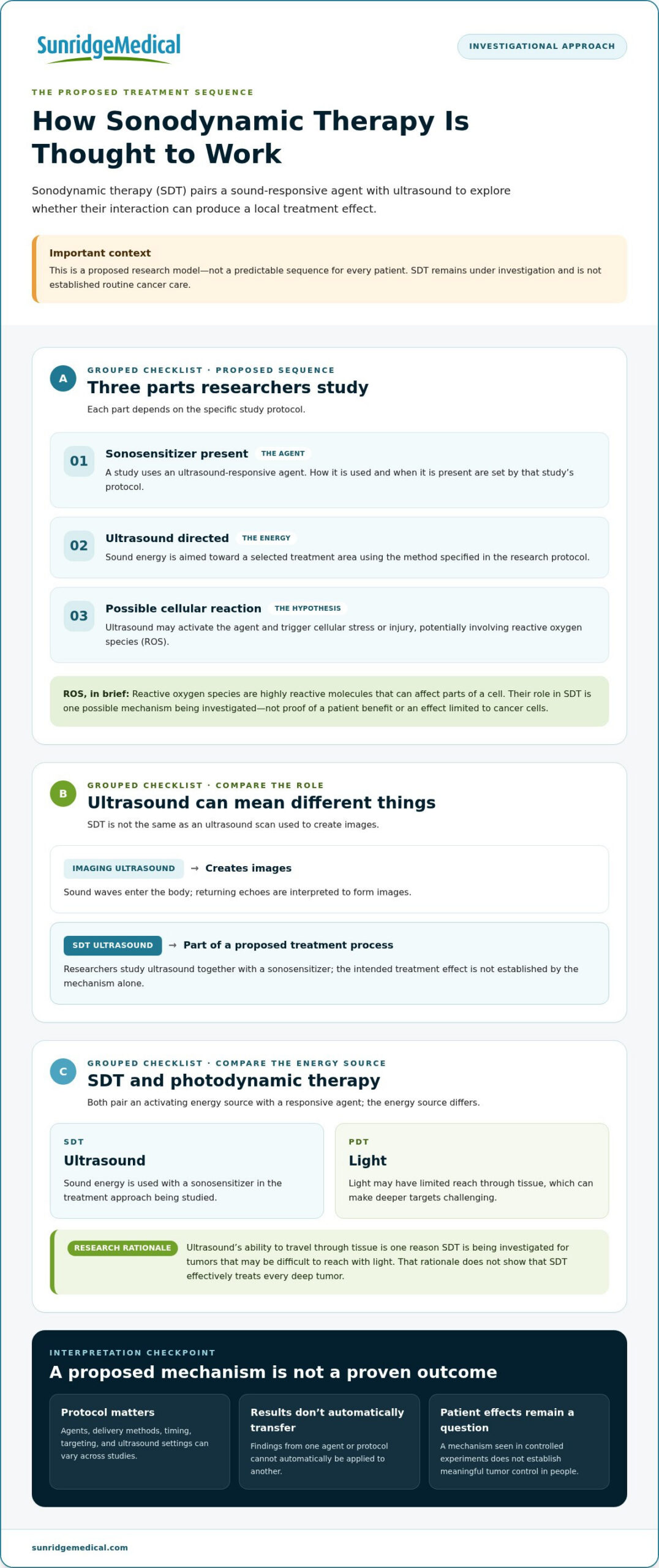
SDT isn’t the same as a diagnostic ultrasound scan. Imaging ultrasound sends sound waves into the body and interprets returning echoes to form images. SDT uses ultrasound as part of a proposed treatment process. Researchers are studying whether the combination can affect tumor cells, but the intended effect should not be mistaken for a proven response in patients. For a general overview of the concept and its relationship to other approaches, see Sonodynamic therapy.
What Are a Sonosensitizer and Focused Ultrasound?
A sonosensitizer is an agent being studied for its ability to respond to ultrasound. The term describes its proposed role, not a guarantee that it will reach a tumor or produce a particular result. In research models, ultrasound exposure is intended to activate the agent and set off reactions that may damage nearby cancer cells.
Focused ultrasound directs sound energy toward a selected area rather than using it only to create an image. The agent, ultrasound settings, and delivery methods can differ between studies. Some approaches use focused ultrasound, and protocols can also vary in intensity and other treatment details. These differences matter: results from one agent or protocol can’t automatically be applied to another.
How Is SDT Different From Photodynamic Therapy?
SDT is often compared with photodynamic therapy (PDT) because both approaches pair an activating energy source with a responsive agent. The key difference is the energy: PDT uses light, while SDT uses ultrasound. Light may have limited reach through tissue, which can make treating deeper targets challenging. Ultrasound’s ability to travel through tissue is one reason researchers are investigating SDT for tumors that may be difficult to reach with light.
That potential reach is a research rationale, not evidence that SDT can effectively treat every deep tumor. The actual effect depends on the agent, ultrasound delivery, tumor characteristics, and clinical context. Understanding the proposed mechanism is a useful first step. To judge SDT’s place in care, look closely at the research and the patients studied.
How Sonodynamic Therapy Is Thought to Work Inside Tumors
Sonodynamic therapy is based on a proposed sequence: a sound-responsive agent is present in the body, ultrasound is directed toward a selected area, and the interaction may trigger chemical reactions that injure cells. This is a research model, not a predictable chain of events for every patient. The agent’s distribution, ultrasound settings, timing, and target depend on the specific study protocol.
In plain language, sonodynamic therapy explained means pairing an investigated agent with sound energy to explore whether their interaction can produce a local treatment effect. The simplified sequence is:
- Agent: A study uses a sonosensitizer, with administration and timing set by the research protocol.
- Ultrasound: Sound energy is directed toward the chosen treatment area using the method specified in the study.
- Proposed reaction: Ultrasound may activate the agent and lead to cellular stress or injury, including through reactive oxygen species.
The Proposed Sequence From Agent to Ultrasound Exposure
The sonosensitizer may be administered or otherwise present before ultrasound exposure, but there is no single universal procedure. Researchers determine how the agent is used, where sound energy is directed, and how the two are timed. Dose, targeting, and ultrasound parameters can vary across studies, so findings from one protocol shouldn’t be assumed to describe all forms of SDT.
This variation matters when interpreting treatment descriptions. A mechanism observed under controlled experimental conditions doesn’t, by itself, establish that the same effect will occur in a person or lead to meaningful tumor control.
What Reactive Oxygen Species May Do in Research Models
Reactive oxygen species (ROS) are highly reactive molecules that can affect components of a cell. In SDT research, the proposed idea is that ultrasound-activated processes may increase oxidative stress and damage structures such as cell membranes or other parts of a cell. This is one possible explanation being investigated, not proof that the effect is confined to cancer cells.
Laboratory findings can help researchers explore how a treatment might work, but they cannot establish patient benefit on their own. The biological steps, degree of targeting, and treatment effects remain research questions. For people weighing emerging approaches, reviewing the evidence alongside an individualized cancer-care plan can provide important context. Learn more about individualized cancer-care planning as you consider how research findings relate to personal treatment goals.
What the Evidence Shows About Sonodynamic Therapy for Cancer
Evidence for sonodynamic therapy spans cell experiments, animal models, and early human studies, but these stages answer different questions. Lab results can support a possible mechanism; they can’t establish that a treatment helps people live longer or feel better. Gliomas, including glioblastoma, are a major area of investigation, not an established indication for SDT.
| Evidence stage | What it can show | What it can’t establish alone |
|---|---|---|
| Laboratory research | Whether an agent and ultrasound produce measurable effects in cells | Whether the approach is safe or effective in patients |
| Animal studies | How a treatment may behave in a living model | Whether results translate to human tumors and care |
| Early human studies | Initial feasibility, safety observations, and signals worth further study | Definitive benefit or comparison with standard care |
| Established clinical practice | Use supported by sufficient evidence and accepted guidance | SDT is not established routine cancer care |
What Preclinical and Early Clinical Research Can Tell Us
Cell and animal studies help researchers investigate mechanisms, select agents, and refine ultrasound protocols. They’re a starting point, not a substitute for clinical evidence. In people, small or early-stage studies may indicate whether a protocol is feasible and identify outcomes to test in larger trials, but they often can’t separate treatment effects from other factors.
For example, findings from a phase 1/2 study in recurrent or refractory high-grade gliomas, presented in December 2024, reported median overall survival of 15.7 months and median progression-free survival of 5.5 months. The comparison was with historical outcomes, not a randomized control group, so it can’t show that SDT caused the difference. A Phase I study published September 18, 2026, examined multi-session SDT alongside standard chemoradiotherapy in 18 people with newly diagnosed glioblastoma and residual lesions. Its reported outcomes are preliminary, and the combined treatment makes SDT’s independent contribution difficult to determine.
Research was still advancing in 2026: Alpheus Medical announced a Phase 2b randomized trial for newly diagnosed glioblastoma in April, with 10 participants enrolled at announcement. A separate recurrent-glioblastoma study was recruiting in 2026, and a pilot combining 5-ALA with low-intensity focused ultrasound was listed as active in May 2026. These trial details describe research activity, not established availability or benefit.
Why Promising Findings Are Not the Same as Established Treatment
Small, early studies can identify safety concerns and generate promising signals, but safety observations don’t prove improved outcomes. Larger, well-designed studies and reproducible results are needed. As of March 2026, there were no FDA-approved clinical applications of SDT; a Fast Track or Orphan Drug designation is not approval. SDT shouldn’t replace or delay established cancer care. Understanding sonodynamic therapy explained means keeping that distinction clear as evidence develops.
How to Evaluate Claims, Safety, and Readiness Around SDT
Claims about an emerging treatment can sound definitive even when the evidence is preliminary. Start by identifying what kind of evidence supports the claim and whether the study resembles the situation being discussed. The questions below can help you assess a claim and prepare for a conversation about how it fits with your cancer-care plan.
Questions That Clarify a Study or Treatment Claim
- What stage is the evidence? Is the claim based on cells, animal models, a clinical trial, or routine clinical practice? These stages answer different questions.
- Who was studied? Check the cancer type, stage, prior treatments, and other details about participants. Findings in one group may not apply to another.
- What was compared and measured? Look for a comparison group, the outcomes researchers tracked, and how long participants were followed. Tumor response, side effects, and survival are distinct measures.
- Where is the information published? A peer-reviewed study can be assessed for its methods and limitations. A company announcement or promotional description may help identify research activity, but it isn’t a substitute for evaluating full study results.
Check whether the conclusion matches the study design. An early study can suggest a question worth testing without proving that SDT caused an observed outcome or will benefit a broader patient group.
Safety, Treatment Coordination, and Informed Decisions
There isn’t one universal safety profile for SDT. Potential risks depend on the agent being investigated, how it’s delivered, ultrasound settings and targeting, and the treatment context. Safety observations from a specific study apply to its protocol and participants; they don’t establish that every agent or approach is safe for every person. When reviewing a study, note which risks were monitored, what was reported, and what remains uncertain.
If SDT is being considered or discussed, bring the information to your oncology team and review it alongside the complete care plan. The team can help consider possible interactions with current or planned treatments, the evidence for the specific approach, and how it relates to your diagnosis and goals. Don’t stop, postpone, or replace established cancer treatment based on a promotional claim or preliminary result. Delaying recommended care can carry serious risks.
Clear, individualized planning can help keep emerging research in perspective. Explore individualized cancer-care planning as a way to consider treatment information within the broader context of your care.
Where Sonodynamic Therapy Fits in an Individualized Cancer-Care Plan
Understanding sonodynamic therapy explained is only one part of making sense of an emerging approach. The practical question is how the research relates to a person’s full cancer-care plan. Decisions depend on factors such as cancer type and stage, treatment goals, therapies already received, and overall health. Consider a proposed approach in that context, not in isolation or on the strength of a headline.
Discussing an Emerging Approach in Context
SDT can be discussed as a research topic alongside established treatment options. A useful conversation considers the quality and stage of the evidence, possible risks, and the outcomes that matter to the patient. It should also account for how a proposed intervention could fit with current or planned care. Clear communication among the patient and their existing oncology team helps ensure everyone is working from the same understanding of the evidence and priorities.
Questions about an investigational therapy are reasonable, as are questions about the treatments already in a plan. The aim isn’t to assume that a new approach is right or wrong, but to distinguish what research suggests from what is known for an individual’s circumstances. Established cancer treatment shouldn’t be stopped or delayed in pursuit of an unproven option.
Building a Thoughtful Next Step
Before a consultation, it may help to organize:
- Your diagnosis details, including cancer type and stage
- Current and previous treatments, including relevant dates
- Current medications and important health concerns
- Questions about evidence, risks, goals, and treatment coordination
This preparation can make complex discussions more focused. Sunridge Medical is a physician-led center that develops individualized cancer-treatment protocols, integrating conventional therapies with research-based alternative approaches. This personalized perspective can help place new research within a carefully considered care plan without treating any single emerging therapy as a guaranteed answer.
For additional context on integrative oncology, explore the guide Alternative Cancer Treatment: A Comprehensive Clinical Guide to Integrative Oncology in 2026. If you’re considering how research and established options relate to your own situation, Sunridge Medical offers individualized cancer-care planning shaped by your diagnosis, history, and goals.
Make Your Next Cancer-Care Decision With Clarity
Sonodynamic therapy pairs ultrasound with a sound-responsive agent, but its proposed mechanism and early research findings don’t make it established cancer care. The stage and design of each study matter, as do the patients included, outcomes measured, and limitations reported. Any discussion of SDT belongs within a broader plan shaped by cancer type and stage, prior treatment, health status, and personal goals.
Emerging research deserves thoughtful attention alongside the evidence for established options and the importance of coordinated care. A clear understanding of sonodynamic therapy explained can help you approach new claims with informed questions rather than assumptions or promises of benefit.
Founded in 2003, Sunridge Medical is a physician-led practice under Medical Director Dr. Steven S. Isaacman. Its individualized approach integrates conventional therapies with research-based alternative options as part of personalized cancer-care planning. Explore individualized cancer-care planning with Sunridge Medical.
With careful guidance and a plan grounded in your circumstances, you can take the next step with greater confidence.
Frequently Asked Questions
What is sonodynamic therapy, in simple terms?
Sonodynamic therapy is an investigational approach that pairs ultrasound with a sound-responsive agent called a sonosensitizer. Researchers study whether ultrasound can activate the agent and trigger cellular effects, including oxidative damage. Put simply, sonodynamic therapy explained describes a proposed treatment process, not proof of cancer benefit in patients. SDT also differs from diagnostic ultrasound, which uses sound waves to create images rather than activate a therapeutic agent.
How does sonodynamic therapy work?
In the proposed process, a sonosensitizer is present in the body and ultrasound is directed toward a selected area. Researchers investigate whether their interaction can generate reactive oxygen species, molecules that may damage cellular structures. The agent, ultrasound settings, timing, and delivery approach vary across studies. Findings from cell experiments or animal models can help test the idea, but they don’t establish that the same effects will occur safely or effectively in people.
Is sonodynamic therapy an established cancer treatment?
Sonodynamic therapy is an emerging research approach, not a universally established cancer treatment. The evidence and clinical availability can vary by cancer type, study, and location, and regulatory information may change over time. Before relying on a claim, look for current peer-reviewed research and authoritative trial or regulatory information. A study or promotional description alone doesn’t establish routine use or proven benefit. Don’t stop, postpone, or replace established cancer care based on claims about SDT.
What is the difference between sonodynamic and photodynamic therapy?
Both approaches pair a sensitizing agent with an energy source, but they use different forms of energy. Photodynamic therapy uses light, while sonodynamic therapy uses ultrasound. Researchers investigate ultrasound partly because it may reach tissue differently from light. This possible difference in reach is a scientific rationale, not proof that SDT is more effective or suitable for a particular cancer. Each approach has its own evidence, risks, and protocols to evaluate.
Which cancers are being studied with sonodynamic therapy?
Research has explored sonodynamic therapy in several cancer settings, including glioma and other brain-tumor research. These are areas of investigation, not necessarily approved indications or proven treatments. The broader research field continues to develop, so check current clinical trials and their eligibility criteria for the latest details. A cancer type’s appearance in a study doesn’t mean SDT is standard care for it or that results apply to every patient with that diagnosis.
Is sonodynamic therapy safe, and what side effects can it cause?
Safety depends on the sonosensitizer, dose, delivery method, ultrasound protocol, treatment area, and a person’s health circumstances. Research may report safety observations for a specific protocol and participant group, but those findings don’t establish one side-effect profile for all forms of SDT. If you’re reviewing a proposed treatment, discuss potential risks, interactions with current care, and unanswered questions with your oncology team before making decisions.
Can sonodynamic therapy replace chemotherapy, surgery, or radiation?
Sonodynamic therapy shouldn’t be treated as a replacement for established cancer therapies based on early or preclinical findings. Appropriate care depends on the diagnosis, cancer stage, treatment goals, and evidence available for each option. Stopping or delaying prescribed treatment can be harmful. If you’re considering an emerging approach, discuss it with the clinicians coordinating your cancer care and evaluate the evidence carefully rather than relying on promotional claims or promised outcomes.
To discuss an individualized cancer-care plan in the context of your diagnosis, history, and goals, explore care planning with Sunridge Medical.