


Could a binder marketed for mold detoxification help, or do its promises go beyond the evidence? If you’re sorting through conflicting claims while trying to understand persistent symptoms, the uncertainty can be unsettling. Binders for mold detoxification are proposed to attach to certain compounds in the gut so they can leave the body in stool. But that mechanism doesn’t establish that a product treats mold-related illness, and symptoms alone can’t confirm that mold exposure is the cause.
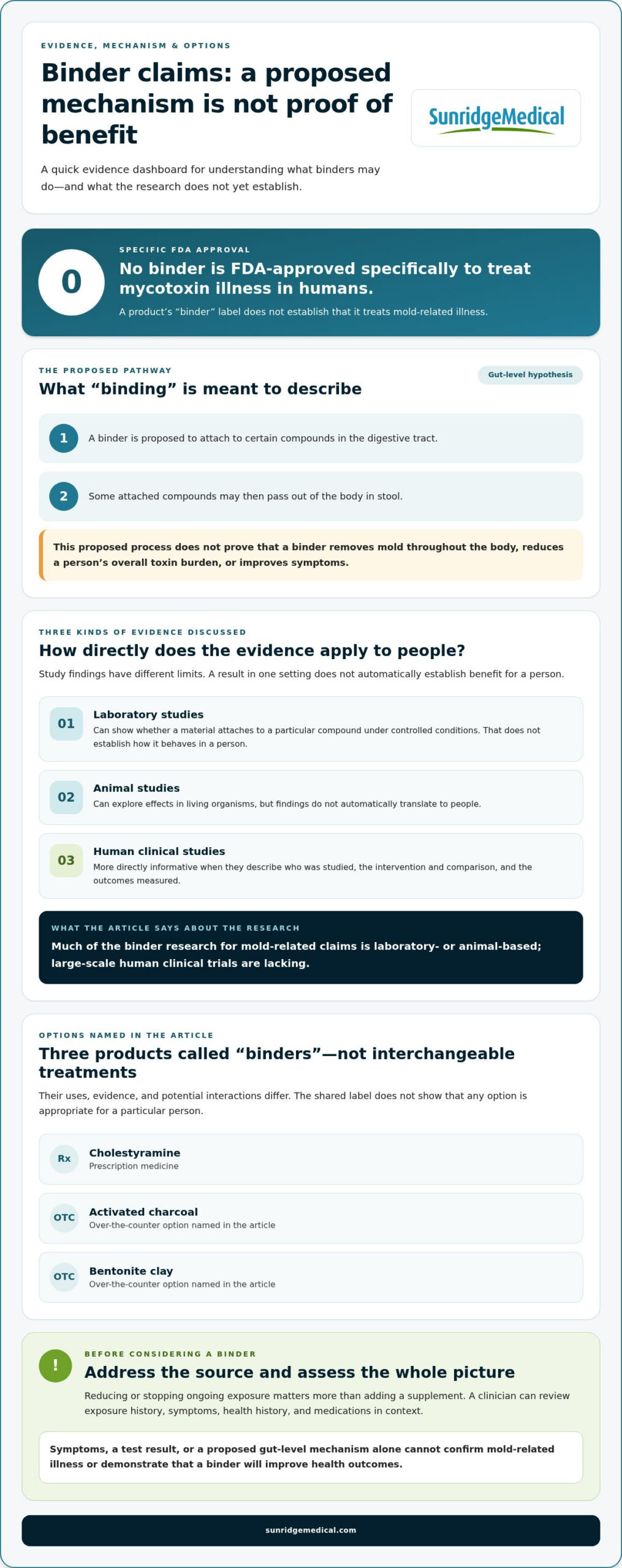
A measured approach starts with the source: reducing or stopping ongoing exposure matters more than adding a supplement. No binder is FDA-approved specifically to treat mycotoxin illness in humans, and much of the research on common options comes from laboratory or animal studies, not large human trials. That doesn’t make every question about binders irrelevant. It makes careful assessment essential.
This article explains how prescription cholestyramine and over-the-counter options such as activated charcoal and bentonite clay differ, what the evidence can and can’t show, and why side effects and medication interactions deserve attention. It also outlines what information to gather before discussing exposure history, symptoms, current medications, and next steps with a qualified clinician.
Key Takeaways
- “Mold detox” can mean different things. Clarify the health concern and intended outcome before considering a binder.
- When evaluating claims about binders for mold detoxification, distinguish a proposed gut-level mechanism from evidence that a treatment improves health outcomes in people.
- Activated charcoal, cholestyramine, and clay are not interchangeable. Their uses, evidence, and potential interactions differ.
- Before considering a binder, review exposure conditions, symptoms, health history, and medications with a qualified clinician.
- An individualized assessment can put binder claims in context and help identify next steps beyond supplements alone.
What Are Binders for Mold Detoxification, and What Do People Mean by “Detox”?
Online, “mold detox” can sound like a defined treatment. In practice, it’s a broad phrase for different approaches to suspected mold exposure, symptoms, or concerns about compounds produced by some fungi. These situations aren’t interchangeable. Dampness or visible mold in a building signals an environmental condition to address; it doesn’t, by itself, establish the cause of a person’s symptoms or confirm a particular internal toxin burden. A clinician considers exposure history and the overall health picture rather than treating a label as a diagnosis.
Some fungi can produce mycotoxins, but the presence of mold does not automatically mean a person has had a harmful exposure. Symptoms attributed to mold can have multiple possible causes. Interpreting them requires context, not assumptions based on symptoms or a test result alone.
What does a binder do in the body?
A binder is a substance proposed to attach to particular compounds in the digestive tract so that some of those compounds may pass out in stool. This describes a proposed gut-level mechanism, not proof that the substance removes mold throughout the body or improves symptoms. A process observed in a laboratory, or suggested by how a substance behaves, doesn’t establish a meaningful clinical benefit in people.
Products also differ. Prescription medicines and supplements can have different compositions, intended uses, evidence, and risks. The word “binder” doesn’t make them interchangeable or establish that a product is appropriate for a particular person.
What does “mold detoxification” mean clinically?
In practical terms, the phrase may refer to distinct goals: reducing ongoing exposure, evaluating and managing symptoms, or attempting to affect a suspected toxin burden. Each goal calls for different considerations. Addressing a moisture problem or avoiding continued exposure is an environmental step; taking a substance is not a substitute for that work.
Before considering binders for mold detoxification, an individualized clinical assessment can put reported exposure, symptoms, health history, and proposed testing in context. This helps avoid treating nonspecific symptoms as proof of mold illness and supports a careful discussion of potential interventions. Suspected exposure, confirmed dampness or mold, symptoms, and a clinical diagnosis are related questions, but none automatically answers the others.
How Might Mold Binders Work, and What Does the Evidence Actually Show?
Proposed binders act in the digestive tract. They may attach to certain compounds in the gut, forming a complex that can pass out in stool. Some explanations also suggest this could limit reabsorption of compounds that enter the digestive tract through bile. These are hypotheses about what may happen locally. They don’t demonstrate that a binder removes mold from the body, reduces a person’s overall toxin burden, or relieves symptoms.
Evidence for a proposed mechanism and evidence of meaningful benefit for patients are separate questions. A substance that binds a compound under laboratory conditions may behave differently in a person. Binding alone doesn’t show that symptoms improve or that a treatment is safe and appropriate.
Which evidence can support a binder claim?
Evidence differs in how directly it applies to people. Laboratory studies can show whether a material attaches to a particular compound under controlled conditions. Animal studies can explore effects in living organisms, but findings don’t automatically translate to people. Human clinical studies are more directly informative when they describe who was studied, what intervention was used, what it was compared with, and which outcomes were measured.
For mold-related claims, much of the available binder research is laboratory or animal-based, and large-scale human clinical trials are lacking. Findings about one toxin, formulation, or study population can’t establish benefit for every binder or for every person concerned about mold exposure. The category label alone isn’t evidence.
Why can symptoms and test results be difficult to interpret?
Fatigue, headaches, and difficulty concentrating can occur in many health contexts. They deserve attention, but they don’t identify a cause by themselves. A home assessment or laboratory test also needs to be interpreted according to what was measured, how the test was performed, and whether the finding fits the person’s exposure history and clinical picture. A single result should not be treated as a diagnosis of mold toxicity.
A careful review asks whether the evidence supports the specific conclusion being drawn, rather than moving directly from a symptom or measurement to a detox plan. This matters before starting binders for mold detoxification, since a plausible explanation is not the same as a demonstrated clinical outcome.
For a more individualized discussion of environmental illness, clinician-guided environmental illness care can help place exposure history, symptoms, and potential interventions in context.
Activated Charcoal, Cholestyramine, and Clay: How Do Binder Options Differ?
“Binder” describes a proposed action, not a standardized treatment. Activated charcoal, clay products, and cholestyramine differ in composition, intended use, and level of medical oversight. None is FDA-approved specifically to treat mold-related illness in humans, and evidence that a substance binds a compound does not establish that it improves mold-related symptoms.
The comparison below is a starting point, not a way to choose a product. Formulations vary, and risks depend on a person’s health and other medications.
| Category | Evidence limits | Interaction considerations | Clinician oversight |
|---|---|---|---|
| Activated charcoal | Laboratory binding findings do not establish benefit for mold-related illness in people. Evidence from other uses cannot be assumed to apply to mold claims. | May interfere with absorption of medicines and other substances; constipation can occur. | Discuss use with a clinician, especially when taking medication or managing a health condition. |
| Clay, including bentonite | Some findings concern particular clays and compounds under laboratory or animal-study conditions. They don’t establish that all clay products work alike or help people with mold-related symptoms. | May affect absorption of medicines or nutrients; constipation and bloating are possible. Product composition varies. | Review the specific product and personal risks with a clinician rather than assuming all clays are equivalent. |
| Cholestyramine | A prescription medicine with established uses separate from mold detox claims. Use for mold-related concerns is off-label, and that does not by itself establish effectiveness. | Can affect absorption of other medicines. Timing and medication adjustments need prescribing guidance. | Requires a prescription and medical supervision; it is not an over-the-counter supplement. |
How do activated charcoal and clay products compare?
Charcoal and clay are distinct materials, not interchangeable versions of one treatment. Products within each category can also vary in formulation and intended use. In vitro binding results may help explain a proposed mechanism, but they don’t show that a retail product produces a health benefit in people. Review product-specific information with a clinician, particularly if you take medication or have a history of constipation.
How is cholestyramine different from supplements?
Cholestyramine is a prescription medication approved for uses such as lowering cholesterol and relieving itching associated with partial biliary obstruction. Its use for mold-related illness is off-label. Because it can interfere with other medicines, a qualified prescriber needs to guide whether it is appropriate and how to manage timing. Don’t use someone else’s prescription or start it without medical supervision.
Claims about binders for mold detoxification should be weighed against the specific substance, evidence, and individual risks, not generalized from one product or study to another.
What Should You Review Before Considering Binders for Mold Detoxification?
A careful review can clarify whether a binder is relevant and what risks need attention. Before starting a supplement or discussing a prescription option, organize details that help a clinician assess the situation as a whole:
- Exposure conditions: Note where and when you may have encountered dampness or visible mold, how long the concern has been present, and whether exposure may be ongoing. Taking a binder doesn’t correct a moisture problem or remove an environmental source.
- Symptoms and timeline: Record what you’re experiencing, when it began, whether it changes in different settings, and how it has progressed. Symptoms can have multiple causes, so this information supports broader assessment rather than proving mold is responsible.
- Health history: Share relevant conditions and major changes in your health. Discuss pregnancy or the possibility of pregnancy, chronic conditions, and other personal risk factors with the clinician rather than deciding on your own whether a product is safe.
- Medications and supplements: Bring a complete, current list, including doses if available. Some binders may interfere with absorption, so a clinician or pharmacist can review potential interactions, timing, contraindications, and monitoring needs.
- Intended goal: Clarify what you hope an intervention will do and how you and your clinician would evaluate whether it is helping. Ask what outcomes to track and when the plan should be reconsidered.
These steps can make a discussion more precise. They also separate environmental action from medical care: addressing persistent dampness or visible mold is different from taking a binder. If the problem continues, building assessment and moisture correction may be needed. A supplement should not delay those steps or an assessment of other possible causes of symptoms.
When should exposure or symptoms receive prompt attention?
Seek timely medical assessment for severe, worsening, or urgent symptoms rather than waiting to see whether a detox plan helps. Persistent or concerning symptoms deserve evaluation even when the cause isn’t clear. Ongoing dampness or visible mold also warrants attention to building conditions; a binder cannot resolve continued exposure.
For an individualized review of exposure history, symptoms, health history, and potential interventions, explore individualized environmental illness care at Sunridge Medical.
How Can Individualized Environmental Illness Care Put Binder Claims in Context?
Binder claims are easier to evaluate within a person’s broader health picture. An individualized assessment doesn’t assume that mold explains every symptom or that one intervention fits everyone. It brings together reported exposure, symptoms and their timeline, health conditions, medications, and relevant prior evaluations. That context supports a careful discussion of possible next steps, including whether a binder is worth considering.
What can a comprehensive assessment consider?
A clinician may review where and when exposure may have occurred, whether dampness or visible mold is ongoing, and how symptoms relate in time to those circumstances. The review can also consider other possible explanations for symptoms, medication or health factors that could affect the picture, and what previous evaluations have already addressed.
Testing should be considered in light of the specific question it can answer and its limitations. A result is not, by itself, proof that mold is causing symptoms or that a binder will help. Its value depends on how it relates to the history and clinical assessment. Careful interpretation avoids turning a single finding into a diagnosis or a promised treatment outcome.
How can readers take a measured next step?
Before a clinical discussion, write down possible exposure locations and timing, symptoms and changes over time, current medications and supplements, and prior evaluations. This record can focus the conversation and support an informed review of potential risks and options.
Keep two priorities distinct. Reducing ongoing exposure involves addressing environmental conditions, while evaluating health concerns involves appropriate medical assessment. Neither should be replaced by a supplement or standardized detox plan. If binder use comes up, discuss the rationale, potential interactions, and how any proposed approach would be evaluated with a qualified clinician.
Sunridge Medical provides individualized care for environmental illness and complex chronic conditions. Its approach considers each patient’s health picture rather than assuming one cause or one solution. For additional perspective, read Alternative Health Medicine: A Clinical Path for Chronic Illness Recovery in 2026. If you’re weighing binders for mold detoxification, discuss your concerns and care considerations with Sunridge Medical.
Take a Measured Next Step Toward Clarity
Binders for mold detoxification are proposed to bind certain compounds in the digestive tract, but that mechanism alone doesn’t show they remove mold from the body or improve symptoms. Evidence varies by substance and study type, and activated charcoal, clay, and prescription cholestyramine aren’t interchangeable. Ongoing exposure and health concerns also call for different steps: addressing dampness is not the same as evaluating symptoms or considering a supplement.
Before trying a binder, review your exposure history, symptoms, health conditions, medications, and goals with a qualified clinician. An individualized assessment can put claims and potential risks in context without assuming mold is the only possible explanation. Sunridge Medical has served patients since 2003, providing individualized care for environmental illness and complex chronic conditions.
Explore individualized environmental illness care with Sunridge Medical and take a thoughtful step toward understanding your options. Personalized guidance can help you move forward with greater clarity.
Frequently Asked Questions
Do binders for mold detoxification remove mold from the body?
No. Binders are proposed to attach to certain compounds in the digestive tract, but this doesn’t show that they remove mold throughout the body. Laboratory or animal findings also can’t establish that a binder reliably reduces symptoms in people. Exposure conditions and symptoms need to be assessed separately, and a clinician can help interpret concerns and discuss appropriate next steps.
Can activated charcoal help with mold exposure?
It’s not established that activated charcoal treats mold exposure or mold-related illness in people. Laboratory binding findings, or charcoal’s use for other purposes, don’t prove a mold-specific health benefit. Activated charcoal may also interfere with the absorption of medicines and other substances, and constipation can occur. Discuss its potential risks with a clinician before using it, especially if you take medications or supplements.
Is cholestyramine used for mold detoxification?
Cholestyramine is a prescription medicine with established uses that include lowering cholesterol and relieving itching associated with partial biliary obstruction. Use for mold-related concerns is off-label, and it isn’t FDA-approved specifically to treat mold illness in humans. It can affect absorption of other medications, so a qualified prescriber must assess whether it’s appropriate and guide its use. Don’t take it without medical supervision.
Are clay binders safe to take every day?
Daily use can’t be assumed safe for everyone. Clay products vary in composition and formulation, and evidence for mold-related benefits in people is limited. Potential concerns include constipation, bloating, or interference with the absorption of medicines and nutrients. Before regular use, review the specific product, your health history, and any medications with a qualified clinician. Don’t rely on a general “detox” label to establish safety.
Can mold binders interfere with medications or supplements?
Yes. Some binders may attach to medicines or nutrients in the digestive tract and affect how much is absorbed. The interaction and appropriate timing depend on the substance and the products you take, so there’s no universal spacing rule to apply on your own. Share a complete list of prescriptions, over-the-counter medicines, and supplements with a clinician or pharmacist before starting a binder.
What should I do first if I suspect mold exposure?
First, consider whether exposure may be ongoing and address persistent dampness or visible mold through appropriate building assessment and moisture correction. Separately, arrange medical evaluation for health concerns, and note when symptoms began and how they change. Binders for mold detoxification shouldn’t replace exposure reduction or appropriate care. Avoid starting a supplement or delaying evaluation of other possible causes based on suspicion alone.
How do I know whether symptoms are related to mold?
Symptoms alone can’t confirm that mold is the cause. Fatigue, headaches, and concentration difficulties can occur for many reasons, so a clinician considers your exposure history, symptom timeline, health conditions, and relevant prior evaluations together. Tests also need interpretation in context; a single result doesn’t automatically establish mold-related illness. Seek prompt medical assessment for severe, worsening, or urgent symptoms rather than waiting on a detox plan.