


What if an inconclusive workup is a reason to clarify the next step, not a sign that your symptoms aren’t real? If you’re wondering why my doctor can’t diagnose my symptoms, it’s understandable to feel frustrated, especially when tests haven’t explained what you’re experiencing or you’re worried something important could be missed.
Diagnosis can take time. Symptoms may overlap across conditions, change over time, or call for follow-up and more targeted evaluation. A normal result can be reassuring, but it doesn’t always explain persistent symptoms or rule out every possible cause. Ask what the results do and don’t show, and what the plan is if your symptoms continue or change.
This article explains why a diagnosis can remain unclear, what an inconclusive evaluation means, and how to make a follow-up conversation more productive. You’ll find practical ways to organize your symptom history, prepare questions, and recognize when symptoms warrant urgent medical attention. A clear plan can help you move forward even when the answer isn’t immediate.
Key Takeaways
- Understanding why my doctor can’t diagnose my symptoms starts with recognizing that symptoms can fluctuate, overlap, or need more than one evaluation to explain.
- Interpret test results in context: each test addresses a particular clinical question, not every possible cause of symptoms.
- Before your next appointment, note symptom timing and patterns, gather relevant records, and prioritize the questions you want answered.
- A second opinion may offer another perspective. Keep your existing clinicians informed so care remains coordinated.
- Individualized integrative care can complement appropriate conventional evaluation when complex or persistent health concerns call for a broader perspective.
Why Can’t My Doctor Diagnose My Symptoms Yet?
Symptoms can be real and disruptive even when an evaluation hasn’t identified a clear cause. Not having a diagnosis yet doesn’t mean nothing is wrong, and it doesn’t mean your experience should be dismissed. It means the information gathered so far hasn’t produced a complete explanation. If you’re asking, “why my doctor can’t diagnose my symptoms,” the answer may be that diagnosis depends on how several pieces of evidence fit together, not on one symptom or test in isolation.
A clinician considers what you report alongside examination findings and test results. Each offers a different kind of information. A result may help assess one possibility without answering every question, while a symptom pattern may become clearer only over time. The clinician interprets these details together and decides whether observation, further testing, or another clinical perspective is appropriate.
That process can feel unsettling when you’re hoping for a definite answer. But an incomplete explanation is not the same as a confirmed absence of disease. This article offers general information to help you understand diagnostic uncertainty and prepare for conversations with your care team. It can’t determine what’s causing your symptoms or replace evaluation and advice from a qualified clinician.
What does an inconclusive medical evaluation mean?
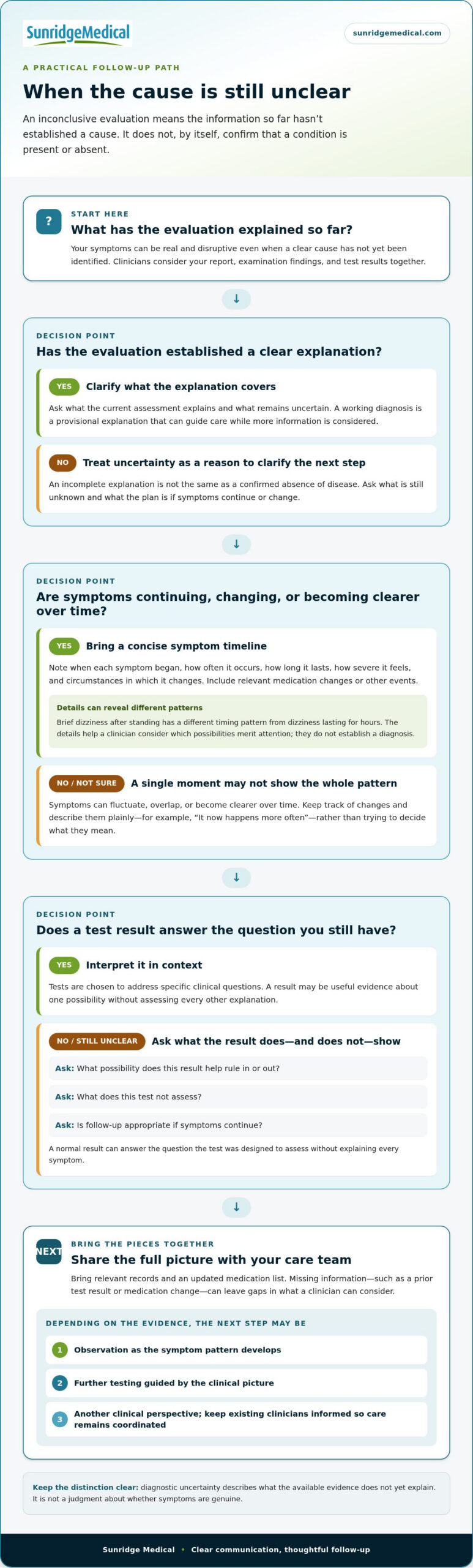
An inconclusive evaluation means the information gathered so far hasn’t established a cause. It doesn’t, by itself, confirm that a condition is present or absent. A clinician may use a working diagnosis, a provisional explanation that guides care while more information is considered. That assessment can change if symptoms persist, new findings appear, or the overall pattern becomes clearer. Ask what the current assessment explains and what remains uncertain.
Why symptoms do not always point to one clear condition
Different conditions can produce similar symptoms, and one condition may affect people in different ways. Fatigue alone, for example, doesn’t identify its cause; its significance depends on what else is happening and the broader clinical picture. The timing, severity, duration, and combination of symptoms all add context. Symptoms that come and go may offer different clues from those that steadily worsen, so a single moment in time may not tell the whole story.
Diagnostic uncertainty means the available evidence does not yet support one clear explanation for a person’s symptoms. It describes a limit in what’s currently known, not a judgment about whether the symptoms are genuine. The phrase medically unexplained symptoms is used in discussions of symptoms without an identified medical cause. An unexplained symptom still deserves respectful attention and appropriate follow-up.
Why Symptoms Can Be Difficult to Diagnose
Symptoms don’t always follow a predictable course. Some develop gradually; others come and go, change in intensity, or appear in combinations that shift over time. That can make it harder to identify a pattern during one appointment. A clinician interprets the evidence available at each stage, rather than simply matching one symptom to one condition. That’s one reason the answer to “why my doctor can’t diagnose my symptoms” may involve several steps instead of a single test.
Context matters, too. The same symptom can have different significance depending on your medical history, current medications, recent changes in health, and other findings. Missing records can leave gaps. For example, a prior test result or medication change may not be visible to a clinician who hasn’t received that information. Bring an updated medication list and relevant records so your care team can see what has already been considered.
How symptom patterns and timelines inform an evaluation
A useful symptom history describes more than what you feel. Note when a symptom began, how often it occurs, how long it lasts, how severe it feels, and whether you’ve noticed circumstances in which it changes. For instance, dizziness that occurs briefly after standing has a different timing pattern from dizziness that lasts for hours. These details don’t establish a diagnosis, but they can help a clinician decide which possibilities merit attention.
A brief snapshot may not capture a pattern that unfolds over days or weeks. If symptoms change, report the change plainly: “It now happens more often” is more useful than trying to decide what the change means. Keep a concise record between appointments, including relevant medication changes or other events, and bring it to your clinician.
What medical tests can and cannot show
Tests are selected to address specific clinical questions, informed by symptoms, examination findings, and a clinician’s judgment. A result may provide useful evidence about one possibility without assessing every other explanation. Results also need to be interpreted alongside your history and the reason the test was ordered. A finding that matters in one context may have a different significance in another.
A normal test result can answer the question that test was designed to assess without explaining every symptom you’re experiencing. Ask what the result helps rule in or out, what it doesn’t address, and whether follow-up is appropriate if symptoms continue. The Agency for Healthcare Research and Quality offers information on understanding diagnostic errors, including ways to support clearer communication and evaluation.
Clear information can support better-informed next steps. If persistent or complex concerns call for individualized care planning, individualized consultation and care planning can complement appropriate conventional medical care.
Do Normal Test Results Mean Nothing Is Wrong?
No. A normal result can be reassuring, but it doesn’t automatically explain every symptom or establish that nothing is wrong. It tells you something about what a particular test assessed, within that test’s limits. It isn’t necessarily a complete evaluation of your health. If you’re wondering why my doctor can’t diagnose my symptoms, understanding what a result does and doesn’t answer can help you have a more focused follow-up conversation.
Tests are ordered to address specific clinical questions. A result may make one explanation less likely while leaving other questions unanswered. Its meaning depends on why the test was ordered, your symptoms, examination findings, and relevant medical history. Understand a normal result as one part of the assessment, not as a verdict on whether your experience is valid.
How clinicians interpret results in context
Clinicians compare test results with the reason for testing, your symptom history, and examination findings. If those pieces don’t align clearly, the next step may be continued observation, another clinical assessment, or further evaluation guided by the overall picture. That doesn’t mean every normal result needs to be repeated or that more testing is always necessary. Your clinician can explain what the result means in your situation.
Rather than trying to interpret a result on your own, ask about its scope and significance. You might say, “What question was this test meant to answer?” or “How does this result fit with the symptoms I described?” Those questions can clarify whether the evaluation is complete for now, what remains uncertain, and whether there’s a reason to check in again.
When to revisit an initial explanation
An initial explanation may be based on the information available at that appointment. If symptoms persist, worsen, or change in a meaningful way, update your clinician instead of assuming the earlier assessment still accounts for everything. Discuss new symptoms, too. You don’t need to identify the cause; describe what’s different and when it began.
Before you leave an appointment, ask what changes should prompt follow-up and how soon to get in touch if they occur. You can also ask what to do if symptoms continue without changing. Clear guidance helps distinguish the agreed plan from uncertainty that needs another conversation. If symptoms feel severe or rapidly worsening, seek appropriate urgent medical care rather than waiting for a routine follow-up.
Persistent symptoms are a valid reason to return to the discussion, even if prior results were normal. A clinician can reassess the situation as new information becomes available. The goal isn’t to pursue every possible explanation, but to make sure the next decision reflects your current symptoms and the full context of your care.
How to Prepare for Your Next Medical Appointment
A little preparation can make a complicated symptom history easier to discuss and help you leave with a clearer plan. You don’t need to arrive with a diagnosis. Focus on what you’ve noticed, what has already been evaluated, and what you need clarified. If you’re still asking why my doctor can’t diagnose my symptoms, a focused conversation can help identify what information is missing and what follow-up makes sense.
Use this short sequence to prepare:
- 1. Summarize your symptoms. Write down when they began, how often they occur, how long they last, and how severe they feel.
- 2. Gather relevant records. Bring prior test reports or visit summaries you have, along with a current list of prescription medications, over-the-counter medicines, and supplements. Include doses if known.
- 3. Prioritize your questions. Choose the concerns you most want addressed, especially what remains unclear and how symptoms affect daily life.
- 4. Agree on follow-up. Before the visit ends, clarify the next step, when to check in, and what changes should prompt earlier contact.
What to document before the visit
Keep a simple, factual timeline rather than trying to interpret your symptoms. Note the approximate onset, frequency, duration, severity, and any context you’ve observed, such as activities or circumstances around an episode. Record how symptoms affect sleep, work, mobility, or usual routines. Include what seems to ease or worsen them, while treating possible triggers as observations, not proof of a cause.
Concise notes are often easier to use than a long narrative. For example: “Headache began last week, occurs in the afternoon, and has interrupted work twice.” Add meaningful changes since your last appointment. If you have extensive records, organize them by date or topic so you can find relevant information without feeling pressure to review everything during the visit.
Questions that can clarify the next step
Clear questions can turn uncertainty into a shared plan. Consider asking: “What explanations are you considering, and what remains uncertain?” “What changes should prompt me to contact you sooner or seek urgent evaluation?” “When should we review this plan, and how should I follow up?” You can also ask what each recommended next step is intended to clarify.
Listen for the plan as well as the explanation. If anything is unclear, ask for it to be restated in practical terms, such as what to monitor and when to reconnect. If symptoms are severe, rapidly worsening, or feel like an emergency, seek prompt medical care rather than waiting for a routine appointment.
For people managing complex or persistent health concerns, explore individualized care planning as a complement to informed medical decision-making and appropriate conventional care.
Finding a Thoughtful Path Forward for Complex Symptoms
When symptoms persist without a clear explanation, it’s reasonable to consider what perspective or support could help you move forward. A second opinion may offer another review of your history, findings, and care plan. It doesn’t require rejecting your current clinician or starting over. With your permission, sharing records and communicating between clinicians can help keep recommendations coordinated and reduce the chance that important context gets lost.
When a broader, coordinated evaluation may be useful
A broader review may be helpful when symptoms are complex, continue over time, or remain difficult to connect to a practical care plan. Bring relevant visit summaries, test reports, medication details, and a concise timeline of changes. These materials can help another clinician understand what has already been explored and how your health concerns fit together.
The aim is to add perspective, not to assume earlier care was inadequate. Your existing clinicians may have been working carefully with the information available at the time. If you pursue another opinion, let your current care team know and ask how new recommendations can be shared. Keeping everyone informed supports continuity and helps you make decisions with a fuller view of your care.
How integrative care can fit into ongoing medical care
People searching for answers to “why my doctor can’t diagnose my symptoms” may also want an approach that considers the complexity of persistent health concerns. Integrative care can combine conventional therapies with research-based alternative treatments, tailored to an individual’s circumstances. It should complement informed medical decision-making and appropriate conventional evaluation, not replace established care or delay urgent assessment.
Sunridge Medical focuses on cancer and complex chronic diseases and provides individualized, integrative care. Its approach combines conventional therapies with research-based alternative treatments to develop care plans for each patient. For complex conditions, this offers a broader perspective while keeping decisions grounded in discussion with clinicians. No approach can promise a diagnosis or a particular outcome, and treatment decisions should be discussed with qualified clinicians who understand your medical history.
If you’re considering another perspective for persistent or complex concerns, explore Sunridge Medical’s individualized approach to care planning. Keep your current clinicians informed as you consider next steps, and continue established care unless your treating clinician advises otherwise.
Take Your Next Step With Clarity
If you’re still asking why my doctor can’t diagnose my symptoms, you don’t have to solve that uncertainty alone. A productive next step is a thoughtful conversation about what matters most to you, what support you’re seeking, and how additional perspectives can fit alongside your established care. Keep your current clinicians informed, and don’t delay urgent medical attention when symptoms require it.
Sunridge Medical focuses on cancer and complex chronic diseases, using individualized care plans that combine conventional therapies with research-based alternative treatments. Its care is intended to complement informed medical decision-making, not replace appropriate conventional evaluation. No consultation or treatment can guarantee a diagnosis or a particular outcome, but a considered plan can help you approach ongoing concerns with greater direction.
When you’re ready to explore another perspective, contact Sunridge Medical to discuss individualized care planning for complex health concerns. Your symptoms deserve thoughtful attention, and a clear next step is possible.
Frequently Asked Questions
Why do I still have symptoms if my test results are normal?
Normal results don’t always account for every symptom, because each test assesses a particular aspect of health. The result may be reassuring about the question it addressed while leaving other explanations unresolved. For example, if pain continues after an initial evaluation, tell your clinician whether its location, intensity, or effect on daily activities has changed. Ask what the result means for your situation and whether the plan should change if symptoms persist.
Does an undiagnosed condition mean my symptoms are psychological?
No. An unclear diagnosis doesn’t establish that symptoms are psychological, and it doesn’t make them less real. Physical and emotional health can influence one another, but that possibility shouldn’t be used to dismiss symptoms or end appropriate evaluation. If emotional distress is affecting your well-being, it can be addressed alongside medical concerns. Ask your clinician how they’re considering both your physical symptoms and overall health.
How long can it take to get a diagnosis?
There’s no single timeline. It can depend on how symptoms develop, what the first evaluation shows, and whether additional appointments or specialist input are needed. Some concerns become clearer quickly; others require reassessment as new information emerges. Ask your clinician what the next decision point is, whether you should schedule a follow-up, and who will contact you about pending results. If your condition changes before then, update the care team.
Can stress cause physical symptoms even when I feel something is medically wrong?
Yes, stress can contribute to physical sensations, but noticing stress doesn’t prove it is the only cause. Symptoms may have several influences, and your concern still deserves a respectful medical discussion. Describe what you feel without minimizing it, and mention any connection you’ve observed with stressful periods, sleep, or daily demands. Your clinician can consider that context while deciding whether further medical assessment or support for stress may be appropriate.
Can I get a second opinion if my doctor has not found an answer?
Yes. You can seek another clinician’s perspective, especially if you remain uncertain about the explanation or proposed plan. To make the review more useful, request copies of relevant records and clarify what questions you want answered, such as whether the current plan addresses your main concern. Let your existing clinician know about the second opinion and share any resulting recommendations, so decisions can be coordinated rather than made in isolation.
Should I stop taking medication if my symptoms are still unexplained?
Don’t stop or change a prescribed medication without discussing it with the clinician who prescribed it. Some medicines need to be reduced gradually, and stopping suddenly may cause problems or make it harder to understand changing symptoms. Contact the prescriber to report what you’re experiencing and ask whether the dose or treatment plan needs review. If you think you’re having a serious reaction, seek prompt medical advice rather than waiting for a routine appointment.
What should I do if my symptoms suddenly become severe?
Seek emergency medical care for sudden, severe symptoms, especially trouble breathing, chest pain, fainting, sudden weakness, confusion, or uncontrolled bleeding. Call 911 in the United States if you may be facing a medical emergency, and don’t drive yourself if you feel unsafe to do so. For a rapid worsening that isn’t immediately life-threatening, contact a clinician promptly for guidance. Don’t wait for a scheduled appointment when urgent evaluation may be needed.