


When symptoms affect several body systems, another isolated treatment may not answer the questions you have about your health. Appointments, tests, and recommendations can feel fragmented, especially when no single diagnosis explains the whole picture. It’s understandable to look for care that considers how the pieces fit together.
Alternative medicine for multisystem illness covers a wide range of approaches, but not all are equally supported by evidence or appropriate for every person. The distinction matters: complementary therapies are used alongside conventional care, while alternative approaches may replace it, which can carry risks. An integrative plan coordinates appropriate care while keeping medical evaluation, safety, and communication among clinicians central.
This guide explains how to distinguish complementary, alternative, and integrative care, assess potential benefits and risks, and prepare practical questions for a clinical discussion. It also covers why coordination matters when treatments may interact. Sunridge Medical combines conventional therapies with research-based alternative treatments and ongoing clinical monitoring, with care plans individualized to each patient.
Key Takeaways
- Think of multisystem illness as a description of overlapping concerns, not proof of one diagnosis or underlying cause.
- Organize your symptom timeline, previous evaluations, and current treatments to give clinicians a clearer picture.
- Assess alternative medicine for multisystem illness by considering its intended role, evidence, potential risks, and fit with your current care.
- Bring relevant records and an up-to-date medication and supplement list to care discussions. Don’t delay needed medical attention to gather them.
- Individualized planning can bring conventional therapies and research-based alternatives into a coordinated approach.
What Does Alternative Medicine for Multisystem Illness Mean?
When symptoms involve more than one part of the body, care can feel divided into separate conversations. One appointment may focus on pain, another on digestion, and another on fatigue or concentration. “Multisystem illness” describes this clinical concern: symptoms or health issues affecting multiple body systems. It is not, by itself, a specific diagnosis or evidence that all symptoms share one cause.
That distinction matters because similar symptoms can occur in different conditions, and several concerns may overlap without having one explanation. A careful assessment considers the pattern, timing, medical history, and relevant findings rather than assuming a single symptom or test accounts for everything. The phrase alternative medicine for multisystem illness describes a broad area of interest, not one treatment plan suited to everyone.
How Can One Illness Affect Multiple Body Systems?
A person might experience fatigue alongside pain, cognitive concerns, and gastrointestinal symptoms. These symptoms can affect daily life in connected ways, but their overlap alone doesn’t establish a shared diagnosis or cause. Clinicians assess each concern in context, including when it began and how it relates to other symptoms, before drawing conclusions or considering care options.
Alternative, Complementary, and Integrative Care: What Is the Difference?
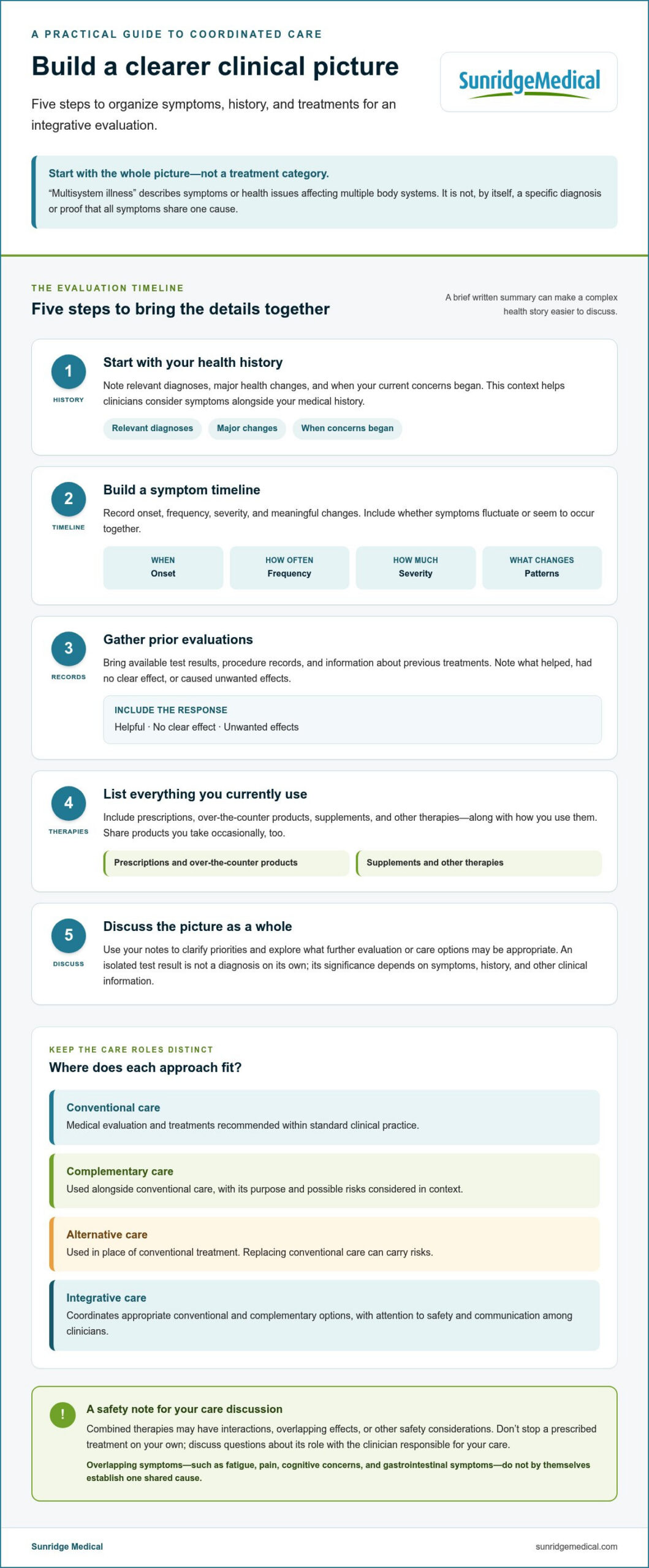
These terms describe how an approach relates to conventional medical treatment. Alternative medicine is used instead of conventional treatment; complementary care is used alongside it. Integrative care coordinates appropriate conventional and complementary options. The terms are not interchangeable, and the role of a particular approach depends on the person, condition, and available evidence.
To understand where an option fits, ask what it is meant to do in the overall plan:
- Conventional care includes medical evaluation and treatments recommended within standard clinical practice.
- Complementary care is added alongside conventional care, with its purpose and possible risks considered in context.
- Alternative care is used in place of conventional treatment, so it should not be confused with an integrated plan.
- Integrative care brings suitable options into a coordinated plan, with attention to safety and communication among clinicians.
This guide focuses on the integrative framework: individualized care that considers appropriate options without treating complementary approaches as replacements for standard medical treatment. Coordination helps keep attention on the whole clinical picture rather than pursuing interventions in isolation. A considered plan can acknowledge overlapping symptoms while preserving the need for medical assessment and evidence-informed decisions.
How Does an Integrative Evaluation Make Sense of Complex Symptoms?
When symptoms span several body systems, a useful evaluation begins by assembling the clinical picture, not by choosing a treatment category. A clinician can review what has changed, what has already been investigated, and how current therapies fit together before discussing possible next steps. This sequence can turn scattered details into a more organized conversation.
An integrative evaluation is a coordinated review of a patient’s whole clinical picture, including symptoms, medical history, prior findings, and current treatments. Test results can inform that review, but an isolated result is not a diagnosis on its own. Its significance depends on the person’s symptoms, history, and other clinical information.
What Information Helps Connect Symptoms Across Systems?
Before an appointment, collect details that show how your health concerns have unfolded. A brief written summary can help you describe connections without assuming in advance that every symptom has the same cause.
- Start with your history. Note relevant diagnoses, major health changes, and when the current concerns began.
- Build a symptom timeline. Record onset, frequency, severity, and meaningful changes. Include whether symptoms fluctuate or seem to occur together.
- Gather prior evaluations. Bring available test results, procedure records, and information about previous treatments. Note what helped, had no clear effect, or caused unwanted effects.
- List current therapies. Include prescriptions, over-the-counter products, supplements, and other therapies, along with how you use them.
- Discuss the picture as a whole. Use these details to clarify priorities and explore what further evaluation or care options may be appropriate.
A complete medication and supplement list matters because combined therapies may have interactions, overlapping effects, or other safety considerations. Share what you actually take, including products you use occasionally. Don’t stop a prescribed treatment on your own; discuss questions about its role with the clinician responsible for your care.
Why Does Individualized Assessment Matter?
Similar symptoms don’t necessarily have similar causes. Fatigue, pain, or changes in concentration can arise in different clinical contexts, so an option that may be relevant for one person might not suit another. Medical history, previous responses, and current therapies all shape which questions and approaches deserve consideration.
That’s why a single test or standardized protocol shouldn’t be expected to explain every multisystem presentation. Findings need to be interpreted in context, and any proposed approach should be considered in relation to the person’s overall care. For people exploring alternative medicine for multisystem illness, an individualized review offers a steadier basis for weighing options than matching a symptom to a treatment.
Sunridge Medical’s physician-led care combines conventional therapies with research-based alternative treatments and ongoing clinical monitoring. Treatment planning is individualized to the patient’s condition and history. Explore individualized complex-condition care to learn how clinical context and treatment coordination can inform care.
How to Evaluate Alternative Medicine Options, Evidence, and Safety
An option can sound persuasive when it’s described as “natural,” “advanced,” or designed to address several concerns at once. Those labels don’t establish whether an approach is effective or safe for a particular condition. When considering alternative medicine for multisystem illness, assess each proposed intervention on its own merits: its intended role, the supporting evidence, potential risks, and fit with current care.
Complementary approaches should be reviewed alongside a patient’s complete treatment plan. This allows clinicians to consider possible interactions, overlapping effects, and whether an option could conflict with a prescribed treatment.
What Does Research-Based Care Mean in Practice?
A biological rationale explains why an approach might have an effect, but it isn’t proof that it helps patients. Early research may suggest a possibility, while stronger clinical evidence requires relevant studies in people with the condition being considered. Evidence for one condition doesn’t automatically apply to another. The National Center for Complementary and Integrative Health (NCCIH) is a resource for learning how complementary approaches are studied and what is known about their safety and effectiveness.
Use the same questions to compare options, while recognizing that their purposes and risks may differ. For example, a supplement and a mind-body practice may have different intended roles, evidence, and safety considerations. Neither category should be assumed to work uniformly.
| Proposed approach | Intended role | Evidence limits | Potential risks | Coordination needs |
|---|---|---|---|---|
| Dietary supplement | Address a specific nutritional or health goal | Evidence depends on the ingredient, condition, and research available | Side effects, product-quality concerns, or interactions may be possible | Review ingredients and use with a clinician, especially alongside medicines |
| Mind-body practice | Support coping, relaxation, or well-being | Research findings may differ by practice and outcome studied | Consider whether the practice is appropriate for current symptoms or limitations | Discuss how it fits alongside other care and personal needs |
| Other complementary therapy | Provide a defined supportive role in care | Evidence may be limited or specific to certain conditions | Risks vary with the intervention and individual health context | Share details with clinicians before adding it to a treatment plan |
How Can Patients Reduce the Risk of Conflicting Treatments?
Give clinicians a complete list of prescribed medicines, over-the-counter products, supplements, and outside therapies. Include how often you use each one, and update the list when something changes. Don’t stop, delay, or change prescribed treatment without guidance from the clinician managing it. Urgent or rapidly worsening symptoms need timely medical assessment rather than waiting to see whether a complementary approach helps.
Individualized care means matching options to the person’s medical context, not adopting a universal protocol. Sunridge Medical combines conventional therapies with research-based alternatives and ongoing clinical monitoring. Learn more about individualized integrative care and how it can inform a coordinated discussion about complex health concerns.
How to Prepare for a Multisystem Illness Care Discussion
When symptoms, appointments, and treatment plans have accumulated over time, it can be hard to know where to begin. A brief, organized summary can turn a complicated health story into a more focused clinical discussion. Start with the concerns affecting your daily life most, then gather information that helps explain their timeline and the care you’ve already received.
What Should You Bring to an Initial Clinical Discussion?
You don’t need to create a perfect record. Bring what you have and note what is missing. A concise timeline and current treatment list can make the discussion more productive.
- Identify your priorities. Write down the symptoms you most want addressed and how they affect sleep, work, mobility, concentration, or daily routines.
- Build a timeline. Note symptom onset and meaningful changes, along with diagnoses, tests, procedures, and major treatment changes.
- Gather available records. Bring relevant test results and medical records, plus the names of clinicians involved in your current care.
- Update your treatment list. Include prescriptions, over-the-counter medicines, supplements, and other therapies, noting how you use them.
- Prepare your questions. Group them by goals, evidence, risks, monitoring, and communication between clinicians so you can return to them during the appointment.
If records are difficult to obtain or organize, don’t postpone needed care while trying to assemble a complete file. Bring the information available to you and explain what is still outstanding. This preparation is a guide for a clearer conversation, not a prerequisite for seeking medical attention.
Which Questions Help Clarify a Proposed Care Plan?
Before deciding whether a proposed approach fits your needs, ask how it relates to your priorities and current care. If you’re exploring alternative medicine for multisystem illness, seek clear explanations and time to consider your options.
- What symptom or health concern is this intervention intended to address?
- What evidence supports its use for my condition, and what remains uncertain?
- What risks or interactions should be considered alongside my current medicines, supplements, and therapies?
- How will we monitor my response, and what would prompt a change in the plan?
- Who should I contact with questions, and how will information be shared among clinicians involved in my care?
You can also ask what alternatives are available, including continuing your current plan without adding an intervention. A sound discussion makes room for uncertainty and questions. You shouldn’t feel pressured to proceed before you understand the purpose, potential risks, and follow-up plan.
For more context on coordinated care, explore this guide to integrative medicine for chronic illness. Sunridge Medical’s individualized approach considers your health history and current treatment plan.
How Sunridge Medical Approaches Alternative Medicine for Multisystem Illness
Complex symptoms call for more than a collection of disconnected interventions. Sunridge Medical brings conventional therapies and research-based alternative treatments into individualized clinical planning. The team considers options in light of the patient’s condition, health history, existing care, and broader clinical context rather than applying one protocol to every person.
This approach is relevant across complex chronic conditions, including autoimmune and Lyme disease, neurologic concerns, hormone-related conditions, and environmental illness. Each has its own clinical considerations. An approach considered in one context shouldn’t be assumed appropriate for another, and alternative care isn’t a reason to stop or delay prescribed treatment without guidance from the treating clinician.
What Does Individualized Care Mean at Sunridge Medical?
Sunridge Medical is a physician-led medical center. Physician evaluation provides a basis for discussing a treatment plan in relation to the patient’s history and clinical circumstances. Conventional and research-based alternative options can be considered as part of that plan, with ongoing clinical monitoring informing care over time. Individualization means the approach responds to the person’s situation; it does not promise a particular outcome.
For someone managing several health concerns, this approach can help bring attention to how therapies fit together instead of viewing each option in isolation. The details depend on the person’s condition and care context. A broad overview can explain the approach, but it cannot substitute for an individual medical evaluation or define a disease-specific protocol.
What Is a Practical Next Step for Patients Exploring Care?
Before a conversation about alternative medicine for multisystem illness, prepare a concise health summary. You don’t need a perfect file. A few organized notes can help focus the discussion and explain what matters most to you.
- Summarize your main concerns and how they affect daily life.
- Note relevant diagnoses, symptom changes, prior evaluations, and treatment responses.
- Prepare a current list of prescriptions, over-the-counter medicines, supplements, and other therapies.
- Write down questions about the purpose of proposed options, potential risks, evidence, monitoring, and coordination with your current clinicians.
Bring available records, but don’t delay needed care while trying to collect every document. If Lyme disease is a central concern, the chronic Lyme disease clinical guide offers condition-specific context. For a broader perspective, explore integrative care for chronic illness.
A thoughtful next step is a conversation grounded in your history, questions, and current treatment plan. Connect with Sunridge Medical to explore an individualized approach to complex chronic care.
Take a Thoughtful Next Step Toward Individualized Care
Exploring alternative medicine for multisystem illness doesn’t require you to settle every question at once. Start by identifying the concern you most want help understanding, then bring it into a clinical conversation. Ask how potential options fit your health history, what remains uncertain, and how decisions will be coordinated with your current care.
Founded in 2003, Sunridge Medical is a physician-led practice under Medical Director Dr. Steven S. Isaacman. Its approach gives complex health concerns individualized consideration rather than a one-size-fits-all answer. You can take time to understand the discussion and decide what feels appropriate for your circumstances.
Explore individualized care at Sunridge Medical and begin a conversation about your health questions.
Frequently Asked Questions
Is alternative medicine the same as integrative medicine?
No. Alternative medicine is used instead of conventional medical treatment, while complementary care is used alongside it. Integrative medicine coordinates appropriate conventional and complementary approaches within a person’s care. For example, a patient managing musculoskeletal discomfort might incorporate hands-on support from providers such as Golden Bay Chiropractic Works while continuing prescribed treatment. The terms describe different roles, so clarify whether a proposed option is intended to supplement existing care or replace it.
Can alternative medicine replace conventional treatment for a complex illness?
Replacing conventional treatment with an alternative approach can carry significant risks, particularly when an illness requires ongoing medical care. Don’t stop, delay, or change a prescribed treatment without first discussing it with the clinician managing your care. If you’re considering another option, explain what you hope it will address and ask how it may fit with your current plan. This supports an informed discussion without assuming every approach is appropriate.
Can supplements interact with prescription medications?
Yes. Supplements can affect how some medicines work or add to their effects, and the possibility depends on the specific products and your health circumstances. Share a complete list with a clinician or pharmacist, including doses when known, over-the-counter medicines, and supplements you take only occasionally. Include products you’re considering adding, too. This review can help identify potential concerns before you make a change or combine therapies.
How do doctors evaluate symptoms that affect multiple body systems?
Doctors assess multisystem symptoms alongside your medical history and the pattern of how they developed. They may review relevant records, diagnoses, test results, procedures, and treatments, then determine what further assessment is appropriate. Share whether symptoms began together or at different times. Their overlap can guide questions, but it doesn’t by itself establish one diagnosis or cause.
Is there strong evidence for alternative medicine in every chronic condition?
No. Evidence varies by intervention, condition, and the outcome being studied. A plausible explanation for how an approach might work is not the same as evidence that it benefits people with a particular diagnosis. Research findings from one condition may not apply to another. Before relying on an option, consider what has been studied, what remains uncertain, and whether the available evidence relates to your specific health concern.
What should I bring to a first appointment for multisystem symptoms?
Bring a concise symptom timeline, available medical records, and a current list of prescriptions, over-the-counter medicines, and supplements. Include relevant diagnoses, tests, procedures, and previous treatments, noting any responses or unwanted effects. Write down the daily activities most affected and the questions you want answered. If you can’t gather everything before the appointment, bring what’s available rather than delaying needed care.
Can an integrative care plan include autoimmune, Lyme, or neurologic concerns?
These concerns can be part of an integrative care discussion, but evaluation and options depend on each patient’s clinical context. Medical history, current therapies, prior findings, and individual goals all matter. Sunridge Medical provides individualized care for complex chronic conditions, including autoimmune, Lyme, and neurologic concerns, combining conventional therapies with research-based alternative treatments. A clinical evaluation helps determine what options may be relevant; it can’t guarantee a particular outcome.