


What if a negative Lyme test reflects when it was taken, rather than settling whether infection is present? If your symptoms or possible tick exposure don’t seem to match your result, it’s understandable to ask why Lyme disease tests are often inaccurate. The answer often lies in what the tests measure: many look for antibodies, which can take time to develop after infection.
That delay can make early results less informative. Differences in test methods may also lead to results that don’t appear to agree. A test result matters, but it needs to be considered alongside timing, symptoms, exposure history, and other clinical findings. On its own, it isn’t a complete picture.
This article explains how antibody response and testing algorithms affect Lyme results, why results can differ, and what a positive or negative finding can and cannot tell you. You’ll also find practical questions to discuss with a licensed clinician, who can interpret laboratory findings in context and consider appropriate next steps without relying on a test alone.
Key Takeaways
- Why lyme disease tests are often inaccurate can come down to timing: antibody levels may not yet be detectable early after infection.
- A limited or negative result isn’t necessarily a laboratory error, and should be interpreted alongside symptoms and possible exposure.
- Standard and modified two-tier testing use different methods, so review the test names and reports rather than relying only on a positive or negative label.
- Keep a clear record of symptoms, possible tick exposure, test dates, and laboratory reports to support a more informed clinical discussion.
- Physician-led evaluation can consider laboratory findings alongside medical history, medications, symptoms, and individual goals.
Why Lyme Disease Test Results Can Be Misleading
A Lyme test result can be limited without being a laboratory mistake. The word “inaccurate” often describes a mismatch between the result and the full clinical picture. A test may not detect evidence of infection under particular circumstances, or a positive finding may not explain a person’s current symptoms. Understanding what a test measures helps make that distinction.
A Lyme antibody test measures immune proteins in a blood sample that the body has produced in response to exposure to Borrelia burgdorferi; it does not directly detect the bacteria. That is why a result needs to be interpreted alongside possible tick exposure, symptoms, and the date of testing. The broader Lyme disease diagnosis picture includes clinical assessment as well as laboratory findings.
What Lyme disease blood tests are designed to detect
Standard serologic tests look for antibodies, proteins made by the immune system. They are different from direct-detection tests that seek the organism or its genetic material. Common antibody classes include IgM and IgG. Their presence is interpreted according to the test method and clinical context. A test result therefore reflects evidence of an immune response, not a direct count of bacteria.
What “inaccurate” can mean in a test result
Several situations may be described as a test being inaccurate, though they don’t all mean the assay itself failed. The distinction matters because a result is one piece of evidence, not a stand-alone diagnosis.
- False negative: The result is negative even though Lyme infection is present. The test may not detect a person’s immune response at that point, or the result may not meet the assay’s reporting criteria.
- False positive: The result is positive, but Lyme disease is not the cause of the person’s illness. A positive antibody finding needs clinical interpretation; it does not automatically establish that current symptoms are due to active Lyme disease.
- Discordant results: Two tests or steps produce results that don’t agree. Differences in assay design, timing, thresholds, or interpretation rules may contribute. Disagreement alone doesn’t show which result best fits the clinical picture.
These terms describe how a result relates to the underlying condition, not necessarily whether a laboratory made an error. For example, someone tested soon after symptoms begin could receive a negative antibody result, while a later assessment may lead a clinician to interpret the evidence differently. Conversely, a positive result calls for careful review rather than an automatic conclusion.
That context is central to why lyme disease tests are often inaccurate in the everyday sense of appearing not to match a person’s experience. Exposure history helps establish whether infection is plausible. Symptoms and examination provide additional clinical information, and test timing helps clarify what an antibody result can reasonably show. A licensed clinician can weigh these factors together and determine whether the result supports, weakens, or leaves unanswered the question of Lyme disease.
How Lyme Test Timing and Antibody Response Affect Accuracy
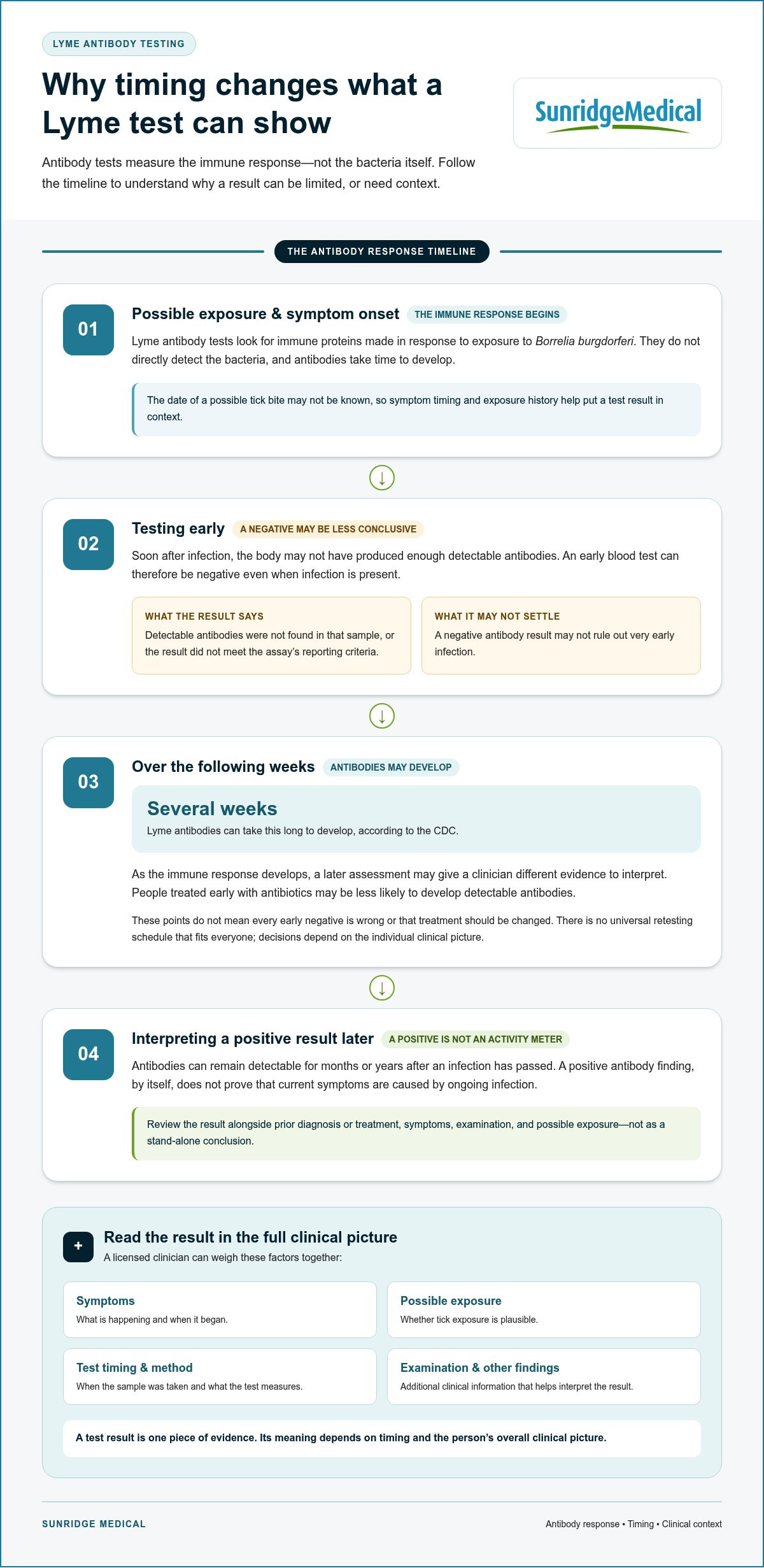
Antibody tests depend on the immune system’s response, and that response takes time. Soon after infection, the body may not have produced enough detectable antibodies for a blood test to identify them. As a result, a negative result early in the course of illness may be less conclusive than one obtained later. Test timing is part of a result’s meaning, not a minor detail.
The Centers for Disease Control and Prevention (CDC) explains that Lyme antibodies can take several weeks to develop, so testing too early may yield a negative result even when infection is present. The CDC also notes that people treated early with antibiotics may be less likely to develop detectable antibodies. These points don’t mean every early negative is wrong or that treatment should be changed. They help clinicians interpret a result in context. CDC guidance on Lyme testing provides further detail.
Why an early test can be negative
After exposure, antibody levels may rise gradually rather than appearing at once. Someone tested shortly after symptoms begin could therefore have a negative result because the immune response is still developing. The timeline varies, and the date of a possible tick bite may not be known. Symptoms, exposure details, examination findings, and clinical judgment help determine whether further evaluation is appropriate.
That’s one reason the question of why lyme disease tests are often inaccurate needs a timing-based answer. The test may accurately report that detectable antibodies weren’t found in that sample, while still being unable to rule out very early infection. A clinician considers when symptoms started, whether there was a plausible exposure, and whether other findings support or weaken the possibility of Lyme disease. There isn’t a universal retesting schedule that fits everyone. Decisions depend on the individual clinical picture.
Why antibodies may remain after an earlier infection
Antibodies can remain detectable after an infection has passed, sometimes for months or years. A positive antibody result therefore isn’t an activity meter and doesn’t, by itself, prove that current symptoms are caused by ongoing infection. The finding needs to be considered alongside a person’s history, symptoms, examination, and any prior diagnosis or treatment.
Likewise, changes in antibody levels shouldn’t be used on their own to diagnose a new infection, determine whether treatment worked, or make treatment decisions. The result is one part of a broader assessment. Avoid drawing conclusions from an isolated number or label. A licensed clinician can explain what the specific test does and doesn’t establish.
If test timing or past treatment makes your results difficult to interpret, a physician-led review can put them in the context of your health history and current symptoms. Sunridge Medical provides outpatient, physician-led care for Lyme and infections. An individualized Lyme care evaluation can include a broader review of your health picture.
Why Two Lyme Tests Can Give Different Results
Two Lyme reports can disagree without either laboratory having made a simple mistake. Tests may use different assay designs, antibody targets, measurement platforms, and thresholds for a reactive result. Results also depend on the testing algorithm: the reported interpretation reflects how the steps work together, not necessarily a head-to-head verdict from two independent tests.
The Centers for Disease Control and Prevention (CDC) recommends a two-step serologic process. The first test is an enzyme immunoassay (EIA); if it is positive or equivocal, a second test follows. In standard two-tier testing, that second step is an immunoblot. In modified two-tier testing, it is a different EIA. Both approaches are recognized testing algorithms, and neither is universally superior for every patient or stage of illness. CDC guidance on Lyme testing describes the current approach.
How two-tier testing combines results
Think of the first step as a screen that determines whether the algorithm calls for a second test. The final interpretation depends on both steps and the rules for that specific method. A reactive first result alone generally isn’t the complete two-tier result; the follow-up step contributes to the overall interpretation. Ask which algorithm was used and how the laboratory classified the combined findings.
| Approach | First step | Follow-up step |
|---|---|---|
| Standard two-tier testing (STTT) | EIA | Immunoblot, often called a Western blot |
| Modified two-tier testing (MTTT) | EIA | A second, different EIA |
How assay design and cross-reactivity can matter
Different assays can look for different antibody targets and use distinct platforms, cutoffs, and interpretation rules. Cross-reactivity means antibodies react with a test target even though they arose in response to something else. The CDC notes that conditions such as relapsing fever, syphilis, rheumatoid arthritis, and Epstein-Barr virus infection can lead to false-positive Lyme serology. That possibility is one reason a result must be interpreted clinically, not in isolation.
A method that identifies more reactive results isn’t automatically more accurate. Sensitivity, specificity, timing, and the clinical purpose of the test all matter. A broader response can potentially detect more true cases while also requiring careful assessment of false positives. Conversely, a more restrictive interpretation may reduce false positives but fail to identify some infections. Performance also varies with disease stage and the population being tested, so a result from one method can’t be compared with another using the positive label alone.
To understand a mismatch, compare the exact test names, the sequence of tests, and the laboratory’s final interpretation. Differences may reflect assay design or algorithm rules rather than a change in health. A physician-led review can weigh those details alongside symptoms and exposure history. Individualized Lyme care can include that broader clinical context.
Managing Negative, Positive, or Conflicting Lyme Results
A result is most useful when reviewed alongside the story around it. If a report seems at odds with symptoms or another test, organize the details before your next clinical discussion. This helps a clinician assess what was measured, when it was measured, and how the finding fits your health history. The question of why lyme disease tests are often inaccurate is best approached through that complete context, not a single result label.
- Make a timeline. Note when symptoms began, how they’ve changed, and when you may have encountered ticks or tick habitat. If you’re unsure about a date or exposure, mark it as approximate rather than guessing.
- Gather the records. Collect complete laboratory reports, including test names, dates, and the laboratory’s interpretation. Include earlier Lyme results and relevant treatment history.
- Compare methods, not just labels. Identify whether testing used standard or modified two-tier testing and which assays were performed. “Positive” or “negative” alone may omit information needed to understand a conflicting report.
- Discuss next steps with a clinician. Ask how the results fit your symptoms, exposure history, and timing, and whether follow-up is appropriate. Don’t repeat testing or start, stop, or change treatment without clinician guidance.
Questions to bring to a clinician
Bring focused questions, along with your timeline and reports. Ask what each test measures, which testing algorithm was used, and what the laboratory’s final interpretation means. Discuss symptom onset, possible tick exposure, earlier results, and relevant treatment history. Then ask how the findings fit your individual clinical picture and whether follow-up is appropriate. A clear explanation can help distinguish what the report supports from what remains uncertain.
Why a test result alone is not a complete diagnosis
Diagnosis involves more than matching symptoms to a laboratory label. A clinician considers the likelihood of exposure, the pattern and timing of symptoms, examination findings, and the test method and result. Current testing guidance also matters, particularly when interpreting results from different algorithms. Persistent symptoms deserve careful assessment, but they don’t by themselves prove Lyme disease; other conditions may need consideration.
If symptoms are concerning or worsening, arrange timely review with a licensed clinician rather than trying to settle the question through online claims or self-interpretation. Individual recommendations depend on the full clinical picture, including medical history and previous care. A Lyme disease specialist care guide can help you understand what physician-led evaluation may involve.
For a physician-led discussion of Lyme results in context, explore Lyme care at Sunridge Medical. Evaluation can consider symptoms and laboratory findings alongside your broader health history, while treatment recommendations remain individualized.
How Physician-Led Care Can Put Lyme Test Results in Context
Confusing or conflicting results can leave you unsure what to do next. Understanding why lyme disease tests are often inaccurate starts with recognizing that a laboratory finding has limits. Its significance depends on the individual’s symptoms, history, timing, and the test method used. Physician-led evaluation can bring those pieces together without treating one result as the whole answer.
Sunridge Medical is an outpatient medical treatment facility offering physician-led, hands-on care for Lyme and infections. Its approach is individualized and integrative, and can complement conventional medical care rather than replace it. Whether care is appropriate depends on a physician’s evaluation of the individual’s circumstances.
What an individualized evaluation may consider
A clinician can review available laboratory reports alongside the reason testing was done, when symptoms began, possible exposure, prior results, and relevant treatment history. This broader review helps distinguish what a test supports from what it cannot establish. A single positive, negative, or borderline finding doesn’t guarantee a particular diagnosis, treatment recommendation, or outcome.
Recommendations depend on the case and may take into account:
- Diagnosis and medical history
- Test reports and other relevant laboratory findings
- Current symptoms and how they affect daily life
- Medications and organ function
- Treatment tolerance, personal goals, and clinical relevance
These factors matter because the same test result may have different significance for people with different histories or symptom patterns. A physician determines whether further assessment or a care plan is appropriate. Recommendations are not made from a laboratory label alone.
A supportive next step for persistent questions
Before discussing your case, gather complete test reports and write down your questions. A timeline of symptoms, possible tick exposure, testing dates, and prior treatment can make the conversation more focused. You might ask what the specific assay measures, how its findings fit your history, and what follow-up, if any, makes sense.
At Sunridge Medical, physician-led care is delivered in an outpatient setting with licensed clinical professionals and a nursing team. Integrative options are considered in relation to clinical relevance and safety, alongside the broader medical picture. This approach is intended to work alongside conventional care, not take its place.
The Patient Care Team can answer general questions, but an introductory call cannot diagnose or prescribe. Individual recommendations require physician evaluation. For a calm overview of Sunridge Medical and its individualized approach to Lyme care, learn about Sunridge Medical.
Take the Next Step With a Clearer Plan
Uncertainty around a Lyme test can be frustrating, but it doesn’t have to define your next decision. Keep your records together and bring your questions to a licensed clinician who can help you understand what the findings mean for your individual situation. Understanding why lyme disease tests are often inaccurate is a starting point for a more informed conversation, not a reason to reach a diagnosis on your own.
At Sunridge Medical, physician-led care is supported by licensed clinical professionals and a full nursing team. Individualized plans are considered in light of medical history, laboratory findings, symptoms, treatment tolerance, and personal goals. This approach can complement, rather than replace, conventional medical care, and recommendations depend on physician evaluation.
If you’re ready to learn more about care for complex and chronic conditions, explore Sunridge Medical’s physician-led approach or call 1‑800‑923‑7878. The Patient Care Team can answer general questions, while diagnosis and treatment recommendations require physician evaluation.
Frequently Asked Questions
Can Lyme disease tests identify which tick bit someone?
No. A Lyme disease blood test looks for evidence of an immune response to the bacteria, not the identity or species of a tick. Even if a tick is available for identification, that information alone can’t confirm whether it transmitted an infection. If you have a photo or details about where and when a tick was attached, share them with a clinician as part of the exposure history.
Do you need to fast before a Lyme disease blood test?
Usually, fasting isn’t required for a Lyme antibody blood test by itself. However, a clinician may order other blood tests at the same time that have different preparation instructions. Follow the directions from the ordering clinician or laboratory, and ask if you’re unsure. Don’t skip meals or change medication instructions based on assumptions about the Lyme test; follow the guidance provided for the full set of tests.
Can Lyme disease tests detect other tick-borne infections?
No. A Lyme test is designed to assess Lyme-specific evidence and doesn’t automatically check for other infections that ticks can transmit. If your exposure or symptoms raise concern about another tick-borne illness, a clinician can decide whether separate testing is appropriate. The tests used may differ by infection, and not every illness has the same testing approach. Share any known tick exposure and symptoms so the clinician can assess what to investigate.
How long do Lyme disease test results take?
Turnaround time varies by laboratory, the specific assays ordered, and whether a follow-up test is needed under the testing algorithm. The laboratory or ordering clinician can provide the most useful estimate for your particular test. If results arrive in stages, wait for the final interpretation rather than drawing a conclusion from a preliminary result alone. Keep the report, including the test names and collection date, for your records.
Can Lyme disease testing tell whether an infection is recent or old?
Not reliably from an antibody result alone. Antibodies may remain detectable after an earlier infection, so a positive result doesn’t necessarily establish when infection occurred or explain current symptoms. The result needs to be considered with past diagnoses, treatment history, symptom onset, and possible recent exposure. If you’ve had Lyme disease before, mention when it was diagnosed and treated so a clinician can interpret the current findings more accurately.
Can a Lyme disease test use a saliva sample?
Standard U.S. Lyme disease serologic testing uses a blood sample to assess antibodies. Saliva testing isn’t part of the CDC-recommended two-step blood-testing algorithms, so a saliva result shouldn’t be treated as interchangeable with those methods. If you’ve received a saliva-based result, bring the report and the test name to a licensed clinician. They can explain what the test measures and whether additional assessment is appropriate for your situation.
What information should I have ready when discussing a Lyme test?
Bring the complete laboratory report, not just a screenshot of the positive or negative label. Note when symptoms began, how they’ve changed, any possible tick exposure, and the dates of prior tests. Include relevant past Lyme diagnoses, treatments, medications, and other health conditions. These details make a conversation about why lyme disease tests are often inaccurate more specific and help a clinician identify what the result does and doesn’t clarify.