


Consistency alone doesn’t establish the benefits of NAD+ IV therapy or how long they last. NAD+ supports cellular energy production and other metabolic processes, but evidence that IV therapy improves energy or cognitive health remains preliminary. A dependable treatment schedule or duration of benefit has not been established.
It’s understandable to want a clear answer when fatigue or difficulty concentrating starts affecting daily life. NAD+ plays important roles in the body, but those roles don’t prove that an infusion will improve symptoms or that repeated treatments will make any effects last.
This article explains NAD+’s roles in cellular energy and brain function, what research does and doesn’t show about IV therapy, and why effects may vary from person to person. It also compares IV infusions with oral precursors and injections, reviews what is known about how long effects may last, and outlines safety considerations to discuss with a medical professional.
Key Takeaways
- Learn how NAD+ participates in cellular energy production and why its role in the body doesn’t, by itself, prove an infusion will improve symptoms.
- Understand what affects how long a person may notice changes after treatment, and which temporary side effects can occur during or after an infusion.
- Compare IV infusions with oral precursors and injections, including what is known about absorption and the limits of human outcome research.
- Review the early evidence on energy and cognitive health, and distinguish promising possibilities from established treatment outcomes.
- Identify health circumstances that call for medical discussion before considering NAD+ therapy, including pregnancy, breastfeeding, and a history of cancer.
NAD+ and cellular energy production
Nicotinamide adenine dinucleotide, or NAD+, is a coenzyme found in all living cells. It participates in hundreds of metabolic processes, including energy production, DNA repair, and cellular defense. In mitochondria, NAD+ helps support reactions that convert nutrients into usable cellular energy. Its role is essential, but raising NAD+ through an infusion does not necessarily relieve fatigue or improve cognitive function.
NAD+ levels naturally decline with age, and the rate varies by tissue type and health. Levels can fall by roughly 50% between a person’s 20s and 50s. Aging, stress, and poor lifestyle choices are also associated with lower levels. This decline is linked with fatigue, cognitive decline, and greater susceptibility to illness, but those symptoms have many possible causes. NAD+ is one part of a larger metabolic picture, not a stand-alone explanation for changes in energy or recovery.
NAD+ also supports pathways involved in cell maintenance. Sirtuins, a family of seven proteins, depend on NAD+ to function, and NAD+ contributes to metabolic regulation and cellular defense. These roles help explain scientific interest in healthy aging: changes in NAD+ levels may affect the activity of NAD+-dependent processes. However, a connection between declining NAD+ and aging does not establish that an IV infusion can reverse age-related changes or restore regenerative capacity.
DNA repair is another key cellular role. Cells encounter damage in everyday life, and NAD+ participates in processes that help maintain DNA and respond to cellular stress. It also supports mechanisms involved in cell defense. These functions provide a biological reason to study NAD+ and cellular health, but they are not proof that NAD+ IV therapy treats disease or improves long-term health outcomes.
Skin health sometimes comes up in discussions of cellular regeneration. NAD+ therapy is described as aiming to support cellular metabolism and the production of healthy new skin cells. It may also support cellular repair and help combat oxidative stress, prompting interest in skin vitality. These are proposed effects, not established cosmetic outcomes. The broader question is whether increasing NAD+ availability meaningfully changes tissue function in people. A plausible cellular mechanism can guide research, but it cannot predict an individual’s visible results, energy, or recovery.
For anyone considering the benefits of NAD+ IV therapy, the key distinction is between NAD+’s established biological roles and the clinical effects of an infusion. The coenzyme is essential to cellular energy and repair, but treatment outcomes must be assessed through human studies. Understanding this difference helps keep expectations grounded as research continues.
How Long Do NAD IV Therapy Benefits Last?
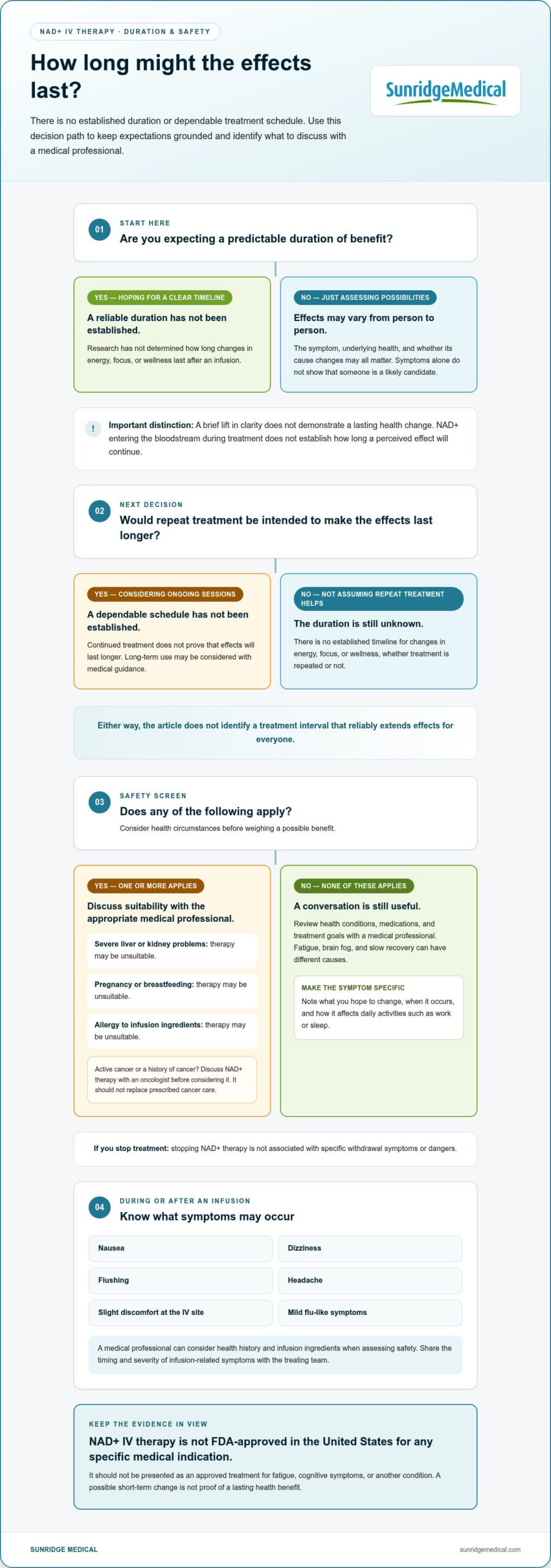
No established duration has been determined for changes in energy, focus, or wellness after an NAD+ infusion. NAD+ enters the bloodstream during treatment, but the duration of any perceived effect may depend on the symptom, underlying health, and whether the symptom’s cause changes. A brief lift in clarity, for example, does not demonstrate a lasting health change. Research has not established a schedule that reliably extends effects for everyone.
People interested in NAD+ therapy may hope to address fatigue, brain fog, or slow recovery. These concerns can have different causes, so symptoms alone don’t establish that someone is a likely candidate. Start by defining the specific symptom and how it affects daily life, then review health conditions, medications, and treatment goals with a medical professional. This can help distinguish a general wellness interest from a symptom that needs evaluation.
Possible side effects during an infusion include nausea, dizziness, flushing, and headache. Temporary effects may also include slight discomfort at the IV site and mild flu-like symptoms. These can affect the treatment experience, even when the goal is improved energy or mental clarity. A medical professional can consider health history and infusion ingredients when assessing safety. Severe liver or kidney problems, pregnancy or breastfeeding, and allergies to infusion ingredients can make therapy unsuitable.
Active cancer or a history of cancer calls for particular care. Anyone in either situation should discuss NAD+ therapy with their oncologist before considering it. Cancer treatment decisions depend on the diagnosis and the existing care plan. NAD+ should not replace prescribed cancer care. If infusion-related symptoms occur, sharing their timing and severity with the treating team can help inform next steps.
Is NAD+ IV therapy FDA-approved for any medical use? No. In the United States, NAD+ is not FDA-approved for any specific medical indication. The infusion should not be presented as an approved treatment for fatigue, cognitive symptoms, or another condition.
How much does NAD+ IV therapy cost in the United States, and is it covered by insurance? Costs vary based on factors such as dose, infusion duration, and clinical setting. Insurance generally doesn’t cover NAD+ therapy because it isn’t FDA-approved.
Stopping NAD+ therapy is not associated with specific withdrawal symptoms or dangers. Long-term use may be considered with medical guidance, but continued treatment does not establish that effects will last longer. For a practical assessment, record the symptom you hope to change, when it occurs, and how it affects activities such as work or sleep. These details make it easier to judge whether a perceived benefit is meaningful, rather than relying on a general impression of wellness.
Delivery methods: oral precursors, injections, and IV infusions
NAD+ can be delivered through intravenous infusions or injections, or supported with oral precursors such as NR and NMN. Each method differs in how it delivers or supports nicotinamide adenine dinucleotide, the coenzyme involved in energy production, mitochondrial function, and DNA repair. These biological roles explain interest in NAD+, but do not establish that one delivery method produces better health outcomes.
An IV infusion sends NAD+ directly into the bloodstream through a drip. The treatment session takes 2-4 hours. The number of sessions depends on the treatment goal, response, and medical assessment; there isn’t one schedule that fits everyone. Oral precursors pass through the digestive system and are often used over weeks or months. Injections offer another route, but clinical outcome data comparing injections with oral forms in humans is limited. No large human trials have shown that one delivery method produces better health outcomes.
Infusion is sometimes described as providing 100% absorption because the substance enters the bloodstream directly. That describes delivery into circulation, not proof of a particular clinical result. Before treatment, screening should account for health history, medicines, allergies, and the reason for considering NAD+. Severe liver or kidney problems, pregnancy or breastfeeding, and allergies to infusion ingredients can make therapy unsuitable. These details help identify safety concerns before an IV is started.
Preparation matters, too. Fasting and alcohol instructions should be part of an individualized pre-infusion plan, not assumptions applied to everyone. During screening, share current medications, supplements, allergies, and relevant health conditions. For example, a history of infusion reactions is important to consider before reviewing ingredients and administration. A clinician can also discuss hydration and the planned treatment when advising on preparation.
The FDA has warned that food-grade NAD+ is a safety concern for injectable products because it does not meet the purity standards required for sterile injectable formulations. Product quality is therefore a central safety issue for IV use. The same concern applies to injections: a substance intended for oral use is not interchangeable with a sterile product intended for injection.
Who might consider an infusion? People exploring NAD+ for energy or cognitive concerns may ask about it, but symptoms alone do not establish likely benefit. Fatigue and reduced focus can have different causes, so the purpose of treatment and a person’s health profile matter. Oral NR or NMN involves a different delivery approach, often taken over weeks or months. Comparing routes means weighing time, screening, method, and evidence, rather than assuming direct bloodstream delivery guarantees greater improvement.
Evidence for energy and mitochondrial function
Research on NAD+ IV therapy is ongoing, with preliminary studies and anecdotal reports of possible benefits for energy, cognition, mood, and wellness. Evidence has not established reliable improvements in energy or mental function. The small infusion studies described below also do not settle effectiveness or safety for broader groups.
Muscle Strength and Energy
NAD+ supports mitochondrial function, where cells convert nutrients into usable energy, making muscle performance a research focus. One study gave healthy adults 750 mg of NAD+ by infusion daily for five days. Another small study used 1,000 mg infusions for six days in healthy adults aged 70-80. These protocols describe what researchers tested, not proof of improved strength or reduced fatigue.
Muscle energy also appears in research involving oral NAD+ precursors, but those results shouldn’t be attributed to IV therapy. A 2021 randomized, double-blind, placebo-controlled trial found that oral NMN improved muscle insulin sensitivity in prediabetic women over 10 weeks. Insulin sensitivity is a metabolic measure, not a direct measure of muscle strength, daily stamina, or recovery after exercise.
Mental Clarity and Reported Energy
Mental clarity includes functions such as focus, alertness, and clear thinking. Preliminary studies and anecdotal accounts report possible cognitive and energy benefits, but they do not establish that an infusion improves these outcomes consistently. Fatigue can also reflect sleep, illness, medication, or other health factors, so a change after treatment alone cannot identify NAD+ as the cause.
To interpret reports of improved energy, distinguish personal experience from a measured clinical outcome. Someone may describe less fatigue after an infusion, for example, while a study would need defined measures and suitable comparison groups to assess effects. Reports can help shape research questions, but they do not show how often benefits occur or how long they last.
Evidence also differs by delivery method. The 10-week NMN trial involved an oral precursor, while the 750 mg and 1,000 mg studies examined infusions. Results from one approach cannot establish the effectiveness of another. Study size, participant health, treatment schedule, and outcome measures all influence what findings can tell readers about boosting energy.
Research involving long-term substance users also needs careful interpretation. One described study used four weeks of NAD+ infusions alongside amino acids and vitamins. Because the study used multiple components, its findings cannot isolate NAD+ as the source of any effect. Overall, current evidence supports continued study, not firm conclusions about IV therapy’s ability to improve mitochondrial energy, muscle strength, or mental clarity.
What conditions is NAD+ IV therapy claimed to treat?
Claims about the benefits of NAD+ IV therapy span brain health, metabolism, and addiction recovery. They draw on NAD+’s roles in cellular energy, metabolic regulation, and cell defense, but a biological mechanism does not establish a treatment effect. In the United States, NAD+ is not FDA-approved for a specific medical indication, so claims should be distinguished from established treatments and evidence.
Claims related to the brain include protecting brain cells from oxidative damage and inflammation, with possible effects on memory, focus, and mental clarity. NAD+ is also described as protective against neurodegeneration. These proposed effects make cognitive health an area of interest, but they do not establish that an infusion prevents or treats neurologic disease. Changes in memory or concentration can have different causes, and the specific condition matters when considering care.
Metabolic claims include improved insulin sensitivity, reduced inflammation, lower blood pressure, and prevention of metabolic syndrome. These outcomes are not interchangeable: insulin sensitivity is a metabolic measure, while blood pressure is a cardiovascular measure. Evidence from oral NAD+ precursors also cannot prove that IV NAD+ produces the same results. The route, participants, and measured outcome all affect what a study can show.
Addiction recovery is another area where NAD+ infusions are used. The approach dates to the 1960s, when clinicians used infusions to support people experiencing alcohol and opioid withdrawal. This history describes clinical use, not proof that NAD+ independently reduces cravings, anxiety, or withdrawal symptoms. Addiction care involves medical and behavioral considerations, so an infusion claim shouldn’t be interpreted as a replacement for established treatment or a complete recovery plan.
Some descriptions also link NAD+ with energy, mood, and overall wellness. These broad outcomes are difficult to interpret without clear measures. Feeling more alert after treatment, for example, differs from demonstrating sustained improvement on a defined cognitive task. Similarly, a change in a metabolic marker does not automatically demonstrate that a condition has been prevented. The specific outcome, study design, and treatment method determine how persuasive a claim is.
For readers weighing neurologic symptoms, the practical distinction is between a proposed mechanism and evidence for a particular diagnosis. Ask what outcome is being targeted, how it will be measured, and whether the care plan addresses the underlying condition. Explore neurologic condition care as part of a broader discussion of brain-health concerns.
Sunridge Medical: Alternative Cancer Treatment Protocols
Sunridge Medical offers Alternative Cancer Treatment Protocols for people exploring care options alongside a cancer diagnosis. Its approach combines conventional therapies with research-based alternative treatments in individualized care plans, keeping the person’s broader health needs in view. NAD+ IV therapy has not been established as a cancer treatment, so questions about it should be considered separately from decisions about cancer care. If you’re weighing treatment options, a conversation focused on your diagnosis, current care, and goals can help clarify what may be relevant. Sunridge Medical also provides support for complex chronic conditions, including autoimmune disease management and chronic Lyme disease treatment. For a discussion of your care needs, contact Sunridge Medical.
Choose a Thoughtful Next Step for Your Health
A useful next step is to connect your health priorities with care that addresses the underlying condition, not just a hoped-for outcome. Weigh the potential benefits of NAD+ IV therapy against your specific goals and broader care needs, rather than treating it as a substitute for condition-focused support. A focused conversation can clarify which questions need attention and how different approaches fit alongside your existing plan.
Sunridge Medical offers Alternative Cancer Treatment Protocols, Chronic Lyme Disease Treatment, and Autoimmune Disease Management. These services may be relevant when your health concerns call for support beyond exploring NAD+ or cellular wellness alone. Care decisions are personal, and a thoughtful discussion can help you consider an appropriate direction without pressure.
Contact Sunridge Medical to learn more and discuss the care options that align with your needs. A clear next step can make a complex health journey feel more manageable.
Frequently Asked Questions
Why Is Consistency Important With NAD+ IV Therapy?
Consistency can make symptom patterns easier to compare over time, but it does not prove that a treatment is working. If you’re receiving infusions, track the same concern, such as afternoon fatigue or focus at work, rather than relying on memory. Note the timing and daily context as well. No schedule has been established to guarantee lasting effects, and repeated infusions do not ensure a particular result.
How Does NAD+ IV Therapy Work?
NAD+ IV therapy administers nicotinamide adenine dinucleotide through a drip into the bloodstream. The rationale is to make NAD+ available for cellular processes, including energy metabolism. This delivery method does not itself demonstrate a change in symptoms. For a useful discussion, identify the specific concern you hope to address, such as fatigue, and distinguish a short-term sensation from a meaningful change in daily function.
What Is NAD+ and Why Does It Matter?
NAD+ is a coenzyme found in living cells, where it supports metabolic activity and cell maintenance. Think of it as part of a larger system: cells use nutrients, enzymes, and coenzymes together, rather than relying on NAD+ alone. Its importance to normal biology explains why researchers study it, but does not establish that a supplement or infusion improves health for everyone.
Can NAD+ Therapy Be Used Long-Term?
NAD+ therapy may be continued long-term with medical guidance, but duration alone does not show that it remains useful. Revisit the original goal, symptom changes, side effects, and other treatments as part of that discussion. Stopping NAD+ therapy is not associated with specific withdrawal symptoms or dangers. If the goal was better concentration, for example, consider whether the change is sustained in everyday tasks, not just noticed briefly after treatment.
Do NAD+ Injections Really Work?
Human evidence does not establish that NAD+ injections reliably improve health outcomes. Clinical data comparing injections with oral forms is limited, and large human trials have not shown that one delivery method produces better outcomes. An injection’s route does not prove that it changes fatigue, focus, or another symptom. When evaluating a treatment claim, look at the specific outcome measured and whether the evidence studied injections, rather than assuming findings from IV therapy or oral precursors apply.
How Does NAD+ Enter Cells?
An IV infusion puts NAD+ into the bloodstream, but that alone does not show how much reaches a particular cell or tissue. Cells use NAD+ in intracellular metabolic processes, and the link between bloodstream delivery and a specific clinical effect should not be assumed. Oral precursors such as NR and NMN are different: they pass through the digestive system and support NAD+ levels rather than delivering NAD+ directly by IV.
How Does NAD+ Work in the Body?
NAD+ participates in cellular metabolism, including processes that help convert nutrients into energy. It also supports pathways involved in DNA repair and cell defense. These functions interact with many other biological systems, so a change in NAD+ does not automatically lead to a noticeable change in energy or health. Fatigue, for instance, can have multiple causes, making its context as important as NAD+’s biological role.
How Often Should You Get an NAD+ IV?
There is no established frequency that applies to everyone. The appropriate interval depends on the reason for treatment, health history, response, and tolerance, while evidence has not identified a schedule that reliably produces lasting benefits. Rather than choosing a recurring appointment pattern based on someone else’s experience, define what you’re monitoring and discuss it with a medical professional. This keeps decisions tied to your circumstances instead of a one-size-fits-all routine.