


Bioidentical hormones aren’t automatically safer than synthetic hormones. The comparison of bioidentical hormones vs synthetic hormones has no universal safety winner: bioidentical hormones are chemically identical to those the body produces, while synthetic hormones are structurally different but designed to have similar effects. Evidence hasn’t shown that compounded bioidentical hormones are safer or work better than conventional hormone therapy.
It’s understandable to be drawn to the word “bioidentical,” especially when considering treatment for symptoms that affect daily life. But the label alone does not determine safety or suitability. The hormone, dose, formulation, delivery method, and your medical history all matter.
This article explains how bioidentical and synthetic hormones differ, how approved and compounded therapies are prepared and delivered, and what is known about their risks. It also outlines factors to discuss when considering hormone therapy and choosing an approach suited to your health needs.
Key Takeaways
- “Bioidentical” describes a hormone’s chemical similarity to one the body produces, not a guarantee that therapy is safer or more effective.
- Distinguish FDA-approved hormone medicines from compounded preparations, since their oversight and consistency differ.
- Compare delivery options, such as patches and pellets, with attention to how each method fits the treatment plan.
- Menopause usually occurs between ages 45 and 55, according to the National Institute on Aging; symptoms and health history also shape treatment decisions.
- Weigh safety by considering the hormone, dose, formulation, route of administration, and personal medical history together.
Are Bioidentical Hormones Safer Than Synthetic?
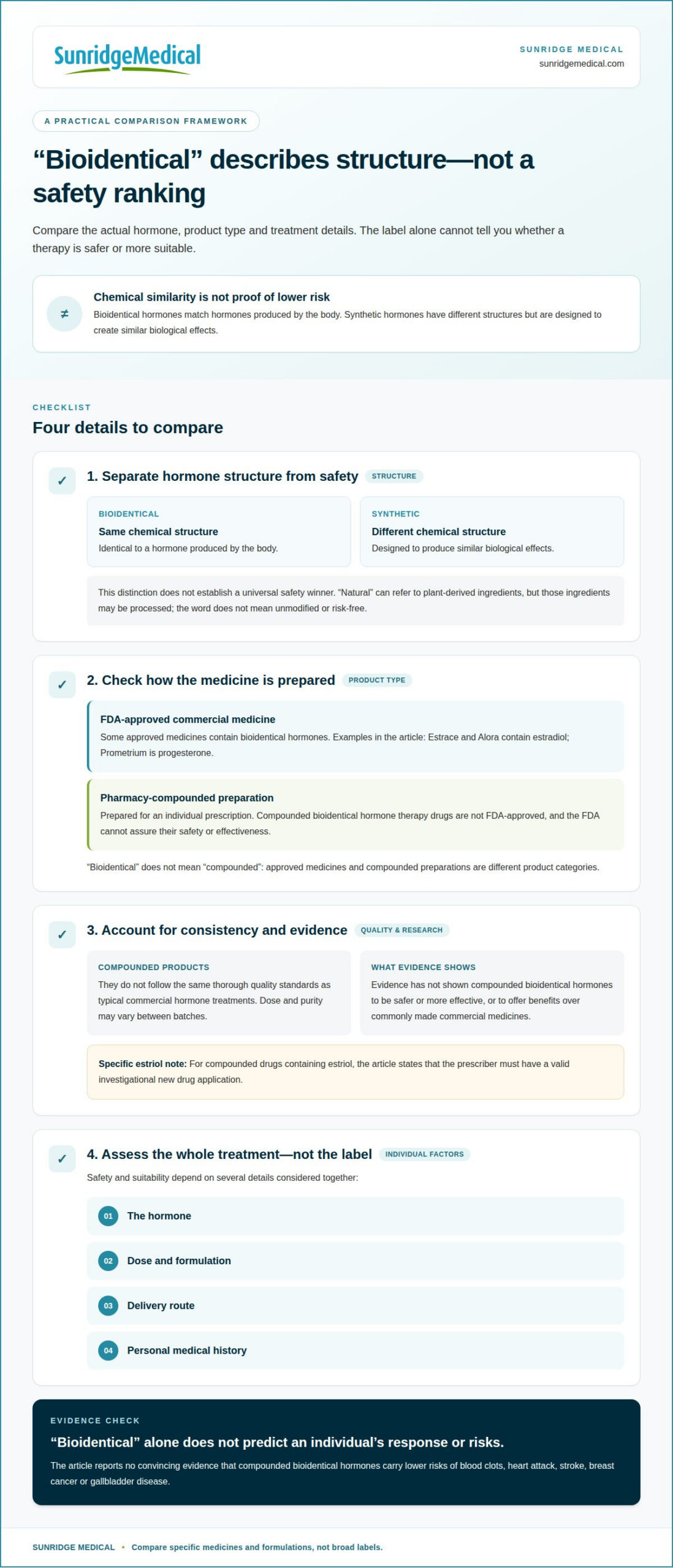
Not automatically. Bioidentical hormones have the same chemical structure as hormones produced by the human body. Synthetic hormones have different structures but are designed to create similar biological effects. This distinction describes molecular structure, not a reliable safety ranking. A bioidentical hormone can still carry risks that depend on its formulation, dose, and the patient’s health history.
The word “natural” can also be misleading. It generally refers to hormones derived from plants, not products used without laboratory processing. Plant ingredients may be processed to create a bioidentical hormone. So “natural” does not mean unmodified, risk-free, or inherently safer. Compare specific medicines and formulations rather than relying on broad labels.
Conventional hormone therapy and bioidentical therapy are not always opposing categories. Some FDA-approved hormone medicines contain bioidentical hormones, while others use different formulations. Premarin contains conjugated equine estrogens; Prempro contains conjugated equine estrogens and medroxyprogesterone acetate. Bioidentical hormones are sometimes used as alternatives, but products differ in their ingredients and are not interchangeable simply because of their names.
Compounded bioidentical hormones are a separate consideration from FDA-approved medicines. Compounding can produce a preparation tailored to a prescription, but compounded products do not undergo the same thorough quality standards as typical commercial hormone treatments. Their dose and purity may vary between batches. The FDA has not approved compounded bioidentical hormone therapy drugs and cannot assure their safety or effectiveness.
For menopause symptoms, evidence does not establish that bioidentical or “natural” hormones are safer or more effective than traditional hormone therapy. Research has not shown that compounded bioidentical hormones offer benefits over commonly made commercial medicines. There is also no convincing evidence that they carry lower risks of blood clots, heart attack, stroke, breast cancer, or gallbladder disease. “Bioidentical” alone cannot predict an individual’s response or risks.
In the United States, costs vary with the medication, formulation, delivery method, and monitoring; service pricing depends on the case and is provided after a quote request. Insurance coverage varies by plan and prescribed product, so there is no single coverage answer for everyone.
To compare options, focus on these practical distinctions:
- Hormone structure: Bioidentical hormones match hormones the body produces; synthetic hormones have a different structure.
- Product type: FDA-approved medicines and pharmacy-compounded preparations have different regulatory oversight.
- Safety assessment: The hormone, dose, formulation, delivery route, and medical history all shape the risk discussion.
What Is Bioidentical Hormone Therapy and How Does It Work?
Bioidentical hormone therapy uses hormones chemically identical to those produced by the body. The term describes a hormone’s structure, not how its medicine is made or regulated. In the United States, some hormone therapy products are FDA-approved, while others are prepared individually by compounding pharmacies. These categories matter because approval and compounding involve different quality controls.
FDA-approved medicines can contain bioidentical hormones. Examples include the estradiol products Estrace and Alora, and the progesterone medicine Prometrium. These examples show why “bioidentical” does not mean “compounded.” A commercially manufactured, approved medicine may contain hormones associated with bioidentical therapy. The product name and preparation type offer more useful information than a broad marketing label.
Compounding pharmacies prepare medicines by combining or altering ingredients for an individual prescription. This can produce a customized preparation, but compounded bioidentical hormone therapy drugs are not FDA-approved, and the FDA cannot assure their safety or effectiveness. Compounded medicines do not follow the same thorough quality standards as typical commercial hormone treatments, and their dose and purity may vary between batches.
That variation has practical implications. Even when a prescription specifies a hormone and dose, batch-to-batch differences can affect what a compounded preparation contains. FDA-approved products such as Estrace, Alora, and Prometrium are distinct from pharmacy-compounded preparations, even when ingredients overlap. Evaluate the exact product type rather than assuming all bioidentical medicines have the same oversight.
For compounded drugs containing estriol, the research provided states that the prescriber must have a valid investigational new drug application. This condition applies specifically to compounded estriol drugs. It is separate from the approval status of commercial estradiol products or Prometrium.
To understand a prescribed option, separate these details:
- Hormone: Identify whether the product contains estradiol, progesterone, estriol, or another hormone.
- Preparation: Determine whether it is an FDA-approved commercial medicine or a compounded product.
- Consistency: Consider the difference between commercial quality standards and possible batch variation in compounded preparations.
- Approval: Remember that FDA approval applies to specific products, not to every medicine described as bioidentical.
Hormone therapy forms and delivery methods
Hormone therapy comes in different forms, and the delivery route affects how treatment is used. A skin patch is worn on the body and changed every few days. Hormone pellets are placed under the skin and release hormones gradually over a few months. Because these methods differ in routine and duration, the prescription should identify the product and how it is administered.
A patch requires regular replacement, while a pellet is inserted and releases hormones gradually. Neither method is automatically preferable for everyone. The hormone, dose, formulation, route of administration, and medical history all shape the risk-benefit assessment. Compare how each method fits the treatment plan and what follow-up involves.
Saliva testing is not a reliable way to adjust hormone therapy doses. For this purpose, hormone levels in saliva do not accurately reflect the amount of hormones in a woman’s body. A saliva result cannot, by itself, establish the right dose. Treatment decisions should reflect the prescribed product and the person’s clinical situation, not saliva measurements alone.
How are bioidentical hormone therapy options chosen, prescribed, and monitored? The prescriber considers the hormone, dose, formulation, delivery route, and medical history, then evaluates the treatment during follow-up. Saliva levels are not an accurate measure for adjusting a woman’s hormone dose.
Dosing is not determined by the “bioidentical” label. For women choosing menopausal hormone therapy, the FDA advises using the lowest dose that helps for the shortest time needed. This makes ongoing assessment important: the plan should remain aligned with symptom relief and the individual’s changing health picture. Do not adjust a dose based on marketing claims or saliva results.
Before starting or changing therapy, clarify the practical details of the prescribed option:
- Product: Identify the specific hormone and formulation, rather than relying on a broad label.
- Route: Confirm whether it is a patch or pellet, and understand how it is administered.
- Schedule: Note that patches change every few days, while pellets release hormones over a few months.
- Review: Discuss symptom response, side effects, and medical history during follow-up.
These questions make the choice more concrete. A patch requires regular replacement, while a pellet releases hormones gradually. The appropriate dose and formulation depend on the same core factors, not on whether a product is called natural or bioidentical.
Menopause and changing estrogen and progesterone levels
Menopause marks a change in hormone production, not a single treatment decision. According to the National Institute on Aging, menopause usually occurs between ages 45 and 55. During menopause, the body makes less of two hormones, estrogen and progesterone. These shifts can coincide with symptoms that lead someone to consider hormone therapy, but they don’t establish which product is appropriate.
What conditions are bioidentical and synthetic hormones used to treat? Menopausal hormone therapy may relieve symptoms such as hot flashes and vaginal dryness. FDA-approved menopausal hormone therapy can also help prevent bone thinning. The treatment purpose depends on the symptoms or health concern, not simply on whether a hormone is bioidentical or synthetic.
FDA-approved menopausal hormone therapy can relieve hot flashes and vaginal dryness. Consider its potential benefits alongside its risks. The distinction between bioidentical and synthetic hormones does not, by itself, show which option will work better for a particular person. The hormone, formulation, dose, route, and medical history all contribute to the assessment.
What are the risks and side effects of bioidentical and synthetic hormone therapy? Relevant risks include blood clots, heart attack, stroke, breast cancer, and gallbladder disease. There is no convincing evidence that bioidentical hormone therapy carries lower risks of these outcomes than FDA-approved menopausal hormone therapy.
Risks and benefits vary by individual. They depend on the hormone, dose, formulation, route of administration, and medical history. A treatment’s delivery method and dose are part of the safety assessment, even if the product is described as natural. Weigh the intended relief against the person’s health history and the specific medicine.
The FDA advises women who choose menopausal hormone therapy to use the lowest dose that helps for the shortest time needed. This supports reviewing the treatment goal and whether the current plan remains appropriate. Changes in symptoms or health history can affect that discussion.
Use these decision points to frame a discussion about menopause therapy:
- Purpose: Identify whether the priority is hot flashes, vaginal dryness, or bone thinning prevention.
- Product: Distinguish the specific hormone and formulation from broad labels such as “natural.”
- Risk profile: Consider medical history alongside risks such as blood clots, stroke, or breast cancer.
- Ongoing review: Revisit the lowest helpful dose and shortest needed duration.
Menopause does not make one hormone approach suitable for everyone. A sound decision connects the symptom being treated with the medicine’s risks, formulation, and personal medical history.
Hormone therapy safety and individual risks
The myth is that bioidentical hormones are inherently safer. In reality, a hormone’s label cannot establish its risk. Safety depends on the hormone, dose, formulation, route, and medical history. Assess a bioidentical product and an FDA-approved menopausal medicine by these details, not by a “natural” claim.
Risks to consider include blood clots, heart attack, stroke, breast cancer, and gallbladder disease. There is no convincing evidence that bioidentical hormone therapy carries lower risks of these outcomes than FDA-approved menopausal hormone therapy. This does not mean every formulation is identical. It means the bioidentical label alone cannot establish a lower-risk choice.
Compounded products add a separate uncertainty. They are not tested or scrutinized by the FDA to verify dose and purity in the same way as approved medicines. Their dose and purity may vary between batches. Compounding pharmacies are also not required to report adverse events associated with these drugs, which can limit the safety information available about reported harms.
That reporting difference matters when interpreting a treatment’s safety record. If compounding pharmacies are not required to report adverse events, reports may not provide a complete picture of possible effects. In addition, no large, long-term study has determined the adverse effects of bioidentical hormones. Broad claims about their long-term safety are therefore difficult to support.
According to the National Heart, Lung, and Blood Institute, the Women’s Health Initiative was a large, long-term study of FDA-approved menopausal hormone therapy drugs. Its findings concern the drugs studied, not every hormone formulation or compounded preparation. Evidence about one studied medicine cannot automatically establish the risks of a different product.
A useful safety review separates the decision into practical questions:
- What is the product? Identify the exact hormone and whether it is FDA-approved or compounded.
- What factors shape personal risk? Consider dose, formulation, route, and medical history together.
- What evidence applies? Match claims to the specific medicine studied, rather than generalizing across all bioidentical products.
- What is the monitoring plan? Track treatment goals, changes in health, and any adverse effects over time.
The clearest takeaway is that “bioidentical” is not a safety guarantee, and “synthetic” is not a complete risk assessment. For an individualized discussion of hormone therapy options, explore a personalized hormone therapy plan.
Sunridge Medical: Alternative Cancer Treatment Protocols
Sunridge Medical offers Hormone Optimization Therapy for people seeking an individualized approach to hormone-related care. If you’re weighing treatment options, discuss how your symptoms, health history, and goals may inform a care plan. Sunridge Medical also provides Alternative Cancer Treatment Protocols, Chronic Lyme Disease Treatment, and Autoimmune Disease Management for people navigating those conditions. Each addresses a distinct health need, so the relevant path depends on your reason for seeking care. Contact Sunridge Medical to discuss your hormone-related care needs.
Make Your Next Hormone Therapy Decision More Personal
The choice between bioidentical hormones versus synthetic hormones is most useful when it clarifies your health priorities. Before taking the next step, note the symptoms you want addressed, how they affect daily life, and what you hope treatment will change. Include relevant health history and current treatments so these details can inform a focused discussion.
The phrase “bioidentical hormones vs synthetic hormones” can make the decision sound like a simple product comparison. A more thoughtful approach centers on the person, the treatment goal, and the factors relevant to their circumstances. You deserve to understand the reasoning behind an option and to discuss your questions without pressure.
Sunridge Medical offers care for people exploring hormone-related support, alongside treatment for other complex health concerns. If you’re ready to discuss your options and next steps, contact Sunridge Medical. A clear, informed conversation can help you move forward with greater confidence.
Frequently Asked Questions
What Is Synthetic HRT and How Does It Work?
Synthetic hormone replacement therapy uses hormones with structures different from the body’s own, designed to produce similar biological effects. In menopause care, hormone therapy may be prescribed for symptoms such as hot flashes or vaginal dryness. The specific medicine, dose, and delivery method determine how it is used. “Synthetic” describes a hormone’s structure, not whether a product is FDA-approved or appropriate for a particular person.
How do bioidentical and synthetic hormones differ chemically and in how they act in the body?
Bioidentical hormones have a chemical structure identical to hormones produced by the body. Synthetic hormones have a different structure but are designed to create similar biological effects. This distinction concerns molecular structure, not a guarantee of different results. A treatment’s formulation and route also affect how it is used. Exact ingredients offer a more useful comparison than the words “natural” or “synthetic” alone.
Are FDA-approved bioidentical hormone therapy products available in the United States?
Yes. FDA-approved bioidentical hormone therapy products are available in the United States. Examples include the estradiol products Estrace and Alora, and the progesterone medicine Prometrium. These examples show that “bioidentical” does not automatically mean compounded. Check the product name and active hormone to distinguish a commercially manufactured, approved medicine from one prepared by a compounding pharmacy.
What is the difference between FDA-approved hormone therapy and compounded bioidentical hormones?
FDA-approved hormone medicines are specific commercial products, while compounded bioidentical hormones are custom-prepared by a pharmacy. The FDA has not approved compounded bioidentical hormone therapy drugs and cannot assure their safety or effectiveness. Compounded preparations may also vary in dose and purity between batches. Two preparations intended to contain the same hormone may not be equally consistent, unlike products manufactured under commercial quality standards.
How do the benefits and effectiveness of bioidentical versus synthetic hormones compare?
There is no established overall advantage of bioidentical hormones over conventional hormone therapy. Research has not shown that compounded bioidentical hormones provide benefits over commonly made commercial medicines. FDA-approved menopausal hormone therapy can relieve hot flashes and vaginal dryness and help prevent bone thinning. These benefits relate to menopausal treatment, not every hormone product or use. Compare specific medicines in relation to the outcome being treated.
Do bioidentical hormones have lower risks of breast cancer, blood clots, or heart disease?
There is no convincing evidence that bioidentical hormone therapy carries lower risks of breast cancer, blood clots, heart attack, or stroke than FDA-approved menopausal hormone therapy. A “bioidentical” label cannot establish a safer choice. Risk assessment depends on the specific hormone, dose, formulation, delivery route, and medical history. A person’s cardiovascular or breast health history, for example, is relevant when weighing treatment risks.
What do FDA and medical organizations recommend about compounded bioidentical hormone therapy?
The FDA has not approved compounded bioidentical hormone therapy drugs and cannot assure their safety or effectiveness. For women who choose menopausal hormone therapy, the FDA advises using the lowest dose that helps for the shortest time needed. These are distinct points: one concerns compounded products, the other menopausal therapy dosing. Decisions should account for the exact medicine, the individual’s treatment goals, and medical history.