


Could an approach described as “natural” or “alternative” help, have no effect, or create risks alongside cancer treatment? The label alone can’t answer that. It’s understandable to feel pulled between conflicting claims when you’re looking for options that support your health without disrupting care. The value of alternative cancer therapy options depends on their intended purpose, the evidence behind them, and how they fit your individual medical situation.
Alternative therapies are used instead of conventional treatment; complementary therapies are used alongside it, often to support symptoms or well-being. Integrative care coordinates approaches within a broader plan. These distinctions matter: a therapy promoted as cancer-directed isn’t automatically proven to treat cancer, and supplements or other interventions may carry risks or interact with treatment.
This guide explains how to assess evidence, recognize claims that deserve caution, and raise practical safety questions with your oncology team. It also explains how individualized planning and ongoing monitoring can put potential benefits and risks in context. Sunridge Medical combines conventional therapies with research-based alternative treatments to develop individualized care plans, without promising a particular outcome or replacing the role of your treating team.
Key Takeaways
- Understand how “alternative,” “complementary,” and “integrative” describe different ways therapies may be used in cancer care.
- Assess alternative cancer therapy options by their intended purpose and the quality of evidence, rather than by labels or testimonials alone.
- Recognize why a therapy used alongside treatment still needs a safety review, including consideration of possible interactions.
- Use a five-step framework to clarify your goals, review evidence and risks, and coordinate options with your medical team.
- Learn how Sunridge Medical uses physician evaluation, individualized planning, clinical administration, and ongoing monitoring to consider care in context.
Alternative cancer therapy options: what the terms mean and what patients seek
Cancer care choices can be difficult to sort through when the same therapy is described as supportive in one place and as a cancer treatment in another. Start by asking how the approach is intended to be used: alongside standard care or instead of it. That distinction clarifies the therapy’s role, while leaving its evidence and safety to be assessed separately.
Complementary care is used alongside standard cancer treatment; alternative care is used instead of it. These terms describe a therapy’s place in a care plan, not whether it is safe, effective, or “natural.” Support aimed at comfort or quality of life is also different from a claim that a therapy can control, shrink, or cure cancer. Those are distinct goals and require different evidence.
How complementary, alternative, and integrative cancer care differ
Complementary approaches are used in addition to standard cancer treatment. They may be considered for supportive goals, such as addressing a symptom or helping someone cope with the demands of care. Whether a particular approach is suitable depends on the person’s health and treatment plan.
Alternative treatment is used in place of standard cancer care. That intended use matters because delaying or replacing recommended treatment can affect decisions about cancer management. A therapy promoted as an alternative should not be assumed to treat cancer simply because it is described as holistic, traditional, or natural.
Integrative care coordinates conventional medical care with selected complementary approaches. This means considering the person’s diagnosis, current treatment, goals, and potential risks together, rather than treating each therapy as an isolated choice. For a broad overview of approaches and their history, see Alternative Cancer Treatment Wikipedia. An overview is not a substitute for evaluating evidence for a specific therapy and purpose.
Why patients explore additional therapy options
People may look for additional support because symptoms, treatment demands, or uncertainty affect daily life. They may hope to improve comfort, protect quality of life, or feel more involved in decisions. These hopes deserve a respectful conversation, not judgment. State the goal clearly: seeking support for a symptom is not the same as seeking a treatment that changes the cancer itself.
Online claims can blur that distinction. A personal story, a promise of broad benefits, and a carefully tested treatment may appear equally persuasive on a screen, even though they do not provide the same kind of evidence. Before acting on a claim, identify the promised outcome and whether it concerns symptom relief or cancer control. Then share the therapy’s name, ingredients or method, and planned use with your oncology team. Specific details give clinicians a clearer basis for discussing fit, potential concerns, and coordination with ongoing care.
You don’t need to settle every question at once. A calm, specific discussion can turn a confusing search for alternative cancer therapy options into a more informed conversation about goals and care.
How to assess evidence and safety across alternative cancer therapy options
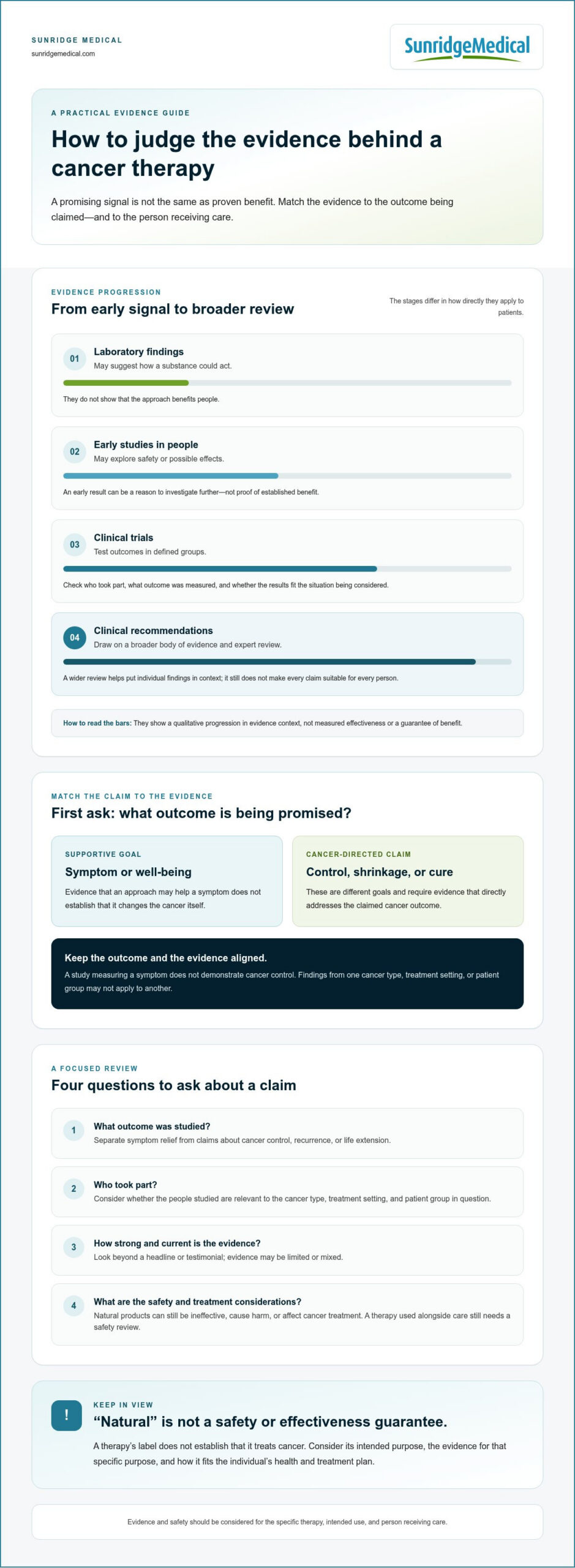
A therapy’s value depends on what it is meant to do and what research has actually measured. Evidence that an approach may help with a symptom does not establish that it can slow a tumor, prevent recurrence, or extend life. Keep those goals separate as you assess alternative cancer therapy options, and look for evidence that matches both the intended benefit and your cancer context.
“Natural” describes a source, not a guarantee: a natural product can still be ineffective, cause harm, or affect cancer treatment. The National Cancer Institute’s information on complementary and alternative medicine is a useful starting point for understanding these approaches and the research behind them. Evidence and safety still need to be considered for the specific therapy, its intended use, and the person receiving care.
What counts as meaningful evidence for a cancer therapy?
Research findings vary in how directly they apply to patients. Laboratory findings can suggest how a substance might act, but they don’t show that it benefits people. Early studies may explore safety or possible effects in people, while clinical trials test outcomes in defined groups. Clinical recommendations draw on the broader body of evidence and expert review. A promising early result is a reason to investigate further, not proof of established benefit.
Read beyond a headline or testimonial. Ask what outcome was studied, who participated, and whether the finding applies to your goal. A study measuring a change in a symptom doesn’t demonstrate cancer control. A result in one cancer type, treatment setting, or patient group may not apply to another. Evidence can also be limited or mixed, so check claims about a specific therapy against current, authoritative information rather than generalizing them to all patients.
Why supplements and natural products need careful review
Supplements, herbs, and other natural products can have side effects or interact with cancer treatment. The risk depends on the specific product and the person’s care. A label that says “natural” doesn’t establish compatibility. Don’t assume that a product is harmless because it’s sold without a prescription or has helped someone else.
Before using a product, share its name, complete ingredient list, amount you plan to take, and intended timing with your oncology team. Include teas, powders, drops, and products marketed for cleansing or immune support. If you don’t have a complete label, bring the packaging or a clear photo. This information helps the team consider the product alongside prescribed medicines and planned treatment. Don’t start, stop, or substitute a supplement for cancer treatment without discussing the decision with your clinicians.
Safety also includes more than physical effects. Consider whether pursuing a therapy could delay recommended care, add burdensome appointments, or create financial and practical strain. A useful review asks: What benefit is supported for my goal? What remains uncertain? What risks or interactions need attention? What could change in my care plan if I use it? A physician-led assessment can help organize those questions. Sunridge Medical’s individualized cancer care planning considers options in the context of a person’s broader care.
Alternative versus complementary cancer therapies: address the key misconception
A therapy doesn’t become a harmless add-on simply because it’s called “alternative.” The distinction depends on how it is used, but either way, an approach may have risks, uncertain benefits, or implications for cancer care. Interest in additional support is understandable. The goal is to examine the specific therapy and its intended purpose without assuming every claim is proven or dismissing a patient’s questions.
Use this comparison to clarify what a therapy is being presented to do:
| Use in the care plan | Intended goal or claim | Coordination needs |
|---|---|---|
| Complementary, alongside care | Support a symptom or aspect of well-being while standard cancer treatment continues. | Review the approach with the oncology team for suitability, possible risks, and interactions. |
| Alternative, replacing care | Claim to treat cancer in place of standard cancer-directed treatment. | Discuss the claim and any proposed change promptly with the treating clinician before acting. |
The table describes intent, not proof of benefit. A supportive goal does not establish that an approach works, and a claim to treat cancer needs evidence for that specific outcome. Don’t delay, stop, or change prescribed cancer treatment without medical guidance. If you’re considering a change, tell your treating clinician what you’re weighing and why.
When an approach is complementary, and when it is alternative
The same practice can be described differently depending on its purpose. For example, a person might consider a mind-body practice as support for stress while continuing cancer treatment. If that same practice is promoted as a replacement for treatment intended to manage the cancer, it is being used as an alternative. These examples explain the distinction; they aren’t recommendations for a particular cancer or individual. In either situation, discuss the specific approach, its evidence, and its place in your care plan with your clinicians.
How to respond to cure claims and pressure to stop treatment
Pause if a source guarantees a cure, advertises a “secret” formula, or pressures you to abandon oncology care. These are warning signs, especially when the person making the claim won’t clearly explain the evidence, possible harms, or uncertainty. A moving testimonial can describe one person’s experience, but it can’t establish what will happen for someone else.
Before acting, write down the claim, the proposed therapy, and any suggested changes to your current care. Bring that information to your treating clinician and ask what is known about the expected benefits and risks in your situation. You can seek support while asking careful questions. A measured conversation helps keep care decisions informed and coordinated as you consider alternative cancer therapy options.
How to compare cancer therapy options for your goals and care plan
A practical comparison starts with your goal, then checks whether a therapy’s evidence, risks, and place in care align with that goal. This helps separate support for symptoms or quality of life from claims about treating cancer itself. Use these five steps to organize a discussion with your cancer care team:
- Define the goal. Name the concern you hope to address, such as a symptom, daily functioning, or a claim about cancer control. Keep these outcomes distinct.
- Identify the therapy. Write down its exact name, method, ingredients, and how it would be used, including any proposed changes to current care.
- Review the evidence. Ask whether research studied the same therapy for the same goal and in a relevant cancer context. Clarify what is known and what remains uncertain.
- Assess risks. Consider possible side effects, interactions with medicines or treatment, timing, and practical or financial burdens.
- Coordinate and monitor. Discuss how the option fits with your treatment plan, what to track, and when to revisit the decision.
The discussion should reflect your diagnosis and circumstances, not just the therapy’s general description. Cancer type and stage, current and planned treatment, other health conditions, medicines and supplements, and your preferences can all shape the conversation. If you’re reviewing alternative cancer therapy options, bring the specific claim or product details so your team can assess the proposal in context.
Questions to take to a cancer care appointment
Written questions can make a complex conversation easier to follow. Consider asking: “What is this therapy intended to do for me?” “What evidence supports that specific goal?” “What risks or interactions should I consider with my current treatment and medicines?” “Could it affect treatment timing?” and “What changes or symptoms should I report, and when?” Bring labels, ingredient lists, written descriptions, or links to the information that led you to consider the approach. That helps the team respond to the specific therapy and claims rather than a broad category.
Track the plan and reassess with the care team
If you and your clinicians decide to consider an approach, agree on a clear goal and a practical way to monitor it. Depending on the goal, that could mean noting a symptom, changes in daily activities, or unwanted effects. Set a point to review what you observe and whether the plan still makes sense. New symptoms, side effects, or proposed changes to cancer treatment call for timely discussion with your treating clinician. A plan should respond to your health and care priorities, not be treated as fixed.
For an individualized discussion of cancer care that considers conventional therapies and research-based approaches together, explore care planning with Sunridge Medical.
How Sunridge Medical approaches individualized alternative cancer therapy options
Cancer care is personal. Diagnosis, current treatment, overall health, and individual priorities all shape the questions a patient may bring to a care discussion. Sunridge Medical develops individualized plans that combine conventional therapies with research-based alternative approaches. The aim is to consider potential options in the context of a person’s broader care, not to apply a universal formula or promise a particular response.
Individualized evaluation instead of a one-size-fits-all protocol
A physician evaluation provides a starting point for discussing a person’s health and care priorities. Sunridge Medical creates individualized treatment plans rather than presenting a standard package for everyone. Planning can consider the patient’s goals, existing cancer treatment, and relevant safety questions together. Because approaches may be considered for different reasons, their intended purpose and available evidence matter.
That distinction helps keep expectations grounded. Support for well-being and a claim to affect cancer are not interchangeable goals, and a care plan should make clear what an approach is intended to address. Alternative protocols should not be understood as a guaranteed result or as a reason to replace standard oncology care. Patients should keep their treating clinicians informed about therapies being considered or used, including products and concurrent treatments, so relevant questions can be addressed as part of care planning.
Coordinating treatment planning and ongoing monitoring
Sunridge Medical’s care model includes individualized treatment planning, clinical administration of integrative therapies, and ongoing monitoring. Monitoring provides an opportunity to review how the plan fits the patient’s broader care over time. Patients can share updates about concurrent cancer treatment, new therapies, and changes in health, helping keep the discussion responsive as circumstances evolve. Any proposed change to prescribed cancer treatment should be discussed with the treating clinician.
A useful clinical discussion can begin with a few clear points: what you hope to address, what care you currently receive, and which approaches you’re considering. Bringing written details about a therapy or product can make the conversation more specific. You don’t need to arrive with every decision settled. The goal is to understand the purpose, evidence, potential risks, and place of an option in an individualized plan.
Sunridge Medical’s physician-led evaluations and ongoing monitoring consider care in context, with attention to the individual rather than a packaged approach. If you’re weighing alternative cancer therapy options, an individualized clinical discussion can help you explore your questions and care priorities.
Take your next step with clarity and support
Choosing whether to explore alternative cancer therapy options doesn’t require you to have every answer today. A useful next step is to bring your questions, priorities, and current care details into a thoughtful clinical discussion. You deserve to understand what an approach is intended to do, what is known about it, and how it may fit your individual situation before making decisions.
Led by Medical Director Dr. Steven S. Isaacman, Sunridge Medical offers individualized evaluation and care planning that considers conventional therapies alongside research-based alternative approaches. A conversation can help you consider your concerns in context, without a promise of a particular outcome or pressure to decide before you’re ready.
Learn about Sunridge Medical’s individualized approach to cancer care. Your questions matter, and a careful next step can help you move forward with greater confidence.
Frequently Asked Questions
Can alternative cancer therapies cure cancer?
No, the label “alternative” doesn’t establish that a therapy can cure cancer. A cure claim needs reliable clinical evidence for the specific cancer and treatment, not testimonials or laboratory findings alone. Some approaches may be studied for supportive purposes, but that doesn’t show they treat the cancer itself. Don’t postpone or replace recommended oncology care based on an unproven claim. Discuss any proposed change with your treating clinician first.
What is the difference between alternative and complementary cancer treatment?
Alternative treatment is used instead of standard cancer care, while complementary treatment is used alongside it. The distinction is about how the approach fits into care, not whether it is effective or safe. For example, a practice described as supportive may be used to help with comfort, while a claim that it replaces cancer-directed treatment gives it a different role. Clarify the intended use before deciding whether to consider it.
Is integrative cancer treatment safe?
It can’t be assumed safe simply because care is called integrative. Safety depends on the specific therapy, a person’s health, and how it fits with current treatment and medicines. A careful clinical review can help identify concerns before an approach is added. Tell the clinicians involved in your care what you’re considering, including the method and timing, and report unexpected symptoms promptly so they can assess the situation.
Can herbs or supplements interfere with cancer treatment?
Yes, some herbs and supplements may cause side effects or interact with cancer medicines or other treatments. The potential concern depends on the exact product and a person’s treatment plan, so don’t assume a supplement is harmless because it’s natural or sold over the counter. Share the container or a clear photo of its label, including all ingredients, with your oncology team before starting or changing use.
How do I evaluate an alternative cancer therapy claim?
Ask what outcome the therapy claims to achieve, then look for human research that studied that outcome in a relevant cancer context. A laboratory result or personal story doesn’t show that a therapy improves cancer outcomes. For alternative cancer therapy options, be cautious of guaranteed results, hidden formulas, or claims that discourage medical review. Bring the claim and any supporting material to your care team for a specific discussion.
Should I tell my oncologist about complementary therapies?
Yes. Share complementary therapies, supplements, and practices you use or plan to try, even if they seem unrelated to cancer treatment. Your oncology team needs an accurate picture of your care to consider possible interactions and timing. A written list with product names, ingredients, and when you use them can make that conversation clearer. If you feel hesitant, explain that you want to coordinate your choices safely.