


Persistent symptoms after treatment don’t automatically mean you need a different antibiotic or that an infection is still active. If you’re exploring antibiotic alternatives for chronic infections, start by clarifying what may be driving your symptoms and what “alternative” means in a medical plan.
It’s understandable to feel frustrated when symptoms continue, treatment is difficult to tolerate, or you’re concerned about interactions and antimicrobial resistance. Supportive approaches may address aspects of care, but they aren’t necessarily proven substitutes for infection-specific treatment. Stopping or changing prescribed antibiotics without medical guidance can carry risks.
This guide explains how complementary approaches differ from replacements, which clinical details can shape an individualized plan, and how to discuss persistent symptoms with a physician. Recommendations depend on your diagnosis, medical history, laboratory findings, medications, organ function, symptoms, treatment tolerance, and personal goals. At Sunridge Medical, physician-led care may integrate conventional medicine with research-informed therapies when appropriate. Use the framework below to compare options and prepare for a focused conversation with your care team.
Key Takeaways
- Persistent symptoms alone don’t confirm an active infection. Diagnosis and relevant clinical findings help guide next steps.
- Before considering antibiotic alternatives for chronic infections, clinicians review your history, prior care, test results, medications, organ function, symptoms, treatment tolerance, and goals.
- Compare antimicrobial treatment and supportive integrative care by their purpose, evidence, limitations, and appropriate role in a medical plan.
- Discuss supplements and botanical products with your care team, since interactions and individual suitability can matter.
- At Sunridge Medical, physician-led evaluation informs individualized care for complex and chronic conditions, with onsite treatment provided by licensed clinical professionals and the nursing team.
What does “antibiotic alternatives for chronic infections” really mean?
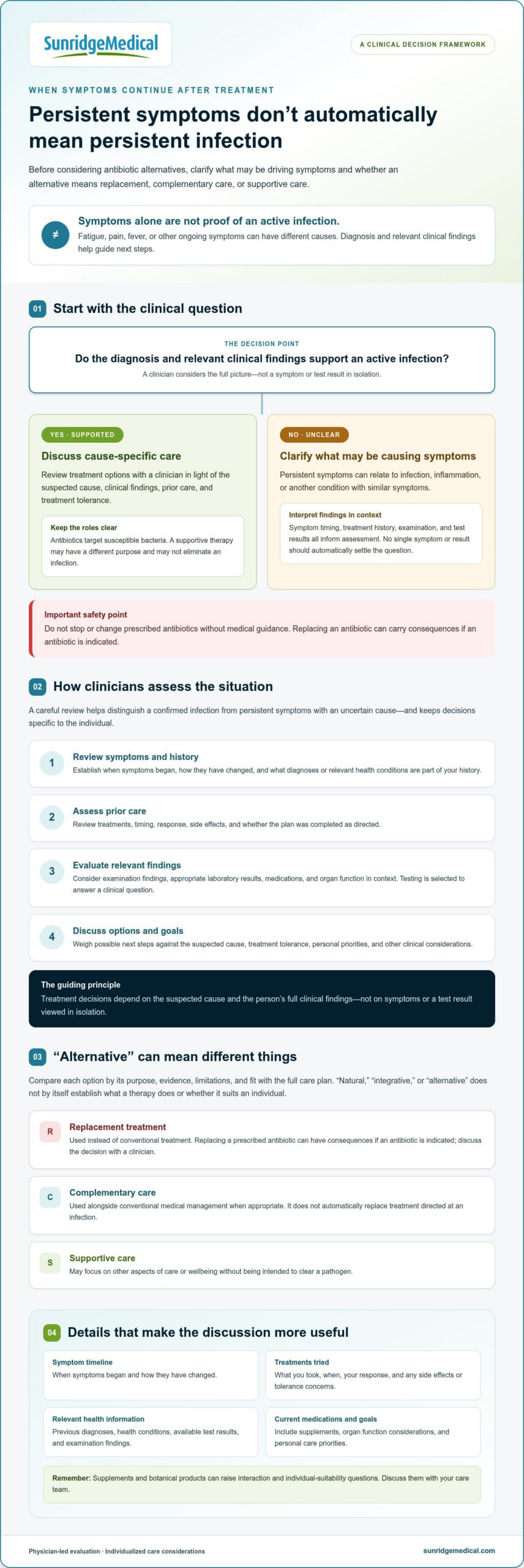
If symptoms continue after antibiotics, it can be hard to know what to ask about next. “Alternative” may mean replacing an antibiotic, adding a complementary therapy, or reviewing the care plan because the diagnosis or treatment approach needs further assessment. These are different decisions. The useful question isn’t simply which option is “natural” or “stronger,” but what the available evidence and your clinical picture support.
A persistent or chronic infection generally refers to an infection that continues over time, though definitions and clinical significance vary by condition. A general chronic infection overview can introduce the concept, but it can’t determine whether a particular person has an active infection. Ongoing fatigue, pain, fever, or other symptoms may warrant assessment, but symptoms alone don’t establish that a pathogen remains. The cause could be bacterial, viral, inflammatory, or something else, and each possibility calls for different considerations.
Antibiotic alternatives are not interchangeable with cause-specific medical treatment. Antibiotics target susceptible bacteria. A supportive therapy may have a different purpose and may not eliminate an infection.
Alternative, complementary, and supportive care are not the same
A replacement treatment is used instead of a conventional treatment. Replacing a prescribed antibiotic can have consequences if an antibiotic is indicated, so discuss that decision with a clinician. Complementary care is used alongside conventional medical management when appropriate. It doesn’t automatically replace treatment directed at an infection.
Supportive care is broader. It may focus on other aspects of a person’s care or wellbeing without being intended to clear a pathogen. Terms such as “natural,” “integrative,” or “alternative” don’t establish what a therapy does, how strong the evidence is, or whether it suits an individual. Consider each option by its purpose, evidence, limitations, and fit with the full care plan.
Why persistent symptoms do not always mean persistent infection
Symptoms can continue for different reasons, including infection, inflammation, or another condition with similar symptoms. Fatigue or discomfort alone, for example, can’t identify the cause. Symptom timing, treatment history, and the interpretation of test results can all shape a clinician’s assessment. Neither one symptom nor one test result should automatically settle the question.
If you’re weighing antibiotic alternatives for chronic infections, organize details that may clarify the discussion: when symptoms began, how they’ve changed, which treatments you’ve tried, and any test results or medication concerns. A clinician can interpret this information in context and determine whether further evaluation, a change in the plan, or supportive care is appropriate. Don’t treat persistent symptoms as proof that you need more antibiotics or that antibiotics should be replaced.
How clinicians assess a chronic infection before considering alternatives
Before discussing antibiotic alternatives for chronic infections, a clinician needs to understand what condition is being treated and what the available information shows. A careful review can help distinguish a confirmed infection from persistent symptoms with an uncertain cause, and keep decisions specific to the individual rather than a one-size-fits-all protocol.
The assessment generally moves through four connected steps:
- Review symptoms and history. Establish when symptoms began, how they’ve changed, and what diagnoses or relevant health conditions are part of your history.
- Assess prior care. Review treatments, timing, response, side effects, and whether the plan was completed as directed.
- Evaluate relevant findings. Consider examination findings, appropriate laboratory results, medications, and organ function in context.
- Discuss options and goals. Weigh possible next steps against the suspected cause, treatment tolerance, personal priorities, and other clinical considerations.
Treatment decisions depend on the suspected cause and the person’s full clinical findings, not on symptoms or a test result viewed in isolation.
What information belongs in a careful medical review?
A useful history includes a symptom timeline, previous diagnoses, treatments tried, and how you responded to or tolerated each approach. Bring a current medication and supplement list, along with relevant laboratory findings if available. Organ function, current symptoms, and personal care priorities also matter because they can affect which options are appropriate to consider. A clinician interprets these details together rather than relying on a single result to explain a complex picture.
Testing is selected to answer a clinical question. No single test detects every infection or gives a complete answer in every situation. For example, a C-reactive protein (CRP) test can help assess inflammation, but that finding alone doesn’t identify its cause. Results need to be understood alongside symptoms, history, examination, and other relevant evidence.
Why diagnosis and treatment history shape the options
A documented infection and symptoms without a confirmed cause are different clinical situations. If an infection has been identified, its type and relevant findings help guide treatment decisions. If the cause is uncertain, further assessment may be the priority rather than choosing a substitute therapy. Prior antimicrobial exposure and response to treatment can also inform what a clinician considers next. They don’t, by themselves, prove that an infection remains or that another course is needed.
For Lyme-related questions, clinical context and care history can be especially important. Sunridge Medical’s clinical guide to Lyme disease specialists offers condition-specific context for understanding individualized care. You can also use the Patient Care Team for general questions. An introductory call isn’t a diagnosis or prescription.
Natural and integrative approaches versus antibiotics: how to compare them
Start with the difference in purpose: antimicrobial treatment is intended to act against a pathogen, while supportive care may address other aspects of a person’s care without eliminating an infection. These approaches aren’t automatically interchangeable. “Research-informed” also doesn’t mean a treatment is proven for every infection or individual. Use the questions below to guide a clinician-led discussion of antibiotic alternatives for chronic infections.
| Approach | Purpose | Evidence question | Limitations and role in a care plan |
|---|---|---|---|
| Antibiotics | Treat susceptible bacterial infections when clinically indicated. | Is there evidence supporting this antibiotic for the suspected or confirmed infection? | They don’t treat viral infections, and the choice depends on the diagnosis and individual circumstances. A clinician determines whether they belong in the plan. |
| Natural or botanical compounds | May be investigated for biological activity or considered as part of individualized integrative care. | Does evidence in people address this specific compound, infection, and intended use? | Laboratory activity alone doesn’t establish clinical benefit. Suitability, interactions, and relevance require individual review. These compounds shouldn’t be presumed to replace indicated treatment. |
| Supportive integrative care | Addresses broader aspects of care alongside infection-directed management, where appropriate. | What specific goal is the approach intended to support, and what evidence relates to that goal? | Supportive care may have a role without acting as an antimicrobial. Its purpose and place in the plan should be clear to both patient and clinician. |
What evidence can and cannot tell you about natural antimicrobials
Evidence comes in different forms. A laboratory finding may suggest that a substance affects a microorganism under test conditions, but it doesn’t show that the substance works safely or effectively in people. Clinical research may offer more relevant information, but its value depends on the population, condition, and treatment studied. Evidence for one compound or infection can’t automatically be applied to another.
Articles about natural antimicrobials sometimes list individual compounds. Treat a list as a starting point for questions, not as a treatment recommendation or proof that a compound can replace antibiotics. Ask what the evidence measured and whether it applies to the diagnosis at hand.
Where integrative care may fit alongside conventional treatment
An individualized integrative plan may combine conventional medical management with research-informed approaches when a physician’s review finds them clinically relevant. That doesn’t make every component an infection treatment or make complementary care a substitute for treatment that is indicated. Consider the intended role, potential limitations, and compatibility with current medications together.
For broader context, integrative medicine for chronic illness describes a wider approach to care. The useful comparison isn’t “natural versus conventional” in the abstract. It’s whether each option has a clear purpose, appropriate evidence, and a medically reviewed place in this person’s plan.
Safety questions to resolve before changing chronic infection treatment
Changing a treatment plan can affect more than symptoms. Before stopping a prescribed antibiotic, replacing it with another approach, or adding a supplement or botanical compound, discuss the decision with your clinician. An article can help you prepare questions, but it can’t determine what is appropriate for your diagnosis or medical history.
A natural label does not establish suitability, effectiveness, or freedom from interactions. Products can vary, and an approach that seems appropriate in general may not fit a person’s medications, organ function, or treatment priorities. “Natural” should prompt careful review, not an assumption of safety.
Medication interactions and individual risk factors
Bring a complete list of prescription and nonprescription medications, supplements, and botanical products to the discussion. Include what you take, how often, and whether you’ve recently started or stopped anything. Your clinician can review this information alongside relevant laboratory findings and organ function rather than assessing a product in isolation.
Other factors matter too: the suspected or confirmed diagnosis, current symptoms, prior treatment, and how well you tolerated it. These details help shape a plan for your circumstances. Don’t rely on a general safety statement or online interaction checker instead of individualized review, especially when several treatments or health conditions are involved.
Questions to bring to a clinician
A focused conversation can clarify what a proposed approach is intended to do and how it fits with current care. Write down your questions in advance, along with your main treatment goals and concerns about side effects or tolerability.
- What diagnosis or specific concern is this approach intended to address?
- What evidence applies to that condition and to the way this approach would be used?
- Is it intended to replace, complement, or support my current treatment, and why?
- Could it interact with my medications or supplements, or raise concerns given my organ function or laboratory findings?
- What symptoms, test findings, or changes in tolerance would prompt a review of the plan?
- How will we assess whether the approach remains appropriate in light of my goals and response?
These questions are especially useful when considering antibiotic alternatives for chronic infections, because the answer depends on each option’s clinical purpose and how it fits with the rest of your care. Monitoring and reassessment should be individualized. Timing may depend on symptoms, tolerance, laboratory findings, imaging, and changing priorities, rather than following a fixed schedule.
For general questions about physician-led, individualized care for complex and chronic conditions, you can contact the Sunridge Medical Patient Care Team. An introductory phone call is for general questions, not diagnosis or prescribing.
How Sunridge Medical approaches complex and chronic infections
When symptoms and treatment history are complex, a careful, physician-led review is more useful than assuming one approach fits every case. Sunridge Medical’s Complex & Chronic Conditions care includes evaluation and treatment for Lyme and infections. Whether a particular treatment is appropriate depends on physician review of the diagnosis and the individual’s clinical picture. Integrative care is considered case by case, alongside conventional medical care when appropriate, not as an automatic replacement.
For people researching antibiotic alternatives for chronic infections, the key is understanding what a proposed therapy is intended to do and how it fits into the complete plan. Recommendations depend on medical history, laboratory findings, current medications, organ function, symptoms, prior treatment, tolerance, and personal goals. Plans can evolve as response, tolerance, findings, or priorities change.
What individualized, hands-on care means
Sunridge Medical is an outpatient medical treatment facility with dedicated infusion rooms and onsite delivery of physician-directed care. Plans may include IV and nutrient therapies, oxidative and redox medicine, and natural and botanical medicine. These are research-informed options, not universal protocols or guaranteed substitutes for antimicrobial treatment. A physician reviews each option for safety and clinical relevance in light of the person’s history and needs.
Care is supported by licensed clinical professionals and a full nursing team. This hands-on model brings evaluation, planning, and onsite treatment together while keeping recommendations specific to the individual case. The purpose is not to presume every modality is suitable, but to consider whether it has a relevant role within a medically guided plan.
How to begin a conversation about your options
Preparation can make an introductory conversation more useful. Gather a summary of your diagnosis and symptom history, previous treatments and responses, current medications and supplements, and the priorities you most want your care team to understand. You don’t need to resolve every question before reaching out. A clear starting point can help organize general next steps.
- Note when symptoms began and how they have changed.
- List prior diagnoses, treatments, and any concerns about tolerance.
- Gather relevant laboratory findings and current medication information.
- Write down your goals and questions about how integrative options might fit alongside existing care.
The Patient Care Team can answer general questions about the process, but an introductory call cannot provide a diagnosis or prescription. Individual treatment recommendations require physician review. If you’re ready to discuss general next steps, contact Sunridge Medical.
Take a thoughtful next step toward an individualized plan
Living with unresolved symptoms can make treatment decisions feel urgent. You don’t have to choose between conventional care and integrative options on your own. Use what you’ve learned about antibiotic alternatives for chronic infections to frame a focused conversation: What outcome matters most to you? Which concerns need attention? What information could help clarify the path forward?
Bring your questions, treatment history, and current priorities to a discussion with your care team. At Sunridge Medical, physician-led care is supported by licensed clinical professionals and a full nursing team. The outpatient medical treatment facility provides hands-on care in dedicated infusion rooms, with individualized plans guided by physician review. Suitability and next steps depend on the person’s circumstances, including diagnosis, medical history, laboratory findings, medications, organ function, symptoms, treatment tolerance, and goals.
For general questions about how to begin, connect with Sunridge Medical about next steps. An introductory conversation can help orient you, while diagnosis and treatment recommendations require physician review. Call 1-800-923-7878 to speak with the Patient Care Team about general questions and next steps.
Frequently Asked Questions
Are there alternatives to antibiotics for chronic infections?
Sometimes, but the appropriate option depends on the diagnosed condition and why symptoms persist. A clinician may consider whether the diagnosis needs clarification, whether a different infection-directed plan is warranted, or whether supportive care has a role alongside treatment. “Alternative” doesn’t identify one specific therapy. Ask what each proposed option is intended to address and whether it treats the infection itself or supports another aspect of care.
Can natural antimicrobials replace prescription antibiotics?
Natural products shouldn’t be assumed to replace prescription antibiotics when those are medically indicated. Evidence may relate to a particular substance, setting, or purpose and may not establish benefit for your infection. If you’re considering a botanical product, share its name and ingredient information with your clinician before using it or changing prescribed treatment. The key question is whether the evidence applies to your diagnosis and intended use.
What happens if symptoms continue after antibiotics?
Contact the clinician managing your care and describe what has changed, including symptoms that improved, persisted, or appeared during treatment. Mention whether you took the medicine as directed and any difficulty tolerating it. Depending on the situation, the clinician may review the original diagnosis, treatment course, or need for further evaluation. Don’t start leftover antibiotics or extend a course on your own.
How do clinicians decide whether an infection is chronic?
There isn’t one time threshold that applies to every infection. Clinicians consider the condition’s expected course, symptom timeline, prior diagnoses and treatment, and relevant examination or test findings. They may also distinguish an infection that has continued from one that has returned after improving. Bring dates and records when possible. A clear timeline can help the clinician interpret the pattern without treating duration alone as proof.
Is it safe to combine supplements with antibiotics?
Not necessarily. Whether a supplement can be used with a particular antibiotic depends on the products and your medical circumstances, so there’s no blanket answer. Before combining them, give your clinician the exact supplement name and ingredient list, along with your full medication list. If you’ve already started a product, say when and note any changes you’ve noticed. Don’t alter prescribed treatment without medical guidance.
Can integrative medicine be used alongside conventional infection treatment?
It may be considered as complementary care when a clinician determines it is appropriate for the individual case. An integrative approach, for example, may have a supportive purpose distinct from treating the infection. Be specific about what you hope it will address, and make sure the clinician overseeing infection treatment knows about every therapy you’re considering. Integrative care should not delay or displace treatment judged necessary for the diagnosed infection.
Does Sunridge Medical treat every chronic infection?
No. Sunridge Medical evaluates and provides care for Lyme and infections within its Complex & Chronic Conditions care, but that doesn’t mean every infection or individual case is suitable. A physician determines whether care fits after reviewing the diagnosis and relevant medical details. The Patient Care Team can answer general questions about next steps, but an introductory call cannot provide a diagnosis or prescription.