


What if the word “bioidentical” tells you less about whether a hormone treatment is right for you than you think? It describes a hormone’s molecular structure, not a guarantee that a product is safer, more effective, or “natural.” If you’re exploring bioidentical hormone optimization, it’s understandable to feel caught between confident claims and conflicting cautions, especially when symptoms can have several possible causes.
A thoughtful evaluation starts with your health concerns, medical history, and the possibility of factors beyond hormone levels. This 2026 guide explains what “bioidentical” means, how FDA-approved hormone products differ from compounded preparations, and what benefits, risks, and alternatives merit discussion with a clinician. It also covers the FDA’s February 2026 decision to remove certain boxed warnings from six menopausal hormone therapy products, a change that doesn’t apply to compounded hormones. The goal is to help you understand the choices and approach hormone concerns with careful, individualized medical guidance.
Key Takeaways
- Symptoms such as fatigue or disrupted sleep can have multiple causes, so consider the full health picture before attributing them to hormones.
- A careful evaluation connects your symptoms and goals with your medical history, medications, and individual risk factors.
- When considering bioidentical hormone optimization, compare treatment options by oversight, formulation, and supporting evidence, not by the “bioidentical” label alone.
- Prepare for a clear discussion of potential benefits, possible harms, monitoring, alternatives, and signs that may warrant follow-up.
- Sunridge Medical’s individualized hormone optimization care begins with your concerns, history, and goals, followed by appropriate clinical assessment and shared planning.
What Does Bioidentical Hormone Optimization Mean?
Fatigue, changes in sleep, and shifts in mood or sexual function can be frustrating, but they don’t point to one cause on their own. Hormone changes may be one consideration among others, including aging, medications, sleep disruption, and other health factors. A careful evaluation starts with the person experiencing the symptoms, not with the assumption that hormones are the answer.
“Bioidentical” describes a hormone’s molecular structure: it matches the structure of a hormone produced in the human body. Estrogen, progesterone, and testosterone are examples of hormones that may come up during an evaluation. The label describes the molecule, not how well a particular treatment works or whether it’s appropriate for a particular person.
Bioidentical hormone optimization is an individualized clinical evaluation and treatment discussion. The word “bioidentical” describes a hormone’s molecular structure, not the plan or its suitability for you. Hormone replacement refers to using hormones as treatment. Optimization is broader: it considers symptoms, health history, goals, assessment findings, and possible approaches before deciding whether hormone treatment belongs in a care plan.
Which hormones and symptoms may prompt an evaluation?
Symptoms can prompt a conversation, but they aren’t a diagnostic checklist. Depending on a person’s circumstances, changes in energy, sleep, mood, menstrual patterns, sexual function, or other aspects of well-being may lead a clinician to consider hormones such as estrogen, progesterone, or testosterone. Similar concerns can also relate to sleep, medications, aging, or other health conditions. The pattern, timing, and context matter, so symptoms alone can’t confirm a hormone imbalance.
Does bioidentical mean natural?
No. Molecular similarity doesn’t establish that a product is unprocessed, plant-derived, safer, or more effective. The source of an ingredient, how it’s manufactured, its regulatory status, and its formulation are separate considerations. A hormone can have a molecular structure identical to one produced by the body and still be manufactured and processed for use as a medication.
Bioidentical hormones are available in FDA-approved products, while compounded preparations are a distinct category. FDA-approved products undergo review for safety, effectiveness, and consistent dosing; compounded drugs aren’t individually FDA-approved. The term “bioidentical” itself isn’t an FDA approval category. For an introduction to the terminology and distinctions, see Bioidentical hormone replacement therapy.
For bioidentical hormone optimization, the useful question isn’t simply whether a hormone matches the body’s own structure. It’s whether a specific option fits the clinical picture, goals, and health considerations identified through an individualized assessment.
How Is Bioidentical Hormone Optimization Evaluated?
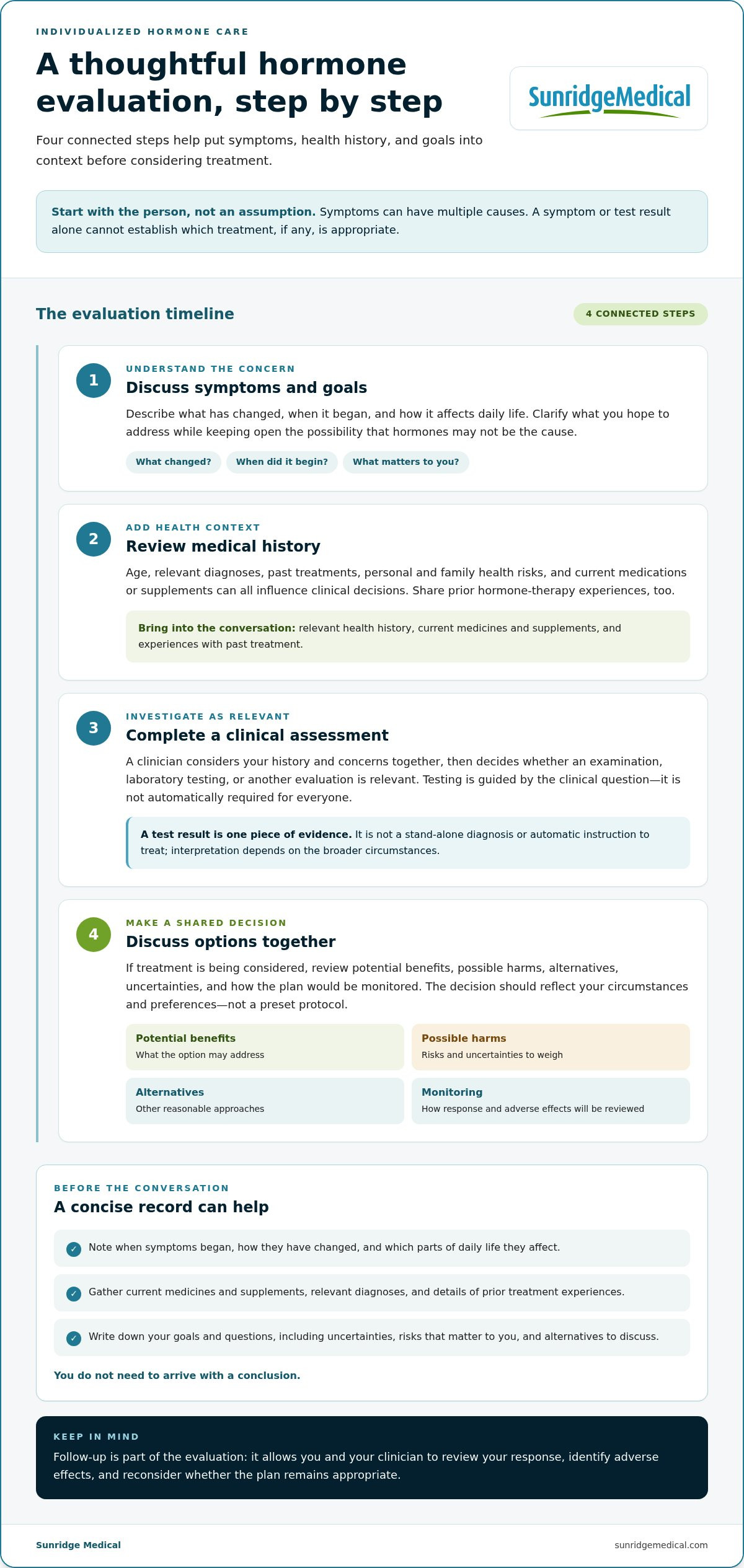
A sound evaluation is a sequence of questions, not a shortcut from symptoms to a prescription. Symptoms, medical history, and clinical context must be considered together because no single complaint or test result can establish which treatment, if any, is appropriate.
Four steps in an individualized evaluation
- Discuss symptoms and goals. Describe what has changed, when it began, and how it affects daily life. Clarify what you hope to address while allowing for the possibility that hormones may not be the cause.
- Review medical history. Age, relevant diagnoses, past treatments, family and personal health risks, and current medications or supplements can all influence clinical decisions. Share this information openly, including your experiences with prior hormone therapy.
- Complete a clinical assessment. A clinician considers your history and concerns together, then determines whether an examination, laboratory testing, or another evaluation is relevant. Testing is guided by the clinical question; it isn’t automatically required for everyone.
- Discuss options together. If treatment is being considered, review potential benefits, possible harms, alternatives, uncertainties, and how the plan would be monitored. The decision should reflect your circumstances and preferences, not a preset protocol.
What should you prepare before an evaluation?
A concise record can make the conversation more useful. Note when symptoms began, how they’ve changed, and which parts of daily life they affect. Bring a current list of medicines and supplements, relevant diagnoses, and details of prior treatment experiences. Write down your goals and questions, including what is uncertain, which risks matter to you, and what alternatives may be reasonable. You don’t need to arrive with a conclusion.
What role do hormone tests play?
Laboratory testing may help investigate a specific concern, but the decision to test depends on symptoms, history, and the clinical question. A result is one piece of evidence, not a stand-alone diagnosis or automatic instruction to treat. Its interpretation may depend on the broader circumstances in which it was obtained. The Cleveland Clinic’s Bioidentical Hormone Therapy overview also discusses treatment considerations and risks.
Follow-up is part of the evaluation, not an afterthought. It gives you and your clinician an opportunity to review your response, identify adverse effects, and reconsider whether the plan remains appropriate. For a physician-led, individualized discussion, explore Sunridge Medical’s hormone optimization care.
Are Bioidentical Hormones Safer or More Effective Than Other Options?
A “bioidentical” label alone can’t establish that a hormone product is safer or more effective than another treatment. It describes molecular structure, not the quality of evidence for a specific product, its risks for a particular patient, or whether it’s suitable for a specific concern. Those questions depend on the hormone, formulation, dose, delivery method, health history, and clinical context.
How do FDA-approved and compounded hormones differ?
These are distinct categories. FDA-approved hormone medicines have undergone FDA review for safety and effectiveness for their approved uses, with standardized manufacturing and labeling. Some are bioidentical. Compounded preparations are custom-made by a pharmacy for a particular prescription and aren’t individually FDA-approved; the FDA does not review them before marketing for safety, effectiveness, and quality in the same way it reviews approved drugs.
Compounding may be considered when a patient has a specific clinical need that an available approved medicine can’t meet. That possibility doesn’t establish that a compounded preparation is more effective or better suited by default. Formulations can differ, and evidence for one product or route shouldn’t automatically be applied to another. The distinction matters whether a hormone is delivered as a pill, cream, patch, or pellet.
A delivery method isn’t proof of superior outcomes. Pellets may offer a different way to administer hormones, but the route alone doesn’t show that treatment will work better or carry fewer risks for an individual. The relevant discussion is whether the formulation fits the clinical need and how its benefits, drawbacks, and monitoring compare with alternatives.
What risks and alternatives belong in the discussion?
Hormone treatment can have potential benefits, but possible harms vary with the specific hormone, formulation, dose, route, and the person’s health factors. For example, the FDA’s February 2026 removal of certain boxed warnings from six menopausal hormone therapy products changed the labeling for those products; it didn’t declare all hormone therapy risk-free. The endometrial cancer warning remains for systemic estrogen-alone products, and the change doesn’t apply to compounded bioidentical hormones.
Before deciding, discuss the expected benefit for your concern, relevant risks, uncertainties, and reasonable alternatives. Depending on the symptoms and their cause, options may include nonhormonal approaches or addressing other contributing health factors. A history of hormone-sensitive cancer or another significant condition calls for individualized medical discussion; it isn’t a detail that the “bioidentical” label resolves.
In bioidentical hormone optimization, a careful comparison focuses on evidence and personal circumstances, not a promise attached to a label or delivery method. Shared decision-making helps clarify whether a treatment’s potential benefits justify its risks for you.
How Can You Prepare for a Safe, Informed Treatment Decision?
Preparation helps turn a complex treatment discussion into a clear, shared decision. Bring your questions and health information, but leave room for uncertainty: hormone therapy may help with some concerns, yet it isn’t appropriate for everyone or guaranteed to address every symptom. Dose and formulation decisions should be individualized with a clinician, not started, changed, or stopped on your own.
A practical checklist for your appointment
- Clarify your goals. Note the concern you most want to address and how you’ll recognize a meaningful change in daily life.
- Gather your health history. Include relevant diagnoses, current medicines and supplements, past treatments, and significant personal health risks.
- Understand the proposed product. Ask which hormone is being considered, whether it’s FDA-approved or compounded, and what formulation and route are proposed.
- Discuss monitoring. Find out how your response and possible adverse effects will be reviewed, and what symptoms should prompt follow-up.
- Consider alternatives. Ask whether nonhormonal approaches or addressing other possible contributors to your symptoms may be appropriate.
Questions that clarify the plan
Ask what clinical concern the treatment is intended to address and what evidence supports using that specific option for your situation. Invite a balanced explanation of likely benefits, possible harms, and areas of uncertainty. If the plan includes a particular dose or delivery method, ask why it fits your needs and what alternatives were considered. You should also understand how new symptoms or side effects will be handled and when the plan will be reassessed.
These questions are especially important if you have an autoimmune condition or another significant health concern, since your broader medical context may shape treatment decisions. For more on this topic, read about hormone optimization for autoimmune disease.
Set thoughtful expectations for follow-up
Responses and timing differ. A careful plan doesn’t promise a particular result by a fixed date; it creates an opportunity to assess whether the intended concern is improving, whether the treatment is tolerable, and whether continuing remains appropriate. Keep track of changes and new symptoms between visits so you can describe them clearly. Don’t stop prescribed treatment or replace other indicated care without discussing it with your clinician.
For a physician-led discussion grounded in your concerns and health history, explore Sunridge Medical’s individualized hormone optimization care.
How Does Sunridge Medical Approach Individualized Hormone Optimization?
Hormone concerns deserve more than a one-size-fits-all answer. At Sunridge Medical, hormone optimization therapy is part of individualized, physician-led medical care. The starting point is understanding what you’re experiencing, what you hope to address, and how your health history shapes the clinical picture. The aim is a considered plan, not hormone treatment by default.
What does individualized hormone care mean?
Individualized care responds to a patient’s circumstances rather than a standardized package. Symptoms, goals, relevant diagnoses, medications, and other health considerations all help shape the evaluation. An appropriate clinical assessment can then inform a discussion of options, including whether hormone treatment is worth considering and what questions remain unresolved.
That distinction matters in bioidentical hormone optimization. No particular hormone, test, formulation, or delivery method is right for everyone simply because it is described as “bioidentical” or included in an optimization plan. Treatment decisions depend on the person and the clinical context. Education supports the conversation, physician evaluation helps place the information in context, and follow-up allows the plan to be reconsidered as needed.
Sunridge Medical Wellness Center, P.C. is led by Medical Director Dr. Steven S. Isaacman. Its approach to hormone optimization sits within care for complex health concerns, where a person’s needs may call for attention to more than one factor. For a broader look at this perspective, read about integrative medicine for chronic illness.
What is a reasonable next step?
Bring a clear account of your concerns to a clinical discussion. A timeline of symptoms, changes you’ve noticed, relevant health history, and treatment goals can help make the conversation more focused. It’s also reasonable to ask what an evaluation may clarify, what options could be considered, and how uncertainty or potential risks will be addressed. You don’t need to decide in advance that hormone therapy is the answer.
If treatment is considered, the specific plan and monitoring should reflect your circumstances. There are no guaranteed outcomes, and a thoughtful discussion may conclude that another approach or further assessment is more appropriate. The value lies in making an informed decision with attention to your health, preferences, and goals.
For a physician-led conversation about your hormone concerns and individualized care, explore hormone optimization at Sunridge Medical.
Take Your Next Step With a Thoughtful Evaluation
The central lesson of bioidentical hormone optimization is simple: the label describes a hormone’s structure, not whether a treatment is right for you. Symptoms can have different causes, so decisions should consider your health history, goals, clinical assessment, and the evidence and risks for a specific option. FDA-approved and compounded preparations are distinct, and neither a product label nor a delivery method can replace an individualized discussion.
Sunridge Medical offers hormone optimization therapy as part of its medical care. Led by Medical Director Dr. Steven S. Isaacman, the practice was founded in 2003. A physician-led conversation can help you clarify your concerns, understand possible options, and consider whether a plan fits your circumstances without promising a particular outcome.
Explore individualized hormone optimization at Sunridge Medical and bring your questions, symptom history, and goals to the discussion. A careful next step can begin with better understanding, guided by your individual needs.
Frequently Asked Questions
What are bioidentical hormones?
Bioidentical hormones have a molecular structure identical to hormones produced by the human body. The term describes this chemical characteristic; it doesn’t guarantee that a treatment is safer, more effective, natural, or suitable for you. Some FDA-approved medicines contain bioidentical hormones. A clinician can explain the status and formulation of a specific product and how it may fit into an individualized treatment discussion.
Are bioidentical hormones safer than traditional hormone therapy?
Not automatically. “Bioidentical” doesn’t establish that a therapy has fewer risks or better outcomes than another option. Safety depends on the specific hormone, formulation, dose, route, and your health history and risk factors. For bioidentical hormone optimization, discuss the evidence and potential harms of the specific treatment being considered with a qualified clinician. Don’t rely on marketing claims or the product label alone to compare options.
Are compounded bioidentical hormones FDA-approved?
No. Custom-compounded medicines aren’t FDA-approved in the same way as FDA-approved drug products, which undergo FDA review for their approved uses. Compounding may be considered to address a specific clinical need, but that doesn’t prove a preparation is safer or more effective. Formulations and quality may vary. Ask your clinician why compounding is being considered, what its limitations are, and whether an FDA-approved alternative may be appropriate.
Can hormone tests tell me whether I need bioidentical hormone therapy?
No single test result can determine whether hormone therapy is right for you. A clinician interprets laboratory findings alongside your symptoms, medical history, medications, and the question the test was intended to investigate. Whether and when testing is appropriate depends on the individual clinical context. Don’t use an isolated result or an online reference range to start, stop, or adjust hormone treatment without medical guidance.
What happens if bioidentical hormone therapy causes side effects?
Contact the clinician managing your care about new or worsening symptoms so they can help determine whether the plan needs reassessment. The right response depends on the symptom and treatment. Don’t change a prescribed dose without medical guidance. For severe or sudden symptoms, seek urgent medical attention and follow applicable emergency guidance in your area. Keep track of what changed and when, which can help inform the discussion.
How long does bioidentical hormone therapy take to work?
There’s no single timeline that applies to every treatment or patient. Response can depend on the hormone, formulation, dose, health context, and concern being treated. Your clinician can discuss realistic expectations and when progress should be reviewed. Be cautious of promises of rapid or guaranteed results. If symptoms persist, change, or worsen, or if unwanted effects arise, share that information during follow-up rather than adjusting treatment yourself.
Are hormone pellets the only way to receive bioidentical hormones?
No. Depending on the hormone and clinical circumstances, treatment may be available in different formulations and routes. Pellets are one delivery method, not a requirement or evidence by themselves of superior results. Discuss the potential benefits, limitations, risks, and alternatives for any option being considered. Your medical history and treatment goals can help guide that discussion; a clinician can explain which choices may be appropriate for your situation.
To discuss your hormone concerns and individualized care, explore hormone optimization at Sunridge Medical.