


Hope for a faster recovery doesn’t make an experimental peptide an established treatment. BPC-157 is a peptide made of 15 amino acids, and it isn’t FDA-approved for medical use in the United States. Interest in BPC-157 for gut health and injury repair centers on proposed effects on tissue healing, but most research on gut health comes from laboratory and animal studies.
It’s understandable to look for options when digestive symptoms persist or an injury disrupts daily life. The key is separating proposed mechanisms from evidence in people, and weighing potential safety concerns alongside possible benefits.
This article explains what BPC-157 is and how researchers think it may affect the gut barrier and tissue repair. It also covers what the evidence can and can’t show, its regulatory status, and why it shouldn’t replace established care for IBS, Crohn’s disease, or autoimmune conditions.
Key Takeaways
- Learn how proposed tissue-repair mechanisms differ from demonstrated clinical outcomes, and how to interpret findings from animal studies.
- Understand what intestinal permeability means and why a proposed effect on the gut barrier doesn’t by itself establish symptom relief.
- See how the 2026 FDA advisory committee recommendation fits into BPC-157’s U.S. regulatory status, and why a recommendation isn’t the same as a final FDA decision.
- Review the limits of human safety evidence, including a published pilot involving two adults who received intravenous BPC-157.
- Competitive athletes can factor in that BPC-157 is prohibited by the World Anti-Doping Agency.
BPC-157 composition and proposed mechanisms
BPC-157 is discussed for possible effects on gut tissue and injury repair. It is a 15-amino-acid peptide, and its proposed actions remain distinct from established clinical benefits. The central question is how researchers think it could influence damaged tissue, and whether those ideas translate into meaningful outcomes in people.
BPC-157 Composition and Definition
BPC-157 is a peptide consisting of 15 amino acids, small building blocks linked in a specific sequence. Its name is commonly associated with “body protection compound,” but the useful distinction is its composition, not a proven protective effect. For readers, that distinction matters: identifying a peptide does not establish that it heals the gut or an injury.
Proposed Biological Mechanisms
Proposed mechanisms describe biological processes that BPC-157 might influence, rather than confirmed results for patients. In gut-health discussions, the hypothesis concerns support for the intestinal lining; in injury discussions, it concerns tissue repair. These are related ideas, but they involve different tissues and outcomes. A change observed in an experimental model cannot by itself show that people will experience symptom relief or faster recovery.
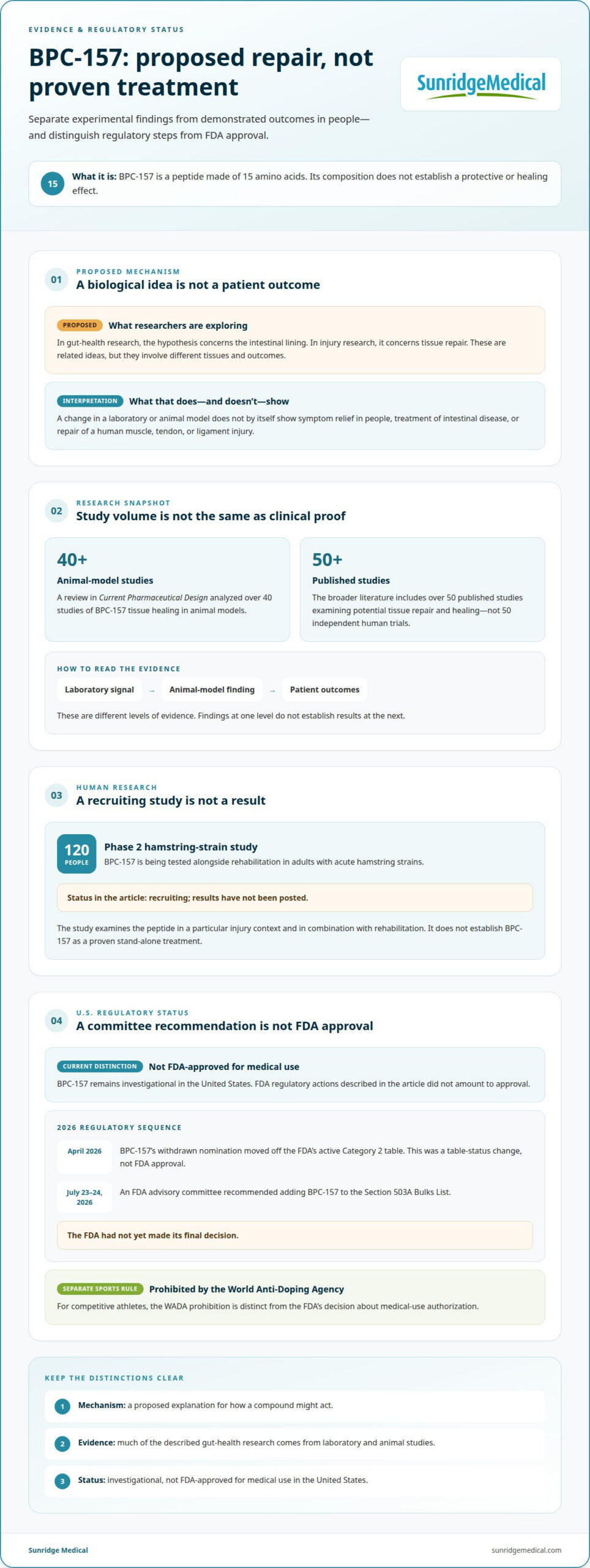
The evidence base includes animal research. A review in Current Pharmaceutical Design analyzed over 40 studies of BPC-157 tissue healing in animal models. The broader literature described on the topic includes over 50 published studies examining potential tissue repair and healing. Those figures indicate research activity, not proof of effectiveness. They also shouldn’t be read as 50 independent human trials, since animal studies make up a substantial part of the evidence.
The proposed logic is that a compound affecting tissue responses could matter where a barrier or structure has been disrupted. For the gut, that means researchers examine whether the intestinal lining responds differently under experimental conditions. For an injury, they examine tissue-repair outcomes in models. Neither example establishes that BPC-157 treats intestinal disease or repairs human muscle, tendon, or ligament injuries.
A recruiting Phase 2 study is testing BPC-157 alongside rehabilitation in adults with acute hamstring strains. It is designed for 120 people, and results haven’t been posted. The study’s combination with rehabilitation also matters: it evaluates the peptide in a particular injury context, not as a proven stand-alone treatment. Until results are available, the proposed mechanisms remain a scientific rationale, not a clinical conclusion.
That distinction can guide how readers interpret claims about BPC-157 for gut health and injury repair. Ask what tissue was studied, whether evidence came from animals or people, and what outcome researchers measured. A laboratory signal, an animal healing result, and improved symptoms in patients are different levels of evidence. The 15-amino-acid description identifies the compound; it doesn’t answer those clinical questions.
FDA approval and regulatory status
BPC-157 isn’t FDA-approved for medical use in the United States. It remains investigational, and the FDA’s regulatory actions in 2026 did not amount to approval. Is BPC-157 prohibited in sports by the World Anti-Doping Agency? Yes. BPC-157 is prohibited by the World Anti-Doping Agency in competitive sport.
The FDA’s 2026 evidence review found very limited clinical information about BPC-157-related substances, including for ulcerative colitis. That finding matters because a proposed use for gut symptoms is not equivalent to an authorized treatment. Most research described for gut health comes from laboratory and animal studies, rather than large human clinical trials. Those evidence limits help explain why proposed effects should not be mistaken for established medical use.
The regulatory timeline has several distinct steps. In April 2026, BPC-157’s withdrawn nomination moved off the FDA’s active Category 2 table. That change describes its status on a particular FDA table; it does not mean the FDA approved BPC-157. On July 23 and 24, 2026, an FDA advisory committee recommended adding BPC-157 to the Section 503A Bulks List. The FDA had not yet made its final decision. A committee recommendation and a final FDA decision are separate actions.
For readers, the practical distinction is between investigational interest and FDA approval. A compound can attract research attention while lacking FDA approval for medical use. Likewise, a committee recommendation about the Section 503A Bulks List should not be presented as an FDA approval decision. These terms describe different regulatory steps, so precise wording matters when evaluating claims about availability or clinical status.
The 5R approach to gut health is a separate care framework, not a regulatory category for BPC-157. Its steps are often described as Remove, Replace, Reinoculate, Repair, and Rebalance. In practice, these labels organize possible areas of attention, such as identifying potential irritants or considering gut-supportive measures. They do not establish that BPC-157 is approved, effective, or appropriate for a particular condition. The FDA’s status decisions and a 5R framework answer different questions.
For athletes, the World Anti-Doping Agency prohibition is a separate consideration from FDA approval. Competitive sport rules prohibit BPC-157, while FDA approval concerns authorization for medical use in the United States. A change in one status does not automatically change the other. Readers weighing claims about BPC-157 should distinguish the FDA’s current regulatory position, the advisory committee’s recommendation, and the World Anti-Doping Agency’s sports prohibition.
Gut-barrier function and intestinal permeability
The intestinal barrier separates gut contents from the body’s internal environment. BPC-157 has been studied for possible effects on this barrier, but a proposed effect is not proof of treatment benefit. Understanding permeability helps clarify what researchers are investigating and what the findings can mean for digestive health.
The intestinal barrier is more than a wall. Cells lining the intestine form a surface, while connections between neighboring cells help regulate what passes through. Mucus and local immune activity also contribute to this boundary. The lining must absorb nutrients while limiting unwanted passage of material from the digestive tract. Intestinal permeability describes how readily substances cross that lining; it is not, by itself, a diagnosis or an explanation for every digestive symptom.
When researchers discuss BPC-157 and gut-barrier function, the central question is whether it could influence the intestinal lining during stress or injury. Experimental work examines changes in tissue integrity and healing. These outcomes help generate hypotheses about barrier support, but they don’t establish that the peptide restores normal permeability in people. A laboratory or animal observation also can’t determine whether someone’s bloating, pain, or bowel changes will improve.
That distinction matters because digestive symptoms can have different causes. Altered bowel habits and abdominal discomfort, for example, may occur in several gastrointestinal conditions, while permeability findings concern a specific feature of the intestinal lining. A proposed effect on the barrier should not be assumed to address the cause of someone’s symptoms. Clinical outcomes, such as symptom changes or disease control, must be considered separately from experimental measures of tissue response.
Research on digestive-tract and intestinal injury asks how tissue responds after damage and whether repair processes change. In BPC-157 studies, this question has largely been explored in laboratory and animal settings, rather than large human clinical trials. The type of model matters: an experimentally induced injury is not identical to chronic intestinal disease. Findings from one tissue or model therefore cannot automatically be applied to conditions such as inflammatory bowel disease.
For readers assessing claims, separate three questions: Was the work done in cells, animals, or people? Did researchers measure barrier integrity, tissue healing, or symptoms? Was the condition an experimental injury or a diagnosed disease? Those distinctions show what a result actually supports. BPC-157’s proposed relationship to the gut barrier remains a research question, not evidence that it treats intestinal permeability or digestive illness.
Potential safety concerns and side effects
Safety claims about BPC-157 require careful interpretation because human evidence is limited. One published pilot followed two adults receiving intravenous BPC-157. That small report cannot establish how often side effects occur, identify uncommon reactions, or show whether findings apply to oral use. It also doesn’t provide a dependable basis for describing the peptide as broadly safe.
Route and formulation matter when assessing exposure. Oral capsules and intravenous administration are different ways of taking a substance, so findings from one route should not automatically be applied to another. The available human pilot involved intravenous use, not a broad comparison of formulations. A safety claim about one route therefore cannot settle questions about another.
When considering side effects, distinguish a reported event from an established risk profile. A small pilot can describe what happened to its participants, but it cannot reliably establish how often effects occur in a wider population. Without adequate human evidence, that report alone cannot provide a complete list of potential reactions or their likelihood. Claims suggesting a predictable response go beyond what this limited example can show.
Product details also shape how a person interprets an experience. The route, formulation, amount used, timing, and any symptoms should be recorded accurately. For example, noting whether BPC-157 was taken orally or administered intravenously helps distinguish unlike exposures. This record gives a qualified healthcare professional concrete information to consider, rather than relying on a general label such as “peptide use.”
A qualified healthcare professional should determine the appropriate BPC-157 route and formulation based on the individual’s circumstances and available evidence. That assessment should account for the intended purpose and the specific preparation under consideration. It should also distinguish a proposed use for gut concerns from a proposed use for an injury. Those contexts are not interchangeable, and evidence for one cannot establish safety in the other.
If symptoms begin after using a substance, note when they appeared and which formulation was involved. Share those details with the healthcare professional overseeing your care. This is particularly useful when other treatments are involved: a clear timeline helps distinguish events without assuming their cause. The absence of a reported reaction in a very small pilot does not prove that someone else will have the same experience.
The practical takeaway is to judge safety by the quality and relevance of human evidence, not by confident claims or anecdotes. The pilot involving two adults and intravenous use offers limited information about that specific setting. It cannot resolve questions about other routes, longer use, or different health circumstances. Reviewing the route, formulation, and individual context carefully helps separate potential benefits from what the safety evidence has actually demonstrated.
IBS, Crohn’s disease, and autoimmune disease
Persistent digestive symptoms can make an experimental treatment seem appealing. But irritable bowel syndrome (IBS), Crohn’s disease, and autoimmune conditions are not interchangeable diagnoses. Their symptoms and underlying clinical considerations differ. A proposed effect on gut tissue doesn’t establish that BPC-157 treats any of them. Keeping diagnosis separate from hypothesis helps prevent unsupported claims from shaping care decisions.
IBS is a gastrointestinal disorder associated with symptoms such as abdominal pain and changes in bowel habits. Crohn’s disease is an inflammatory bowel disease that can affect the digestive tract. Similar symptoms don’t mean the conditions have the same cause or treatment approach. A theory about intestinal-barrier support cannot show that BPC-157 controls Crohn’s inflammation or resolves IBS symptoms. Those are clinical outcomes, not simply proposed biological effects.
The human evidence described for gut health remains limited. The FDA’s 2026 evidence review found very limited clinical information about BPC-157-related substances, including for ulcerative colitis. That finding is relevant to readers considering claims about inflammatory bowel disease. It doesn’t demonstrate benefit for Crohn’s disease, IBS, or another gastrointestinal diagnosis. Evidence relating to one condition should not be treated as evidence for another.
BPC-157 should not replace evidence-based treatment for IBS, Crohn’s disease, or other gastrointestinal conditions. Replacing prescribed care based on a proposed mechanism can leave the diagnosed condition without its established management plan. For example, someone with Crohn’s disease should not interpret an experimental gut-barrier hypothesis as proof that prescribed treatment is unnecessary. Symptom changes also don’t establish that underlying disease activity has been controlled.
Autoimmune conditions add another important distinction. A person may have an autoimmune diagnosis alongside digestive symptoms, but that doesn’t establish that BPC-157 addresses either problem. People with autoimmune conditions shouldn’t use BPC-157 as a replacement for prescribed treatment. Decisions about care should account for the specific diagnosis and current treatment, rather than assuming one proposed effect applies across different conditions.
For readers with an autoimmune diagnosis, a focused care discussion can help keep the condition and its treatment plan central. Sunridge Medical offers Autoimmune Disease Management for people seeking condition-focused support. The key takeaway remains clear: BPC-157 is not a substitute for prescribed treatment, and proposed gut effects don’t establish treatment for IBS or Crohn’s disease.
Sunridge Medical: Alternative Cancer Treatment Protocols
Sunridge Medical offers Alternative Cancer Treatment Protocols for people exploring individualized care alongside conventional treatment. BPC-157’s proposed effects don’t establish it as a treatment for cancer, digestive disease, or injury. If your broader health needs include a diagnosed autoimmune condition or chronic Lyme disease, Sunridge Medical also provides Autoimmune Disease Management and Chronic Lyme Disease Treatment.
Consider these services when you’re seeking condition-focused support for cancer, autoimmune disease, or chronic Lyme disease. Care decisions should reflect your diagnosis and current treatment plan, rather than assumptions about an experimental peptide. For information about Sunridge Medical’s approach, visit Sunridge Medical online.
Make your next health decision with clarity
Evaluating BPC-157 for gut health and injury repair starts with a practical question: what outcome are you trying to address? A clear goal can help you distinguish a research hypothesis from a care decision that fits your diagnosis, current treatment, and priorities.
Before making changes, write down the concern you want addressed and the questions you still have. Consider whether a proposed option has evidence relevant to your specific condition, and how it may fit alongside prescribed care. If you’re managing a complex health concern, a thoughtful conversation can help you consider your options in context. Individual circumstances matter, so discuss BPC-157 with a qualified healthcare professional before acting on claims about its effects.
Contact Sunridge Medical to discuss your options and explore a considered next step for your health. You deserve a clear, informed path forward.
Frequently Asked Questions
What Is BPC-157 and How Does It Work in the Body?
BPC-157 is an experimental peptide studied for possible effects on tissue responses. Researchers propose that it could influence processes involved in intestinal lining or injury repair, but those mechanisms don’t establish a clinical benefit. For example, a change in an experimental tissue measure doesn’t show that a person’s digestive symptoms or tendon pain will improve. Interpret claims by looking at the tissue studied and the outcome measured.
Are there any contraindications for BPC-157 use?
The limited human information available does not establish a complete contraindication profile. Do not assume a product is suitable because someone else used it or because a claim describes it as protective. For a practical safety discussion, identify the formulation and route being considered, your health conditions, and your current treatments. A qualified healthcare professional can assess the route and formulation in light of your circumstances and the available evidence.
BPC-157 and the Gut-Brain Axis: What Is Known?
The gut-brain axis refers to communication between the digestive system and the nervous system. BPC-157’s role in that communication is not established by clinical evidence. A proposed effect on gut tissue doesn’t demonstrate an effect on mood, cognition, or brain function. If digestive symptoms occur alongside stress or changes in well-being, record when each happens and discuss the pattern as part of your overall health assessment.
Can BPC-157 Help with Gut Healing and Digestive Issues?
Current evidence doesn’t establish BPC-157 as a treatment for digestive symptoms or intestinal healing in people. A proposed effect on tissue repair is different from demonstrated relief of pain, nausea, or bowel changes. If symptoms persist, note their timing, triggers, and effects on daily activities for discussion during care. That information can help focus attention on the digestive problem itself rather than assuming an experimental peptide addresses its cause.
Can BPC-157 Treat IBS or Crohn’s Disease?
BPC-157 hasn’t been established as a treatment for IBS or Crohn’s disease, and it shouldn’t replace evidence-based care for either condition. These diagnoses require different clinical considerations, even when symptoms overlap. For example, abdominal pain alone doesn’t show whether a person has IBS, Crohn’s disease, or another cause. Keep prescribed treatment central, and bring questions about experimental substances into discussions about your specific diagnosis.
Can BPC-157 be taken orally or does it require injection?
Both oral and injected forms are discussed, but neither route is established as a required or approved treatment method. The route and formulation are not interchangeable: an oral product is intended for a different administration context than an injection. A qualified healthcare professional should determine the appropriate route and formulation based on your circumstances and the available evidence. Do not treat an online protocol as an individualized medical recommendation.
Can BPC-157 help with chronic tendon injuries or tendinopathy?
BPC-157 hasn’t been established as a treatment for chronic tendon injuries or tendinopathy in people. Evidence from animal tissue-repair research can’t confirm that persistent tendon pain or impaired function will improve clinically. Tendon symptoms also need to be considered in context, including the affected tendon and how symptoms limit movement. Don’t interpret general claims about injury repair as proof of a specific effect on chronic tendon conditions.
Does BPC-157 help with leaky gut?
“Leaky gut” is a popular phrase for increased intestinal permeability, but claims about BPC-157 don’t establish that it corrects this problem in people. A proposed effect on the gut lining isn’t the same as demonstrated symptom relief or treatment of an underlying diagnosis. If digestive symptoms are ongoing, describe the specific changes and their impact rather than relying on the label alone. BPC-157 shouldn’t replace care for a diagnosed gastrointestinal condition.