


What if the best cancer treatment decision isn’t simply the newest option, but the one supported by evidence and suited to your diagnosis and priorities? If you’re navigating cancer treatment decisions, conflicting information, unfamiliar medical terms, and concerns about risks can make each choice feel heavier. Asking questions is part of understanding your options, not a failure to trust your care team.
This guide offers a practical way to compare proposed treatments by their purpose, potential benefits, risks, and supporting evidence. It also explains how to prepare focused questions for your oncology team, discuss timing, and raise complementary approaches as part of your care conversation.
Cancer care continues to evolve, and the right approach depends on your diagnosis and circumstances. We’ll look at how to weigh clinical guidance alongside quality of life and personal goals. Sunridge Medical develops individualized care plans that consider conventional therapies alongside research-based alternative treatments, in discussion with conventional oncology care and not as a substitute for it. The aim is to help you have a more informed conversation grounded in evidence and your priorities.
Key Takeaways
- Use your cancer type, stage, pathology, biomarkers, health history, and goals to understand why particular treatments may be considered.
- Follow a structured process for navigating cancer treatment decisions: clarify the diagnosis, identify options, compare evidence, discuss preferences, and revisit the plan as needed.
- Compare each option by its treatment goal, supporting evidence, potential benefits, risks, practical burden, and remaining questions.
- Prepare for appointments with focused questions and relevant records, such as pathology reports, imaging summaries, and medication lists.
- Sunridge Medical’s individualized approach considers conventional therapies alongside research-based alternative treatments in a comprehensive clinical discussion.
Navigating Cancer Treatment Decisions: Start With the Diagnosis and Your Goals
A cancer diagnosis can bring unfamiliar terms, multiple recommendations, and pressure to decide. Start by clarifying what the care team knows about the cancer and what each proposed treatment is intended to do. That foundation can make navigating cancer treatment decisions more manageable, though it can’t guarantee a particular outcome.
Shared decision-making combines clinical evidence with informed patient preferences. Your oncology team can explain the medical considerations, while you contribute what matters in your daily life, your concerns, and your hopes for care. Both perspectives belong in the conversation.
Clarify what the care team is treating
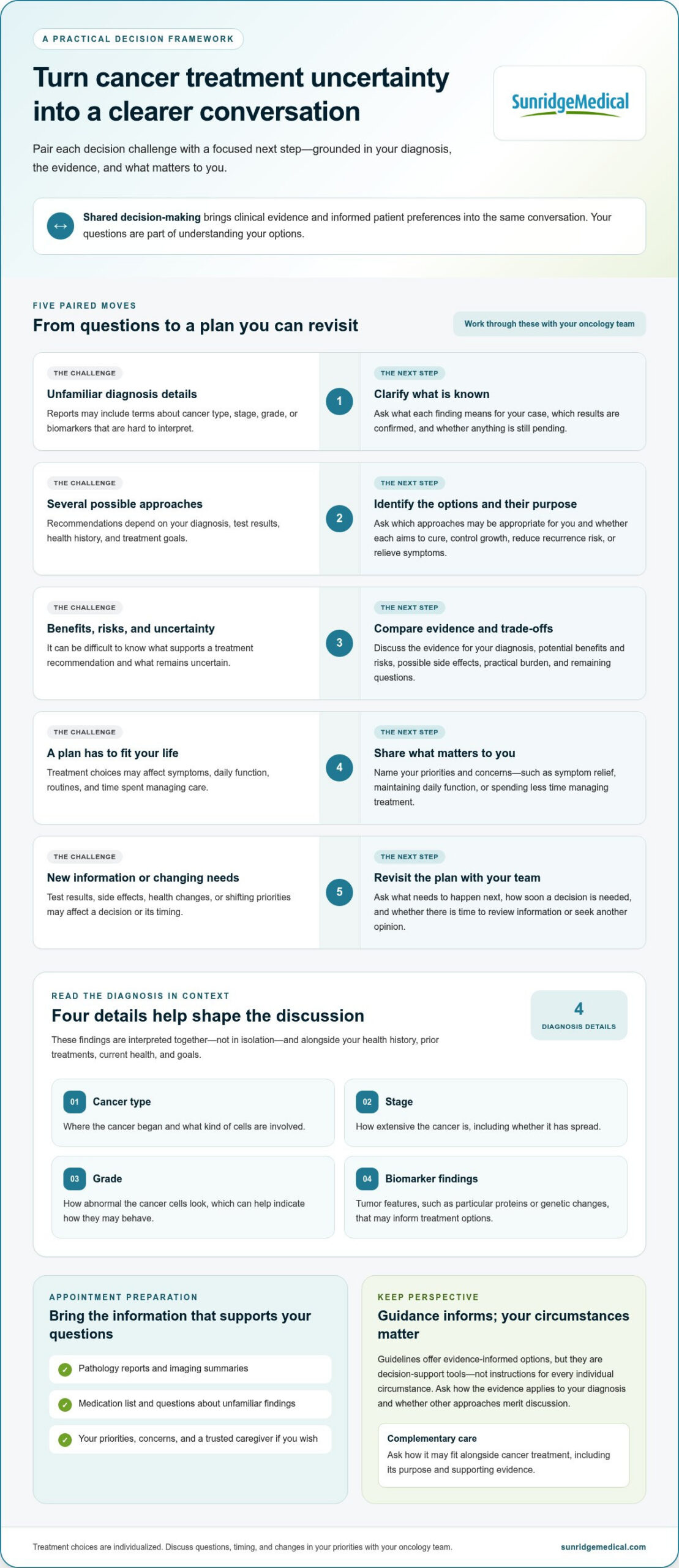
Several details describe different aspects of a cancer diagnosis. The cancer type identifies where it began and what kind of cells are involved. The stage describes how extensive it is, including whether it has spread. The grade reflects how abnormal the cancer cells look and can help indicate how they may behave. Biomarker findings identify features of the tumor, such as particular proteins or genetic changes, that may inform treatment options.
These findings are interpreted together, not in isolation. Recommendations may also depend on your health history, prior treatments, current health, and the treatment goal, such as controlling disease, reducing symptoms, or lowering the chance of recurrence. If a pathology report or imaging summary includes unfamiliar terms, ask what they mean for your case. Ask which findings are confirmed and whether any results are still pending. A cancer-staging guide can provide additional context, while your oncology team can explain how staging applies to you.
Name the outcomes and trade-offs that matter to you
Before a treatment discussion, consider what you most want your care to support. Priorities might include symptom relief, maintaining daily function, spending less time managing treatment, or pursuing a particular treatment goal. Weigh potential benefits against possible side effects, appointments, and effects on your routines. Ask the team to explain these trade-offs in a way that makes the options easier to compare. Treatment decision support describes how clear information about benefits and side effects can help patients take part in choices.
Write down your priorities and bring them to the appointment. If you want, invite a trusted caregiver to listen, take notes, or help you remember questions. Your preferences can change as you learn more or as your health and circumstances shift, so revisit them with your clinicians rather than treating an earlier choice as permanent.
Ask directly about timing. The urgency of a decision varies by diagnosis and individual circumstances. Find out what needs to happen next, how soon a decision is needed, and whether there is time to review information or seek another opinion. Ask your oncology team to explain the timeline and the reasons behind it.
How Cancer Treatment Decisions Take Shape: Evidence, Options, and Timing
A clear decision process turns a complex set of recommendations into questions you can work through with your care team. Guidelines offer evidence-informed options, but they’re decision-support tools, not instructions that account for every individual circumstance. Clinicians interpret them alongside your diagnosis, test results, health history, and preferences. This process can make navigating cancer treatment decisions more manageable while leaving room to revisit a plan as circumstances change.
- Understand the diagnosis: Clarify the findings and what they mean for treatment.
- Identify the options: Ask which approaches are appropriate for your case and what each aims to achieve.
- Compare the evidence: Discuss potential benefits, risks, and areas of uncertainty.
- Share your preferences: Explain your priorities and concerns so they can inform the conversation.
- Revisit the plan: Check in with your team if new results, side effects, or changing priorities affect the decision.
Recommendations are individualized because the same treatment may not suit every cancer or patient. Ask how the evidence applies to your situation and whether other approaches merit discussion.
Understand the purpose and evidence for each option
Ask what a proposed treatment is intended to do: cure cancer, control its growth, reduce the risk of recurrence, or relieve symptoms. Then ask what evidence supports its use for your diagnosis and what remains uncertain. A personal story may help you understand someone else’s experience, but it can’t establish what is likely to happen in your case. The National Cancer Institute on Cancer Treatment offers an overview of treatment types and questions patients can raise with clinicians.
It also helps to distinguish how different approaches fit into care. Established cancer treatment refers to medical approaches used to treat cancer, such as surgery, radiation therapy, or drug therapy. Complementary care is used alongside cancer treatment, often to support well-being or manage symptoms. Alternative care is used instead of established treatment. These terms describe how an approach is used; they don’t establish that it is effective or safe for a particular person.
Clarify timing, sequencing, and coordination
Ask which decisions are time-sensitive, what steps must happen first, and which questions can be addressed before you decide. Some treatments need to be coordinated in a particular sequence, while the timeline depends on the diagnosis and clinical circumstances. Don’t stop or postpone prescribed cancer treatment without discussing it with your oncology team. A delay or change may affect your care, and your clinicians can explain the considerations specific to you.
Discuss supplements and complementary therapies with your clinicians, because interactions with cancer treatment may matter. Bring a complete list of prescription and over-the-counter medicines, supplements, and therapies, including how you use them. This gives the team relevant information for coordinating care. Sunridge Medical’s individualized approach considers conventional therapies alongside research-based alternative treatments in a discussion alongside oncology guidance. Read more about Sunridge Medical’s approach to cancer care.
How to Compare Cancer Treatment Options, Benefits, Risks, and Uncertainty
A comparison framework can make recommendations easier to discuss without reducing a complex decision to a simple score. There isn’t always one obvious best option for every patient. The right choice depends on the clinical evidence and how potential outcomes, treatment demands, and personal priorities fit together. Use the same questions for each option, then ask your oncology team to clarify where the comparison is uncertain.
Compare benefits and burdens in context
Ask which outcomes are realistic for your diagnosis and how the team estimates them. Benefits and side effects vary with the cancer, treatment, and individual health, so a general description may not predict your experience. Practical demands matter, too. Consider visits, recovery time, monitoring, and effects on work, caregiving, or everyday activities alongside medical outcomes.
| What to compare | Questions to ask |
|---|---|
| Treatment goal | Is the aim to remove cancer, control it, lower recurrence risk, or relieve symptoms? |
| Evidence | What evidence supports this option for my diagnosis and circumstances? |
| Potential benefits | Which outcomes may improve, and how will we know whether treatment is helping? |
| Risks and uncertainty | What side effects or complications are possible, and what is not yet known? |
| Practical burden | How might appointments, recovery, and monitoring affect my daily life? |
| Open questions | What information could change this recommendation or the decision? |
If your clinician shares statistics, ask whether a figure is an absolute chance or a relative change. Relative risk describes a change compared with a starting level; absolute risk describes the chance of an outcome in a defined group. Ask which group and timeframe the statistic refers to, and how closely that evidence applies to you. This helps put a striking percentage in context.
Preferences matter when options involve different trade-offs. One person may prioritize a treatment’s chance of controlling disease; another may give greater weight to recovery demands or preserving daily function. Share what matters most, then ask how each option aligns with those priorities.
Assess complementary and integrative approaches carefully
Supportive care intended to ease symptoms is different from a therapy claimed to treat cancer. For any complementary or integrative approach, ask what it is meant to do, what reliable evidence supports the claim, what safety concerns or interactions may apply, and whether it could affect established treatment. Sunridge Medical’s comprehensive approach considers individualized care alongside oncology treatment, not as its substitute.
Claims deserve careful scrutiny, especially when they promise to cure cancer or replace recommended treatment. Discuss the approach and its evidence with clinicians who know your care plan. A thoughtful comparison supports decisions grounded in the clinical picture and your priorities, rather than pressure to choose a supposedly universal “best” option.
Prepare for a Cancer Treatment Decision: Questions, Records, and a Second Opinion
A focused appointment can turn a long list of concerns into a clearer conversation. Before you meet, choose the questions you most need answered and gather relevant records if they’re available. You don’t need to understand every medical term in advance. Aim to leave with a better sense of what’s known, what happens next, and whom to contact with follow-up questions. These steps can bring structure to navigating cancer treatment decisions.
Questions to take into the oncology conversation
Write questions down before the appointment, then start with the ones that will affect your next decision. If an answer is unclear, ask for a plain-language explanation or a written summary.
- What is my current diagnosis, and what findings support it?
- What is the intent of the proposed treatment, and what outcomes are realistic for me?
- What alternatives are appropriate, including the option of monitoring or waiting if that applies?
- How soon do I need to decide, and which parts of the decision are time-sensitive?
- What side effects or changes in daily life should I prepare for, and who should I contact if they occur?
- How will we assess whether treatment is working, and what results or changes might lead us to adjust the plan?
- How would a complementary therapy be coordinated with my current cancer care?
These questions invite discussion of both evidence and individual circumstances. Ask what is established, what remains uncertain, and how each option relates to your goals. If several clinicians are involved, clarify who is coordinating the plan and how recommendations will be shared.
Organize information and involve support
Bring available pathology reports, imaging summaries, a current list of medicines and supplements, and your written questions. If you have records from different clinics, note where they came from and when they were prepared. Don’t delay a time-sensitive conversation just to assemble a perfect file. Tell the oncology team which documents you have and ask how to provide them.
After each visit, make a dated note of recommendations, decisions, pending tests, and follow-up questions. If you’d like another person to listen or take notes, invite a trusted support person. Ask the clinic whether recording is permitted before you do so. Request clarification whenever terminology or next steps remain unclear. It’s reasonable to ask the clinician to explain a recommendation in different words.
A second opinion can offer another perspective on the diagnosis or proposed plan. Seeking one doesn’t have to signal distrust, and it doesn’t automatically mean care will change. Ask your oncology team how to arrange a review and what records the reviewing clinician will need. Discuss timing so you understand whether obtaining another opinion could affect a treatment schedule.
Sunridge Medical develops individualized cancer care plans that consider conventional therapies alongside research-based alternative treatments, as a discussion alongside oncology care rather than a substitute for it. Learn about Sunridge Medical’s individualized cancer care approach as you prepare questions for your care conversations.
How Sunridge Medical Supports Individualized Cancer Treatment Decisions
Cancer care is not one-size-fits-all. Sunridge Medical develops individualized care plans that bring conventional therapies and research-based alternative treatments into a comprehensive clinical discussion. This approach considers the person and the diagnosis together, with attention to existing oncology care and the priorities that shape each patient’s decisions.
This perspective can be useful when you’re navigating cancer treatment decisions and want to understand how different approaches relate to your care. Integrative care is a discussion alongside oncology treatment, not a reason to replace it. Don’t stop, change, or delay prescribed treatment without discussing the decision with your treating oncology team.
What an individualized integrative discussion can cover
A care-planning discussion can take into account your cancer history, current and prior care, available diagnostic information, broader health context, goals, and questions. These details help frame what an approach is intended to address and how it may relate to established oncology treatment. Bring relevant records and a current list of medicines, supplements, and therapies to give the conversation a clear foundation.
Any proposed alternative or complementary approach should be considered in relation to your oncology plan. Ask what it is intended to do, what evidence supports the claim, what risks or interactions may apply, and how it would be coordinated with current care. An individualized plan should not be presented as a proven cure or a guarantee of benefit. Discussing evidence and uncertainty can help you weigh options with your clinicians and identify questions that need further attention.
Sunridge Medical evaluates care through a comprehensive, patient-specific lens. That means connecting clinical considerations with your circumstances and preferences, rather than treating a protocol as suitable for everyone. Your oncology team remains central to decisions about cancer treatment and its timing.
Take a supported next step
Before a consultation, write down your most important questions, the goals you want care to support, and anything about your current treatment that you’d like to understand more clearly. This can help you explore how individualized integrative care may fit alongside your oncology plan. Sunridge Medical’s cancer-treatment guide can also help orient you to integrative care and its terminology.
A consultation discussion can clarify the process, give you space to share your care context, and help you identify questions to bring back to your oncology team. It should support informed conversations, not pressure you toward a particular decision or promise a specific outcome.
To discuss your care questions and the consultation process, Discuss your care questions with Sunridge Medical.
Move Forward With a Clearer Sense of Your Next Step
You don’t need to have every answer before continuing the conversation. Identify what remains unclear, note the questions you want addressed, and keep your oncology team involved as decisions develop. Navigating cancer treatment decisions means weighing clinical guidance alongside your needs, not finding a perfect choice with certainty.
For patients considering a broader, individualized perspective, Sunridge Medical offers care planning that brings conventional therapies and research-based alternative treatments into discussion alongside oncology care. Founded in 2003 and led by Medical Director Dr. Steven S. Isaacman, the center approaches cancer care through each patient’s circumstances and priorities. Discuss any changes to prescribed treatment with your treating oncology team.
If you’d like to explore an individualized discussion as a next step, Explore a care discussion with Sunridge Medical. Continue asking questions and seek the clarity you need to move forward thoughtfully.
Frequently Asked Questions
How do I decide between cancer treatment options?
Compare each option with your oncology team in the context of your diagnosis and priorities. Ask what the treatment is meant to achieve, what evidence applies to your situation, and what benefits, risks, and practical demands may come with it. If statistics are discussed, clarify the timeframe and patient group they describe. Write down what matters most to you and use that list to guide the conversation and make navigating cancer treatment decisions more manageable.
Should I get a second opinion before starting cancer treatment?
A second opinion may help if you’re uncertain about a diagnosis, facing a complex choice, or want another perspective on a proposed plan. The reviewing clinician can assess relevant records, so ask how to share pathology reports, imaging results, and treatment summaries. A second opinion doesn’t necessarily change the recommendation. Discuss timing with your treating team, especially if treatment has been recommended soon, so you understand how another review fits your care schedule.
Can I use complementary therapies during cancer treatment?
Some complementary approaches are intended to support comfort or well-being, while others make claims about treating cancer itself. Their purpose and evidence are not the same. Tell your clinicians about every therapy, supplement, or product you’re considering, even if it seems unrelated to cancer care. Some may interact with medicines or affect treatment. Your oncology team can help assess safety and explain whether an approach can be considered alongside your current plan.
What questions should I ask before choosing a cancer treatment?
Ask what the treatment is intended to do, what evidence supports it for your diagnosis, and what benefits and risks are relevant to you. Find out whether alternatives are available, how soon a decision is needed, and what monitoring will involve. Ask how treatment could affect activities important to you, such as work or caregiving. If an answer uses unfamiliar terms, ask the clinician to explain it in everyday language.
How do clinical trials fit into cancer treatment decisions?
A clinical trial studies a specific intervention or care approach under a defined protocol. Whether a study may be relevant depends on details such as cancer type, stage, prior treatment, and the trial’s eligibility criteria. Ask your oncology team whether a suitable study is available and what its purpose is. Discuss potential benefits, risks, added visits or tests, and how participation could affect other treatment options before deciding whether to explore it.
What if I am unsure about a recommended cancer treatment?
Tell your oncology team what’s giving you pause, whether it’s a possible side effect, an unclear term, or concern about how treatment may affect daily life. Ask the clinician to explain the recommendation again and identify what remains uncertain. Before postponing or changing care, ask how time-sensitive the decision is and what the consequences of waiting could be in your specific case. You deserve clear answers and a chance to discuss unresolved concerns.
Can I change my cancer treatment plan after it starts?
Sometimes a plan is reassessed as new test results arrive, side effects emerge, or a patient’s health and priorities change. That doesn’t mean you should stop, skip, or adjust treatment on your own. Contact your treating clinicians to explain what has changed and ask what options are appropriate. They can discuss whether the plan should be reviewed, what monitoring or information may guide that review, and how any adjustment would be coordinated.