


What if the reason your lab results keep coming back “normal” isn’t because you’re healthy, but because standard medicine isn’t looking for the right markers? You’ve likely spent years describing chronic fatigue, cognitive fog, and persistent physical pain to specialists, only to be told there’s no clinical explanation for your suffering. It’s exhausting to feel your body failing under an invisible toxic load while being dismissed by the very systems designed to help you. We understand that your symptoms aren’t imaginary; they’re often the result of a systemic failure in your body’s natural detoxification pathways.
You deserve more than a generic diagnosis or a prescription that only masks the surface. You deserve a sophisticated environmental illness treatment that addresses the specific cellular bio-accumulation at the heart of your condition. This article will guide you through how advanced integrative medicine identifies these hidden burdens when conventional tests fail. You’ll discover a structured, medically supervised path to cellular recovery that validates your experience and offers a clear, scientific way forward to restoring your well-being.
Key Takeaways
- Understand the “Toxic Bucket” theory and how lipophilic toxins hide in your tissues even when standard blood tests appear normal.
- Discover why conventional diagnostics often fail to detect chronic toxicity and how specialized identification reveals your unique toxic profile.
- Learn how a structured environmental illness treatment plan uses advanced medical protocols to restore health at a cellular level.
- Explore why individualized care is essential for complex patients and how targeted IV therapies can accelerate the body’s natural detoxification process.
- Gain a clear, clinical perspective on your symptoms and a roadmap for reversing systemic failure through integrative medical intervention.
What is Environmental Illness? Defining the Clinical Spectrum
Conventional medicine often views illness through the lens of acute events: a broken bone, a sudden infection, or a singular toxic exposure. However, chronic environmental illness operates on a different, more insidious timeline. While an acute exposure results in immediate, identifiable distress, chronic environmental illness is the result of a slow, steady accumulation of substances that the body can no longer effectively process. This condition is frequently categorized as an Environmental Disease, a term that encompasses a broad spectrum of health challenges triggered by our surroundings. In many clinical settings, it becomes a diagnosis of exclusion. When standard blood tests return within “normal” ranges yet the patient remains debilitated, the underlying cause is often found in the modern landscape of persistent triggers, such as:
- Phthalates and plasticizers found in common consumer goods
- Heavy metals like lead, mercury, and arsenic
- Mycotoxins from hidden mold growth in indoor environments
Recognizing the Multi-Systemic Symptoms
The clinical presentation of environmental illness is rarely confined to a single organ system. Patients often experience a constellation of neurological indicators, including chronic brain fog, migraines, and a noticeable decline in cognitive clarity. Dermatological and respiratory signals are also common, manifesting as unexplained rashes or persistent “allergies” that don’t respond to standard antihistamines. The emotional toll is equally significant. Neuroinflammation, driven by systemic toxicity, can trigger profound anxiety and depression. These are not merely psychological reactions to being unwell; they are physiological consequences of a brain under chemical stress.
The Difference Between Sensitivity and Toxicity
A frequent point of confusion is why two people can inhabit the same environment while only one becomes ill. The answer often lies in the intersection of toxicity and genetic sensitivity. While everyone carries some level of toxic burden, individuals with specific genetic variations, such as the MTHFR SNP, have a diminished capacity for methylation and detoxification. For these individuals, what might be a “safe” level of chemical exposure for the general population becomes a catalyst for systemic failure. Effective environmental illness treatment must therefore look beyond the exposure itself and examine the patient’s unique biological ability to clear those toxins. Environmental illness is a state of systemic physiological overload.
Seeking a specialized environmental illness treatment requires moving past the limitations of standardized care. Common presentations like Multiple Chemical Sensitivity (MCS) and Sick Building Syndrome illustrate how our built environments can overwhelm a compromised system. By identifying the specific triggers and biological bottlenecks, we can begin the process of unburdening the body and restoring its natural resilience.
A truly comprehensive approach to systemic recovery often includes maintaining oral health; for those requiring restorative or surgical care, Concept Dental offers professional services that support a healthy foundation for long-term wellness.
The Biological Mechanism of Toxic Bio-accumulation
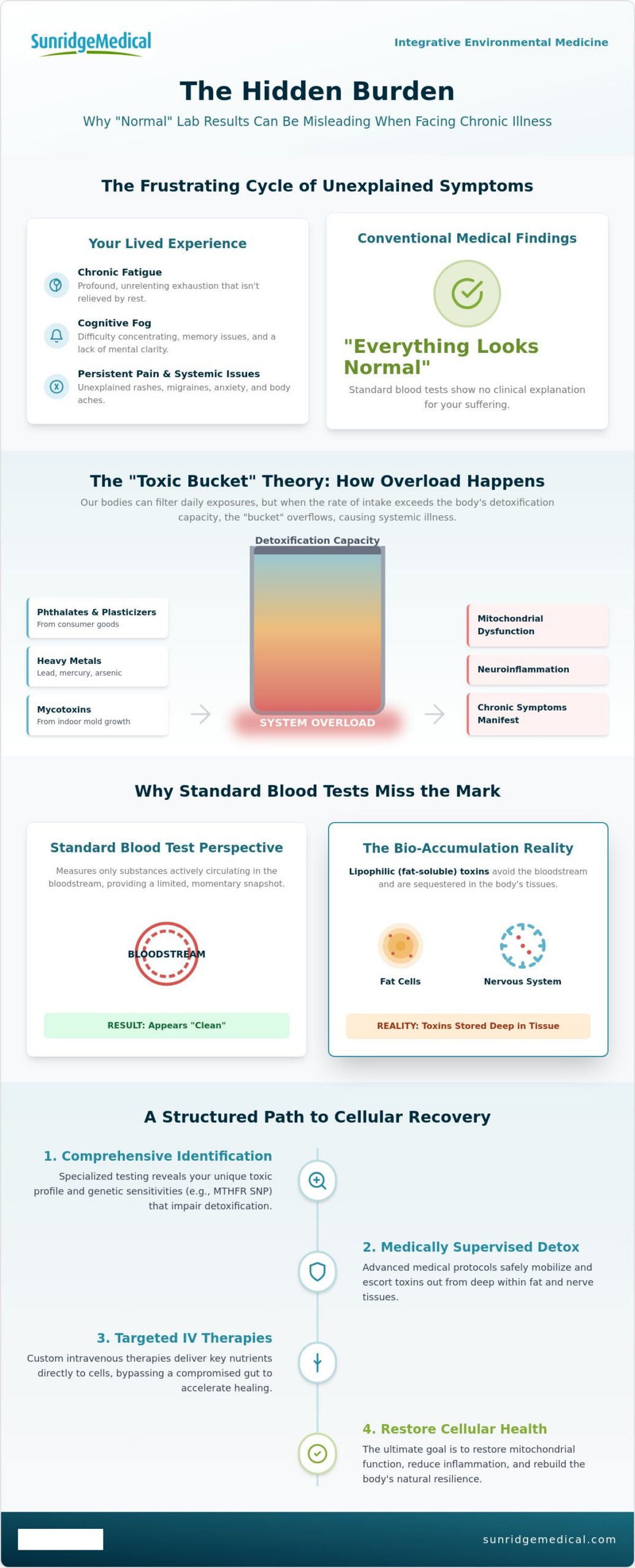
Every human body possesses a finite capacity to process and expel foreign substances, a concept often referred to as the “Toxic Bucket” theory. Under ideal conditions, your liver, kidneys, and lymphatic system work in concert to filter out daily exposures. However, when the rate of exposure exceeds the body’s ability to detoxify, the bucket begins to overflow. This is the point where a patient transitions from being “exposed” to suffering from a condition that requires specialized environmental illness treatment. The toxins don’t simply disappear; they are sequestered within the body’s tissues to protect vital organs from immediate damage.
Many of the most persistent environmental toxins are lipophilic, meaning they are fat-soluble. These substances have a high affinity for adipose tissue and the nervous system, which is largely composed of fatty myelin. Once these toxins embed themselves in your fat cells or the brain’s protective layers, they are no longer circulating in the blood. This explains why standard blood tests often fail to capture the true extent of a patient’s toxic burden. These stored chemicals act as internal stressors, causing chronic mitochondrial dysfunction. When the mitochondria, the power plants of your cells, are compromised, cellular energy production drops, leading to the profound, unrelenting fatigue that characterizes many environmental conditions.
The complexity of this illness is often compounded by synergistic toxicity. You aren’t just dealing with one chemical; you’re likely managing the combined effects of heavy metals, pesticides, and mycotoxins. Research suggests that multiple low-level exposures can be more damaging than a single high-level exposure because they overwhelm multiple detoxification pathways simultaneously. This creates a high-level health crisis from sources that conventional diagnostics might consider “insignificant.”
Disruption of the Endocrine and Immune Systems
Many common pollutants act as Endocrine Disruptors, mimicking or blocking natural hormones. This interference often necessitates hormone optimization therapy to restore balance. Additionally, these toxins can confuse the immune system, leading it to attack the body’s own tissues. If you’re struggling with these overlapping symptoms, exploring Advanced Management for Autoimmune Disease can be a vital step in your recovery journey.
The Glymphatic and Lymphatic Connection
For effective environmental illness treatment, the body’s drainage pathways must be clear. The lymphatic system and the brain’s glymphatic system act as a waste management network, but chronic toxicity can cause these pathways to become “clogged” with cellular debris. When drainage fails, the blood-brain barrier can become more permeable, allowing toxins to enter the central nervous system. Heavy metals further complicate this by through cellular sequestration; they often displace essential minerals like zinc or calcium in cellular structures, effectively “locking” themselves into the bone and brain tissue where they disrupt enzyme functions for decades. In patients where this neurological toxic burden is severe, the resulting neuro-metabolic failure can mirror the biological drivers explored in integrative treatment for Parkinson’s disease, where environmental triggers are increasingly recognized as contributors to progressive neurodegeneration.
If you feel your recovery has stalled, it may be because these deep-seated toxins haven’t been properly addressed. A professional consultation at Sunridge Medical can help identify the specific biological bottlenecks preventing your return to health.
Why Conventional Diagnostic Approaches Often Fall Short
It’s a familiar and demoralizing scenario for many: you feel fundamentally unwell, yet your primary care physician insists your labs are perfect. Standard medical diagnostics, such as the Complete Blood Count (CBC) or basic metabolic panels, are designed to detect acute pathology or end-stage organ failure. They are not calibrated to identify the subtle, chronic bio-accumulation of Environmental Health Hazards that disrupt cellular function. This mismatch between diagnostic tools and patient reality is why so many people remain stuck in a cycle of worsening health without a clear name for their suffering.
The primary reason blood tests often appear “normal” is that the body is highly efficient at self-preservation. When your system is overwhelmed by toxins, it quickly moves them out of the bloodstream and sequesters them in deeper tissues, such as adipose tissue, bone, and the central nervous system. Because the blood is a transport medium rather than a storage site, a simple blood draw only captures what is circulating at that exact moment. It fails to account for the massive toxic burden locked within your cells. Effective environmental illness treatment begins by acknowledging that a clean bill of health on a standard lab report is often a false negative for systemic toxicity.
To move forward, we must utilize tools that look beyond the surface. Validating your lived experience requires a shift from standard testing to intracellular analysis and provocation. By using advanced methodologies, we can finally provide the clinical explanation you’ve been seeking, transforming “unexplained” symptoms into a structured medical roadmap.
Advanced Environmental Diagnostics
Precision is the cornerstone of our diagnostic process. We utilize mycotoxin testing to identify specific mold metabolites that standard panels miss. For heavy metals, we often employ challenge testing, which uses a safe, temporary agent to “provoke” stored toxins out of the tissues and into the urine for measurement. Additionally, Organic Acid Testing (OAT) allows us to see the metabolic “footprints” left by toxins, revealing exactly how your energy production and neurotransmitter balance are being compromised.
Identifying Root Cause Triggers
True recovery requires a comprehensive assessment of your daily environment. We look for hidden biological hazards in the home and workplace that may be continuously refilling your “toxic bucket.” Often, environmental illness doesn’t exist in a vacuum; it frequently overlaps with other complex conditions. For many patients, Chronic Lyme Disease Treatment becomes a necessary part of the conversation, as these co-infections can further suppress the immune system and complicate the detoxification process. Identifying these intersecting triggers is the first step toward a targeted environmental illness treatment plan that actually works.
A Comprehensive Framework for Environmental Recovery
Most conventional advice for toxic exposure stops at avoidance. If you’ve been told to simply “fix the leak” or “avoid the trigger,” you’ve been given only half the solution. While stopping the influx of toxins is necessary, it does nothing to address the bio-accumulation already sequestered in your deep tissues. A sophisticated environmental illness treatment must go beyond avoidance, utilizing a structured, five-step medical architecture designed for systemic restoration.
- Step 1: Precise Identification. We map your unique toxic profile using the advanced diagnostics previously discussed.
- Step 2: Tactical Elimination. We identify and remove current environmental triggers to ensure your “toxic bucket” stops refilling.
- Step 3: Clinical Mobilization. We safely draw stored toxins out of adipose tissue and the nervous system into the circulatory system.
- Step 4: Drainage Support. We optimize the primary pathways, including the liver, kidneys, and lymphatic system, to ensure toxins are expelled rather than recirculated.
- Step 5: Cellular Repair. We focus on immune system recalibration and mitochondrial healing to restore your baseline energy.
The Role of Clinical Detoxification
You’ve likely seen “juice cleanses” or over-the-counter detox kits marketed as quick fixes. These are insufficient for treating complex medical conditions. True clinical detoxification requires the strategic use of binders to prevent enterohepatic circulation. Without these binders, toxins released from the liver are simply re-absorbed by the gut and sent back into the system, creating a cycle of “re-toxing” that can worsen symptoms. Medical supervision is critical during the mobilization phase to ensure toxins are safely channeled out of the body without causing secondary injury.
Repairing the Damage: Beyond Detox
Recovery isn’t just about what we remove; it’s about what we restore. Chronic toxic load often leaves the gut microbiome in disarray and the nervous system in a state of persistent neuroinflammation. Addressing brain fog and cognitive fatigue requires targeted neurological rehabilitation. For patients whose neuroinflammatory burden has progressed to affect motor function and dopaminergic pathways, the principles underlying advanced integrative treatment for Parkinson’s disease offer important insights into how environmental and biological drivers of neurodegeneration can be systematically addressed. We also prioritize high-dose nutritional support to replenish antioxidant stores, specifically Glutathione, which is almost always depleted in patients with environmental illness. This multi-faceted approach ensures that once the toxins are gone, the body has the resources it needs to rebuild.
If you’re ready to move past temporary fixes and toward a structured medical recovery, we invite you to learn more about our specialized environmental illness treatment protocols.
Advanced Medical Protocols at Sunridge Medical
Standardized protocols often fail complex patients because they treat the toxin rather than the individual. At Sunridge Medical, we recognize that your genetic makeup, your history of exposure, and your current physiological state are entirely unique. This is why a “one-size-fits-all” approach to environmental illness treatment is fundamentally inadequate. We move beyond generic care by crafting individualized protocols that prioritize your specific biological requirements and recovery pace.
Our methodology utilizes specialized IV and injection therapy to facilitate rapid cellular restoration. By delivering high-concentration nutrients and detoxifying agents directly into the bloodstream, we bypass the often-compromised digestive system. This ensures that the building blocks your cells need for repair are immediately available. Additionally, we incorporate oxidative therapies to help neutralize chronic biological stressors. These therapies assist in breaking the cycle of persistent inflammation that toxins often leave in their wake, effectively resetting your body’s internal environment.
We remain steadfast in our commitment to research-based alternative medicine. By staying at the leading edge of environmental health research, we provide our patients with access to advanced methodologies that bridge the gap between emerging science and clinical application. We don’t just aim for temporary relief; we strive for a permanent shift in your health trajectory.
The Sunridge Patient Experience
Entering our clinic marks a transition from “symptom management” to true “system restoration.” We understand the frustration of being a “mystery case” in the conventional system. Our physician-led monitoring ensures that every phase of your recovery is carefully tracked and adjusted. You are never navigating this complex journey alone; you have a dedicated clinical ally guiding you toward wellness. If you’re ready to begin your recovery, you can contact our specialized medical team to discuss your specific needs.
A Sanctuary for Complex Recovery
Sunridge Medical serves as a national clinical focus for individuals who require a higher level of specialization. Our sanctuary is built on the synergy of combining conventional diagnostics with advanced alternative treatments, ensuring no stone is left unturned. With over 20 years of experience in treating complex chronic diseases, we possess the clinical depth required to address the most challenging environmental cases. This longevity is a testament to our reliability and our unwavering focus on the individual human experience. We provide the steady hand and the sophisticated tools necessary to help you navigate your path back to health.
Your Path to Systemic Restoration
Environmental illness isn’t a permanent state of being, but a complex physiological puzzle that requires the correct diagnostic key. You’ve seen how chronic symptoms like brain fog and unrelenting fatigue are often rooted in the deep sequestration of toxins within your tissues. By shifting from standard symptom management to a comprehensive environmental illness treatment, you can finally address the systemic failure at the cellular level. Recovery is possible when you move beyond simple avoidance and embrace a structured medical framework designed to mobilize, drain, and repair.
Since 2003, Sunridge Medical has served as a pioneering sanctuary for those navigating the most challenging chronic conditions. Led by Medical Director Dr. Steven S. Isaacman, our team specializes in advanced alternative medicine that bridges the gap between emerging research and clinical recovery. We’re here to provide the clinical expertise and steady hand you need to unburden your body and restore your vitality. You deserve a partner who understands the depth of your experience and possesses the tools to change your health trajectory.
In addition to clinical protocols, incorporating holistic rest into your recovery plan can be transformative; you can discover Shunyata Retreat and Day Spa for dedicated wellness and health support.
Speak with a Sunridge Medical Patient Advocate to explore your treatment options and begin your journey toward lasting wellness. You don’t have to navigate this complex path alone; a future of clarity and energy is within your reach.
Frequently Asked Questions
Is environmental illness the same as having allergies?
No, environmental illness is distinct from traditional allergies. While allergies involve an immediate IgE-mediated immune response to specific proteins like pollen or dander, environmental illness represents a systemic physiological failure. It’s the result of a cumulative toxic burden that disrupts cellular function and metabolic pathways. This condition often manifests as Multiple Chemical Sensitivity (MCS), where the body reacts to minute levels of various substances because its detoxification pathways are already overwhelmed.
Can environmental illness be cured, or is it a permanent condition?
Environmental illness is a treatable condition rather than a permanent diagnosis. The human body possesses a remarkable capacity for cellular regeneration once the underlying toxic obstacles are removed. By utilizing a structured environmental illness treatment plan, we can unburden the tissues and restore healthy mitochondrial function. Progress depends on the precision of the detoxification protocol and the patient’s commitment to creating a clean environment for long-term health maintenance.
How long does environmental illness treatment typically take?
The duration of recovery varies significantly based on the individual’s toxic profile and genetic detoxification capacity. Some patients notice improvements within several weeks, while others with deep-seated bio-accumulation may require several months of intensive therapy. Because we prioritize safety and systemic stability, we don’t rush the mobilization of toxins. A steady, methodical approach ensures that the primary drainage pathways aren’t overwhelmed during the restoration process.
What are the most common toxins found in environmental illness patients?
We frequently identify heavy metals like mercury, lead, and arsenic, alongside persistent organic pollutants. Mycotoxins from hidden mold exposure are also extremely common in patients suffering from unexplained chronic symptoms. Additionally, modern environments often introduce high levels of phthalates, bisphenols, and various volatile organic compounds (VOCs). Identifying these specific agents is critical for designing a targeted environmental illness treatment that addresses the unique burden each patient carries.
Why didn’t my primary care doctor find these toxins in my blood work?
Conventional blood work is designed to detect acute, life-threatening poisoning rather than chronic, low-level bio-accumulation. Most toxins are lipophilic and quickly move from the bloodstream into fat cells and nervous system tissues for storage. Since your primary care doctor’s tests only capture what is currently circulating in the blood, they often miss the substantial toxic load sequestered deep within your organs. We use provocation testing to reveal these hidden burdens.
Can environmental illness cause autoimmune disorders?
Yes, chronic toxic load is a well-documented trigger for immune dysregulation and autoimmune responses. When toxins embed themselves in cellular structures, they can alter the appearance of your cells, leading the immune system to misidentify them as foreign invaders. This process of molecular mimicry often results in chronic inflammation and the development of autoimmune disorders. Addressing the toxic root cause is essential for stabilizing the immune system’s overactive response.
What is the first step in starting an environmental illness treatment protocol?
The first step is always a comprehensive diagnostic assessment to map your unique toxic landscape. We start with advanced testing to identify specific contaminants and evaluate the current state of your liver, kidneys, and lymphatic drainage. This data allows us to create a customized roadmap that prioritizes your safety and clinical outcomes. Understanding your biological starting point ensures that every subsequent treatment step is both tactical and effective for your recovery.
Is insurance typically accepted for these advanced alternative treatments?
Sunridge Medical does not participate in standard health insurance billing for our specialized protocols. Most advanced integrative and alternative medical treatments are not currently recognized by traditional insurance carriers, which typically only cover standardized conventional care. We focus on providing a level of specialized attention and research-based methodology that goes beyond the ordinary. Our team can provide information on how patients manage the investment in their long-term health and cellular restoration.