


Could an environmental exposure influence autoimmune risk without determining who develops disease? That distinction is central to the environmental toxins and autoimmune disease link. Research has associated exposures such as solvents, pesticides, silica, heavy metals, and PFAS with some autoimmune outcomes, but an association does not prove that a particular exposure caused an individual’s condition. Genetics, exposure timing and level, and other factors may also matter.
If you’re trying to make sense of symptoms or a diagnosis, it’s understandable to want clear answers. It’s equally important to approach alarming toxin and “detox” claims carefully. This article explains the difference between exposure, association, susceptibility, and causation; reviews common exposure categories and what research can and can’t establish; and offers practical ways to prepare for a conversation with a qualified clinician. An exposure history alone cannot diagnose the cause of your illness. A clinician can consider it alongside your broader health context and conventional medical evaluation without assuming a toxin is responsible.
Key Takeaways
- The environmental toxins and autoimmune disease link is complex: an exposure may be associated with risk without proving what caused an individual’s illness.
- Assess an exposure in context, including the substance, dose, route, and duration, rather than treating all environmental contact as equally concerning.
- Research findings vary: population studies can identify patterns, while biological mechanisms alone do not establish that an exposure causes disease in people.
- Prepare a concise exposure history by noting possible sources, dates, duration, and work or home circumstances to discuss with a clinician.
- Consider environmental concerns alongside established autoimmune evaluation. Sunridge Medical offers individualized autoimmune disease management and environmental illness treatment.
Environmental Toxins and Autoimmune Disease: What Does the Link Mean?
If you’re wondering whether an exposure could be connected to an autoimmune diagnosis, that concern deserves a careful conversation, not an automatic conclusion. Contact with a substance does not, by itself, mean it caused illness. The environmental toxins and autoimmune disease link is studied because exposures may influence immune function or susceptibility, but autoimmune conditions are complex and can involve interactions between environmental and genetic factors.
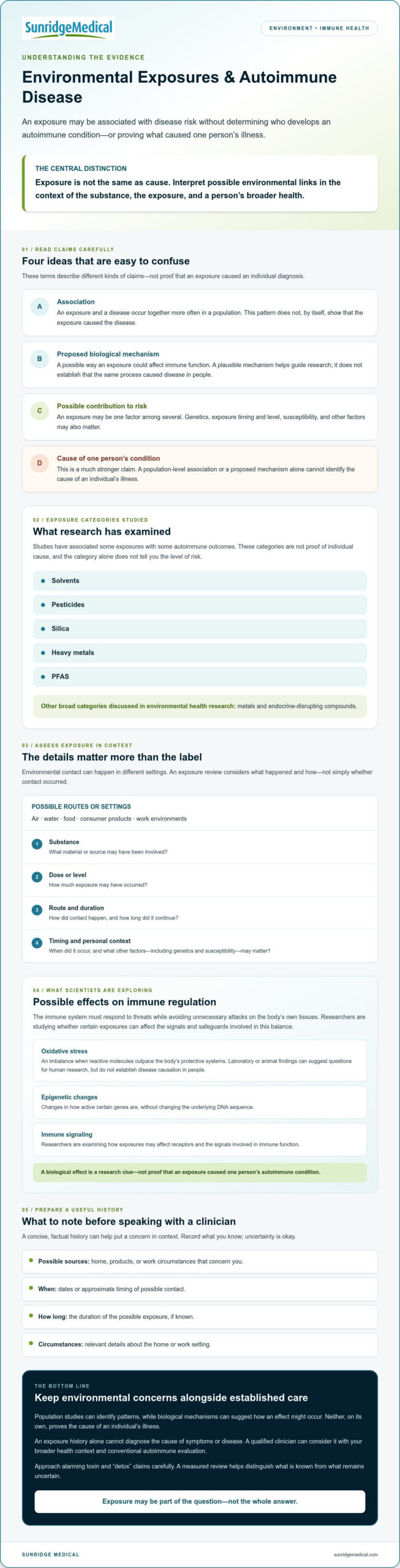
The environmental toxin and autoimmunity link describes a possible relationship between certain exposures and altered immune function or disease risk. It does not, by itself, prove that an exposure caused one person’s autoimmune disease.
Researchers may report an association when an exposure and a disease occur together more often in a population. A proposed biological mechanism can make that relationship plausible, but it still isn’t proof of cause. Evidence that an exposure contributes to risk means it may be one factor among several. Demonstrating that it caused an individual’s condition is a much stronger claim, and population-level patterns generally can’t establish that on their own.
The field of Immunotoxicology examines how external substances may affect immune function. This helps explain why researchers investigate environmental exposures, while keeping a clear distinction between biological effects and a confirmed clinical cause.
What counts as an environmental exposure?
“Environmental toxins” is a broad, informal label for substances that can pose health concerns under particular conditions. Categories studied in relation to immune health include metals, PFAS, solvents, and endocrine-disrupting compounds. Exposures may occur through air, water, food, consumer products, or work environments. The category alone doesn’t tell you the level of risk. The substance, amount, route of contact, and length of exposure all matter.
Does an exposure mean a toxin caused autoimmune disease?
No. Assessing a possible contribution requires context: when exposure occurred, its likely dose, how it entered the body, how long it continued, and a person’s susceptibility. These details can be difficult to reconstruct, and a suspected exposure may have other explanations or no established connection to a specific diagnosis. Even a study linking an exposure with disease in a group can’t identify the cause of an individual’s condition.
If a particular home, product, or work exposure concerns you, write down what you know and when it occurred. Share those details with a qualified clinician as part of your health history and established autoimmune evaluation. Avoid treating an exposure history as a diagnosis or assuming broad “detox” claims explain your symptoms. A measured review can help clarify what is known, what remains uncertain, and what is appropriate for your circumstances.
How Environmental Exposures May Affect Immune Regulation
The immune system must recognize threats while avoiding unnecessary attacks on the body’s own tissues. This balance is called immune regulation. Researchers are examining whether some exposures can affect the signals and safeguards involved in that balance. The Autoimmune Diseases and Your Environment resource from the National Institute of Environmental Health Sciences summarizes this area of research. These proposed pathways help scientists investigate the environmental toxins and autoimmune disease link, but a biological effect is not proof that an exposure caused an individual’s disease.
Several biological pathways are under study, but no single mechanism proves that an environmental exposure caused one person’s autoimmune condition.
Oxidative stress, epigenetic changes, and immune signaling
Oxidative stress occurs when reactive molecules, produced during normal processes or in response to outside stressors, outpace the body’s protective systems. In laboratory or animal research, this imbalance may affect cells and immune signaling. Findings in these settings can point to questions for human research, but they don’t establish that the same process leads to autoimmune disease in people.
Epigenetic changes alter how active certain genes are without changing the underlying DNA sequence. Researchers are also studying whether exposures can affect receptors, which receive and relay chemical signals, or modify proteins in ways that alter immune responses. These are possible routes of influence, not a checklist of effects that will occur in every exposed person. Results depend on the substance, experimental conditions, and evidence available in humans.
Hormones, sex differences, and immune susceptibility
Hormones help regulate immune activity, and studies continue to explore how hormonal signaling may interact with exposures and autoimmune susceptibility. A 2026 review considers hormones and sex-related differences as part of this broader picture. That focus should not be read as a simple rule: sex or hormone status alone cannot predict who will develop an autoimmune condition, and responses to an exposure are not universal.
Susceptibility may reflect several interacting biological factors, including genetics, hormonal context, immune activity, and the characteristics of an exposure. This complexity is one reason findings from cells or animal models must be distinguished from patterns observed in human populations and from evidence about an individual patient. For more context on hormones and immune health, see this hormone optimization and autoimmune disease guide.
If you have persistent concerns, a clinician can review them alongside your medical history and established autoimmune evaluation. Sunridge Medical provides individualized autoimmune disease management and environmental illness treatment. Learn more about its individualized medical care.
What Research Shows, and What It Cannot Yet Prove
Evidence about the environmental toxins and autoimmune disease link comes from different kinds of research, and each answers a different question. A population study may reveal a pattern; a laboratory experiment may suggest how a substance affects immune cells. Neither, alone, establishes that an exposure caused a specific person’s illness. The research from the National Institute of Environmental Health Sciences offers an overview of how environmental factors are being studied alongside autoimmune disease.
| Study type | What it can show | Main limitation |
|---|---|---|
| Population studies | Whether exposure and disease occur together more often in a group | Association may reflect other factors, not cause and effect |
| Laboratory research | How a substance may affect cells, proteins, or immune signals | Lab conditions may not reflect exposure or responses in people |
| Animal studies | Possible effects in a whole organism under studied conditions | Findings may not translate directly to human disease |
| Clinical studies and trials | Human health patterns or effects of a tested intervention | May not identify the original cause; results depend on design and participants |
How to interpret studies about environmental triggers
Read a reported association as a clue, not a verdict. For example, research has examined possible associations between autoimmune outcomes and exposures such as solvents, silica, pesticides, metals, and PFAS. That does not mean every substance in these categories has the same effect, or that each association is equally well established.
Studies may measure different exposure levels, routes, time periods, and health outcomes. Exposure records can be incomplete, especially if a condition develops years after contact. Researchers also account for confounding: factors such as occupation, smoking, other exposures, or health history may relate to both exposure and disease, complicating interpretation. A plausible biological mechanism supports further investigation, but it cannot prove that one toxin caused one person’s illness.
Why risk findings do not predict an individual outcome
A risk factor changes probability; it doesn’t guarantee disease. Genetic susceptibility, medical history, exposure timing and duration, and combinations of exposures can all shape how findings apply to a person. Even when a study identifies a group-level pattern for a particular substance or condition, it cannot determine from that pattern alone what caused an individual diagnosis.
When reviewing a claim, ask what type of study produced it, whether it measured exposure directly, and whether it followed people over time. These questions help separate a research signal from a clinically established conclusion, without dismissing a concern or turning uncertainty into a diagnosis.
How to Review Possible Exposures Without Self-Diagnosing
When you’re concerned about the environmental toxins and autoimmune disease link, a concise exposure history is more useful than trying to identify a cause on your own. The goal isn’t to prove that a substance explains your symptoms. It’s to give a qualified healthcare professional clear details to consider alongside your medical history and autoimmune evaluation.
Build a useful exposure history
Note plausible exposures from work, home, hobbies, water, or products. Keep the record factual and focused. Include:
- What and where: the substance or product, if known, and the setting where contact may have occurred.
- When and how long: approximate dates, frequency, and duration.
- Route: whether contact may have involved breathing it in, skin contact, or another route, if known.
- Symptoms: when they began and how they changed over time, without assuming the exposure caused them.
Include relevant work tasks or changes at home, but don’t worry if some details are uncertain. Bring prior test results, a current medication and supplement list, and questions about any exposure you believe may be important. This information can help your clinician decide what deserves follow-up.
Choose next steps with a clinician
Ask direct questions: “Is this exposure relevant to my health history?” “Is there a validated test for the concern I’m describing?” “What would the result change about my care?” Testing isn’t automatically useful simply because an exposure is possible. A healthcare professional can explain the purpose and limitations of any proposed test in your specific situation.
If an exposure is confirmed or reasonably suspected, discuss proportionate ways to reduce further contact. Appropriate steps depend on the substance and setting; avoid drastic changes based on online claims alone. Don’t stop prescribed medication, replace established care, or begin restrictive diets or supplement regimens without clinical advice. These actions may carry risks and may not address the concern.
For more context on Sunridge Medical’s integrative approach, read its environmental illness treatment overview. If persistent exposure concerns are affecting how you approach your health, contact Sunridge Medical to discuss individualized care. A consultation can review your broader health context; it should not be treated as confirmation that a toxin caused an autoimmune disease.
Discussing Autoimmune and Environmental Health Concerns in Individualized Care
Environmental questions are best considered within the full picture of your health, not used as a substitute for an established autoimmune evaluation. The environmental toxins and autoimmune disease link remains an area of research. A thoughtful clinical discussion can help distinguish relevant history from assumptions without dismissing what you’ve experienced.
What a comprehensive conversation can cover
A clinician may review your diagnosis, symptoms and their timeline, current care, medications, relevant exposure history, and what matters most to you. Bring notes or records that help clarify these details, and share your questions openly. The goal is to understand your overall health context, not to confirm a toxin-based explanation in advance.
Care decisions should reflect your individual circumstances and the evidence available. Ask how any proposed testing could inform next steps, what its limitations are, and whether a result would change your care. If you already work with clinicians, coordination can help keep your care consistent. Don’t stop prescribed treatment or replace established medical care with an alternative approach unless the clinician managing your treatment advises you to do so.
Sunridge Medical offers individualized autoimmune disease management and environmental illness treatment. The center describes its model as integrative, combining conventional therapies with research-based alternative treatments. These services should not be understood as proof that an exposure caused an autoimmune condition, or as a promise to remove toxins, cure disease, or prevent it. Specific testing and treatment decisions depend on the person’s situation and should be discussed with a qualified clinician.
When to seek medical guidance
Contact a healthcare professional about new, worsening, or concerning symptoms, and share possible exposure details as part of that conversation. Don’t delay an established evaluation while trying to identify a suspected environmental cause. For severe or rapidly worsening symptoms, seek emergency medical care.
If you’d like to discuss whether individualized care may fit your needs, you can ask the Sunridge Medical clinical team about a consultation. A conversation can help review your health context and questions; it can’t establish exposure as the cause of an autoimmune diagnosis without appropriate evidence.
Turn Uncertainty Into a Clearer Next Step
The evidence on the environmental toxins and autoimmune disease link points to a complex relationship, not a simple explanation for any one diagnosis. Some exposures are associated with autoimmune outcomes, and researchers are studying possible biological pathways, but association or plausibility alone can’t establish individual causation.
A practical next step is to bring a concise exposure history, symptom timeline, and questions about testing to a qualified clinician. Consider this information alongside your established autoimmune evaluation, and don’t stop prescribed treatment or begin restrictive regimens without medical guidance. Careful review can help separate relevant concerns from alarming claims and identify decisions that fit your circumstances.
Sunridge Medical offers individualized autoimmune disease management and environmental illness treatment through an integrative approach that considers a person’s broader health context. It doesn’t assume an exposure caused a specific condition. To discuss your concerns and ask about individualized care, contact Sunridge Medical.
You deserve a thoughtful conversation grounded in evidence and attentive to your individual experience. A measured, informed next step can help you move forward with greater clarity.
Frequently Asked Questions
Is there a proven link between environmental toxins and autoimmune disease?
Research suggests some environmental exposures may affect immune function or be associated with autoimmune risk, but the evidence varies by substance and condition. An association in a population or a mechanism observed in research doesn’t prove an exposure caused one person’s disease. The environmental toxins and autoimmune disease link is complex, involving possible interactions between environmental and genetic factors. Discuss specific exposure concerns with a qualified clinician rather than treating them as a diagnosis.
Can PFAS or heavy metals cause autoimmune disease?
Researchers have studied PFAS and metals such as mercury, lead, and cadmium for possible immune effects and associations with autoimmune outcomes. These findings don’t mean every exposure causes disease or that a particular substance explains your symptoms. Potential relevance depends on factors such as the substance, dose, route, duration, and individual susceptibility. Ask a clinician whether your exposure history warrants further assessment or testing, and what a test result could meaningfully change about your care.
What environmental toxins are associated with autoimmune disease?
Research has examined toxic metals, persistent chemicals such as PFAS, solvents, air pollution, and endocrine-disrupting compounds in relation to immune function and autoimmune conditions. The evidence differs across substances and diseases, and some findings are stronger or more direct than others. A list of exposures under study is not a list of confirmed causes. Consider only exposures relevant to your circumstances and discuss them within your broader medical evaluation.
How do environmental toxins affect the immune system?
Researchers are investigating possible effects on immune regulation, including oxidative stress, changes in gene activity, altered immune signaling, and effects on immune cells. These mechanisms may help explain how an exposure could influence immune function, but they don’t establish that it caused autoimmune disease. Laboratory and animal findings may not translate directly to human health. The strength of evidence depends on the study design and whether similar effects are observed in people.
Should I get tested for toxins if I have an autoimmune disease?
Not necessarily. Testing is most useful when it addresses a specific, credible exposure and uses a validated method that could inform care. Broad or unvalidated testing may produce results that are difficult to interpret and can lead to unnecessary concern. Before pursuing a test or supplements, describe the suspected exposure and your health history to a qualified clinician. Ask what the test can show, its limitations, and whether the result would change your next steps.
Can reducing exposure improve an autoimmune disease?
Reducing contact with a confirmed or plausible harmful exposure may be a sensible health measure, but it can’t be assumed to treat or reverse autoimmune disease. Possible effects depend on the substance, exposure level, timing, and individual circumstances. Ask a clinician about practical ways to reduce relevant exposure. Don’t stop prescribed medication or begin a restrictive diet, supplement plan, or “detox” regimen without professional guidance. These steps aren’t substitutes for your established medical care.
What should I tell my doctor about possible environmental exposures?
Share what you may have encountered, where and when it happened, how long it lasted, and any relevant work, home, or hobby context. Note when symptoms began or changed, but avoid presenting a suspected exposure as a confirmed cause. Bring prior test results and a current list of medications and supplements. This organized history can help your clinician consider whether further evaluation is appropriate and how the concern fits your overall care.