


What if the clearest way to explain integrative medicine is to start with what it doesn’t mean? It doesn’t mean rejecting conventional care. When you’re explaining integrative medicine to your family, that distinction can ease a common worry and open the door to a more useful conversation.
It’s understandable if relatives have questions about evidence, safety, or cost, especially when medical terms make the discussion feel complicated. Integrative medicine focuses on the whole person and may bring appropriate approaches together with conventional care. At Sunridge Medical, individualized care plans combine conventional therapies with research-based alternative treatments for cancer and complex chronic diseases. The approach is individualized, not a promise of a particular result.
This practical guide will help you describe the approach in plain language, respond calmly to concerns, and explain why coordination and safety matter. You’ll also find ways to set respectful boundaries and ask for the support you need, so your family can understand your choices without agreeing on every detail.
Key Takeaways
- Use a simple comparison of conventional, complementary, alternative, and integrative care to clarify what each term means.
- When explaining integrative medicine to your family, focus on how care decisions are considered and coordinated instead of trying to settle every disagreement at once.
- Respond to questions about evidence and safety by discussing specific treatment choices and the role of your care team.
- Use five flexible steps to prepare for a family conversation, from choosing the moment to following up afterward.
- Individualized care plans can combine conventional therapies with research-based alternative treatments without promising a particular outcome.
What Does Integrative Medicine Mean? Start with a Clear Family-Friendly Explanation
It can be difficult to explain a personal care decision, especially when people you love worry that you’re turning away from familiar medical treatment. You don’t need to give your family a lecture or defend every detail. Start with a straightforward description of what integrative medicine means in your situation.
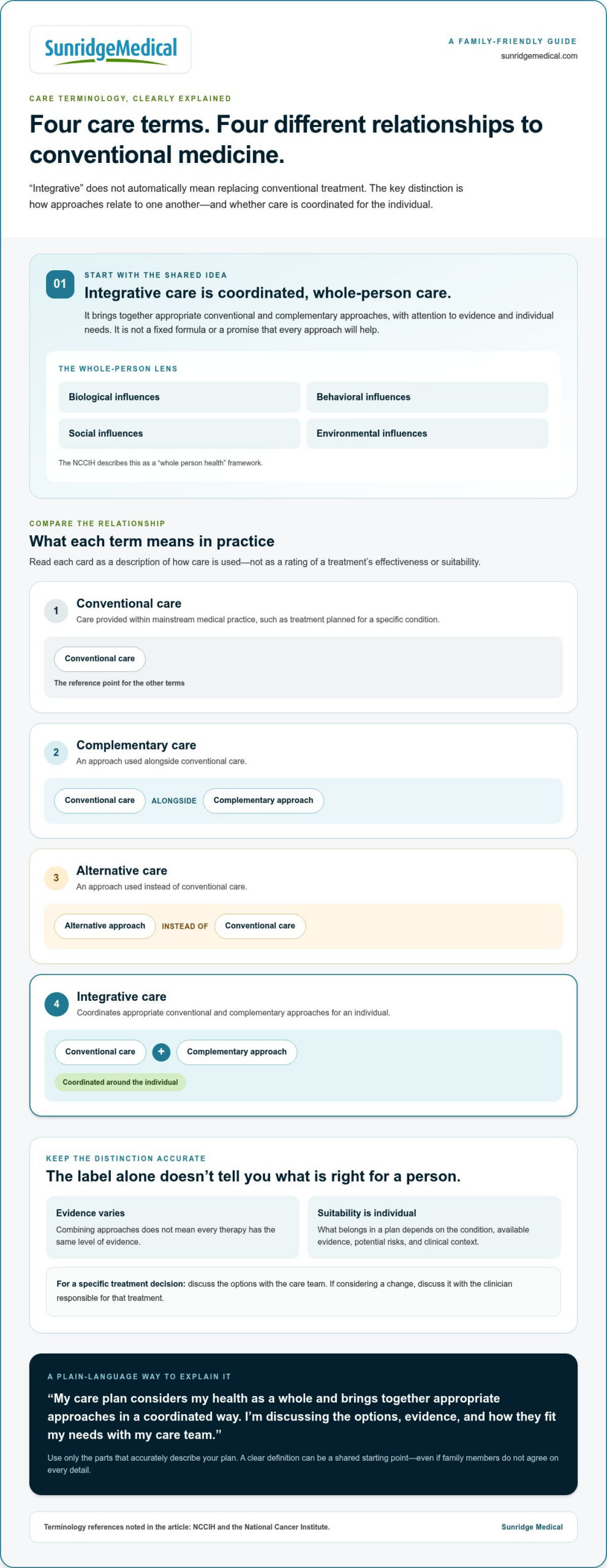
Integrative medicine is coordinated care that considers the whole person and brings together appropriate conventional and complementary approaches with attention to evidence and individual needs. This definition is a starting point, not a promise that every approach will help or a claim that all options have equal research support.
The National Center for Complementary and Integrative Health (NCCIH) describes integrative health through a “whole person health” framework. It considers connected influences on health, including biological, behavioral, social, and environmental factors. In plain language, care may take account of a person’s condition, health needs, preferences, and broader circumstances. The focus is on the individual, not on applying one fixed formula.
A simple way to describe integrative medicine
Try adapting this explanation: “My care plan considers my health as a whole and brings together appropriate approaches in a coordinated way. I’m discussing the options, evidence, and how they fit my needs with my care team.” Keep only the parts that accurately describe your plan. A family member may need the basic idea first; details can come later.
For example, if someone asks whether integrative medicine means replacing a prescribed treatment, clarify that “integrative” describes an approach to coordinating care. It doesn’t automatically mean stopping conventional treatment. A particular plan may combine conventional therapies with research-based alternative treatments, while another person’s plan may be different. The label alone doesn’t tell you which approaches are appropriate for an individual.
Complementary, alternative, and integrative care are not interchangeable
These terms describe different relationships to conventional medicine, as the NCCIH explains. Complementary approaches are used alongside conventional care. Alternative approaches are used instead of conventional care. Integrative care coordinates conventional and complementary approaches when appropriate, with attention to the whole person and evidence. These labels describe how care is used, not whether a specific therapy is effective or suitable.
This distinction can keep a conversation from getting stuck on assumptions. If relatives hear “alternative” and think you’re rejecting standard treatment, explain which term describes your choices and what coordination means in practice. The overview of integrative medicine also discusses how the terminology relates to conventional and alternative medicine. Your care team can explain how the terms apply to your specific plan.
When explaining integrative medicine to your family, aim for accuracy rather than agreement. A clear definition gives everyone a shared starting point and leaves room to discuss the choices and evidence relevant to your care.
How Integrative Medicine Can Fit Alongside Conventional Care
A family member may hear “integrative” and worry that you’re replacing established treatment. State the distinction plainly: Complementary care describes an approach used alongside conventional treatment, not an automatic replacement for it. What belongs in an individual plan depends on the condition, available evidence, potential risks, and clinical context. Combining approaches doesn’t mean every therapy has the same level of evidence or suits every person.
The National Cancer Institute’s definition of Integrative Medicine describes it as combining conventional medicine with complementary approaches. For a family conversation, you can add that the aim is coordinated, individualized care, not a universal package or a guaranteed result.
How the approaches differ
This comparison shows how each term relates to conventional care. The label alone doesn’t establish a therapy’s effectiveness or safety.
| Approach | How it relates to conventional care |
|---|---|
| Conventional | Care provided within mainstream medical practice, such as treatment planned for a specific condition. |
| Complementary | An approach used alongside conventional care. |
| Alternative | An approach used instead of conventional care. |
| Integrative | Care that coordinates appropriate conventional and complementary approaches for an individual. |
These distinctions matter when discussing a real decision. If a family member asks, “Are you stopping your treatment?” answer specifically about your own plan rather than relying on the broad label. If you’re considering a change, discuss it with the clinician responsible for that treatment.
Coordination, evidence, and safety
Coordination is a practical consideration, not something to assume happens automatically. Clinicians involved in a person’s care need an accurate picture of current treatments and supportive approaches to consider potential risks and maintain continuity. A plan may account for conventional treatment while addressing other needs, but the approaches and communication between clinicians depend on the individual situation.
Be precise about evidence: distinguish what is established for a particular use, what remains uncertain, and what is still being studied. Don’t say a therapy “works” based only on an anecdote, and don’t dismiss questions as opposition. Supplements and other therapies can carry risks, including possible interactions with medications. Tell the relevant licensed clinicians what you’re using or considering, and discuss proposed treatment changes with the clinician overseeing that care.
When explaining integrative medicine to your family, a calm, specific account of how decisions are made can be more helpful than broad claims. Sunridge Medical develops individualized plans that combine conventional therapies with research-based alternative treatments for cancer and complex chronic diseases. Its individualized approach to care reflects the importance of coordination and personal clinical context.
Answering Family Concerns About Evidence, Safety, and Treatment Choices
A skeptical question may come from care, not criticism. A relative might be afraid you’ll lose time, take an unsafe supplement, or abandon treatment they trust. Instead of trying to win an argument, ask what specifically worries them. Then respond to that concern with clear information about your own choices, including what you know and what you’re still discussing with clinicians.
One point deserves a direct answer: integrative care doesn’t automatically mean rejecting conventional care. The term alone doesn’t tell your family which treatments you’re receiving or whether a particular approach is appropriate. Those decisions depend on the condition, the evidence for each option, possible risks, and your clinical circumstances.
Responding when relatives ask whether it’s evidence-based
Discuss a specific therapy rather than making a sweeping claim about integrative medicine as a whole. Evidence can differ by approach and intended use. Some questions have clearer answers than others; research may be limited, evolving, or not directly relevant to your situation. Acknowledging uncertainty is more credible than describing every option as proven.
You might say, “I’m looking at this specific approach, what evidence is available for its intended use, and what my clinician thinks about its relevance to me.” If you’re both open to it, offer to review reputable information together, such as material from the National Center for Complementary and Integrative Health (NCCIH), which provides research and safety information about complementary and integrative health approaches. Keep the conversation focused on understanding, not scoring points. It’s reasonable to pause if the discussion becomes heated.
Responding when relatives fear treatment will be stopped
Answer in terms of your plan, not an assumption about what “integrative” means. For example: “I’m not making treatment changes on my own. I’m discussing my options with the clinician responsible for my care.” If you’re considering an addition or change, discuss it with that clinician before acting. Don’t stop, delay, or change prescribed treatment independently.
Make sure your reassurance reflects your circumstances. If a change is being considered, explain that it’s under discussion rather than promising that nothing will change. Integrative care isn’t a cure or a guarantee of improvement. Clear communication helps keep expectations grounded.
A practical safety principle: disclose every supplement and therapy you use or are considering to your treating clinical team. Supplements and therapies can carry risks, including possible interactions with medications. Keep a current list of what you use and share the details with relevant licensed clinicians. If you choose, sharing that list with family can also help them understand what you’re discussing with your care team.
When explaining integrative medicine to your family, you don’t need to resolve every concern in one conversation. A measured answer, honest acknowledgment of limits, and a clear commitment to discuss treatment decisions with your clinical team can make room for trust without requiring everyone to agree.
Explain Integrative Medicine to Your Family in 5 Steps
A family conversation doesn’t need to cover every detail of your health or settle every difference in perspective. A little preparation can help you explain your choices clearly while protecting your privacy. Adapt these steps to the person you’re speaking with, your relationship, and what they already know.
- Choose a moment that allows for a real conversation. Look for a time when neither of you is rushed or already upset. A quiet, private setting may suit a close relative; a brief phone call or message may feel more manageable with someone you see less often. You can ask, “Is now a good time to talk about my care?” If the timing isn’t right, suggest another moment.
- Start with your reason for sharing. Say what you hope your family will understand or how they might support you. You may want them to know why you’re considering an approach, understand how it fits into your care, or simply listen without trying to make the decision for you. A clear purpose helps keep the conversation focused.
- Use one plain-language explanation, then share only what you choose. Before introducing unfamiliar terms, describe the approach in a sentence that feels accurate to your situation. You might say: “I’m exploring care that considers my individual needs and coordinates appropriate approaches with attention to evidence. I’m discussing decisions with my clinical team.” Personalize or shorten this script. You don’t owe anyone details about a diagnosis, treatment, or appointment that you’d rather keep private.
- Ask what concerns them, then respond to the specific question. Try, “What part worries you most?” A relative may be concerned about evidence, safety, or whether a prescribed treatment will change. Listen before answering, and be honest if you don’t know. You could offer to look at a reputable resource together or continue the conversation another day. You don’t have to answer every question on the spot.
- Set a respectful limit and follow up. If the discussion becomes intrusive or unproductive, try: “I know you care about me. I’m not ready to discuss more details, but I’ll let you know what support would help.” Later, you might share an update, revisit a question, or explain that you’ve considered their concern. Support doesn’t require your family to agree with every decision.
For relatives who want more background, a guide to integrative medicine for chronic illness can provide context beyond your personal explanation. If you’re exploring an individualized care plan, Sunridge Medical combines conventional therapies with research-based alternative treatments; learn about Sunridge Medical’s approach to care.
How Sunridge Medical Approaches Individualized Integrative Care
Once your family understands the general idea of integrative care, make the conversation more concrete by describing what an individualized approach means in practice. Sunridge Medical treats cancer and complex chronic diseases. Its care plans combine conventional therapies with research-based alternative treatments, tailored to the individual rather than presented as one protocol for everyone.
This distinction can help when relatives ask what “integrative” means for you. The term doesn’t tell them which specific treatments are part of a person’s plan or guarantee a particular result. It describes an approach that considers conventional and research-based alternative therapies within an individualized plan. For cancer care, integrative treatment should not be framed as a replacement for conventional cancer treatment or another clinician’s care.
Describe the clinic’s approach accurately
A clear way to explain Sunridge Medical’s approach is: “The clinic develops care plans for each individual, combining conventional therapies with research-based alternative treatments. The plan depends on the person and their health needs.” Adapt this wording to your circumstances. Don’t suggest that every person receives the same combination or that a treatment is appropriate simply because it is part of an integrative approach.
If cancer treatment is the family’s main concern, Sunridge Medical’s information on alternative cancer treatment can provide context. When discussing any care plan, focus on what’s actually being considered and direct treatment questions to the clinicians responsible for your care.
Choose a next step that feels informed and manageable
Before a family conversation or a care discussion, write down the questions you want answered. Keeping them specific can make a complicated topic easier to discuss and help you separate your questions from relatives’ concerns. You might note:
- Which parts of the plan are conventional therapies and which are research-based alternative treatments?
- What is known about a proposed approach for its intended use, and what remains uncertain?
- What should the clinicians responsible for my care know about supplements or other therapies I’m considering?
You don’t need to resolve every question in one visit or conversation. Share your questions with your clinical team and discuss treatment concerns with the clinicians responsible for your care. That keeps the conversation grounded in your circumstances instead of assumptions about integrative medicine as a whole.
When explaining integrative medicine to your family, you can describe Sunridge Medical’s individualized approach without promising an outcome or asking relatives to agree with every decision. Explore the clinic’s information on individualized treatment and bring your questions to a conversation about your care.
Let Your Next Conversation Begin With One Clear Question
You don’t have to find perfect words or win agreement to make a family conversation worthwhile. Decide what support you want, whether that’s a listening ear, help preparing questions, or room to make your own care decisions. Explaining integrative medicine to your family can be an ongoing conversation, shaped by what you’re ready to share and what they’re ready to understand.
If you’re considering care for cancer or a complex chronic disease, Sunridge Medical develops individualized plans that combine conventional therapies with research-based alternative treatments. Learning about that approach can help you organize your questions and decide what you want to discuss with your clinical team.
Explore Sunridge Medical’s individualized approach to integrative care and request an appointment to discuss your questions.
Frequently Asked Questions
What is the simplest way to explain integrative medicine to my family?
Say, “I’m considering care that looks at my overall health and how different options may fit together.” Then explain why the conversation matters to you, such as wanting relatives to understand your decisions or support you in a specific way. If they ask for details, share only what you’re comfortable discussing. Inviting one question at a time can make the conversation feel manageable rather than overwhelming.
Is integrative medicine the same as alternative medicine?
No. The terms describe different relationships to conventional care. An approach used instead of conventional treatment is described as alternative; integrative care considers how conventional and complementary options may be coordinated. A useful follow-up question is, “Are we talking about replacing a treatment, or considering an additional approach?” That can clarify what your relative means before you respond to their concern.
Can integrative medicine be used alongside conventional treatment?
Yes, integrative care may be used alongside conventional treatment, depending on the person’s condition, clinical context, and the approaches being considered. Explain what you’re continuing, what you’re considering adding, and which questions remain for your care team. Don’t assume that every therapy is appropriate to combine. Discuss proposed additions or changes with the clinicians responsible for your treatment before making a decision.
How do I explain the evidence for integrative medicine to a skeptical relative?
Discuss the evidence for the specific therapy and intended use instead of claiming that integrative medicine as a whole is proven or unproven. You might say, “I’m looking at what has been studied for this approach, where the findings are uncertain, and whether it applies to my situation.” If useful, choose a reputable research resource to review together. Acknowledging limits can keep the exchange grounded and respectful.
What should I tell my family if they are worried about supplements or treatment interactions?
Tell them you take the concern seriously and will disclose supplements and other therapies to your treating clinical team. Keep a current list of each product or therapy and how you use it, so you can share accurate details with clinicians. Supplements can carry risks or interact with medications, so don’t rely on a family member’s experience to decide whether something is safe for you.
How can I talk to my family about integrative medicine without sharing private health details?
You can explain your general approach without discussing your diagnosis, test results, or treatment specifics. For example: “I’m making care decisions with my clinical team, and I’d appreciate your support without going into private details.” Explaining integrative medicine to your family doesn’t mean giving everyone the same information. Decide in advance what you’re comfortable sharing, and calmly repeat your boundary if questions become intrusive.