


What if managing an autoimmune condition meant looking beyond symptoms without stepping away from medical treatment? The holistic management of autoimmune disease takes a whole-person view, considering how symptoms, medical history, daily habits, and care priorities fit together. It can also raise important questions: Which complementary approaches may be relevant, and could a supplement interact with your current treatment?
If you’re unsure where to begin, that uncertainty is understandable. “Holistic” shouldn’t mean trying every trend or expecting a cure. It means considering individualized, research-informed options alongside appropriate conventional care, with decisions guided by your health circumstances and a physician’s evaluation.
This guide explains what whole-person autoimmune management can involve and how it may complement your existing care. You’ll learn how to discuss nutrition, supplements, and other approaches with your physician, consider safety and clinical relevance, and connect your symptoms and medical history to practical next steps. The goal is a clearer, coordinated plan that reflects your needs, not a one-size-fits-all protocol.
Key Takeaways
- Holistic management of autoimmune disease considers your health context alongside disease-specific care, rather than relying on a standardized plan.
- Diagnosis, medical history, symptoms, medications, laboratory findings, organ function, treatment tolerance, and personal goals can all inform physician recommendations.
- Lifestyle supports, supplements, and physician-directed options have different purposes and considerations. Bring details about supplements and therapies to your care team for review.
- Prepare for a care discussion by organizing your priorities, symptoms, health history, medications, and questions.
- Sunridge Medical provides physician-led care that may integrate conventional medicine with individualized, research-informed options when physician review supports them.
What Holistic Management of Autoimmune Disease Means in Practice
Persistent symptoms, changing flares, or care that feels fragmented can leave a person looking for a broader perspective. That doesn’t mean disease-specific medical care has failed or that every possible lifestyle change should be added. It means asking how the diagnosis, treatment, day-to-day health, and personal priorities fit together, then discussing relevant options with the care team.
Holistic management of autoimmune disease is an individualized approach that considers a person’s wider health context alongside appropriate medical care for their condition. It is a framework for coordinated decisions, not a stand-alone cure or a reason to stop prescribed treatment. Since autoimmune diseases encompass different conditions, there is no single plan that applies to everyone.
The distinction matters. Two people with the same diagnosis may have different symptoms, medication regimens, other health considerations, and goals. A whole-person perspective brings those details into the conversation, but it doesn’t establish that a particular food, supplement, or practice will change the course of disease.
Which parts of health may holistic care consider?
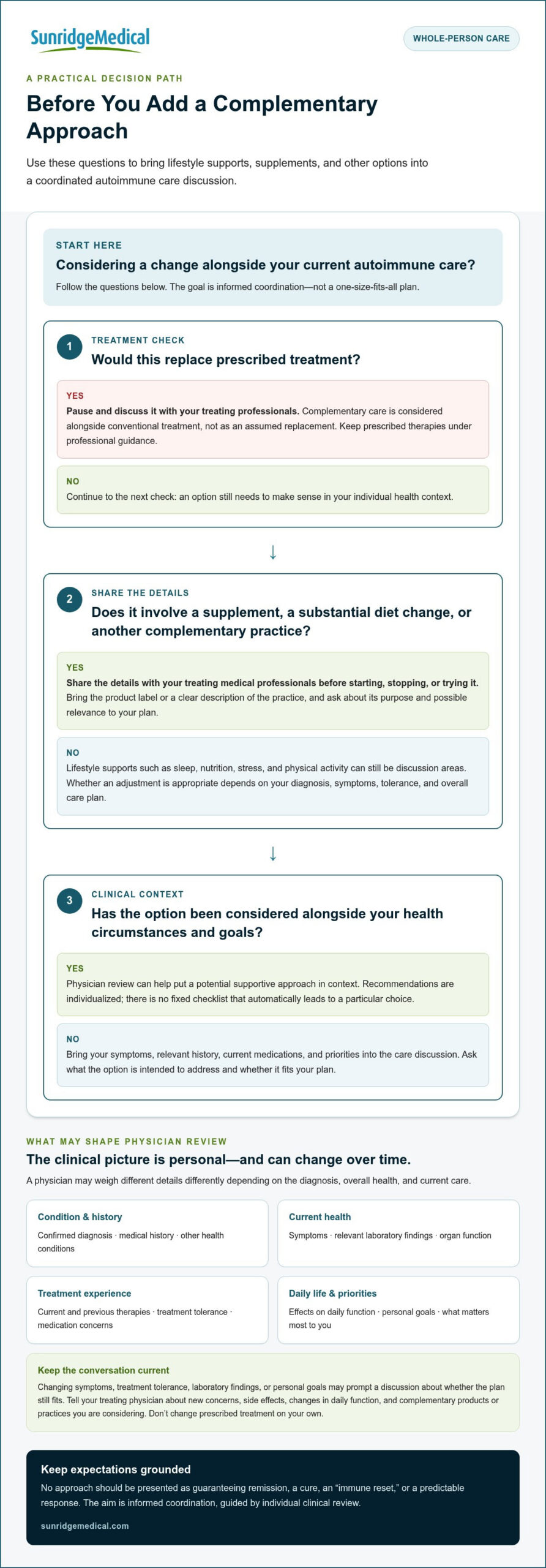
A useful discussion can include symptoms and how they affect daily function, medical history, current medications, and relevant laboratory findings. A physician may also consider organ function, treatment tolerance, other health conditions, and what matters most to the person. These details help put potential supportive approaches in context rather than treating them as universal recommendations.
Sleep, nutrition, stress, and physical activity can also be discussion areas. For example, a person might describe how fatigue affects work or ask whether a change in routine is appropriate alongside current treatment. The relevance of any adjustment depends on the diagnosis, symptoms, tolerance, and overall care plan.
How does holistic care relate to conventional treatment?
Complementary care is considered alongside conventional medical treatment, not as an assumed replacement for it. Keep prescribed therapies under the guidance of the professionals managing your condition. Before starting or stopping a supplement, substantially changing your diet, or trying another complementary practice, share the details with your treating medical professionals.
That conversation gives the care team a chance to consider the full picture, including current medications and your medical circumstances. Bring product labels or a clear description of a practice, along with questions about its purpose and possible relevance to your plan. No approach should be presented as guaranteeing remission, a cure, an “immune reset,” or a predictable response. The aim is informed coordination, with recommendations shaped by individual clinical review.
How Individualized Autoimmune Care Considers the Whole Clinical Picture
A treatment decision can’t be separated from the person who will live with it. The same diagnosis may involve different symptom patterns, medical histories, current therapies, and personal priorities. That is why an individualized plan begins with clinical context, not a preset list of interventions.
Autoimmune recommendations should be individualized because diagnosis, health history, symptoms, medications, laboratory findings, organ function, treatment tolerance, and personal goals differ from person to person. This principle helps distinguish a considered care plan from a standardized protocol that assumes the same approach suits everyone.
What information can shape an individualized care plan?
A physician may consider the confirmed diagnosis and its history, current and previous therapies, symptom patterns, and other relevant health conditions. Laboratory findings can contribute useful information, but they need to be interpreted by a qualified clinician in context. A result alone may not explain how someone feels or determine which care choices are appropriate.
Other considerations can include organ function, how a person has tolerated treatment, and what they hope to address. For instance, a patient may want to discuss persistent fatigue, a medication concern, or how symptoms affect daily activities. These priorities make the conversation more specific; they don’t replace clinical evaluation.
The information considered will vary. A physician may weigh certain findings more heavily for one person than another, based on the diagnosis, overall health, and current care. There isn’t a fixed checklist that automatically leads to a particular recommendation.
Why can a care plan change over time?
Autoimmune care may need to adapt as a person’s circumstances change. Symptoms may shift, a therapy may be difficult to tolerate, laboratory findings may add context, or personal goals may change. These developments can prompt a discussion about whether the current plan still fits. A change in symptoms doesn’t, by itself, establish what caused it or what adjustment is needed.
Keep your treating physician informed about new or changing concerns, including side effects, changes in daily function, and any complementary products or practices you’re considering. Don’t change prescribed treatment on your own. Your physician can review those updates alongside your medical history and other relevant findings.
At Sunridge Medical, individualized plans may evolve in response to symptoms, laboratory findings, treatment tolerance, and changing priorities. Physician-led evaluation considers the individual’s diagnosis, medical history, medications, organ function, and goals when assessing whether research-informed options are clinically relevant. For readers exploring individualized autoimmune care, the central question is not simply which options exist, but which, if any, make sense within a coordinated plan.
Holistic Autoimmune Care: Weighing Lifestyle, Supplements, and Other Options
People exploring holistic management of autoimmune disease may encounter everything from everyday wellness suggestions to specialized treatment options. These approaches don’t serve the same purpose, and none should be assumed appropriate simply because it is described as natural or complementary. A useful comparison considers what an option is intended to support, what questions it raises, and whether it fits the person’s medical circumstances.
| Approach | Potential purpose | Considerations |
|---|---|---|
| Lifestyle supports | Support general well-being and daily function through areas such as sleep, nutrition, stress management, and physical activity. | Personal choices should reflect symptoms, limitations, and clinician guidance. These supports are not disease-specific cures. |
| Supplements | Address a specific nutritional or wellness goal when appropriate. | Products can interact with medications, affect symptoms, or be unsuitable for a particular condition. Review ingredients and use with a treating professional. |
| Physician-directed options | Consider research-informed approaches as part of an individualized medical plan. | Suitability depends on physician evaluation, clinical relevance, and the person’s overall care. |
What can lifestyle measures contribute?
Sustainable habits may support general well-being, but they aren’t a substitute for disease-specific medical care. Regular, nourishing meals, a sleep routine, manageable stress practices, or activity adapted to current abilities may be useful areas to discuss. There is no single diet or exercise plan that should be presented as preventing, reversing, or curing autoimmune disease.
Start with what feels practical and relevant. A person experiencing pain or fatigue, for example, may need to consider how activity affects daily function and seek clinical guidance before making changes. The aim is a realistic support, not a demanding set of rules that ignores symptoms or treatment needs.
Why do supplements and complementary therapies need review?
Supplements can contain active ingredients that may affect medications, symptoms, or treatment decisions. That doesn’t mean every supplement is harmful. It means the specific product and the person’s health context matter. Natural origin alone doesn’t establish that an option is suitable or safe for an individual.
Share the product name, ingredient list, amount used, and reason for taking it with your treating medical professionals. Include complementary practices in that conversation too, especially before starting something new or changing prescribed treatment. This helps the care team consider possible interactions and whether the option fits the broader plan.
General wellness practices differ from physician-directed care. At Sunridge Medical, research-informed nutritional, metabolic, botanical, regenerative, and other options may be considered alongside conventional care when physician review supports their clinical relevance and safety. Recommendations depend on the individual case and goals; an option’s presence in a comparison table isn’t a recommendation for every patient.
How to Discuss Holistic Autoimmune Management With Your Care Team
A focused conversation can help turn a long list of possible approaches into questions your care team can assess in context. You don’t need to arrive with a treatment decision already made. For holistic management of autoimmune disease, the aim is to share what matters to you and understand how an option may fit with your diagnosis and current care.
What should you prepare before discussing complementary options?
Before the appointment, gather a concise picture of your symptoms, treatment history, and priorities. Note what has changed, what affects daily function, and what you hope to address. Bring relevant test results if available, along with an up-to-date list of medications, supplements, and complementary practices you’re using or considering.
- Summarize your goals. Identify practical priorities, such as supporting daily function, discussing a persistent symptom, or coordinating treatments.
- Describe your symptoms and history. Note when symptoms occur, how they affect you, and relevant medical history or past treatment experiences.
- List current therapies. Include prescribed medications, over-the-counter products, supplements, and complementary practices. Product labels or ingredient lists can help clarify what you’re taking.
- Bring questions and relevant findings. Write down questions in advance and include laboratory results or other information your clinician has asked you to track.
What questions can help clarify an option?
Ask how a proposed option relates to your diagnosis, medical history, medications, laboratory findings, and organ function. You can also ask what research informs its use, how safety and clinical relevance are evaluated, and what signs of response or poor tolerance should be discussed. These questions invite shared decision-making without presuming a particular treatment is right for you.
To keep the discussion specific, consider asking:
- What is this option intended to support, and what are its limitations?
- Could it interact with my medications or affect my symptoms or treatment decisions?
- How would my medical circumstances shape whether it is appropriate?
- What should I report if my symptoms or tolerance change?
For focused background, explore hormone optimization for autoimmune disease and IV therapy for autoimmune disease. Use these topics to prepare questions, not to self-select treatment. Any potential option requires consideration within your care plan, and you should discuss changes with the professionals managing your condition.
If you’re considering a physician-led, individualized approach, learn about autoimmune disease management at Sunridge Medical. Suitability and recommendations depend on your circumstances and physician evaluation; complementary care is not a substitute for prescribed treatment.
How Sunridge Medical Approaches Individualized Autoimmune Care
For people seeking a broader perspective on complex or chronic conditions, Sunridge Medical provides physician-led care in an outpatient medical treatment facility. Its approach to holistic management of autoimmune disease is individualized: conventional medical care may be considered alongside research-informed options when physician review supports their relevance to the person’s circumstances and goals. Complementary care is not presented as a replacement for prescribed treatment.
What does physician-led, hands-on care mean?
Care begins with an evaluation of the individual case. A physician considers the person’s diagnosis, medical history, laboratory findings, medications, organ function, symptoms, treatment tolerance, and goals before determining whether additional options may be appropriate. These may include IV and nutrient therapies, oxidative and redox medicine, natural and botanical medicine, or regenerative and recovery care. Options are considered for their research-informed context, safety, and clinical relevance, not applied as a standard package.
Sunridge’s outpatient treatment facility provides onsite physician-directed therapies in dedicated infusion rooms, with care supported by licensed clinical professionals and a full nursing team. Evaluation and treatment delivery are part of a hands-on outpatient care model, not inpatient hospitalization. The distinction matters: care is developed around the individual’s needs, rather than implying that every patient requires the same intervention or setting.
A plan may evolve as the physician and care team consider symptoms, laboratory findings, tolerance, and changing priorities. If an option isn’t tolerated or a person’s goals shift, those details can inform further discussion. No particular response is guaranteed, and changes to prescribed therapies should be guided by the treating medical professionals.
For a closer look at this model, Explore Sunridge Medical’s approach to individualized care.
What is a practical first step for learning about care?
A first conversation can help you understand the care process and prepare questions. Sunridge Medical’s Patient Care Team can answer general questions, but an introductory phone call doesn’t include diagnosis or prescribing. Diagnosis and treatment recommendations require physician evaluation of the individual case.
Before reaching out, note your main questions, current care arrangements, and what you hope to understand. You can call 1-800-923-7878 to speak with the Patient Care Team about general information. For wider context on how integrative approaches may relate to complex and chronic conditions, read about integrative medicine for chronic illness.
Whole-person care is most useful when it supports informed, coordinated decisions. Learning about the model can help you identify questions to discuss with your treating professionals while keeping your existing medical care central to the conversation.
Take Your Next Step With a Clearer Care Priority
You don’t need to solve every question about autoimmune care at once. Choose one concern you’d like to discuss, note what you hope to understand, and bring that priority to your next conversation with your treating physician. A focused question can make it easier to explore whether an option fits your circumstances, how it may relate to current care, and what should guide any decision.
The goal of holistic management of autoimmune disease isn’t to pursue every possible intervention. It’s to make thoughtful, individualized choices with appropriate medical guidance and realistic expectations. Your needs and priorities can change, so it’s reasonable to revisit questions as your situation evolves.
If you’re considering a more coordinated perspective on autoimmune care, Explore Sunridge Medical’s physician-led approach to individualized care. Call 1-800-923-7878 to speak with the Patient Care Team about general questions and next steps.
Frequently Asked Questions
What does holistic management of autoimmune disease mean?
Holistic management of autoimmune disease means making care decisions with the person’s broader health and circumstances in view, not treating a diagnosis as the only relevant detail. In practice, that might mean discussing how fatigue affects work or family responsibilities alongside disease-specific treatment. It’s a way to organize informed conversations about care, not a separate cure or a promise that addressing lifestyle factors will change the disease.
Can holistic approaches replace medication for autoimmune disease?
No. Don’t stop, reduce, or change prescribed medication without discussing it with the clinician managing your condition. Some complementary practices may be considered alongside medical treatment, but their role depends on the diagnosis and individual circumstances. If you’re concerned about side effects or whether a medication still fits your needs, write down what you’ve noticed and ask your physician about options rather than making changes on your own.
Are natural supplements safe for people with autoimmune disease?
Not necessarily. A supplement’s natural origin doesn’t establish that it’s safe or suitable for a particular person. Ingredients may interact with medications or affect symptoms, and a product’s name alone may not reveal its full formulation. Before using one, share the label or ingredient list with your treating clinician, including how much you plan to take and why. That review can help inform a decision without assuming all supplements are harmful.
How can lifestyle changes support autoimmune disease management?
Appropriate lifestyle habits may support general well-being and everyday function, but they aren’t cures for autoimmune disease. Rather than making several major changes at once, consider choosing one manageable area to discuss, such as a consistent bedtime or activity adapted to your current abilities. Notice how the change affects your routine and symptoms, and bring that information to your clinician, particularly if your condition or limitations make the change difficult.
What should an individualized autoimmune care plan consider?
A plan should reflect the person’s confirmed diagnosis, health history, symptoms, medications, relevant test findings, organ function, and treatment tolerance. It should also account for personal goals and practical priorities, such as maintaining daily activities or coordinating care across clinicians. These details can help a physician judge whether an option is relevant to the individual case. No single factor, including a laboratory result, should be treated as a complete answer on its own.
How do I discuss supplements or integrative therapies with my doctor?
Bring the product label or the name and details of the therapy, and explain whether you’ve already tried it or are only considering it. You might ask, “Could this affect my current medications?” or “What would make this appropriate for my situation?” Be open about your goals and concerns. This gives your clinician a chance to discuss potential benefits, limitations, interactions, and how changes should be communicated as part of your care.
Does Sunridge Medical provide hands-on treatment for autoimmune conditions?
Yes. Sunridge Medical is a physician-led outpatient medical treatment facility for complex and chronic conditions, including autoimmune disorders. Its hands-on treatment center has dedicated infusion rooms and onsite physician-directed therapies, supported by licensed clinical professionals and a full nursing team. Whether a particular option is appropriate depends on physician evaluation of the individual case, including diagnosis, medical history, laboratory findings, medications, organ function, symptoms, tolerance, and goals. An introductory call can address general questions, but it can’t provide a diagnosis or prescription.