


A calendar isn’t a care plan. If you’ve seen conflicting advice online, it’s reasonable to ask: how often should you get IV nutrient therapy, and does the answer depend on what the infusion is meant to address? There’s no universal schedule for elective IV nutrient therapy. A routine cadence shouldn’t take the place of an individualized clinical assessment.
It’s sensible to consider more than convenience. The formulation, your health status, nutritional needs, treatment goals, and response to previous infusions can all affect whether therapy is appropriate and how it should be monitored. Repeated treatment also deserves a careful review of possible side effects and interactions.
This guide explains why schedules vary, what to discuss with a qualified clinician before starting, and when to pause and seek medical advice. Sunridge Medical develops customized IV protocols within individualized care following physician evaluation. The goal is a clinically informed plan, not a one-size-fits-all timetable. You’ll be better prepared to ask whether an infusion addresses a specific need, what follow-up makes sense, and how safety will be assessed over time.
Key Takeaways
- There’s no single answer to how often should you get IV nutrient therapy. Frequency should reflect the treatment goal, formulation, health context, and clinician assessment.
- Ask what documented need or clinical rationale supports the proposed infusion, and how your clinician will interpret relevant test results.
- Before agreeing to repeat sessions, clarify what response will be monitored and when the plan will be reviewed.
- Discuss potential risks, ingredient-specific concerns, and any changes in your health or medications with a qualified clinician.
- A physician-guided evaluation can help shape an individualized plan without relying on a fixed package or promising a particular outcome.
How often should you get IV nutrient therapy? Why there is no universal schedule
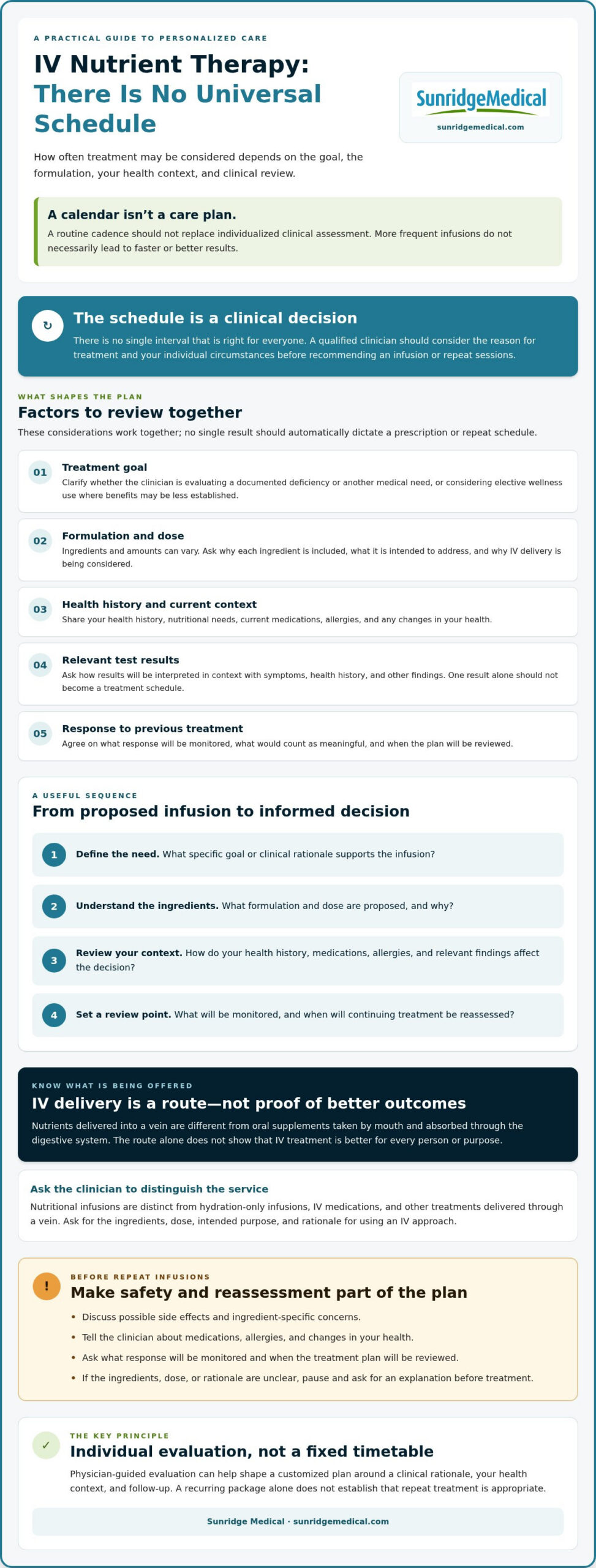
There’s no single interval that’s right for everyone. How often should you get IV nutrient therapy depends on the clinical goal, formulation and dose, your health history, relevant laboratory findings, and how you respond. A qualified clinician should review these factors before recommending treatment. A schedule promoted for general wellness isn’t a universal medical recommendation, and a recurring package doesn’t establish that repeat treatment is appropriate for you.
IV nutrient therapy delivers nutrients into a vein, while oral supplements are taken by mouth and absorbed through the digestive system. Intravenous delivery is a different route, not proof of better outcomes for every person or purpose. An overview of intravenous therapy explains the procedure and its broader uses, including nutrient delivery. An individualized schedule gives a clinician room to consider the reason for treatment, specific ingredients, and your changing medical context before recommending repeat infusions.
What does IV nutrient therapy include?
Nutritional infusions contain nutrients delivered intravenously, but ingredients and amounts can vary by protocol. They’re distinct from hydration-only infusions, IV medications, and other treatments delivered through a vein. The route alone doesn’t make these services interchangeable. Before proceeding, ask the prescribing clinician to clarify the ingredients, dose, intended purpose, and rationale for using an IV rather than another approach. If those details aren’t clear, pause and ask for an explanation before treatment.
Why does the right interval differ between patients?
The reason for treatment matters. When considering whether treatment is appropriate and when to review it, a clinician may consider your medical history, laboratory findings, proposed formulation, and response to any prior infusion. Test results need to be interpreted in context. One result by itself shouldn’t become a prescription or dictate a repeat schedule.
Repeated treatment should have a defined rationale and a point for reassessment. Ask what the clinician hopes to address, what change would count as a meaningful response, and when the plan will be reviewed. More frequent infusions don’t necessarily lead to faster or better results. If the goal or rationale for continuing isn’t clear, discuss that before scheduling another session.
What determines how often IV nutrient therapy may be considered?
A repeat infusion should have a clear purpose, not simply a place on the calendar. Clinicians may distinguish treatment intended to address a documented deficiency or other medical need from elective wellness use, where benefits may be less established. The goal helps determine whether an infusion is appropriate, what outcome to monitor, and when to reassess whether continuing makes sense.
Before scheduling repeat infusions, clinicians consider the treatment goal, evidence of need, proposed ingredients and doses, medical history, medications and allergies, relevant test results, and the patient’s response. These factors work together. A laboratory result needs interpretation alongside symptoms, health history, and other findings. A single value shouldn’t automatically become a prescription for an IV or a repeat schedule.
How do the treatment goal and formulation shape the plan?
The rationale for an infusion may differ depending on whether a clinician is evaluating a documented deficiency or a general wellness goal. Formulations also vary, and ingredients and doses can have different intended uses and safety considerations. Ask the prescribing clinician why each ingredient is included, what evidence supports its use for your goal, and what response would prompt a change or review. Nutrient-specific dosing and reassessment timing should be based on reliable clinical guidance, not generalized marketing claims.
More treatment isn’t automatically better. The University of Miami Health System discusses who may benefit from IV vitamin drips and the dangers of excessive supplementation. Use that context to ask whether a proposed infusion has a defined rationale for you, rather than assuming a wellness package applies to everyone.
What personal health factors should a clinician review?
Give the clinician a complete picture before treatment: medical history, current medications, allergies, prior reactions to infusions, relevant test results, and all supplements or other treatments you use. Disclose pregnancy and chronic conditions, including kidney or heart conditions, since health factors may affect whether an infusion is suitable. These details inform an individualized risk assessment; they don’t automatically determine a particular schedule.
Ask how your health context affects the proposed ingredients and what monitoring is appropriate. If your circumstances change or you experience a new reaction, contact the clinician before another infusion rather than following an existing calendar by default.
Sunridge Medical offers customized IV protocols as part of individualized care following physician evaluation. If you’re considering this approach, you can review Sunridge Medical’s individualized care as a starting point for discussing whether a clinician-guided assessment is relevant to your situation.
How to assess a proposed IV nutrient therapy schedule
A proposed schedule should explain more than how frequently sessions are offered. It should connect the infusion to a stated goal, explain the clinical rationale, and include a plan to assess whether continuing is appropriate. A fixed package or recurring appointment without reassessment gives you little information about whether treatment still serves that goal.
If you’re asking how often should you get IV nutrient therapy, use this framework to clarify the reasoning with the clinician. The example below is a discussion aid, not a recommended treatment schedule.
| Stated goal | Supporting rationale | Monitoring plan | Review point |
|---|---|---|---|
| What is the infusion intended to address? | What patient-specific findings or evidence support it? | What symptoms, test results, or other measures will be assessed? | When will the clinician decide whether to continue, change, or stop? |
A useful plan makes each answer understandable. If the goal is vague, the rationale relies only on a general wellness promise, or there’s no plan to review your response, ask for clarification before agreeing to repeat sessions. No schedule can be labeled safe for everyone without evidence that applies to the specific ingredients, dose, indication, and patient context.
What should a transparent treatment plan explain?
Ask what the infusion contains, why each ingredient is proposed, and what outcome the clinician expects to assess. Discuss alternatives, including whether oral intake or standard care is appropriate for your situation. You should also understand who oversees treatment, how your response will be documented, and when the plan will be reviewed. A clear plan leaves room to revise or stop treatment if the rationale changes or the intended benefit isn’t evident.
How can you weigh expected benefit against uncertainty?
Evidence isn’t interchangeable across nutrients, conditions, doses, or patients. A clinician should distinguish evidence for a specific medical indication from broader claims about wellness and explain any uncertainty in terms you can evaluate. Testimonials may describe individual experiences, but they don’t establish effectiveness or show what interval is appropriate for you.
For condition-specific context, read Sunridge Medical’s IV therapy for autoimmune disease guide. It can help you consider how an individualized discussion differs from a general wellness claim. It shouldn’t be taken as a promise that IV nutrient therapy treats or cures autoimmune disease. A sound decision rests on your clinical context, the proposed formulation, and a defined plan for review.
Safety checks and questions to ask before repeat IV infusions
Safety isn’t established by following a standard interval. It depends on the proposed ingredients, your health context, how the infusion is administered, and whether a qualified clinician reviews the plan. IV-related concerns can include infection, bruising, or irritation around the insertion site. Specific risks vary by formulation and patient. Ask the clinician to explain the risks relevant to your infusion rather than relying on a generic safety checklist.
Before another session, make sure the clinician has an up-to-date account of your medications, supplements, allergies, health conditions, and any prior reactions to infusions. Don’t stop prescribed treatment or change your medical care to accommodate an infusion without discussing it with the clinician responsible for that care.
Which questions help clarify a repeat-treatment recommendation?
Use the conversation to understand the clinical reasoning behind the plan. Ask:
- What specific need is this infusion intended to address, and what evidence supports its use for that purpose?
- What ingredients and doses are proposed, and what risks apply to my health history or medications?
- What will be monitored, and what finding or reaction would lead you to change or stop treatment?
- How does this plan fit with my existing medical care and prescribed therapies?
These questions can help you judge whether there’s a clear reason to repeat treatment or whether the plan needs further review. If the answers are unclear, ask for clarification before proceeding. Consider “how often should you get IV nutrient therapy” alongside the treatment rationale and monitoring plan, rather than relying on a preset package alone.
What symptoms or changes warrant a prompt review?
Contact a qualified clinician promptly about new, severe, or worsening symptoms after an infusion, or about a reaction that concerns you. Describe when it began and how it has changed. Don’t wait for a scheduled follow-up if you feel your condition is deteriorating. For a severe reaction or immediate danger, seek emergency medical help through local emergency services.
Pause before booking another infusion if you’ve had a concerning reaction or your health circumstances have changed. Get clinical advice about whether to continue. A plan should be reviewed as your health and response evolve.
If you’re also managing an autoimmune condition, explore Sunridge Medical’s autoimmune disease management as a starting point for learning about the clinic’s care approach. IV nutrient therapy shouldn’t be considered a substitute for appropriate medical care.
How physician-guided care can shape an individualized IV nutrient therapy plan
A thoughtful plan begins with a specific question: what are you hoping the infusion will address? From there, a clinician can review your health context, consider the rationale and evidence for the proposed formulation, and discuss how any response will be monitored. This keeps treatment decisions connected to your broader care rather than to a preset calendar.
So, how often should you get IV nutrient therapy? The answer should follow an assessment of whether an infusion fits your needs and care plan, not an assumed routine. Physician evaluation can help clarify that decision, including whether another approach is more appropriate. IV nutrient therapy shouldn’t replace condition-specific standard treatment or other prescribed care.
What happens when treatment is considered as part of individualized care?
Sunridge Medical offers customized IV protocols, including nutritional infusions, within individualized care for complex and chronic conditions. The center develops individualized care plans following physician evaluation. When discussing IV therapy, bring the full treatment context forward and ask how the proposed protocol relates to your existing care. Address questions about coordinating with conventional care or continuing prescribed therapies with the clinicians responsible for those treatments.
For a broader view of care planning, see the integrative medicine guide for chronic illness. IV nutrients are one possible component to discuss, not a stand-alone promise of improvement or a substitute for appropriate treatment.
What is a sensible next step if you are considering IV therapy?
Preparation can make a clinical conversation more useful. Gather your current medication and supplement list, relevant medical history, prior test information, and details of any previous infusion reactions. You don’t need to interpret the information yourself. Share it with the clinician and ask:
- What is the proposed protocol intended to address, and why is it being considered for me?
- What alternatives should I consider, including oral options or standard care?
- What will be monitored, and when will the plan be reviewed?
- What changes or reactions should prompt me to pause and seek advice?
Clear answers can help you decide whether the plan feels clinically grounded and appropriately monitored. For information about physician evaluation and Sunridge Medical’s approach to individualized care, contact Sunridge Medical. A conversation can help clarify what to discuss next; it doesn’t establish a universal infusion schedule or guarantee an outcome.
Make your next step an informed one
There’s no universal calendar for IV nutrient therapy. The answer to how often should you get IV nutrient therapy depends on the reason for considering it, the proposed formulation, your health context, and a clinician’s assessment of your response. A schedule should have a clear rationale and a plan for monitoring and review, not simply repeat by default.
Before agreeing to another infusion, ask what need it is intended to address, what alternatives may be appropriate, and how your care team will decide whether to continue, adjust, or pause. Keep your medication and supplement list, relevant health history, and prior test information ready for that conversation.
Sunridge Medical offers customized IV protocols, including nutritional infusions, and develops individualized care plans following physician evaluation. To discuss whether an individualized evaluation may fit your situation, discuss an individualized care plan with Sunridge Medical. With clear questions and clinician-guided review, you can take a thoughtful next step toward care that reflects your needs.
Frequently Asked Questions
How often should you get IV nutrient therapy?
There is no universal evidence-based schedule for everyone. How often should you get IV nutrient therapy depends on why it’s being considered, the ingredients and dose, your health history, clinical findings, and your response. A qualified clinician should interpret these factors and determine what monitoring is appropriate. Ask for an individualized recommendation rather than following a fixed interval found online or promoted in wellness marketing.
Is weekly IV nutrient therapy safe?
Weekly IV nutrient therapy can’t be labeled universally safe or unsafe. Its risks depend on the ingredients, dose, your medical history, and the clinical oversight involved. Repeated IV access can also carry risks. Ask the treating clinician why a weekly interval is being proposed, what monitoring is planned, and what symptoms or findings would prompt a pause or reassessment. Don’t assume a schedule is appropriate simply because it’s offered routinely.
Can you get IV nutrient therapy too often?
Yes, unnecessary or poorly monitored infusions may expose you to avoidable risks, though the concerns vary with the formulation and your health status. There is no universal threshold that defines “too often” for every person or infusion. Before continuing, review the treatment goal, cumulative exposure, your response, and possible alternatives with the clinician overseeing your care. If the rationale for repeat treatment is unclear, ask for a clinical review before scheduling another session.
How long should you wait between IV nutrient therapy sessions?
There’s no appropriate waiting interval that can be set without knowing the treatment purpose, ingredients, dose, health context, and response. Follow an individualized plan developed with a qualified clinician rather than applying a default number of days or weeks. Contact the clinician before changing, adding, or postponing a session, especially if your health has changed or you’ve experienced a reaction since the previous infusion.
What should you ask a provider before starting IV nutrient therapy?
Ask what the infusion contains, what medical goal it addresses, and what evidence supports its use for that purpose. Clarify how benefit and safety will be assessed, who oversees care, and when the plan will be reviewed. Share your medications, supplements, allergies, health conditions, and any prior infusion reactions. Discuss alternatives and follow-up, too. A clear reassessment plan is more informative than an open-ended recommendation for repeat sessions.
Do you need blood tests before IV nutrient therapy?
Whether blood tests are appropriate depends on the proposed treatment and your clinical context. A qualified clinician should select relevant tests and interpret the results alongside your health history and other findings. A single result doesn’t independently establish that you need an infusion. Ask what a test is intended to clarify, how its result could affect the decision, and whether other information is needed before making a care plan.
Can IV nutrient therapy replace oral supplements or prescribed treatment?
Not automatically. An IV infusion and an oral supplement use different routes, and their clinical purposes may differ depending on the nutrient and indication. IV nutrient therapy shouldn’t be assumed to replace oral nutrition, prescribed medication, or standard care. Don’t stop or change a prescribed treatment because you’re considering an infusion. Discuss the specific comparison with the clinician responsible for your care, including whether an alternative is appropriate for your circumstances.
What should you do if you feel unwell after an IV infusion?
Contact the treating clinician promptly about new or worsening symptoms after an infusion, and explain when they began and how they’ve changed. Don’t try to diagnose the cause or dismiss a possible reaction. If symptoms are severe, your condition is deteriorating rapidly, or you’re in immediate danger, seek emergency medical help. Share the infusion details, including its ingredients if known, and the timing with healthcare professionals assisting you.