


What matters to an insurer is often the specific service and how it’s billed, not simply the name of the treatment. If you’re asking, “is integrative medicine covered by insurance,” the answer depends on the service, provider, and terms of your plan.
It’s understandable to want a clear answer before committing to care. Plan language can be difficult to interpret, and coverage for one service doesn’t guarantee coverage for another. Knowing what details to ask about can help you anticipate costs and make informed decisions.
This guide explains which details commonly shape coverage and how to ask your insurer about benefits, referrals, prior authorization, and out-of-pocket responsibility. It also explains Sunridge Medical’s payment model: the practice doesn’t offer standard health insurance billing. Sunridge provides individualized physician evaluations and treatment plans, so understanding payment expectations is an important part of planning care. With a clearer picture of your plan and the practice’s billing approach, you can assess your options more confidently.
Key Takeaways
- To answer “is integrative medicine covered by insurance,” identify the specific service and how it’s billed. The integrative label alone doesn’t determine coverage.
- Review your plan’s benefits, exclusions, provider network rules, and coverage requirements before scheduling care.
- Ask your insurer whether the service requires a referral or prior authorization, and what costs may remain your responsibility.
- If coverage is unclear or unavailable, compare your plan’s benefits with self-pay arrangements before proceeding.
- Sunridge Medical provides individualized care planning for cancer and complex chronic conditions, but doesn’t offer standard health insurance billing.
Is integrative medicine covered by insurance? Start with the service, not the label
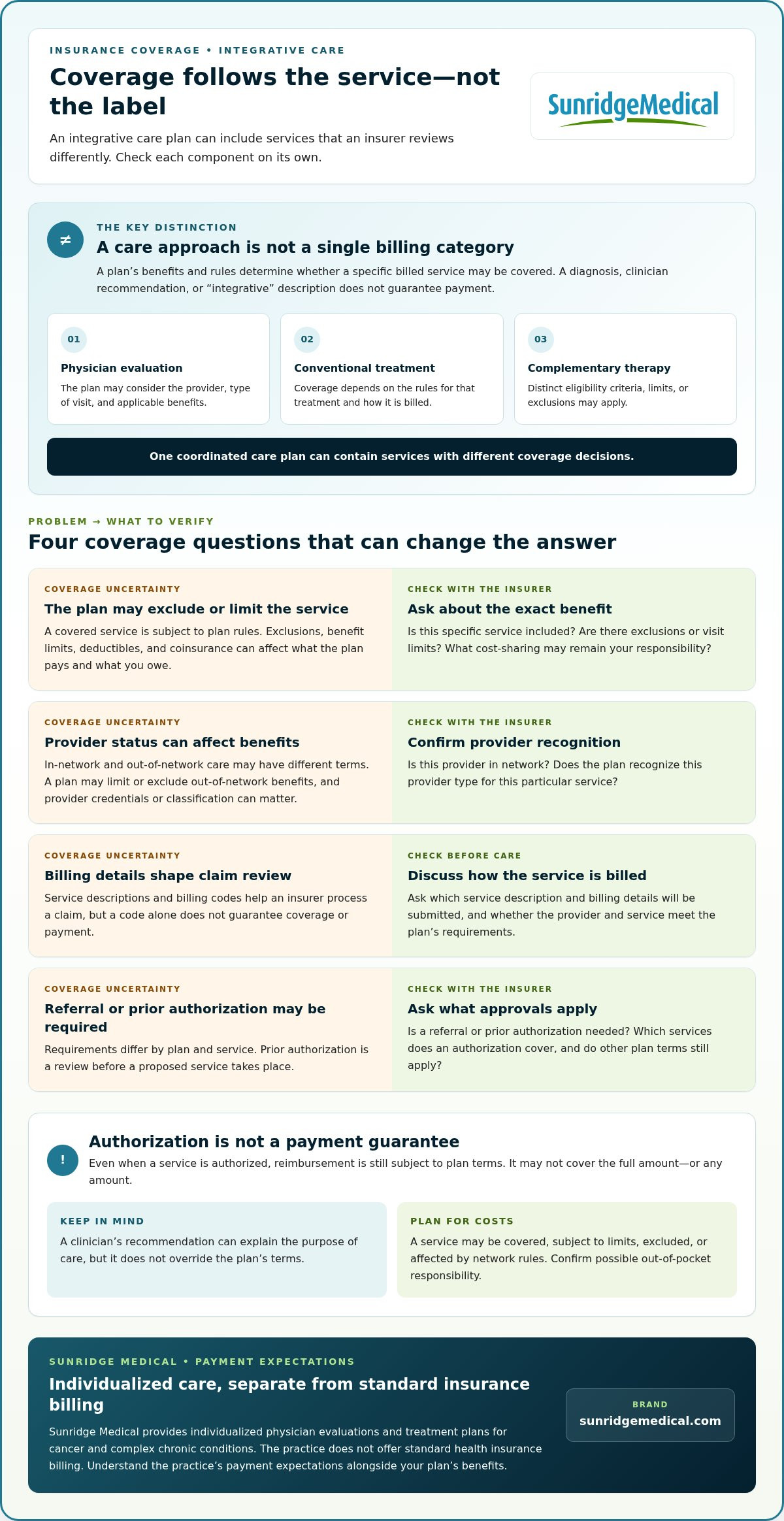
Sometimes, but coverage varies by plan, provider, service, and billing circumstances. If you’re asking, “is integrative medicine covered by insurance,” there isn’t one answer that applies to every type of care. Integrative medicine describes an approach, not a single service with one universal billing category. A physician evaluation, a conventional treatment, and a complementary therapy may each be assessed differently by a health plan.
Integrative care may combine conventional clinical care with complementary therapies in an individualized plan. That shared approach doesn’t mean every component is billed the same way or receives the same coverage decision. For a general overview, see What is Integrative Medicine? The key distinction is simple: a care philosophy describes how services are brought together; a health plan’s benefit rules determine which services it may cover.
What does insurance mean by a covered service?
A covered service is one that a plan includes under its benefits, subject to the plan’s rules. Those rules may include exclusions, in-network requirements, and cost-sharing, such as deductibles or coinsurance. Your plan documents describe the terms, but payment for a particular claim may also depend on how the service is submitted and assessed.
Medical necessity, provider credentials, and billing details may affect that decision. A diagnosis, or the fact that care is described as integrative, doesn’t guarantee payment. A clinician’s recommendation can explain the purpose of care, but it doesn’t override plan terms.
Why can two integrative services receive different coverage decisions?
Insurance generally evaluates specific services rather than a broad approach to care. A physician evaluation, a conventional treatment, and a complementary therapy may have different benefit rules, provider requirements, or billing descriptions. Even when coordinated as part of one care plan, each service can be considered separately.
That distinction matters when estimating your financial responsibility. A plan might treat one component as a covered benefit, another as subject to limits, and a third as excluded or outside the plan’s network rules. These are possibilities, not predictions about a particular claim. The service description and billing details can influence how the insurer reviews each component.
- Physician evaluation: The plan may consider the provider, type of visit, and applicable benefits.
- Conventional treatment: Coverage depends on the plan’s rules for that specific treatment and how it is billed.
- Complementary therapy: The plan may have distinct eligibility criteria, limits, or exclusions for the service.
Reimbursement means payment by a plan under its terms. It doesn’t guarantee that the insurer will pay the full amount, or pay at all. Treat each service as a separate coverage question, even when your care is coordinated as a whole.
Which factors determine whether integrative medicine services may be covered?
A plan’s decision can depend on several details at once. Benefits and exclusions set broad boundaries, while network status, provider credentials, the service description, and how a claim is submitted can affect how a specific service is processed. That’s why asking “is integrative medicine covered by insurance” is only a starting point. The answer for one service may not apply to another, even under the same plan.
The plan, the provider, and the billed service are separate variables, and each can affect a coverage decision. Check your plan documents for the relevant benefit and any limits. Then consider whether the provider and service meet the plan’s stated requirements.
How network status and provider credentials can affect benefits
Plans define their own in-network and out-of-network benefits. In-network care may have different cost-sharing or terms from out-of-network care. Some plans may limit out-of-network benefits or exclude them. Your summary of benefits and full plan documents are the authority for your coverage, so don’t assume an out-of-network service will qualify for reimbursement.
Provider credentials and classification can also matter. A plan may process a service differently depending on who performs it and how the provider is recognized under the policy. Confirm the provider’s network status and ask whether the plan recognizes that provider type for the specific service.
How service descriptions, codes, and authorization affect a claim
A claim generally identifies the service provided using billing details, including codes. These details help the insurer determine how to process a claim, but a code doesn’t guarantee coverage or payment. The plan may also consider whether the service meets its criteria, whether the provider is eligible under the policy, and whether benefit limits apply.
Prior authorization is another plan-specific requirement. It means the insurer reviews a proposed service before it takes place. Some services may require it, while others may not. Even an authorization isn’t a promise that every charge will be paid, so ask which services the decision applies to and whether other plan terms remain relevant.
Before care begins, ask your insurer:
- Is this specific service included in my benefits, and are there exclusions or visit limits?
- Does the provider’s network status or credential affect how the service is processed?
- Is prior authorization or a referral required, and what information is needed?
- What cost-sharing or other patient responsibility may apply?
Keep a record of the representative’s answer, the date, and any call reference number. A provider’s ability to submit a claim is not the same as a guarantee that your plan will cover it. For individualized care planning for cancer or a complex chronic condition, Sunridge Medical’s integrative care includes physician evaluations and treatment planning. The practice doesn’t offer standard health insurance billing, so plan for payment separately.
How to check your insurance benefits before starting integrative care
Before scheduling care, turn the broad question “is integrative medicine covered by insurance” into specific benefit questions. Preparing details in advance can make an insurer’s answer more useful and help you understand what remains uncertain. Verify each service separately, and check the rules for the plan year in which you expect to receive care.
Questions to ask your health plan
Start with your member portal, summary of benefits, and plan documents, including exclusions. If the written language doesn’t clearly address the service, call the insurer’s support line. Have the provider’s name, provider type, network status, and a clear description of the planned service available. Ask the insurer how its benefit terms apply to those details.
Use this process to organize your review:
- 1. Identify the service. Write down the specific evaluation, treatment, or therapy you’re considering. Don’t rely on “integrative care” as the service description.
- 2. Identify the provider. Note the provider’s name, credentials or provider type, and whether they’re in your plan’s network.
- 3. Check the correct plan year. Confirm your coverage’s effective dates and use documents that apply to that year.
- 4. Review written benefits. Search the portal and summary of benefits for relevant services, exclusions, network rules, and limits.
- 5. Call with focused questions. Ask whether the specific service and provider type are listed under covered benefits, and whether a referral, prior authorization, or visit limit applies.
Ask how the deductible, copayment, or coinsurance may apply, and whether the plan requires particular claim-submission steps. If the provider doesn’t bill the plan directly, ask whether you can submit a claim yourself, what documentation is needed, and whether the plan processes that type of claim. Submitting paperwork doesn’t guarantee reimbursement.
How to compare an estimate with your plan documents
Compare the provider’s description of the service with the benefit language, but don’t assume that different wording means the same thing. If the terms don’t match, ask the insurer how it classifies the service and what information it needs to give a more specific response. Record the representative’s answer, the date, and any call reference number. Request written confirmation or a secure portal message when available.
Keep the provider’s estimate separate from the insurer’s estimate of your responsibility. The provider’s estimate describes its charges; the insurer’s estimate may reflect how the plan expects benefits to apply based on the information available. Neither should be treated as a final claim decision. Actual payment can depend on the submitted claim and applicable plan terms.
When planning care for a complex condition, explore Sunridge Medical’s integrative care with payment expectations in mind. Sunridge Medical doesn’t offer standard health insurance billing, so benefit verification and payment planning are separate considerations.
Steps if integrative care is not covered or unclear
An uncertain answer doesn’t have to end your planning, but it does call for clear financial expectations. If you’re still asking, “is integrative medicine covered by insurance,” separate the question into individual services and possible payment paths. A plan may cover a service under certain conditions, contribute only part of the cost, or exclude it. The outcome depends on the plan and claim details, so don’t treat a general benefits answer as a final estimate of what you’ll owe.
Sunridge Medical doesn’t offer standard health insurance billing. Patients considering care should understand the practice’s charges and payment expectations before making decisions. This is especially relevant when care includes multiple components, such as an evaluation, treatment administration, and ongoing monitoring. An individualized plan can clarify which services are being considered, but it doesn’t mean an insurer will cover or reimburse them.
How to prepare for potential out-of-pocket expenses
Before proceeding, make a written list of the services you expect to discuss and ask for applicable fee information. Review each item separately rather than assuming one total or general description accounts for every part of care. When comparing payment options, keep the provider’s charges distinct from any possible insurer contribution.
- Evaluation: Clarify the charge for the physician evaluation and what it includes.
- Treatment administration: Ask which treatment-related services may be part of the plan and how their charges are handled.
- Ongoing monitoring: Include follow-up or monitoring in your financial planning rather than focusing only on the initial evaluation.
Then compare your options: a service might be covered under your plan’s conditions, partially covered with patient cost-sharing, or paid for directly if coverage isn’t available. Don’t build a budget around assumed reimbursement or a broad statement that a service is “usually covered.” Seek service-specific information and make a decision based on payment expectations you can verify.
What an insurer’s denial or unclear answer means
A denied claim is a decision about a particular claim, not a universal finding that all integrative care is excluded. Read the explanation of benefits or denial notice carefully. Look for the stated reason, relevant plan language, and any appeal instructions or deadlines in your plan materials. If the explanation is unclear, ask the insurer to identify the specific rule or information behind its decision.
Keep organized records: save plan documents, written responses, denial notices, and claim materials. For calls, note the date, the representative’s explanation, and any reference number. If you submit additional information or an appeal, record what you sent and when. A clear record can help you understand the decision and follow the plan’s stated process.
For care involving cancer or complex chronic conditions, Sunridge Medical develops individualized evaluations and treatment plans, with payment expectations considered separately from insurance coverage. Explore individualized care planning as you weigh the practical and financial questions involved.
How Sunridge Medical approaches individualized care and payment expectations
At Sunridge Medical, care for cancer and complex chronic conditions begins with an individualized medical evaluation and treatment plan. The process considers each person’s health circumstances and priorities rather than treating a diagnosis as a one-size-fits-all protocol. Plans may bring conventional therapies together with research-based alternative approaches, with ongoing monitoring as care progresses.
Payment expectations are a separate, essential part of planning. Sunridge Medical doesn’t offer standard health insurance billing. Patients shouldn’t assume that a recommended service, protocol, or treatment will be submitted to an insurer or reimbursed. If you’re asking, “is integrative medicine covered by insurance,” the answer for any service still depends on your plan. The clinic’s payment model and your insurer’s benefits are distinct considerations.
What individualized integrative care means at Sunridge Medical
Individualized care connects clinical evaluation to a plan shaped around the person’s condition and circumstances. For cancer care, this may involve considering conventional therapies alongside research-based alternative approaches; the integrative cancer treatment clinical guide offers further context on this model. For complex chronic conditions, evaluation, planning, and monitoring can help organize the questions and services relevant to a person’s care.
A comprehensive plan is not a promise of a particular outcome, nor does it establish insurance coverage. It provides a structured clinical framework for understanding the care being considered. The financial discussion should be equally specific: know which services are part of the proposed plan and understand the applicable payment expectations before deciding how to proceed.
How to take the next step with clear financial expectations
Before making a decision, consider what matters most in your care and what financial commitments are manageable for you. Review the services being considered, clarify the practice’s charges and payment expectations, and keep those details separate from any benefit information you receive from your insurer. That preparation can help you weigh your options without relying on assumed coverage.
If you’re exploring care for an ongoing condition, the integrative medicine guide for chronic illness provides additional perspective on an individualized approach. Understanding the clinical framework and payment model together can help you make a more informed decision grounded in your priorities.
For a clearer view of Sunridge Medical’s approach to individualized care, learn about Sunridge Medical.
Make your next care decision with clarity
Coverage is one part of deciding what care fits your needs. Your priorities, the services being considered, and payment expectations all deserve attention before you move forward. Rather than relying on a broad answer to “is integrative medicine covered by insurance,” use the information you’ve gathered to make a decision that reflects both your health goals and financial circumstances.
At Sunridge Medical, individualized physician evaluations and treatment planning provide a framework for considering care that combines conventional therapies with research-based alternative approaches. This process is tailored to the person, not a standardized pathway, and it doesn’t promise a particular outcome. Taking time to understand the approach and your priorities can help you enter the next conversation prepared.
Explore the care model and decide what questions matter most to you. Explore Sunridge Medical’s individualized approach to care. A clear next step can make a complex decision feel more manageable.
Frequently Asked Questions
Is integrative medicine covered by insurance?
Sometimes, but coverage depends on the specific service and the terms of your plan. A plan may treat a physician visit differently from a therapy provided as part of an integrative care plan. Check the service’s benefit category and exclusions rather than relying on the word “integrative.” Sunridge Medical doesn’t offer standard health insurance billing.
Does Medicare cover integrative medicine?
Original Medicare covers some specific services, not integrative medicine as a broad category. For example, Medicare Part B covers acupuncture only for qualifying chronic low back pain, subject to coverage limits and provider requirements. It also covers manual spinal manipulation to correct a subluxation, but not other chiropractic services or tests. Coverage can differ under Medicare Advantage, so review your plan’s current benefits before arranging care.
Can I get reimbursed for integrative medicine if my provider does not bill insurance?
Possibly, if your plan allows you to submit a claim for that service and provider type. Ask the insurer what documentation it requires, such as an itemized receipt or claim form, and whether out-of-network benefits apply. Reimbursement isn’t assured just because you can submit paperwork. Sunridge Medical doesn’t offer standard health insurance billing, so don’t assume its services will be submitted to or reimbursed by your plan.
How much does integrative medicine cost if insurance does not cover it?
There isn’t one standard cost; charges depend on the services involved and the care plan. At Sunridge Medical, fees relate to services such as physician evaluations, individualized treatment planning, clinical administration of integrative therapies, and ongoing monitoring. Ask for applicable fee information for the specific care being considered, and clarify whether follow-up services are separate. Don’t treat a general estimate or another patient’s experience as a quote for your care.
What happens if my insurance denies an integrative medicine claim?
A denial applies to the submitted claim and its circumstances; it doesn’t automatically mean every integrative service is excluded from your plan. Read the explanation of benefits for the denial reason, then check your plan documents for any appeal process and instructions. If information is missing or incorrect, ask the insurer what documentation it needs. Keep copies of the notice, submitted records, and any follow-up correspondence.
Can health savings or flexible spending accounts pay for integrative medicine?
Eligibility depends on the expense, current tax rules, and the terms of your account. Don’t assume that every service described as integrative qualifies for HSA or FSA payment. Before using account funds, review current official guidance and your plan administrator’s documentation requirements for the specific expense. Keep receipts and any supporting records. Account eligibility is separate from whether your health insurer covers or reimburses the service.
Does insurance cover integrative cancer treatment?
Coverage depends on the specific cancer-care service, provider, and plan terms. A plan may assess conventional oncology services and research-based alternative approaches under different benefit rules, so coverage for one component doesn’t establish coverage for another. Sunridge Medical develops individualized cancer care plans but doesn’t offer standard health insurance billing. Review payment expectations for the proposed care separately from any benefits your insurer may describe.