


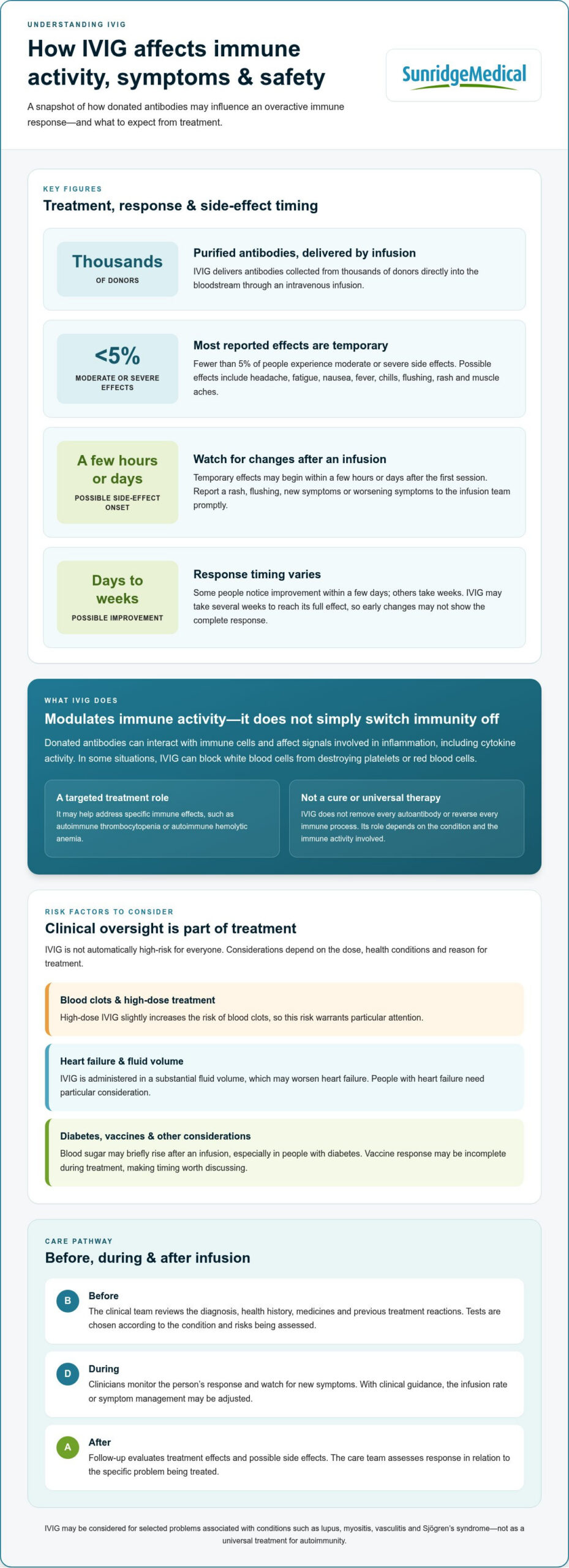
IVIG can quiet immune activity, not just strengthen immunity. IVIG therapy for autoimmune disorders delivers purified antibodies collected from thousands of donors directly into the bloodstream through an intravenous infusion. These antibodies may help regulate an overactive immune response and reduce inflammation.
IVIG therapy for autoimmune disorders has different roles depending on the condition and the symptoms being addressed. This guide explains what IVIG is, how donated antibodies may affect immune activity, and what to understand about its potential risks.
IVIG may be considered for specific problems associated with conditions such as lupus, myositis, vasculitis, and Sjögren’s syndrome, rather than as a universal treatment for autoimmunity. The sections ahead explain how infusions work, what responses and side effects may look like, and how IVIG can fit into broader autoimmune disease management.
Key Takeaways
- Understand how antibodies from donated blood can influence immune activity, and why this treatment differs from a simple immune boost.
- See which autoimmune conditions, including lupus and myositis, may be treated with IVIG and what symptoms or blood-cell problems it can address.
- Learn how treatment schedules and dosing are shaped by the condition being treated and a person’s body weight.
- Know the side effects to watch for, including headache, fatigue, nausea, and the increased risk of blood clots with high-dose treatment.
- Explore how Sunridge Medical’s autoimmune disease management can support a broader approach to complex autoimmune health needs.
Is intravenous immunoglobulin a high-risk medication?
Intravenous immunoglobulin (IVIG) is not automatically high-risk for everyone, but it requires careful clinical oversight. Risk depends on the dose, a person’s health conditions, and the reason for treatment. For some autoimmune conditions, IVIG may help regulate excessive immune activity and reduce inflammation. Clinicians weigh potential benefits against risks such as blood clots, infusion reactions, and fluid-volume concerns.
IVIG modulates immune activity rather than simply switching immunity off. Donated antibodies can interact with immune cells and affect signals involved in inflammation, including cytokine activity. In some situations, IVIG can block white blood cells from destroying platelets or red blood cells. This may matter in autoimmune thrombocytopenia or autoimmune hemolytic anemia, when these blood cells are targeted.
IVIG may also be considered when treatment for an autoimmune disease lowers protective antibody levels. For example, some people with lupus develop low antibody levels while taking immune-suppressing treatment, which can raise concerns about infection. In that setting, IVIG may supplement antibodies. This does not mean everyone taking immune-suppressing medication needs IVIG; the reason for treatment and the person’s antibody status inform the decision.
In the United States, IVIG costs vary with the dose, product, infusion setting, and treatment schedule. Insurance coverage depends on the plan, diagnosis, and coverage requirements, so there is no single coverage amount.
People with heart failure need particular consideration because IVIG is administered in a substantial fluid volume and may worsen the condition. High-dose IVIG slightly increases the risk of blood clots, while blood sugar may briefly rise after an infusion, especially in people with diabetes. Vaccine response may also be incomplete during treatment, making timing a relevant discussion for people receiving vaccines.
Before starting IVIG, the clinical team reviews the diagnosis, health history, medicines, and previous treatment reactions. Tests are chosen according to the condition and risks being assessed. During an infusion, clinicians monitor the person’s response and watch for new symptoms. Follow-up evaluates treatment effects and possible side effects.
Common temporary effects include headache, fatigue, nausea, fever, chills, flushing, rash, and muscle aches. They may begin within a few hours or days after the first session. With clinical guidance, the infusion rate or symptom management may be adjusted. High-dose treatment warrants particular attention to clot risk, while heart failure and diabetes call for monitoring tailored to those conditions.
How Does IVIG Help To Improve Symptoms?
IVIG affects immune activity through several pathways, so its effects depend on the condition being treated. Understanding what treatment may involve also means considering how long a response takes and what side effects can occur.
Potential Symptom Relief
Potential symptom relief means reducing problems caused by abnormal immune activity, not curing the autoimmune disease. Some people notice improvement within a few days, while others take weeks to see progress. IVIG may take several weeks to reach its full effect, so early changes may not show the complete response.
For example, when immune cells attack platelets or red blood cells, IVIG can sometimes block that destruction. This may help address autoimmune thrombocytopenia or autoimmune hemolytic anemia. Tracking symptoms alongside relevant clinical findings helps the care team determine whether changes are meaningful, gradual, or temporary.
IVIG is not a cure for autoimmune disease. It may be used with other medicines or treatments to control a specific immune effect or symptom. A person’s response is assessed in relation to the problem being treated, such as blood-cell destruction, rather than assuming every autoimmune symptom will improve at once.
Effects on Autoantibodies
Autoantibodies are antibodies that mistakenly target the body’s own cells or tissues. IVIG introduces a large pool of donated antibodies and can alter immune responses involving antibodies and immune cells. This broader action matters because symptoms can arise from immune activity affecting different targets, not just from the presence of one antibody.
In some situations, IVIG blocks white blood cells from destroying platelets or red blood cells. This effect is relevant to autoimmune thrombocytopenia and autoimmune hemolytic anemia. IVIG does not remove every autoantibody or reverse every immune process; its effects depend on the condition and the immune activity involved.
Side effects can include headache, fever, chills, flushing, rash, muscle aches, and nausea. They can begin within a few hours or days after the first session. Fewer than 5% of people experience moderate or severe side effects. A rash or flushing during an infusion should be reported to the infusion team promptly, so the reaction can be assessed.
Severe allergic reactions require urgent clinical attention. Infusion staff monitor for new symptoms and, with provider guidance, can adjust the infusion rate or manage temporary effects. These steps help distinguish an expected, short-lived reaction from a more serious problem. Communicate new or worsening symptoms during treatment immediately.
For readers managing complex neurologic symptoms alongside immune concerns, Sunridge Medical’s neurologic condition treatment offers a related avenue of care.
Autoimmune conditions treated with IVIG
IVIG is used for selected autoimmune diseases, not as a universal treatment for every condition. The diagnosis, immune effect, and treatment goal help determine whether it may be considered.
Conditions and Symptoms Treated
Conditions treated with IVIG include systemic lupus erythematosus, Sjögren’s syndrome, Guillain-Barré syndrome, and certain forms of dysautonomia. It is also used for dermatomyositis, polymyositis, and Kawasaki disease in children. These conditions affect different tissues and body systems, so the diagnosis alone does not explain why IVIG might be selected.
In lupus, IVIG may be used to address abnormally low platelet counts or, in particular situations, low red blood cell counts. In myositis, including polymyositis, the immune system attacks muscle cells. These examples show why clinicians consider the specific immune-related problem, such as low blood-cell counts or muscle inflammation, alongside the disease name.
Standalone and Adjunctive Use
IVIG may be used as part of a treatment plan, either alone or alongside other medicines. Its role depends on the condition and intended effect, such as supporting platelet counts in lupus or treating muscle inflammation in myositis.
Steroids and immunosuppressants act through different approaches to immune control, while IVIG provides pooled antibodies. Biologic treatments target selected immune pathways; IVIG has broader immune-modulating effects. These approaches are not interchangeable, and treatment choice depends on the disease and its specific manifestations.
Symptom Response Over Time
Symptom response describes how a person’s condition changes during and after treatment. Some people notice progress over weeks, but the timing and extent of change vary with the condition and treatment goal. Improvement may be gradual rather than immediate.
IVIG infusions may be administered over one to five days, depending on the condition. People who need multiple treatments usually receive them weekly or monthly. The schedule is part of the treatment plan, not a universal timetable; repeat infusions may be considered when ongoing treatment is needed.
An infusion itself can take a few hours, but that is different from the time needed to assess a response. Changes in platelet counts and changes in muscle symptoms, for example, are distinct treatment outcomes. Tracking the relevant signs over time helps clarify whether IVIG is addressing the intended problem.
IVIG is not a cure for autoimmune disease and may take several weeks to reach its full effect. No immediate change, by itself, does not indicate the eventual response. The condition being treated, intended outcome, and pattern of symptoms all provide context for assessing progress.
How donated antibodies are collected and work
IVIG is purified immunoglobulin made from antibodies isolated from donated blood. Each infusion contains antibodies from thousands of donors, creating a broad pool for treatment.
Collection of Donated Antibodies
To prepare IVIG, antibodies are separated and purified from donated blood. The pooled material brings together antibodies from thousands of healthy donors rather than relying on one donor’s antibody profile. This broad source matters because IVIG supplies a range of antibodies that can support immune functions or influence abnormal immune activity.
After purification, the antibodies are delivered directly into the bloodstream by intravenous infusion. They enter circulation, where they can interact with immune cells and other components involved in inflammation. Depending on the condition being treated, IVIG is used for antibody replacement or immune modulation.
IVIG Antibody Composition
IVIG used for autoimmune diseases contains 95-98% pure immunoglobulin G, or IgG, derived from healthy donors. IgG is a major antibody class that helps the immune system respond to bacterial and viral infections. Its presence in IVIG helps explain the treatment’s established role in supplying protective antibodies.
The product’s central immune feature is its concentrated IgG pool, delivered in a large dose through a vein. For autoimmune conditions, this dose may affect immune responses as well as provide antibodies. The intended purpose therefore differs from simple replacement, depending on the person’s condition.
In autoimmune disease, the immune system may target the body’s own tissues. IVIG can influence immune-cell activity and inflammatory signaling, including cytokine pathways. These effects may help regulate excessive immune responses without acting like a single-target medication. The broad pool of antibodies may alter interactions among immune components, which is relevant when inflammation contributes to tissue damage.
IVIG dosage for immune-modulating and anti-inflammatory effects is typically 1,000 to 3,000 mg/kg of body weight. The dose depends on body weight and varies with the condition being treated. This is why the same treatment doesn’t mean an identical dose or schedule for every individual. The goal may be immune modulation, antibody replacement, or both.
IVIG also treats antibody deficiencies, including primary antibody deficiency, common variable immunodeficiency, and congenital agammaglobulinemia. These conditions can leave the body with very low antibody levels. Regular infusions supply protective antibodies that the person’s immune system cannot produce adequately. People with very low antibody levels who receive regular IVIG infusions have fewer infections.
This replacement role differs from autoimmune treatment. For example, a person with common variable immunodeficiency receives IVIG to supply antibodies and help protect against infection. In autoimmune disease, the aim may instead be to influence excessive immune activity. The product is similar, but the reason for treatment shapes the dose and clinical goal.
Autoimmune conditions mentioned, including lupus, myositis, vasculitis and Sjögren’s syndrome
IVIG is used for selected conditions, but a diagnosis alone does not establish its role. Lupus, myositis, vasculitis, and Sjögren’s syndrome involve different disease processes. The practical takeaway is to connect IVIG to the specific condition and treatment objective, rather than assume one approach applies to every autoimmune diagnosis.
For systemic lupus erythematosus, IVIG may be used in particular situations involving low platelet counts or low red blood cell counts. This is a targeted use, not a general treatment for every lupus symptom. IVIG’s potential role depends on the problem being addressed, while other aspects of lupus care may have separate goals.
Myositis includes dermatomyositis and polymyositis, conditions in which the immune system attacks muscle cells. IVIG is used for these inflammatory muscle diseases. The relevant question is whether the treatment plan targets the muscle-related immune process. The term “myositis” alone does not describe the person’s symptoms, disease activity, or intended treatment outcome.
Sjögren’s syndrome is another autoimmune condition for which IVIG may be used. Guillain-Barré syndrome and certain forms of dysautonomia are also among the conditions where it may have a role. These diagnoses affect different functions, so the term “autoimmune” does not make their symptoms or treatment targets interchangeable.
Vasculitis refers to a distinct category of conditions involving blood vessels. The diagnosis alone does not tell patients whether IVIG is appropriate or what an infusion would aim to address. The specific vasculitis subtype and clinical problem matter. This distinction helps prevent a list of conditions from being mistaken for a universal treatment recommendation.
IVIG is also used for Kawasaki disease in children, a separate example from adult autoimmune conditions. These examples show the range of diagnoses associated with IVIG, but they do not imply equal evidence, identical protocols, or the same expected response. Schedules vary by condition; repeat infusions are often given weekly or monthly when multiple treatments are needed.
When comparing these diagnoses, focus on three details: the precise condition, the symptom or immune effect being targeted, and whether IVIG is intended alone or alongside other treatments. Response may unfold over weeks, so the signs of progress depend on the condition. An infusion may take a few hours, but appointment length does not predict when symptoms will change.
For individualized support with complex autoimmune concerns, explore autoimmune disease management and discuss how your diagnosis and treatment goals fit together.
Sunridge Medical: Alternative Cancer Treatment Protocols
Sunridge Medical offers Autoimmune Disease Management for people seeking a comprehensive approach to complex autoimmune concerns. IVIG is one treatment option for specific conditions and goals; understanding its potential benefits and risks can help frame a broader discussion about care.
Sunridge Medical combines conventional therapies with research-informed alternative treatments in individualized care plans. This approach may be relevant when autoimmune symptoms persist or several health factors need consideration together. The focus is on understanding each person’s circumstances and identifying an appropriate path, rather than assuming one therapy suits every diagnosis.
If you’re considering support for autoimmune concerns, contact Sunridge Medical to discuss your situation and possible next steps.
Take a thoughtful next step in your care
IVIG decisions are best considered within the wider context of your health, treatment history, and personal priorities. Whether IVIG therapy for autoimmune disorders fits your situation depends on the condition being addressed and the treatment goal. Bringing your questions and relevant medical history to a focused conversation can help clarify which options merit further consideration.
Sunridge Medical offers Autoimmune Disease Management for people seeking support with complex autoimmune concerns. Its care also includes Chronic Lyme Disease Treatment and Alternative Cancer Treatment Protocols. These services address distinct health needs, so the next step should reflect the condition you want to manage, rather than assume one approach suits everyone.
If you’re ready to discuss your autoimmune care and possible next steps, contact Sunridge Medical. A considered conversation can help you move forward with greater clarity and purpose.
Frequently Asked Questions
What Is IVIG?
IVIG is purified immunoglobulin G antibodies collected from donated blood and given as treatment. Each dose combines antibodies from thousands of donors, rather than one person. IVIG therapy for autoimmune disorders uses these antibodies to influence immune activity, while treatment for antibody deficiencies supplies protective antibodies. The purpose depends on the diagnosis and the immune problem being addressed.
What autoimmune disorders are treated with IVIG, and for which is it FDA-approved?
IVIG is used for conditions including systemic lupus erythematosus, Sjögren’s syndrome, Guillain-Barré syndrome, certain forms of dysautonomia, dermatomyositis, polymyositis, and Kawasaki disease in children. FDA approval is specific to the product and indication; a condition’s use in treatment does not by itself establish FDA approval for that use. For lupus, a possible treatment aim is addressing abnormally low platelet counts or, in particular situations, low red blood cell counts.
How does IVIG work for autoimmune diseases?
In IVIG therapy for autoimmune disorders, pooled antibodies may alter immune responses involving antibodies and immune cells. They may help regulate abnormal activity, but do not remove every autoantibody. For example, in some situations IVIG can block white blood cells from destroying platelets or red blood cells. This mechanism can matter in autoimmune thrombocytopenia or autoimmune hemolytic anemia, but effects depend on the condition and immune process being targeted.
What evidence supports IVIG for different autoimmune disorders?
Evidence and clinical use are condition-specific. IVIG is described as an effective treatment for certain inflammatory diseases, including myositis, in which the immune system attacks muscle cells. In lupus, it may be used in particular situations involving low platelets or low red blood cell counts. These examples involve different treatment goals, so evidence for one condition or outcome should not be assumed to establish benefit for every autoimmune disease.
What IVIG dose and treatment schedule are used for autoimmune diseases?
For immunomodulatory and anti-inflammatory effects, typical dosing is 1,000 to 3,000 mg/kg of body weight, with the condition also shaping the dose. Infusions may be given over one to five days. People needing repeated treatment usually receive infusions weekly or monthly. These figures describe common approaches, not a single schedule for every diagnosis; treatment duration and frequency are tied to the condition and intended effect.
How is IVIG administered, and what should patients expect during treatment?
IVIG is infused into a vein, commonly in the arm; subcutaneous immunoglobulin is given under the skin. An IV infusion typically takes a few hours. People receiving IVIG can usually eat, drink, and take their usual medication beforehand. Vaccine timing deserves attention because vaccine response may be incomplete during treatment; discuss timing with the rheumatology provider managing your care.
What are the common and serious side effects and risks of IVIG?
Common effects include headache, fever, chills, flushing, rash, muscle aches, and nausea. Fewer than 5% of people experience moderate or severe side effects. High-dose IVIG slightly increases blood-clot risk, and the fluid volume may worsen heart failure. Blood sugar may rise briefly after an infusion, particularly for people with diabetes. Report new symptoms during treatment so the infusion team can assess them.
How long does IVIG take to work, and how long do its benefits last?
Some people notice improvement within a few days, while others take weeks; IVIG may take several weeks to reach its full effect. The timing and duration of any benefit depend on the condition and treatment plan. When multiple infusions are needed, they are usually scheduled weekly or monthly. Track the specific symptoms or clinical findings being treated to understand changes over time.