


What if the value of heating a tumor depends less on the idea itself than on the cancer type and how the treatment is used? That’s the central question behind local hyperthermia cancer treatment. If you’re weighing it alongside other care, it helps to understand what the treatment is intended to do and what evidence supports that use.
Local hyperthermia uses controlled heat directed at a tumor or specific body region. It may be combined with treatments such as radiation or chemotherapy, but it isn’t a universal approach or a replacement for established cancer care. Evidence and potential risks vary by cancer, treatment method, and individual circumstances, so broad promotional claims deserve careful scrutiny.
This guide explains how local hyperthermia works, where clinical evidence is stronger or more limited, and which questions about safety and treatment goals matter. It also outlines how to discuss the option within a coordinated cancer care plan. Sunridge Medical develops individualized cancer protocols that consider each patient’s overall circumstances and may integrate conventional therapies with research-based alternative approaches. This context can help make conversations about possible next steps more specific and informed.
Key Takeaways
- Understand how local hyperthermia directs controlled heat to a tumor or targeted region, and why its use varies by cancer type and clinical setting.
- Learn how researchers assess its role alongside other treatments, while distinguishing proposed mechanisms from demonstrated patient benefits.
- Recognize that potential benefits, evidence limitations, and safety considerations depend on the treatment method and individual circumstances.
- Use a practical framework to discuss diagnosis, treatment goals, evidence, safety, coordination, and follow-up with your care team.
- See how local hyperthermia cancer treatment can be considered within an individualized plan that accounts for conventional care and research-based approaches.
What Is Local Hyperthermia Cancer Treatment?
Local hyperthermia cancer treatment uses controlled heat directed at a tumor or a targeted area of the body. The method and purpose depend on the clinical protocol. In some settings, heat is investigated or used alongside treatments such as radiation or chemotherapy. That rationale does not establish a benefit for every cancer or patient.
The term “hyperthermia” covers different approaches, including local, regional, and whole-body methods. The Hyperthermia therapy overview describes these categories, but the label alone doesn’t tell you which area will be heated, what the treatment is meant to achieve, or how strong the evidence is for a particular diagnosis. When evaluating a proposed treatment, clarify those details and how they relate to the overall care plan.
Local hyperthermia is not a universal cancer cure, and it shouldn’t be treated as a substitute for oncology care. Its potential role needs to be assessed in the context of the cancer type, treatment goal, evidence for the specific protocol, and other care being considered.
How Is Local Hyperthermia Different From Whole-Body Hyperthermia?
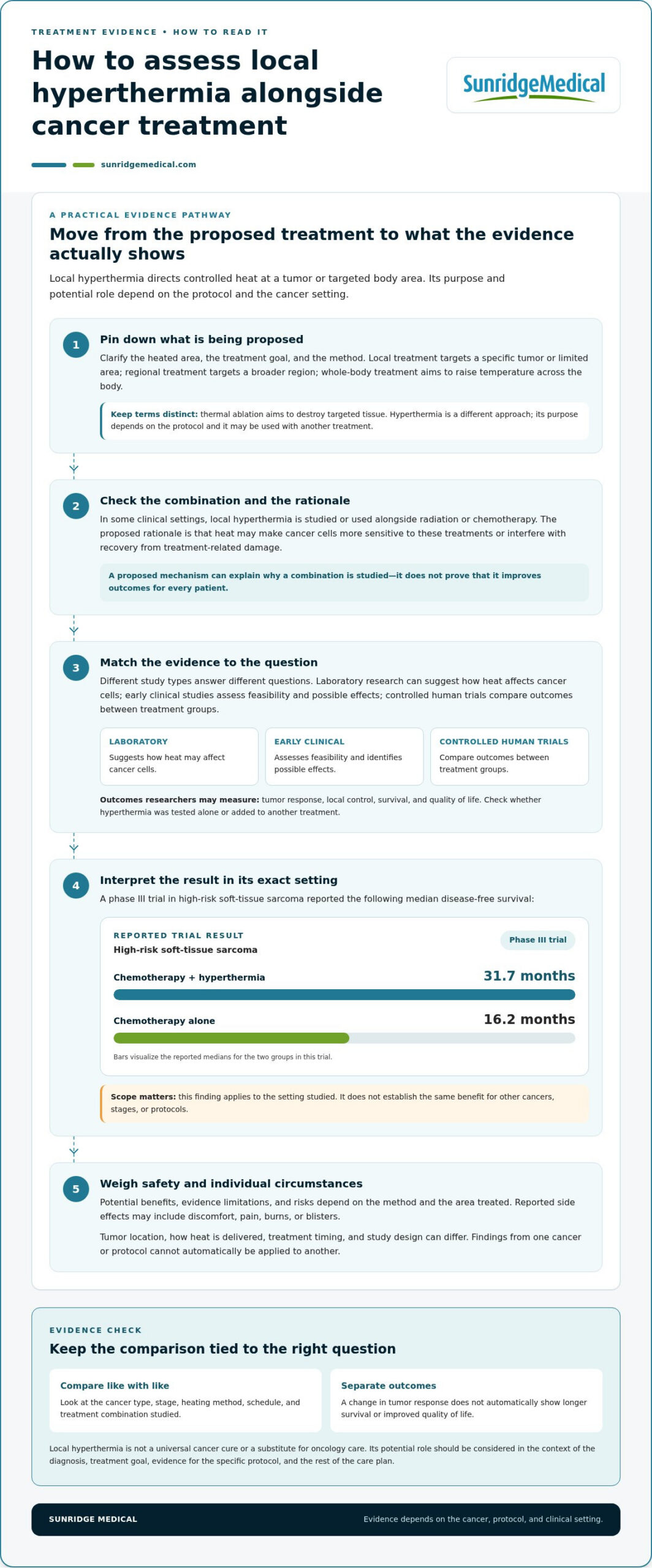
Local hyperthermia is intended to heat a specific tumor or limited body area. Whole-body hyperthermia, by contrast, aims to raise temperature across the body. Regional hyperthermia targets a broader body region, so it isn’t simply another name for local treatment. Before comparing these approaches, clarify the area each one targets and the treatment goal, since protocols can differ.
Is Hyperthermia the Same as Thermal Ablation?
No. Thermal ablation uses heat with the aim of destroying targeted tissue. Hyperthermia is a distinct approach whose purpose depends on the protocol; it may be used with another treatment rather than to destroy tissue by itself. Because similar terms can describe different procedures, ask what the proposed treatment is designed to do, what evidence supports its use for the specific cancer, and how it fits with the overall care plan.
How Local Hyperthermia Is Used Alongside Cancer Treatment
Local hyperthermia may be studied or used with another treatment in specific clinical settings. The proposed rationale is that heat can make cancer cells more sensitive to radiation or certain chemotherapy drugs, or may interfere with their ability to recover from treatment-related damage. These mechanisms help explain why researchers study combinations, but they do not prove that a combination improves outcomes for every patient.
The National Cancer Institute’s Hyperthermia to Treat Cancer overview describes hyperthermia as an approach used alongside treatments such as radiation and chemotherapy in some settings. To assess local hyperthermia cancer treatment, look for evidence tied to the specific cancer type, stage, heating method, treatment schedule, and combination under consideration. Findings from one diagnosis or protocol cannot automatically be applied to another.
What Does the Research Measure?
Laboratory research can suggest how heat affects cancer cells, but it cannot show by itself whether patients live longer or feel better. Early clinical studies can help assess feasibility and identify possible effects, while controlled human trials compare outcomes between treatment groups. Researchers may measure tumor response, local control, survival, and quality of life. Check whether a study tested hyperthermia alone or added it to another treatment, since those approaches answer different questions.
Why Do Results Differ Across Cancer Types and Protocols?
Tumor location, how heat is delivered, treatment timing, and study design can all vary. A result for one cancer and combination doesn’t establish the same benefit for a different cancer, stage, or protocol. For example, a phase III trial in high-risk soft-tissue sarcoma reported median disease-free survival of 31.7 months when hyperthermia was added to chemotherapy, compared with 16.2 months with chemotherapy alone. That finding applies to the setting studied, not to cancer care generally.
When reviewing a reported benefit, look at who participated, what the comparison group received, which outcome was measured, and what treatments were combined. A change in tumor response, for instance, isn’t automatically evidence of longer survival or improved quality of life. Keeping these distinctions in view helps separate a plausible biological explanation from demonstrated patient benefit.
For a broader perspective on how research-based options can be considered alongside conventional care, explore Sunridge Medical’s individualized cancer care approach. Reviewing the diagnosis, current treatments, and evidence for a specific protocol can help put any proposed adjunct in context.
Local Hyperthermia Benefits, Limitations, and Safety: What to Weigh
Weigh any potential benefit against the quality of the evidence and the risks of the specific protocol. A plausible explanation for how heat might affect tumor cells is not proof that local hyperthermia cancer treatment will reliably help every patient. The National Cancer Institute notes that side effects can vary with the method used and area treated, and may include discomfort, pain, burns, or blisters.
| What to weigh | Questions to consider |
|---|---|
| Potential role | Is the treatment intended to complement another therapy, and what outcome is it meant to improve? |
| Evidence limitations | Does the research match this cancer type, stage, treatment method, and combination? Are results based on human trials, and have they been replicated? |
| Practical considerations | What area is treated, how is heat delivered and monitored, and how does the schedule fit with other care? |
| Unanswered questions | What remains uncertain about likely benefit, side effects, or the effect on this person’s overall treatment plan? |
What Are the Main Limitations of the Evidence?
Study findings are easier to interpret when you know how many people were studied, what the comparison group received, how long participants were followed, and whether separate research groups found similar results. A small or short study may offer useful early information without establishing a lasting benefit. Even a well-designed trial describes outcomes for a study population, not a guarantee for an individual patient. Look for current clinical guidance and evidence summaries that address the specific diagnosis and treatment combination, rather than relying on a general claim about hyperthermia.
What Safety Questions Matter Before Treatment?
Risks depend on the treatment area, heating method, equipment, monitoring, and any therapies given at the same time. The National Cancer Institute identifies discomfort, pain, burns, and blisters among possible side effects; the likelihood and relevance of these effects depend on the particular approach. Discuss personal risks with the treating oncology team, including how the proposed protocol would be coordinated with current care. Don’t stop or delay established treatment based on a promotional claim or a proposed adjunct without discussing the decision with that team.
How to Assess Whether Local Hyperthermia Fits a Cancer Care Plan
A structured discussion can turn a broad treatment claim into a specific decision. Before considering local hyperthermia cancer treatment, bring your diagnosis details, current treatment plan, and questions to the clinicians involved in your care. Use this framework to identify what is known, what remains uncertain, and how the option might fit your goals.
- 1. Confirm the diagnosis. Identify the cancer type, stage, tumor location, and other details that shape treatment decisions.
- 2. Define the treatment goal. Clarify whether the proposed approach aims to support local tumor control, response to another therapy, symptom relief, or another outcome.
- 3. Match evidence to your situation. Look for evidence involving the same cancer type, stage, heating method, and treatment combination. A result from a different clinical setting may not apply.
- 4. Review safety. Discuss how the treatment area, method, monitoring, and concurrent therapies may affect personal risks.
- 5. Coordinate care. Make sure the clinicians overseeing your cancer care know about the full proposed plan, including timing and other treatments.
- 6. Agree on follow-up. Establish what will be monitored, when it will be assessed, and how the team will interpret benefit, side effects, or lack of response.
Which Questions Help Clarify the Treatment Goal?
Ask what measurable outcome the approach is intended to support and how that outcome will be evaluated. Which evidence relates to your diagnosis and the specific protocol being proposed? Is the treatment intended to work alongside another therapy, and how does its timing relate to that care? Discuss realistic uncertainties as well as possible benefits. A clearly defined goal makes it easier to understand what the treatment can and cannot be expected to do.
How Can Patients Protect Continuity of Care?
Share the proposed plan with the clinicians involved in your cancer care so they can consider timing, safety, and potential interactions together. Don’t delay, change, or stop prescribed treatment without medical guidance. Writing down the proposed benefit, known uncertainties, monitoring plan, and follow-up schedule can also help. It gives you and your care team a shared reference as decisions evolve.
Treatment context matters throughout care. Sunridge Medical’s guide to integrative cancer treatment by stage offers a broader perspective on considering options within an individualized plan. The aim is to assess each option in light of the diagnosis, current care, and priorities, rather than assume one protocol suits every patient.
Individualized Cancer Care: Putting Local Hyperthermia in Context
A proposed adjunct should be considered as one part of a coordinated plan, not as a stand-alone answer to cancer. Whether local hyperthermia cancer treatment has a potential role depends on the individual diagnosis, the evidence for the specific protocol, other treatments, and the patient’s priorities. No single approach fits every cancer or every person.
A thorough care-planning conversation considers:
- Diagnosis: cancer type, stage, location, and relevant test results.
- Treatment history: therapies already completed, current care, and planned next steps.
- Overall health: other medical conditions and factors that may affect treatment decisions.
- Goals and preferences: what outcomes matter most to the patient and what trade-offs they consider acceptable.
What Does an Individualized Cancer Plan Consider?
Clinicians can weigh the evidence for a proposed approach alongside its uncertainties, potential risks, and relationship to other treatments. For example, the rationale for combining an adjunct with radiation or chemotherapy doesn’t establish that the combination is appropriate for every diagnosis. The discussion should connect the proposed protocol to the patient’s actual circumstances, rather than assume a treatment used in one setting will suit another.
How Can Patients Take a Clear Next Step?
Before a care-planning conversation, gather relevant records, a current treatment list, and questions about goals, evidence, safety, and follow-up. Ask how the proposed option would fit with existing care and how the clinicians involved will stay informed. Keep the treating oncology team involved in decisions throughout, and don’t change or stop prescribed treatment without medical guidance.
Sunridge Medical is a physician-led center offering individualized cancer treatment protocols that may integrate conventional therapies with research-based alternative approaches. Each plan takes the person’s overall circumstances into account rather than applying a standard package. This broader perspective can help patients consider possible options while keeping coordination and continuity of care in view.
For a thoughtful discussion of an individualized cancer care plan, explore individualized cancer care at Sunridge Medical.
Make Your Next Cancer Care Decision With Clarity
Local hyperthermia cancer treatment has a specific role in some clinical settings, but its evidence and potential risks depend on the cancer type, treatment method, and combination of therapies. A promising mechanism or result from one study doesn’t guarantee the same outcome for another person. Consider any proposed treatment alongside your diagnosis, goals, current care, and follow-up plan.
That decision benefits from a coordinated, individualized perspective. Sunridge Medical is a physician-led practice directed by Medical Director Dr. Steven S. Isaacman and founded in 2003. Its cancer care plans are tailored to the individual and may integrate conventional therapies with research-based alternative approaches. This places options in context without treating one protocol as right for everyone.
Bring your questions and treatment information into the care-planning conversation, and keep your oncology team involved as decisions take shape. To learn more about a personalized approach, explore individualized cancer care at Sunridge Medical.
Frequently Asked Questions
Is local hyperthermia an effective cancer treatment?
There isn’t one answer for every cancer or patient. Research findings depend on the cancer type, heating method, treatment combination, and outcomes measured. Some studies evaluate hyperthermia alongside other cancer treatments, but a result in one setting doesn’t establish effectiveness in another. Review evidence for the specific diagnosis and protocol with your oncology team, and distinguish a proposed biological mechanism from demonstrated clinical benefit.
Can local hyperthermia be combined with radiation or chemotherapy?
Yes, some research and clinical protocols evaluate hyperthermia alongside radiation or chemotherapy. Whether a particular combination is appropriate depends on the diagnosis, protocol, and individual circumstances. Evidence from one cancer type or treatment schedule may not apply to another. Before adding or changing treatment, discuss the proposed goal, potential benefits and risks, timing, and possible interactions with the clinicians coordinating your cancer care.
What are the possible side effects of local hyperthermia?
Possible side effects vary with the heating method, treatment area, equipment, and clinical protocol. They may include discomfort or skin effects, but general lists can’t predict an individual’s risk. Ask the treating team what effects are expected, how treatment will be monitored, and which symptoms require prompt attention. Report new or worsening symptoms to the clinicians coordinating your care so they can assess them in context.
How is local hyperthermia different from thermal ablation?
Local hyperthermia generally refers to controlled heating directed at a specific target area. Thermal ablation uses heat with the aim of destroying tissue. These terms describe different treatment purposes and shouldn’t be used interchangeably. Since techniques can vary, clarify what procedure is proposed, its intended outcome, and what evidence applies to your diagnosis before evaluating its potential role in your care.
Should local hyperthermia replace standard cancer treatment?
No. Local hyperthermia shouldn’t be assumed to replace established cancer treatment. Decisions about adding, changing, delaying, or stopping any treatment should be discussed with the clinicians responsible for your care. Evidence and recommendations can vary by diagnosis and protocol, so review the proposed goal, risks, and alternatives in context. Keep your oncology team informed to support continuity and coordinated decisions throughout treatment.