


What if worsening symptoms after treatment aren’t proof that it’s working? When you’re already managing a complex illness, a new flare can be difficult to interpret. Online descriptions also use “Herxheimer reaction” for symptoms with different possible causes. Managing Herxheimer reaction starts with noticing what’s changed, not assuming why.
It’s understandable to worry that reporting symptoms could derail your treatment plan. A classic Jarisch-Herxheimer reaction is an acute inflammatory response that can occur after antimicrobial treatment for certain infections, including spirochetal infections. But worsening symptoms may have another explanation, and a reaction shouldn’t be treated as evidence that therapy is effective.
This guide explains what the classic reaction means, how to track symptoms and their timing, and how to share those details with your clinician. Treatment decisions, including whether to continue or adjust a plan, should be made with individualized clinical guidance rather than online assumptions. A careful process can help you seek clarity while keeping your care team informed.
Key Takeaways
- A symptom flare after treatment can have several explanations, so timing and context matter more than an assumption.
- When managing Herxheimer reaction, track what changed, when it began, and any recent treatment or medication changes.
- A symptom log can help your clinician assess patterns and decide whether further evaluation or a treatment-plan adjustment is appropriate.
- Follow your clinician’s existing instructions for self-care, and share worsening or concerning symptoms with your treatment team.
- Persistent or complex symptoms may benefit from individualized physician review that considers your health circumstances and care goals.
What Does Managing a Herxheimer Reaction Actually Mean?
Symptoms that worsen after treatment can be unsettling, especially when they overlap with the illness you were already experiencing. The change deserves careful interpretation, not an automatic label. Managing Herxheimer reaction means understanding what clinicians mean by the classic Jarisch-Herxheimer reaction while recognizing that similar symptoms can have other explanations.
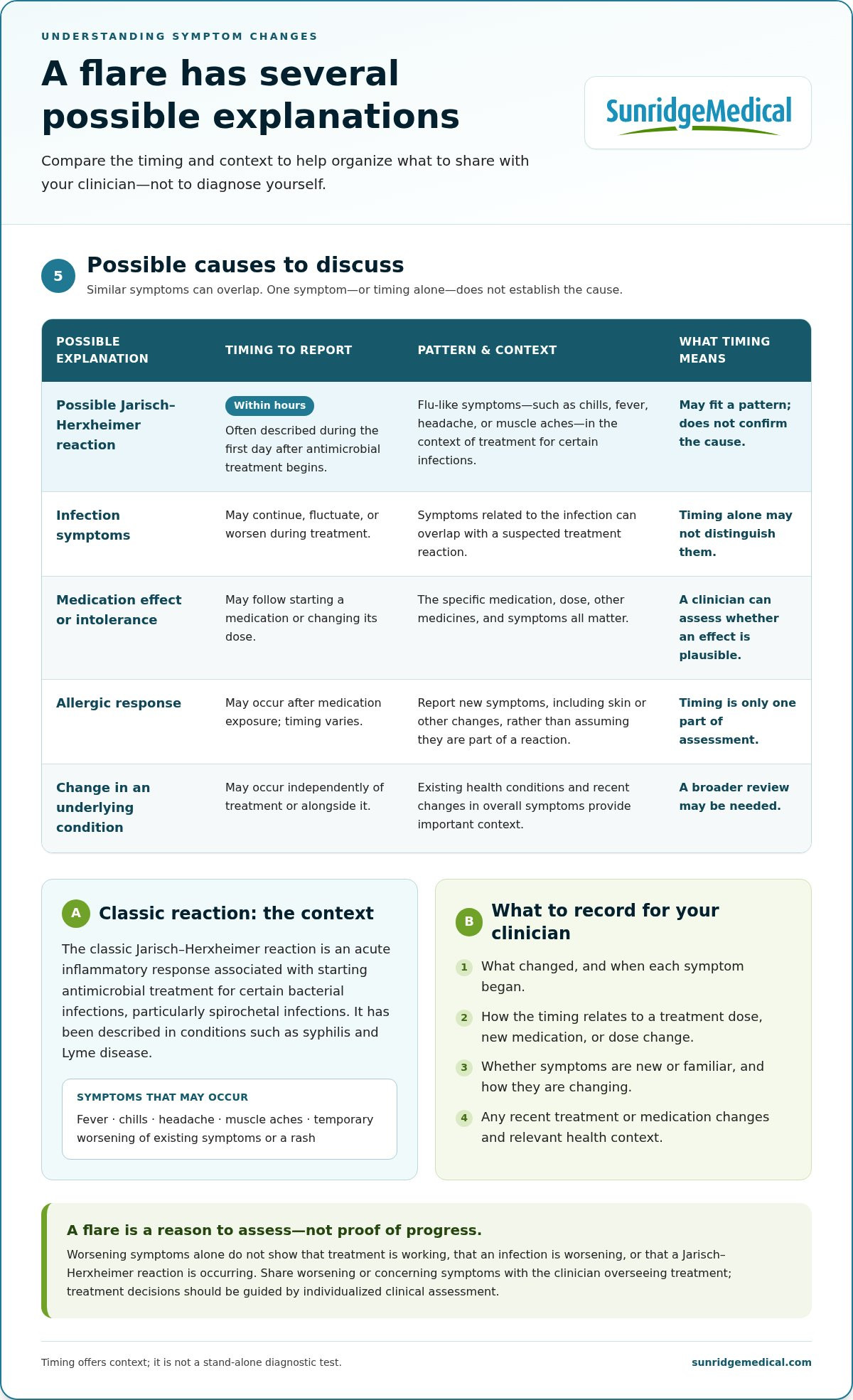
The classic reaction is an acute inflammatory response associated with starting antimicrobial treatment for certain bacterial infections, particularly infections caused by spirochetes. It has been described in conditions such as syphilis and Lyme disease. Fever, chills, headache, muscle aches, and a temporary worsening of existing symptoms or a rash may occur. These features can provide context for a clinician, but they don’t confirm the cause on their own.
The classic Jarisch-Herxheimer reaction in brief
Traditionally, the Jarisch-Herxheimer reaction refers to a short-term response following the start of antimicrobial treatment for certain infections. Symptoms are generally described as beginning within hours and during the first day after treatment starts. The Jarisch-Herxheimer reaction overview summarizes its association with particular infections and treatment. Timing can help a clinician assess what may be happening, but it isn’t a stand-alone diagnostic test.
The term describes a recognized clinical phenomenon, not a conclusion to apply whenever someone feels worse. A clinician considers the infection being treated, the medication and when it was started, the symptom pattern, and the person’s medical circumstances. For example, chills soon after beginning antimicrobial treatment may be relevant to that assessment, but they don’t establish that a Jarisch-Herxheimer reaction is the cause.
Why the term is used differently in Lyme discussions
In conversations about Lyme disease, “Herx” is often used more broadly for symptoms that worsen during treatment. That use may reflect a person’s experience, but it isn’t always equivalent to the classic Jarisch-Herxheimer reaction described in clinical settings. The distinction matters because the label alone can’t explain what caused a flare or determine whether a treatment should change.
Worsening during Lyme treatment may have several possible explanations. Symptoms could relate to the infection itself, an effect or intolerance associated with medication, an allergic response, or a change in another health condition. These possibilities can overlap, and timing may not settle the question. Terms such as “die-off” or “detoxification” are sometimes used to explain a flare, but worsening symptoms alone don’t establish those explanations as fact.
A flare is a reason to assess, not proof of progress. It doesn’t, by itself, show that a treatment is working, that the infection is worsening, or that a Jarisch-Herxheimer reaction is occurring. Share changes with the clinician overseeing treatment so they can interpret them in context. Individualized assessment helps distinguish a familiar pattern from a new concern without relying on an assumption.
How to Tell a Possible Herxheimer Reaction From Other Causes
Similar symptoms can arise from different causes, so the pattern matters more than any single symptom. A clinician will interpret what you’re experiencing alongside the infection being treated, the medication or other treatment involved, your medical history, and recent changes in your health. The comparison below can help organize what to report. It isn’t a tool for diagnosing yourself.
| Possible explanation | Timing to report | Pattern and context to discuss | What timing can tell you |
|---|---|---|---|
| Possible Jarisch-Herxheimer reaction | Often described as starting within hours, and during the first day after antimicrobial treatment begins | Flu-like symptoms such as chills, fever, headache, or muscle aches in the context of treatment for certain infections | It may fit the pattern, but doesn’t confirm the cause |
| Infection symptoms | May continue, fluctuate, or worsen during treatment | Symptoms related to the infection can overlap with a suspected treatment reaction | Timing alone may not distinguish the two |
| Medication effect or intolerance | May follow starting a medication or changing its dose | The specific medication, dose, other medicines, and symptoms all matter | A clinician can assess whether a medication effect is plausible |
| Allergic response | May occur after exposure to a medication; timing varies | Report any new symptoms, including skin or other changes, rather than assuming they’re part of a Herxheimer reaction | Timing is only one part of clinical assessment |
| Change in an underlying condition | May occur independently of treatment or alongside it | Existing health conditions and recent changes in overall symptoms provide important context | A broader review may be needed |
Symptoms and timing clinicians may ask about
Commonly described symptoms of a classic reaction include fever, chills, headache, and muscle aches. Note when each symptom began in relation to a treatment dose, a new medication, or a dose change. Record whether it’s new or familiar, steadily changing, or occurring with other symptoms. These details help your clinician assess the pattern; they don’t establish a diagnosis.
Timing after treatment may be a clue, but it cannot confirm the cause by itself. A symptom you recognize from past flares can still have a different explanation this time. Likewise, a symptom that begins soon after treatment may be related to treatment without being a Jarisch-Herxheimer reaction.
Why worsening symptoms shouldn’t automatically be called a Herx
A suspected reaction, medication side effect, allergic response, infection-related symptoms, and a change in another condition can overlap. A clinician can evaluate these possibilities using your medical history, treatment context, and symptom progression. Neither the intensity of a flare nor how uncomfortable it feels proves that treatment is effective.
When symptoms or treatment tolerance are difficult to interpret, a physician-led review can help put the details in context. Sunridge Medical provides individualized, research-informed care for complex and chronic conditions alongside conventional care. Learn about physician-led care for complex conditions.
Managing a Possible Herxheimer Reaction: Practical Steps to Discuss
If symptoms worsen during treatment, a clear record can help your clinician assess the change without assuming its cause. These steps can help you organize information and follow your existing care plan; they aren’t for diagnosing a reaction or changing treatment on your own. Managing Herxheimer reaction safely begins with keeping your treating clinician involved.
Build a useful symptom and treatment record
Keep notes in a format that’s easy to update, such as a journal or phone document. Focus on observable details rather than deciding whether a symptom is a Herxheimer reaction. Brief, consistent entries can make the sequence clearer.
- Record what you feel. Note each symptom, when it began, whether it’s changing, and how it affects everyday activities such as sleeping, eating, or moving around. Describe its intensity consistently, such as mild, moderate, or severe, rather than relying on memory later.
- Mark the timing. Record when symptoms started in relation to each treatment dose, infusion, or medication change. If you’re unsure of the exact time, make a best estimate and label it as approximate.
- Review recent changes. List treatments, prescription and nonprescription medicines, supplements, and dose adjustments, with dates when possible. Note changes in your routine or health that may help your clinician understand the broader context.
- Contact the treating clinician. Share your notes and ask what next steps fit your treatment plan. Don’t stop, restart, reduce, or increase a medication or treatment unless the prescribing clinician advises you to do so.
Track measurements, such as temperature, only if your clinician has recommended them and explained how to take or record them. Extra measurements without guidance may add stress without answering the key clinical questions.
Use supportive measures without adding treatment risks
Rest, fluids, and familiar comfort measures may be appropriate for some people, but they aren’t universal instructions. Your medical conditions, medications, and treatment plan can affect what’s suitable. Follow existing clinician guidance and ask which measures fit your circumstances before making a change.
Don’t start a supplement, detox protocol, or new medicine for a presumed reaction without discussing it with your clinician. These additions may affect current medications or complicate the assessment of new symptoms. A simple, careful approach is often more useful than adding several interventions at once.
For persistent or complicated symptoms, an individualized physician review can bring treatment tolerance, medical history, and changing priorities into the discussion. Sunridge Medical provides physician-led, research-informed care for complex conditions as an integrative option alongside conventional care. Explore individualized care for complex conditions.
How to Discuss Symptoms and Reassess the Treatment Plan
A symptom log is most useful when it supports decisions with your clinician. Bring the sequence of changes, treatment dates, and effects on daily activities to the conversation. The pattern may help the clinician consider whether symptoms fit a possible treatment reaction or whether another cause, medication effect, or change in your health needs attention.
Reassessment should reflect the individual’s symptoms, treatment, and clinical findings. There’s no single follow-up schedule or treatment response that applies to everyone. Be direct about what has changed, what concerns you, and how well you’re tolerating the plan. Reporting a problem gives your care team information to assess; it doesn’t require you to decide whether treatment should stop.
Prepare focused questions for the treating clinician
Before reaching out, identify the main changes you want to discuss and have your symptom notes and current medication list ready. You can ask:
- What evidence supports a suspected Jarisch-Herxheimer reaction in my specific treatment context?
- What other causes or treatment effects should we consider, given my medical history and current symptoms?
- Which changes should prompt me to update the treatment team, and how should I reach them?
- What symptoms or measurements should I record, and when would you like an update?
These questions can clarify what to monitor without requiring you to interpret symptoms alone. If you’re unsure whether a change is relevant, include it in your update and let the clinician assess its significance.
Reassess without assuming one fixed schedule
Follow-up timing depends on the situation. The clinician may consider symptom progression, treatment tolerance, laboratory findings when relevant, and the overall treatment context. A mild, familiar symptom and a new or worsening pattern may call for different responses. Ask what follow-up makes sense for you rather than relying on a general timeline or dismissing symptoms because someone called them a “Herx.”
Before changing a prescribed plan, discuss potential benefits, risks, tolerability, and alternatives with the prescribing clinician or established care team. Don’t independently stop, reduce, delay, or add treatment based on an assumed cause. If treatment is difficult to tolerate, say so plainly; the clinician can review the details and consider whether the plan needs reassessment.
For complex symptoms, managing Herxheimer reaction isn’t about pushing through at all costs or making a treatment decision from a label. It’s about sharing useful information and receiving individualized clinical guidance. Sunridge Medical offers physician-led, research-informed care for complex and chronic conditions as an integrative option alongside conventional care. Explore individualized physician-led care.
Where Individualized Integrative Care Fits When Symptoms Are Complex
Persistent or complicated symptoms deserve a broader clinical review, not an automatic “Herxheimer” label. A physician can consider whether the suspected reaction fits the treatment context while reviewing other possible explanations and your overall health. This wider perspective can be useful when you have multiple conditions, take several medications, or find a treatment difficult to tolerate.
Integrative care can complement conventional care; it doesn’t need to replace it. At Sunridge Medical, physician-led, research-informed recommendations are individualized rather than based on a single symptom or standard protocol. Whether this approach is suitable, and what care may be appropriate, depends on physician review of your individual circumstances.
What an individualized review can take into account
A careful review may consider your diagnosis and treatment history, medical history, laboratory findings, medications, organ function, current symptoms, and treatment tolerance. Personal goals matter, too. Priorities can change as symptoms and circumstances evolve, and that context can help inform a plan that responds to the individual rather than to a presumed reaction alone.
Plans may be reassessed as a person’s response, tolerance, clinical findings, or priorities change. This doesn’t promise a particular outcome; it provides a framework for weighing relevant information and options over time. The aim is to make decisions with a clear understanding of the person’s health needs and the role of existing conventional care.
What to expect when exploring Sunridge Medical
Sunridge Medical is an outpatient medical treatment facility providing hands-on care with licensed clinical professionals, a full nursing team, and dedicated infusion rooms. Its physician-led Complex & Chronic Conditions care includes evaluation and treatment for conditions such as Lyme disease and infections. Treatment recommendations depend on physician review of the individual’s diagnosis, medical history, laboratory findings, medications, organ function, symptoms, treatment tolerance, and personal goals.
The Patient Care Team can answer general questions about Sunridge Medical’s approach. An introductory call doesn’t provide a diagnosis or prescription; treatment decisions require appropriate physician review. Learn about Sunridge Medical’s integrative approach.
For anyone managing Herxheimer reaction amid a more complex health picture, individualized review can keep the focus on careful assessment instead of assumptions. It can support a considered conversation about how symptoms, treatment history, and personal priorities fit together, while keeping integrative options alongside conventional care.
Take the Next Step With Clarity
You don’t have to settle the meaning of a symptom flare before asking for help. Decide what you most need clarified, then bring that question to the clinician guiding your treatment. That conversation can help turn uncertainty into a considered plan without asking you to make medication decisions alone.
Managing Herxheimer reaction is about responding thoughtfully to what your body is telling you while keeping decisions grounded in clinical guidance. If you’re considering a broader perspective on complex symptoms or treatment tolerance, learn more about Sunridge Medical’s physician-led, integrative care, or call the Patient Care Team at 1-800-923-7878 with general questions. The team cannot diagnose or prescribe during an introductory call.
Frequently Asked Questions
What is a Herxheimer reaction, and when can it happen?
A Jarisch-Herxheimer reaction is an acute response classically associated with treatment for certain bacterial infections. It’s generally described as beginning soon after treatment starts, but timing alone can’t confirm the cause. In Lyme-treatment discussions, “Herx” may be used more broadly for worsening symptoms. Ask your treating clinician how the term applies to your diagnosis and treatment, especially if symptoms are new or differ from your usual pattern.
How long does a Herxheimer reaction last?
There isn’t one reliable duration that applies to everyone or to every symptom described as a “Herx.” The classic reaction is generally considered acute, while symptoms attributed to Lyme-treatment flares may have different explanations and patterns. Note when symptoms begin, whether they ease or continue, and how they affect daily activities. That timeline gives your clinician more useful context than trying to match your experience to a general estimate.
How can I manage a possible Herxheimer reaction at home?
Start by writing down what changed and when, then follow the instructions already given by your clinician. For managing Herxheimer reaction symptoms, ask which comfort measures are appropriate for your health conditions and medicines rather than adopting a general online regimen. Don’t add supplements, detox protocols, or medicines based on an assumption about the cause. Share your observations with the treating clinician before changing a prescribed plan.
Does feeling worse after treatment mean it is working?
No. Feeling worse doesn’t show that treatment is effective or confirm a Herxheimer reaction. A symptom that appears after a dose could relate to treatment, the underlying infection, or another health change, and the sequence alone can’t settle which. Track whether the symptom is new, familiar, or affecting your usual activities, then discuss that pattern with your clinician. Discomfort isn’t a measure of treatment success.
Should I stop or reduce treatment during a suspected Herxheimer reaction?
Don’t stop or reduce prescribed treatment based only on an online description or a suspected reaction. Contact the prescribing clinician, explain what changed and when, and ask how to proceed with your specific plan. They can weigh your symptoms, treatment history, other medicines, and tolerance before recommending whether a change is appropriate. If you have questions about an upcoming dose, raise them with the treatment team rather than deciding from the label alone.
Is a Herxheimer reaction the same as an allergic reaction?
No. They are different concepts, although some symptoms may overlap, so a symptom list can’t reliably distinguish them in every case. Tell your treating clinician about new symptoms, when they appeared, and any recent treatment or medication changes. Include whether the symptom has happened before and whether it is changing. This context can help the clinician assess what may be happening and advise you about next steps.
Can Lyme disease treatment cause a Herxheimer reaction?
The term “Herxheimer reaction” is used in some Lyme-treatment discussions to describe worsening symptoms, but that wording alone doesn’t establish a specific cause or mechanism. The classic Jarisch-Herxheimer reaction has a more established association with treatment of certain infections. If symptoms change during Lyme treatment, ask your clinician to interpret them in light of your diagnosis, treatment history, other medicines, and overall health rather than assuming the label explains them.