


A “natural” label doesn’t guarantee that a remedy is safe or effective. If symptoms persist despite care, it’s understandable to look for additional options. But conflicting online claims and possible supplement interactions can make it difficult to know what’s trustworthy. The question isn’t simply which natural remedies for autoimmune disease to try. It’s how to assess them without putting established treatment at risk.
This guide distinguishes supportive lifestyle approaches from claims that go beyond the evidence. It explains what research can and can’t tell us, why some supplements may be unsuitable for people with autoimmune conditions, and how to discuss complementary options with a qualified clinician. Natural approaches may contribute to overall well-being, but they aren’t substitutes for prescribed treatment. What’s appropriate depends on your diagnosis, medications, and health history.
You’ll find practical guidance on nutrition, movement, sleep, and stress management, along with steps for reviewing supplements and preparing focused questions for your care team. An individualized discussion can help you explore options while keeping safety and effective autoimmune care at the center.
Key Takeaways
- Consider natural remedies for autoimmune disease as potential supports for well-being, not cures or replacements for prescribed care.
- Build everyday habits around balanced eating, appropriate movement, restorative sleep, stress support, and avoiding tobacco. Don’t assume these habits control disease activity.
- Assess supplements carefully. Evidence may apply to one condition but not another, and some products can pose safety concerns or interact with treatment.
- Before trying an option, define your goal, list your current therapies, discuss the choice with your clinician, and monitor changes. Adjust one factor at a time only with their agreement.
- If symptoms persist or treatment choices feel complex, an individualized clinical review can help weigh complementary approaches in the context of your diagnosis and current care.
Natural remedies for autoimmune disease: what supportive care can and cannot do
When you’re living with a chronic condition, it’s understandable to look for additional ways to support your health. Persistent symptoms can be frustrating, and online advice may make a diet, supplement, or wellness routine sound like a solution for everyone. A more reliable starting point is to ask what an approach may reasonably support, what remains uncertain, and whether it’s safe for you.
Supportive self-care may promote general well-being or help with specific symptoms. Disease-modifying treatment is care intended to alter the course or activity of a disease. The two aren’t interchangeable. Natural or complementary approaches can be considered alongside medical care, but they shouldn’t be presented as proven cures or replacements for prescribed therapies.
Why one natural approach cannot suit every autoimmune condition
Autoimmune diseases aren’t one diagnosis with one pattern. They can affect different organs and involve varied symptoms, treatment plans, and health considerations. The overview of Autoimmune disease illustrates the breadth of conditions grouped under this term. That variety matters: an approach that feels manageable for one person may be unsuitable or unhelpful for another.
Clinical decisions depend on the specific diagnosis, current disease activity, medical history, medicines, and individual needs. A dietary change may need to account for nutritional needs or other health conditions. A supplement may raise questions about interactions with prescribed medication. Don’t assume that one diet, supplement, or daily routine treats all autoimmune disorders. The relevant question is whether an option fits your circumstances, not whether it’s popular online.
Supportive care versus treating the underlying disease
Habits such as eating nourishing meals, getting appropriate physical activity, maintaining sleep routines, managing stress, and avoiding tobacco may contribute to general health. They can be worthwhile parts of self-care, but that doesn’t establish that they suppress autoimmunity or control disease activity. Evidence and potential benefits can also differ by condition and person.
Prescribed treatment has a distinct role. Delaying, stopping, or changing medication without guidance from the prescriber can carry risks, including loss of disease control or a return or worsening of symptoms. If you’re concerned about side effects, uncertain about a treatment, or hoping to add a complementary approach, raise that with your care team before making a change.
Set a measured goal. Supportive care may help you work toward comfort, daily function, or overall well-being, but no natural remedy can be promised to produce remission or a cure. An individualized discussion can help distinguish a reasonable supportive step from a claim that goes beyond what’s known.
Which natural approaches have the most practical role in autoimmune health?
Everyday habits can support general health, but they aren’t a universal treatment plan. The National Institute of Environmental Health Sciences explains that autoimmune conditions involve the immune system attacking healthy cells, potentially causing weakening bodily function. That context makes it important to distinguish wellness support from claims about changing a disease’s course.
Broad wellness benefits don’t, by themselves, prove that a habit treats autoimmune disease. Research varies by intervention and diagnosis, so assess claims for the specific condition rather than generalizing across all autoimmune disorders. Practical areas to consider include:
- Balanced eating: Aim for varied, nutritionally adequate meals that fit your health needs.
- Appropriate movement: Choose activity and pacing that account for your symptoms and current capacity.
- Sleep: Build a regular routine where possible, and discuss persistent sleep difficulties with your care team.
- Stress support: Consider practices such as breathing exercises, relaxation, or other approaches you find sustainable.
- Avoiding tobacco: If you use tobacco, ask a clinician about support for stopping.
Food patterns, restrictive diets, and autoimmune symptoms
A balanced, varied eating pattern can help meet nutritional needs, but no single diet is established as universally therapeutic for autoimmune disease. If you notice that a food seems to affect a symptom, record what you ate and what followed, then discuss the pattern with your clinician. A personal symptom trigger isn’t proof that avoiding the food changes the underlying disease.
Broad restrictions can make it harder to get adequate nutrients. Before removing major food groups or starting a restrictive plan, talk with your care team or a registered dietitian, particularly if you have other health needs or take medication affected by food.
Movement, sleep, and stress support
Movement can be adapted to your energy, pain, mobility, and other symptoms. Gentle activity, rest breaks, or a gradual return to routine may be more realistic than a fixed exercise target. Regular sleep and stress-management practices can also support daily well-being, but they don’t cause or cure autoimmune disease. If symptoms, disability, or treatment make activity difficult, seek individualized guidance before changing your routine.
These habits work best as sustainable supports, not as a test of willpower or a substitute for medical care. If you want to consider complementary options alongside your current treatment, Sunridge Medical’s individualized autoimmune disease management integrates conventional therapies with research-based alternative treatments.
Supplements and popular remedies: how to weigh possible benefits against risks
Supplements are often marketed with broad “immune support” claims, but evidence for an ingredient may relate to a specific condition, formulation, or outcome. It can’t automatically be applied to every autoimmune disease. Products may also vary in ingredients and strength, and some have been found to contain undeclared substances. “Natural” doesn’t guarantee that a product is safe, effective, or appropriate for you.
Use this comparison as a prompt for discussion, not as a recommendation to start a remedy:
| Proposed remedy | Evidence limitations | Potential safety concern | Clinician discussion point |
|---|---|---|---|
| “Immune support” herbs, such as echinacea, ginseng, or spirulina | Evidence for a general benefit across autoimmune diseases isn’t established. | Some may have immune-activating effects, which could be unsuitable for certain conditions or treatments. | Could this ingredient affect my diagnosis or current medicines? |
| Turmeric or curcumin products | Findings may depend on the condition, product, and intended outcome. | Interactions and side effects are possible. Safety may matter around surgery or with other medicines. | Is there reliable evidence for my condition and goal? |
| Probiotics | Evidence may be specific to certain strains and conditions, not probiotics as a whole. | Suitability can depend on health status and treatment. | Is this product appropriate for my health circumstances? |
| Vitamins or minerals | Addressing a documented need is different from treating autoimmune disease. | Excess intake or interactions may cause problems. | Should a need be assessed before I take this? |
Questions to ask before trying a supplement
Bring the exact product label, including the full ingredient list, to your physician or pharmacist. Ask whether it could interact with prescription medicines, over-the-counter products, or other supplements, and what credible evidence supports its use for your diagnosis and intended outcome. Mention pregnancy, trying to conceive, breastfeeding, or planned surgery, since these circumstances may affect whether a product is appropriate.
Red flags in natural-remedy claims
Be cautious of promises to cure autoimmune disease, replace prescribed medication, or work for every diagnosis. Testimonials aren’t the same as clinical evidence, and scientific-sounding language doesn’t prove that a product works. Take extra care if ingredients or amounts aren’t clearly disclosed. Don’t start, stop, or change treatment based on a supplement claim. Discuss the option with your care team first.
A careful review can help you weigh possible benefits against interactions, side effects, and uncertainty. That’s especially important with natural remedies for autoimmune disease, where safety and evidence depend on the specific product and your treatment context.
How to discuss natural remedies for autoimmune disease safely
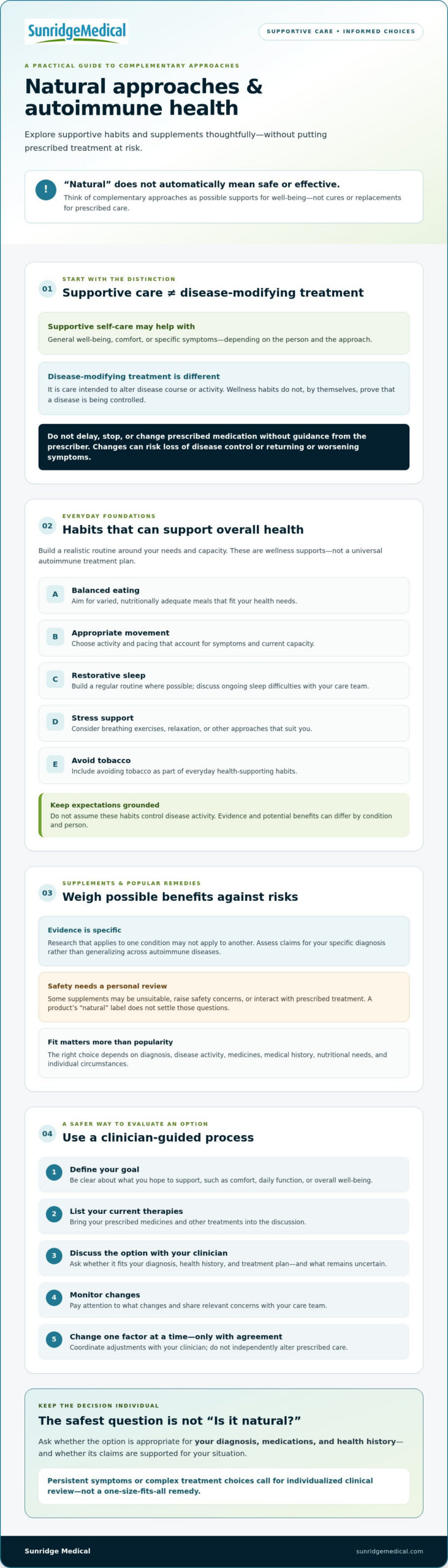
A clear plan can turn online research into a more useful conversation with your care team. Before trying an option, work through these steps:
- Identify your goal: Be specific about what you hope to support, such as a symptom or daily function.
- List current therapies: Include prescription medicines, over-the-counter products, and supplements.
- Research the option: Note the exact remedy, ingredients, source, and evidence you found. Treat marketing claims cautiously.
- Consult your care team: Ask whether it fits your diagnosis, health history, and current treatment.
- Monitor together: If your clinician agrees it’s appropriate, discuss how to track effects and when to review the plan.
Change only one factor at a time, and only with your clinician’s agreement. This may make it easier to notice changes, though a symptom diary alone can’t establish that a remedy caused an improvement or worsening.
Prepare a useful appointment conversation
Bring the product or remedy name, full ingredient list, source, intended benefit, and when you’re considering using it. Ask what reliable evidence exists for your specific diagnosis and goal, whether it could interact with medicines or other products, and what monitoring would be appropriate. Your prescribing clinician or pharmacist can help assess safety in light of your treatment and broader health circumstances.
If you’re considering an IV approach, ask about its rationale, evidence, risks, and supervision for your situation. Sunridge Medical’s published IV Therapy for Autoimmune Disease: 2026 Guide may also provide context for questions to raise with your clinician. A guide can inform the discussion, but it doesn’t replace an individualized medical review.
Track changes without replacing medical monitoring
Use a simple, consistent record of symptoms, daily function, remedy use, and any new or worsening effects. Note when changes occur and share the record at follow-up. Keep scheduled appointments and recommended tests. Feeling better doesn’t mean you should stop treatment or alter a prescribed dose on your own.
Contact a qualified clinician about concerning symptoms or a suspected adverse effect. For an emergency, use emergency services.
If you want a clinician-guided review of complementary options in the context of your diagnosis and current therapies, explore individualized autoimmune disease management at Sunridge Medical.
When individualized autoimmune care can help you evaluate complementary options
Persistent symptoms, complex treatment decisions, or uncertainty about whether a supplement could interact with your medicines are good reasons to seek a clinician’s input. You don’t have to sort through conflicting claims alone. An individualized review can consider a proposed approach in the context of your diagnosis, current care, and broader health needs, without assuming that every complementary option is appropriate.
Sunridge Medical offers individualized autoimmune disease management, integrating conventional therapies with research-based alternative treatments. A conversation about natural remedies for autoimmune disease should focus on your goals and the available evidence, not promises of a particular result. Recommendations depend on clinical evaluation and individual circumstances.
What an individualized review should take into account
A useful review considers more than a remedy in isolation. Be prepared to discuss your diagnosis, symptom history, current treatments, previous responses to care, other relevant health conditions, and the changes you hope to make. This context can help a clinician assess a proposed complementary approach alongside conventional care and consider potential safety concerns. The outcome may be that an option is worth discussing further, requires additional caution, or isn’t suitable for your situation.
Bring relevant records or a written summary if that helps you explain your experience. Include changes in symptoms over time and any products you currently use. Clear information supports a more focused conversation, though it doesn’t guarantee that a particular option will help.
Questions to consider before choosing a care pathway
Ask how a proposed option is supported by evidence for your specific diagnosis and intended goal. If evidence is limited or uncertain, ask what that means for the decision. You can also clarify how a complementary approach would fit with current treatment, how changes would be monitored, and whom to contact if you have concerns. A thoughtful care plan should make room for questions and explain why recommendations may differ from one person to another.
Hormone-related concerns may be relevant for some individuals, but they shouldn’t be assumed to explain autoimmune symptoms or apply to every diagnosis. If hormone care is part of your discussion, ask how it relates to your health history and overall treatment plan.
If symptoms persist or you’re unsure how to weigh complementary options, consider discussing whether an individualized evaluation is appropriate for you. Sunridge Medical’s autoimmune disease management takes an individualized approach, integrating conventional therapies with research-based alternatives. A conversation can help you review your history, clarify your goals, and understand the options without treating any approach as a guaranteed outcome.
Take your next step with a thoughtful care plan
Natural remedies for autoimmune disease are best approached as possible supports for well-being, not cures or substitutes for prescribed treatment. Everyday habits may contribute to general health, while supplement evidence and safety can vary by diagnosis, product, and personal health circumstances. Before trying an option, discuss its purpose and potential interactions with your care team, and monitor changes without adjusting medication on your own.
If symptoms persist or you’re weighing complex choices, an individualized conversation can help you review your diagnosis, current therapies, goals, and complementary options together. Sunridge Medical offers autoimmune disease management with individualized care plans that combine conventional therapies with research-based alternative treatments. This approach supports a considered discussion without promising a particular outcome.
Explore individualized autoimmune disease management and consider whether a personalized evaluation may help you make informed decisions. A clear, clinician-guided next step can bring greater confidence to your care journey.
Frequently Asked Questions
Can natural remedies cure autoimmune disease?
No natural remedy should be considered a proven cure for autoimmune disease or a substitute for prescribed treatment. Some lifestyle measures may support general well-being, and certain approaches may be studied for specific conditions, but evidence for one diagnosis doesn’t automatically apply to another. Discuss potential benefits and risks with your clinician, and don’t delay or change treatment based on a cure claim.
What natural approaches may support someone with an autoimmune disease?
Balanced, nutritionally adequate eating, movement adapted to your capacity, regular sleep habits, stress-management practices, and avoiding tobacco can support general health. These habits aren’t proven to control every autoimmune condition, and the right approach depends on symptoms, diagnosis, treatment, and personal needs. Start with realistic changes you can sustain, and ask your care team for guidance if pain, fatigue, disability, or treatment affects daily activities.
Are supplements safe to take with autoimmune medication?
Not always. Supplements can cause side effects, vary in ingredients, or interact with prescription medicines, over-the-counter products, and other supplements. Safety may also depend on your diagnosis, health history, pregnancy status, or planned surgery. Before taking one, show the full product label to your physician or pharmacist and ask whether there’s reliable evidence for your condition and intended goal. Don’t assume “natural” means harmless.
Can diet reduce autoimmune inflammation?
Diet may support overall health, but no single eating plan is established as a universal treatment for autoimmune inflammation. Research and possible effects can differ by diagnosis, and noticing that a food coincides with a symptom doesn’t prove it changes the underlying disease. Aim for adequate nutrition, and discuss major restrictions with a clinician or registered dietitian to reduce the risk of nutritional gaps.
Should I stop my medication if I feel better after trying a natural remedy?
No. Feeling better doesn’t establish that a remedy caused the change or that your condition is controlled. Stopping, delaying, or changing prescribed medication without the prescriber’s guidance can carry risks, including worsening symptoms or loss of disease control. Keep taking medication as directed unless your prescriber advises otherwise. If you have concerns about side effects or want to adjust treatment, contact the prescribing clinician to discuss a safe plan.
How can I tell whether a natural autoimmune remedy is evidence-based?
Look for research that addresses your specific diagnosis, the exact intervention, and the outcome you care about. A testimonial, scientific-sounding explanation, or claim that one remedy works for every autoimmune disease isn’t strong evidence. Check whether the source explains study limitations and potential harms, and ask your clinician or pharmacist to help assess the information. Be especially cautious of promises to cure disease or replace medication.
When should I talk to a doctor about natural remedies for autoimmune disease?
Talk with a clinician before starting a supplement or making a major diet or treatment change, especially if you take medication, have other health conditions, are pregnant, or have surgery planned. Seek advice if symptoms persist, worsen, or affect daily function, or if you’re unsure about an interaction. Bring the product label and a list of your current therapies so your care team can review options in context.