


A peptide marketed for recovery isn’t automatically a proven or approved healing treatment. Peptide therapy for healing and recovery refers to approaches using specific peptides that are being studied for possible effects on tissue repair and other healing processes. BPC-157 and TB-500 are investigational for general healing and aren’t FDA-approved for that purpose.
It’s understandable to look for options when an injury or surgery leaves progress feeling slow. The key is separating proposed benefits from established evidence, while considering safety and how a treatment might fit alongside standard care. This article explains what peptide therapy involves, what is known about its safety, and how eligibility, dosing, and insurance coverage can shape decisions. It also examines peptide therapy as a possible adjunct to injury and surgery recovery, including the limits of current evidence. Treatment plans and candidacy vary by individual, so the factors behind a clinical decision matter as much as the peptide being considered.
Key Takeaways
- Separate proposed tissue-repair mechanisms from evidence that a peptide improves healing in people.
- Consider potential side effects and the factors that can affect when effects appear.
- Understand how health history, treatment goals, and coverage considerations shape eligibility.
- Learn what to weigh when considering administration and dosing, and how peptide approaches relate to injury or surgery recovery.
- See how Sunridge Medical’s Alternative Cancer Treatment Protocols may fit into care for people exploring cancer treatment options.
What Is Peptide Therapy and Is It Safe?
Peptides are short chains of amino acids that can influence biological processes. When considering peptides for healing, distinguish a proposed effect from a treatment shown to be safe and effective for a specific purpose.
“Peptide therapy” covers different compounds, routes, and goals, so one safety claim cannot describe every peptide. BPC-157 and TB-500, for example, are being researched for possible tissue-healing effects, but their status differs from approved medicines used for defined conditions.
Potential Side Effects and Time to Effect
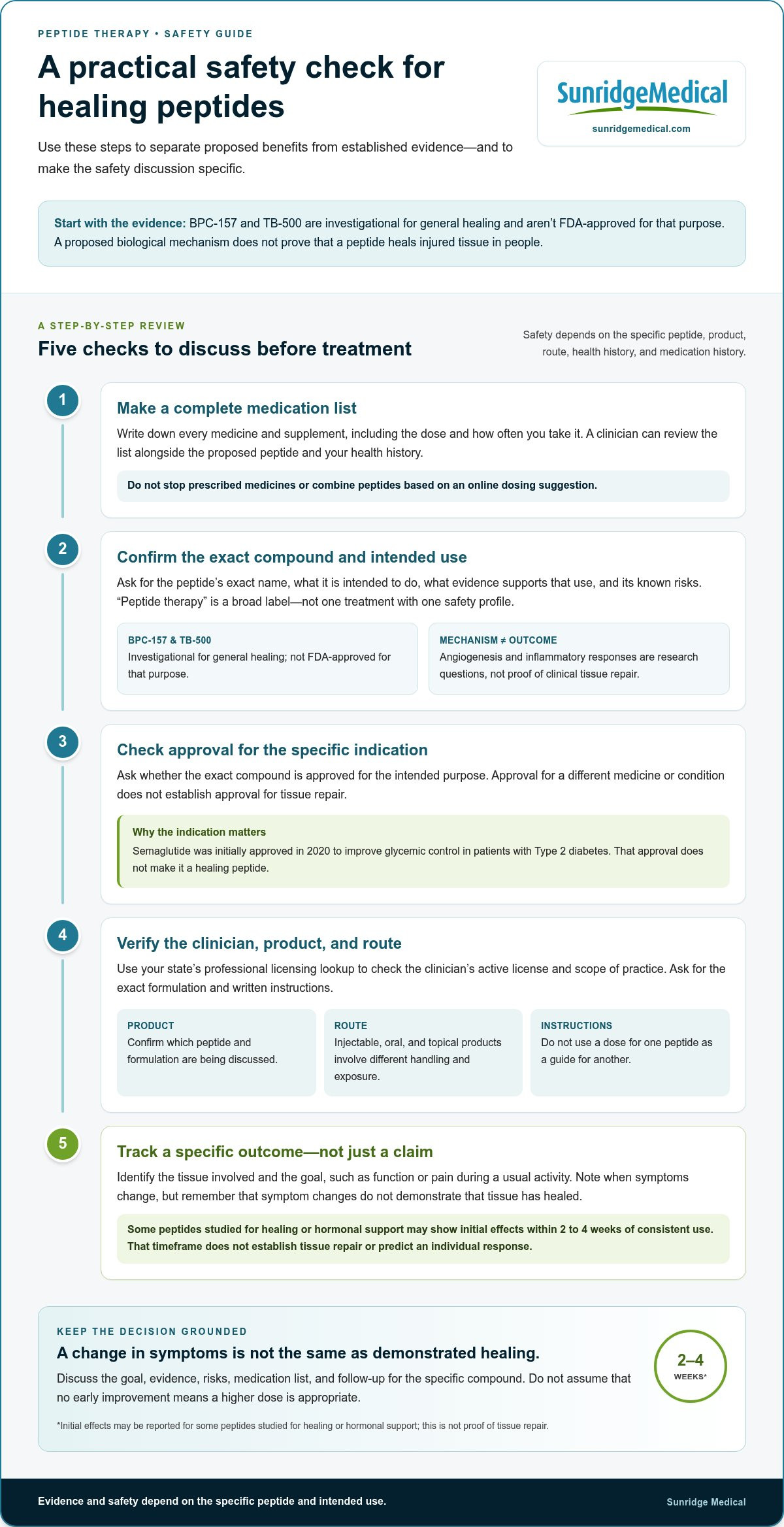
Time to effect and possible side effects depend on the peptide, its intended use, and how it is administered. Some peptides studied for healing or hormonal support may show initial effects within 2 to 4 weeks of consistent use, while that timeframe doesn’t establish tissue repair or predict an individual response.
This distinction matters: a change in symptoms is not the same as demonstrated healing. Track the specific outcome you hope to improve, such as function or pain during a usual activity, and note when it changes. Don’t assume that no early improvement means a higher dose is appropriate.
FDA Approval Status
Healing and recovery peptides aren’t a single FDA-approved treatment category. BPC-157 and TB-500 are investigational for general healing and aren’t FDA-approved for that purpose; approval for a different medicine or condition doesn’t establish approval for tissue repair.
Semaglutide illustrates why the specific indication matters: it was initially approved in 2020 to improve glycemic control in patients with Type 2 diabetes. That approval doesn’t make it a healing peptide. Check the exact compound, intended use, and approval status rather than relying on the broad label “peptide therapy.”
Risks and Drug Interactions
Risks, side effects, and interactions vary with the peptide, product, route, and a person’s health and medication history. Calling something a “recovery peptide” does not establish that it is safe alongside a prescription, supplement, or existing condition.
Before treatment, make a complete list of medicines and supplements, including doses and how often you take them. A licensed clinician can review the list alongside the proposed compound and explain which symptoms warrant prompt attention. Don’t stop prescribed medicines or combine peptides based on an online dosing suggestion.
To find a licensed, reputable provider near you, use your state’s professional licensing lookup to verify the clinician’s active license and scope of practice. At an appointment, ask for the peptide’s exact name, intended use, evidence, known risks, and how it fits with your medication list.
Product quality and administration also affect safety. The route matters because injectable, oral, and topical products involve different handling and exposure. Ask for the exact formulation and written instructions, and don’t use a dose for one peptide as a guide for another.
Keep expectations tied to the evidence for the specific compound. For BPC-157 or TB-500, proposed mechanisms involving angiogenesis or inflammatory responses remain research questions, not proof of a clinical outcome. A structured discussion of the goal, evidence, risks, and follow-up gives patients a clearer basis for weighing peptide therapy for healing and recovery.
BPC-157 and TB-500 for tissue repair
BPC-157 and TB-500 are peptides under investigation for possible tissue-healing effects. Research interest centers on angiogenesis, the formation of new blood vessels, and modulation of inflammatory responses. These processes matter because injured tissue needs coordinated biological activity, not simply a reduction in discomfort. A proposed mechanism, however, does not establish that a peptide repairs an injury in people.
Angiogenesis is relevant to tissue repair because blood vessels help deliver oxygen and nutrients to tissue. BPC-157 and TB-500 are being researched for potential effects involving this process. Researchers are also examining how these peptides may influence inflammatory responses. Those mechanisms are research questions, not proof that either compound restores a tendon, muscle, or other injured structure.
BPC-157 has also been studied for potential gastrointestinal protective effects. Research has examined possible support for intestinal tissue repair and mucosal integrity, the condition of the lining that protects the gut. This is a distinct area of interest from recovery after a muscle or joint injury. A proposed gut-related effect should not be treated as evidence of benefit for every tissue type.
For a person considering these compounds, the distinction between a mechanism and a clinical outcome is central. A biological pathway may explain why researchers are interested in BPC-157 or TB-500, but it cannot predict whether pain, movement, or function will improve. Each outcome requires its own evidence. Changes in symptoms alone also don’t establish that underlying tissue has healed.
The type of injury shapes what “repair” means. A strained muscle, tendon injury, and intestinal tissue involve different structures and recovery goals. Proposed angiogenesis or inflammation-related effects do not establish equal relevance across these examples. A clear discussion should identify the tissue involved, the intended outcome, and the evidence for that specific use.
BPC-157 and TB-500 are investigational for general healing and aren’t FDA-approved for that purpose. That status matters when weighing claims about tissue repair: promotional language can describe a proposed effect more confidently than the evidence allows. Patients should distinguish research interest from established treatment, and should not treat these peptides as substitutes for appropriate injury assessment or recovery care.
A useful way to evaluate a claim about BPC-157 or TB-500 is to ask what outcome it describes. Does it refer to angiogenesis, a change in inflammation, or measurable recovery of function? Those are not interchangeable results. Keeping the compound, tissue, mechanism, and outcome distinct helps readers assess claims carefully without mistaking a promising research direction for a proven healing effect.
Treatment eligibility and insurance coverage
Whether peptide treatment is appropriate depends on the proposed compound, the reason for considering it, and your health context. A licensed clinician weighs the treatment goal, medical history, current medicines, and other care underway. Candidacy and treatment plans vary, so the same recovery goal doesn’t make two people equally suitable.
For example, seeking help after a tendon injury raises a different clinical question from exploring a peptide for hormonal support. The compound’s evidence and approval status for that specific use matter alongside your diagnosis and recovery needs. A careful assessment defines the intended outcome first, then considers whether the proposed treatment fits.
Insurance coverage depends on the plan, product, and intended use. Clarify the decision by separating the clinician’s consultation from the medication or peptide product, then asking the insurer about each item. Documentation describing the diagnosis, treatment purpose, and product can explain what coverage is being requested. Don’t assume coverage for one medicine or condition applies to another.
AOD-9604 is not FDA-approved for fat loss. That example shows why eligibility and coverage discussions need the exact compound and intended use, rather than a broad label such as “recovery peptide.” A treatment plan should make clear which substance is proposed and what outcome it is intended to address.
Athletes should not assume a recovery peptide is allowed under their sport’s rules. WADA and other sports organizations may set substance-specific requirements, so review the current rules for your competition before using a peptide.
There is no single U.S. cost for every peptide therapy case. A quote depends on the case; relevant factors include the compound, formulation, clinician consultation, administration, monitoring, and insurance coverage. Ask for these components separately so you understand what the estimate includes.
Before starting, patients can ask a clinician:
- What exact peptide and treatment goal are being considered?
- What evidence supports that use, and what risks or interactions apply to my medicines?
- How will progress be assessed, and what would prompt a change or stop?
- Which costs relate to the consultation, product, administration, and follow-up?
Clear answers help you compare a proposed plan with your recovery goals, health history, insurance terms, and any sports restrictions. Keep the compound name and intended use consistent across clinical discussions, coverage inquiries, and sports-rule reviews.
Administration and dosing
Administration and dosing depend on the specific peptide, formulation, and intended use. A protocol discussed for BPC-157 cannot automatically be applied to TB-500, CJC-1295, or Ipamorelin. These compounds have different proposed uses, and BPC-157 and TB-500 remain investigational for general healing. The name alone doesn’t provide enough information to guide administration.
Start by identifying the exact product and intended route. Instructions depend on the product’s formulation, so directions for one form should not be transferred to another. Ask for the dose, timing, duration, and any preparation or storage directions in writing. If the label and verbal instructions differ, pause and resolve the discrepancy before using it.
Do not calculate a dose from an online post or another person’s protocol. Body weight, treatment goal, medical history, and other medicines can affect clinical decisions. A schedule for hormonal support, for example, is not a template for tissue repair. Increasing the amount because symptoms persist can create risk without showing that the peptide addresses the underlying injury.
Administration technique matters, too. Follow the instructions for the specific formulation, including how it is measured and handled. Don’t reuse directions for a different peptide or change timing without clinical guidance. Keep the product name and instructions available for follow-up, so the care team can review exactly what you used.
A useful treatment record connects each dose with the intended outcome. Note the date, administration time, prescribed amount, and any new symptoms. For an injury, record a practical measure, such as comfort while walking or the ability to complete a usual movement. This makes follow-up more specific than relying on memory or a general impression of improvement.
- Confirm the peptide’s exact name and formulation.
- Record the prescribed amount, timing, and route.
- List medicines and supplements being used alongside it.
- Track the target outcome and any changes after administration.
Missed doses, uncertainty about measurement, or a change in the product are reasons to clarify instructions before the next administration. Don’t double a later dose to compensate unless the specific instructions say to do so. For BPC-157 or TB-500, proposed tissue-repair effects do not establish a standard dose for general healing.
Follow-up should assess whether the original goal remains appropriate and whether the plan needs adjustment. A change in mobility, for example, differs from a change in discomfort, so define the outcome before treatment begins. Clear instructions and consistent tracking keep peptide use connected to a specific clinical question rather than an improvised dosing routine.
Peptide therapy as an adjunct to injury and surgery recovery
Peptides are being explored as possible additions to recovery, but their role depends on the evidence for each compound and use.
Adjunct Role in Recovery
An adjunct is an additional approach used alongside, not instead of, injury or postoperative care. This distinction matters because BPC-157 and TB-500 are investigational for general healing and aren’t FDA-approved for that purpose. Their proposed effects don’t establish that they can replace assessment, surgery, rehabilitation, or other care selected for a specific injury.
After surgery, the treating team’s recovery plan addresses the procedure, healing goals, and individual progress. A claim about peptide-related tissue repair doesn’t show that a peptide is appropriate after a particular operation. Consider any proposed addition in relation to the surgery, medicines, and rehabilitation plan, not as a standalone shortcut.
Comparing Recovery Approaches
Physical therapy, standard medical treatment, and peptide therapy have different roles. Medical care evaluates and treats the injury, physical therapy works on movement and function, and peptides are being investigated for possible biological effects. This distinction helps separate established care goals from research interest.
For example, a rehabilitation plan may focus on restoring movement after an injury, while a proposed peptide mechanism may involve tissue processes. The mechanism alone does not demonstrate better function or faster recovery in people.
Injury recovery starts with standard medical care to identify the problem and select care suited to it. A fracture, tendon injury, and postoperative wound present different clinical needs. Treatment may address the injury itself, while physical therapy can support strength, mobility, and functional goals as appropriate. These roles are not interchangeable.
CJC-1295 and Ipamorelin stimulate growth hormone release, and are described as promoting muscle growth, improving recovery, and helping maintain muscle mass. Those proposed effects do not establish treatment for a specific injury or prove improved surgical healing. Muscle-related claims should not be confused with evidence that a damaged tendon, bone, or surgical site heals faster.
If you’re considering peptides during rehabilitation, define the goal before evaluating a claim. “Recover faster” is less useful than a concrete outcome, such as improved movement or returning to a daily activity. Keep prescribed care and rehabilitation central, and discuss the proposed compound with the clinician overseeing your injury or surgery.
A practical discussion can cover the exact peptide, its intended role, current evidence, and possible effects alongside existing care. It should also address whether the plan changes rehabilitation or medication instructions. Don’t alter postoperative directions or pause physical therapy to accommodate an unproven approach.
If recovery concerns intersect with a complex health condition, explore individualized medical care as part of the broader conversation about treatment goals.
Sunridge Medical: Alternative Cancer Treatment Protocols
Sunridge Medical offers Alternative Cancer Treatment Protocols for people seeking care related to cancer. Its focus may also be relevant for readers managing complex conditions alongside recovery, including chronic Lyme disease, autoimmune disorders, or hormone concerns. Care is individualized and combines conventional therapies with research-based alternative treatments.
Peptide research does not replace evaluation or treatment for cancer, surgery, or an injury. If your care questions involve cancer or a complex chronic condition, consider whether Sunridge Medical’s treatment focus aligns with your needs. For a discussion about its Alternative Cancer Treatment Protocols, contact Sunridge Medical or visit sunridgemedical.com.
Choose a thoughtful next step for your care
Decisions about peptide therapy for healing and recovery should start with a clear goal: what change are you seeking, and how will progress be assessed? Bring that goal, your medication list, and questions about the proposed approach to a qualified clinician. A considered plan keeps your overall health and existing care at the center.
For people managing complex conditions, Sunridge Medical offers Alternative Cancer Treatment Protocols, Chronic Lyme Disease Treatment, and Autoimmune Disease Management. Treatment plans and candidacy vary by individual, so the next step should reflect your health needs rather than a generalized promise about peptides.
Contact Sunridge Medical to discuss your health needs and explore whether its care may fit your situation. A considered conversation can help you move forward with greater clarity and confidence.
Frequently Asked Questions
How long do peptides take to work?
Timing depends on the peptide and the outcome being assessed. Some peptides studied for healing or hormonal support may show initial effects within 2 to 4 weeks of consistent use; aesthetic or performance-related changes may take 4 to 12 weeks. An early change in symptoms doesn’t establish tissue repair. Track a specific measure, such as movement during a daily task, and distinguish that result from a broader impression of feeling better.
What peptides are used for healing?
BPC-157 and TB-500 are investigated for potential tissue-healing effects, while CJC-1295 and Ipamorelin are associated with growth hormone release. These are distinct research directions, not interchangeable treatments. For example, a proposed effect involving inflammatory responses differs from a goal related to muscle growth. The compound’s name and intended outcome matter, so broad claims about “healing peptides” can obscure important differences.
What is peptide therapy, and which peptides are promoted for healing and recovery?
Peptide therapy refers broadly to using peptide compounds with the aim of influencing biological processes. In recovery discussions, BPC-157 and TB-500 are promoted for tissue repair, while CJC-1295 and Ipamorelin are associated with muscle-related claims. These examples have different proposed roles. Ask which exact compound is intended and what specific outcome it targets, rather than treating “peptide therapy” as one standardized treatment.
What evidence supports BPC-157, TB-500, and other peptides for tissue repair in humans?
Current evidence does not establish BPC-157 or TB-500 as proven treatments for general healing in humans. They are investigational for that purpose and are not FDA-approved for it. Research interest includes proposed effects on angiogenesis and inflammatory responses, but a possible mechanism is not proof of improved recovery. For any peptide claim, separate laboratory or proposed biological effects from demonstrated patient outcomes.
How are peptide therapies administered, and what dosing protocols are used in clinical studies?
Administration and dosing depend on the specific peptide, formulation, and study purpose; no single protocol applies to every compound. A study involving one formulation cannot automatically guide use of another. Before considering a protocol, identify the peptide, route, intended outcome, and population studied. Don’t use a study dose as personal instructions; discuss any proposed regimen with a licensed clinician familiar with your health history.