


What makes a cancer treatment plan truly personal: a tumor test, a broader view of your health, or the priorities you bring to the conversation? In practice, personalized cancer treatment plans can draw on several kinds of evidence, and a test result alone doesn’t determine the right next step. Your diagnosis, overall health, previous treatments, potential benefits and risks, and goals all matter.
It’s understandable to feel uncertain when complex results and unfamiliar options arrive alongside an important decision. Personalized care doesn’t automatically mean genetic testing, and integrative care shouldn’t mean replacing established cancer treatment with an alternative approach. The key is to understand what each option is intended to do, what evidence supports it, and how it fits with the rest of your care.
This article explains the clinical and personal factors that may shape an individual plan, how to discuss evidence, risks, and priorities with your care team, and what to ask about coordinating complementary approaches with conventional therapies. At Sunridge Medical, clinicians combine conventional therapies with research-based alternative treatments in individualized care planning. The aim is a thoughtful, informed conversation, not a promise of a particular outcome.
Key Takeaways
- Understand why people with similar diagnoses may need different care plans based on their clinical circumstances and priorities.
- Learn how clinicians review a diagnosis and relevant evidence before discussing options and revisiting the plan.
- See why personalized cancer treatment plans can guide decisions without guaranteeing that a therapy will work.
- Prepare for a clinical discussion by organizing records and identifying what you want each proposed test or treatment to clarify.
- Explore how Sunridge Medical combines conventional therapies with research-based alternative treatments in individualized care plans.
What Does a Personalized Cancer Treatment Plan Actually Mean?
Two people can share the same cancer diagnosis and still face different treatment decisions. Their cancers may differ in stage, pathology, or test findings. Each person may also have distinct health considerations, treatment experiences, and priorities. A plan should account for those differences rather than treating the diagnosis as the only factor that matters.
A personalized cancer treatment plan is a clinician-guided approach that uses evidence about the disease alongside the patient’s health, circumstances, and goals to inform care decisions. Personalization describes how decisions are considered, not a guarantee that a particular treatment will work. It also doesn’t necessarily mean that every patient needs advanced testing or a completely different treatment from someone with a similar diagnosis.
Personalized care and precision medicine are related, but not identical
Precision medicine focuses on biological details, such as features of a tumor’s genes or proteins, that may help inform selected diagnostic or treatment decisions. Molecular testing can be useful when a result addresses a specific clinical question, but it’s one possible input, not a requirement for every patient. Broader individualized planning also weighs health history, treatment tolerance, daily responsibilities, and personal priorities. The overview of Personalized Medicine describes the wider concept and its relationship to precision medicine.
In practical terms, biological targeting asks what a tumor’s characteristics may indicate, while individualized care planning asks how the available options fit the whole person. These perspectives can work together, but they aren’t interchangeable.
What can shape an individual cancer plan?
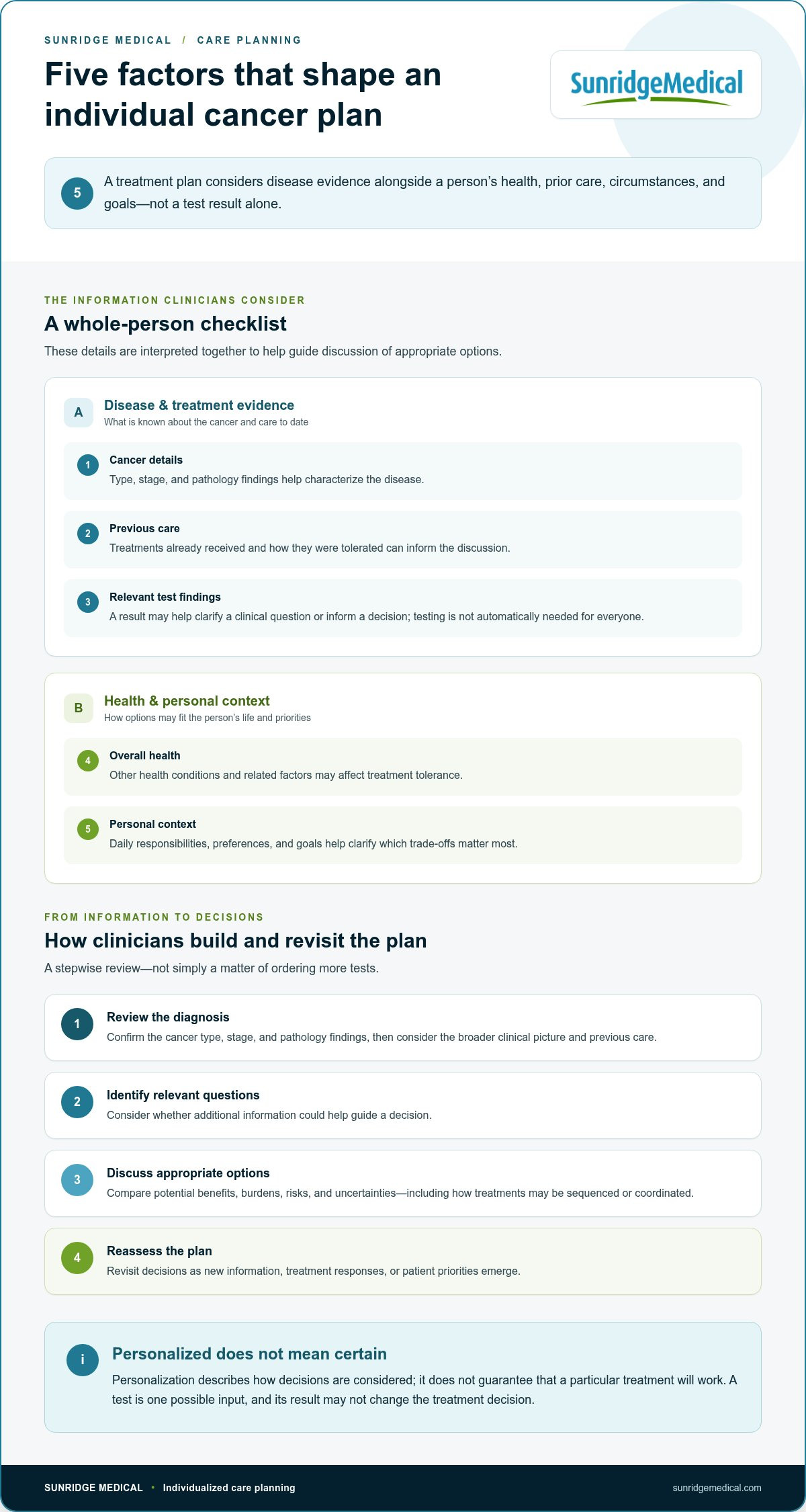
Clinicians interpret several factors together rather than letting one test result dictate the plan. Relevant information may include:
- Cancer details: type, stage, and pathology findings, which help characterize the disease.
- Previous care: treatments already received and how the patient tolerated them.
- Relevant test findings: results that may clarify a clinical question or inform a decision.
- Overall health: other health conditions and factors that may affect treatment tolerance.
- Personal context: daily responsibilities, preferences, and goals for care.
These details can change which options deserve discussion and which trade-offs matter most. For example, a treatment’s potential benefits and burdens may be weighed differently depending on a person’s health and what they hope to prioritize. The purpose isn’t to make a complex decision seem simple. It’s to make the reasoning clearer, so patients and clinicians can discuss how evidence applies to the individual and what uncertainties remain.
How Clinicians Build a Personalized Cancer Treatment Plan
Building a plan is a stepwise clinical process, not simply a matter of ordering more tests. The care team reviews what is known, identifies questions that could affect decisions, and weighs possible options against their benefits, risks, uncertainties, and the patient’s goals. A clear explanation of each step can make a complex discussion easier to follow.
- Review the diagnosis. Confirm the cancer type, stage, and pathology findings, then consider the broader clinical picture and previous care.
- Identify relevant questions. Determine whether additional information could help guide a decision.
- Discuss appropriate options. Compare potential benefits and burdens, including how treatments may be sequenced or coordinated.
- Reassess the plan. Revisit decisions as new information, treatment responses, or patient priorities emerge.
Start with diagnosis, pathology, and the clinical picture
Pathology and disease stage provide essential context for understanding a cancer and considering appropriate options. Clinicians interpret these findings alongside the person’s overall health and treatment history. Depending on the cancer and the question at hand, molecular or other testing may also be considered. Testing isn’t automatically necessary for everyone, and a result may not change the treatment decision.
For example, the team may consider whether a test could clarify a feature relevant to a treatment choice. If the result wouldn’t help answer the clinical question or inform a decision, its role may be limited. A guide to integrative cancer treatment by stage can provide additional context for stage-specific discussions. The treating team can explain how an individual’s stage relates to their circumstances and options.
Turn findings into a plan that can be reviewed
After reviewing relevant information, clinicians discuss options in terms the patient can weigh. That means considering not only what a treatment is intended to do, but also its potential risks, limitations, and uncertainties. Patients can ask how strong the evidence is for a specific option and what alternatives may be reasonable. No plan can remove uncertainty, but a transparent discussion can show how the team reached its recommendation.
Coordination matters, too. The care team can discuss the order of treatments, how different parts of care fit together, and what should be communicated among clinicians. If a patient is considering an additional or alternative approach, it’s important to discuss it openly so the team can consider its role alongside established cancer care and assess potential concerns.
A plan isn’t necessarily fixed. New results, changes in health, how treatment is tolerated, or a shift in personal priorities may prompt another conversation. That’s a reason to clarify how decisions will be revisited, not a sign that the original discussion failed. Patients seeking a thoughtful conversation about individualized cancer care can explore care planning with Sunridge Medical.
Evidence, Limitations, and the Misconception That Personalized Means Certain
A plan can be carefully matched to a patient and still involve uncertainty. A tumor finding or test result may help clinicians consider an option, but it can’t prove in advance that the treatment will work for a particular person. Individualization can make evidence more relevant to a person’s circumstances; it cannot make an uncertain treatment certain.
When considering personalized cancer treatment plans, distinguish evidence for a specific treatment in a defined setting from evidence for a broad category or biological mechanism. A rationale that sounds precise is not the same as proof of benefit.
How to interpret research and treatment claims
Research offers different levels of evidence. Laboratory findings may suggest how a treatment could act, but they don’t establish that it benefits people. Early research can help identify questions for further study, while clinical trials assess treatments in people under defined conditions. Evidence supporting an established treatment may be stronger for a particular cancer and clinical situation than for other settings. The details matter.
A study’s results apply first to the people and treatment approach it examined. They don’t automatically predict an individual’s response or establish that the same approach is appropriate across cancer types. A test can also be inconclusive, unavailable, or unrelated to a treatment decision. Sometimes, the result doesn’t change the options clinicians recommend. Ask what a result can clarify, how it may affect care, and what uncertainties would remain.
When reviewing a claim, consider whether it refers to laboratory work, a clinical trial, or evidence for a specific treatment in a relevant patient group. Ask what outcome was measured and whether the findings apply to the situation being discussed. One promising result deserves attention, but it shouldn’t be presented as a universal guarantee or an individual prognosis.
Integrative care should be discussed with the oncology team
Complementary and alternative approaches also need careful evaluation. Discuss their evidence, potential risks, and possible interactions with prescribed cancer treatments with the oncology team. Share what you’re taking or considering, including supplements and other therapies, so clinicians can review how those choices may fit with the treatment plan. Open discussion supports coordination; it isn’t a commitment to pursue any particular approach.
Don’t stop, delay, or change prescribed cancer treatment without discussing the decision with your clinicians. If you have concerns about side effects, timing, or how different approaches fit together, raise them directly so the team can address the risks and options with you.
Sunridge Medical develops individualized care plans that combine conventional therapies with research-based alternative treatments. This integrative approach is not a promise of cure or a substitute for evaluating evidence. Each option calls for a clear discussion of its intended role, limitations, and relationship to the rest of a person’s care.
How to Prepare for a Discussion About Your Cancer Treatment Plan
A focused conversation can help you understand what a proposed plan is based on and how it relates to your priorities. You don’t need to arrive with every answer. Bringing organized information and a short list of questions can make it easier to follow the discussion, raise concerns, and identify what you’d like clarified before making decisions.
Preparing for personalized cancer treatment plans supports collaboration with your existing oncology team; it isn’t a test you have to pass. If possible, bring someone you trust to listen, take notes, or help recall questions during the appointment.
Bring the information that helps clinicians understand your case
Gather available records in one place, either digitally or in a folder. You can ask the clinic how it prefers to receive documents. The goal is to help the team review your history and understand what has already been discussed or tried.
- Diagnosis information: pathology reports, imaging summaries, and relevant test results.
- Treatment history: treatments received, approximate dates, and any effects or difficulties you experienced.
- Current medicines and supplements: include prescriptions, over-the-counter products, vitamins, and other therapies so the team can review potential interactions.
- Symptoms and practical concerns: note changes you’ve noticed, daily responsibilities, and issues that may affect treatment decisions.
- Your goals: identify what matters most to you, such as understanding options, weighing potential burdens, or discussing how care may fit into daily life.
If the records feel overwhelming, start with what you have. A simple timeline of key treatments and changes can help organize the conversation without requiring you to interpret medical findings on your own.
Questions that make the plan clearer
Choose a few questions that address your main concerns. You can ask the clinician to explain unfamiliar terms in plain language or summarize the discussion before the visit ends.
- What is each proposed test or treatment intended to clarify or inform?
- What evidence supports this option for my situation, and what uncertainties remain?
- What potential benefits, risks, or limitations should I weigh?
- How might this option fit with my current treatment, medicines, or supplements?
- How would treatment be sequenced, and who will coordinate decisions across my care team?
- What changes in results, symptoms, or priorities might lead us to reassess the plan?
You can also ask what the next decision is and when it needs to be made, so you leave with a clear understanding of any follow-up steps. For a clinical conversation about individualized cancer care, schedule an appointment with Sunridge Medical.
How Sunridge Medical Approaches Individualized Cancer Care
After learning what individual planning involves, patients may want to understand how a clinical practice puts that perspective into care. Sunridge Medical focuses on cancer and complex chronic disease care, and its clinicians develop individual plans that combine conventional therapies with research-based alternative treatments. The aim is to consider the person’s clinical context and priorities, not to promise a particular result.
An individualized discussion can bring together information that may feel disconnected: the diagnosis, treatment history, current care, concerns, and questions about possible approaches. Patients don’t have to arrive with a fixed decision. They can use the conversation to clarify what is being considered, why it may be relevant, and what uncertainties deserve attention.
An integrative plan considers the whole clinical context
Integrative care means discussing how different approaches may fit into an individual plan. Conventional therapies and research-based alternative treatments are considered in relation to the patient’s condition and circumstances. A careful conversation can address the intended role of an approach, the evidence relevant to it, potential risks, and how it may relate to other care.
This doesn’t mean that an alternative treatment replaces oncology care or that combining approaches guarantees a benefit. The details matter. Patients can share what treatments they’re receiving or considering and discuss how decisions can be coordinated with their existing oncology team. Sunridge’s approach centers on individualized care planning, with attention to how the parts of a plan fit together.
Readers seeking broader background can explore a comprehensive guide to alternative cancer treatment to understand terminology and questions they may wish to raise. Whatever information they review, it’s useful to discuss potential approaches with clinicians who understand the patient’s current care and can consider risks and coordination.
What a first conversation can help clarify
A first discussion can create space to describe your health history, current concerns, previous treatment experiences, and goals. You might explain what feels most important to understand, such as how a proposed approach relates to your existing care or what uncertainties remain. Bringing records and a few priority questions can help keep the conversation focused, but you don’t need to interpret results or choose a treatment in advance.
Clear questions can turn a complex topic into a more manageable next step. Ask what information would shape the discussion, what options may warrant consideration, and how the care team can coordinate around your current treatment. It’s also reasonable to ask what follow-up may help you understand your choices. The purpose is to support an informed clinical conversation, not to rush a decision.
Sunridge Medical focuses on cancer and complex chronic disease care. To discuss an individualized conversation, contact the center about scheduling and personalized support.
Take Your Next Step With Clarity
You don’t have to resolve every question at once. A useful next step is to choose the concern you most want addressed, such as how a proposed option fits your priorities or what you need to understand before deciding. Bringing that question into a clinical conversation can help turn uncertainty into a clearer path forward, one decision at a time.
Personalized cancer treatment plans are most useful when patients can understand the reasoning behind decisions and feel able to raise concerns. Sunridge Medical is a privately owned practice led by Medical Director Dr. Steven S. Isaacman. If you’re ready to discuss your circumstances and what individualized cancer care could involve, contact Sunridge Medical to discuss individualized cancer care.
There’s room to ask questions, consider your options, and move forward at a pace that supports informed care. Your next conversation can begin with one clear question.
Frequently Asked Questions
Does personalized cancer treatment always require genetic testing?
No. A care plan can be tailored using information such as diagnosis, pathology, health history, and treatment experience without genetic testing. If testing is discussed, ask whether it analyzes tumor features or inherited genetic risk, since those address different questions. You can also ask what a result might change in your care and whether there are other ways to make the decision.
Can a personalized cancer treatment plan change over time?
Yes. A plan may be reviewed if new information emerges, treatment causes difficulties, or your health or priorities change. Ask your care team how to report changes between appointments and which symptoms or concerns warrant prompt attention. Understanding how decisions will be revisited can help you stay engaged without feeling that you must assess treatment progress on your own.
Does personalized cancer treatment mean alternative medicine?
No. Personalization describes how care decisions take a person’s clinical circumstances into account; it doesn’t automatically mean alternative medicine. A plan may involve conventional cancer therapies, while an integrative discussion may also consider research-based alternative treatments. Ask what role each proposed approach would have, what evidence informs its use, and how it would be coordinated with your oncology care.
Can supplements interfere with cancer treatment?
They can be relevant to treatment safety, so tell your care team about every supplement you use or are considering, including vitamins, herbal products, and combination formulas. Bring the product label or a clear list of ingredients and how much you take. Don’t start, stop, or change a supplement or prescribed treatment without discussing it with your clinicians.
What if a tumor test does not identify a treatment target?
A test without an identified target doesn’t by itself mean there are no treatment options. The result may not point to a treatment decision, and clinicians can still consider other information about the cancer and your health. Ask whether the test provided a useful result, whether additional testing could change care, and what options remain relevant to your diagnosis.
How can I tell whether a personalized treatment claim is trustworthy?
Look for a clear explanation of which treatment is being discussed, what evidence supports it for your cancer type and situation, and what limitations or risks remain. Be cautious of claims that promise a cure, guarantee results, or urge you to abandon prescribed care. Ask your oncology team to help assess the claim and explain whether it applies to your circumstances.