

Most advice about red light therapy on the scalp starts with the wrong promise. It isn't a universal hair-loss cure, and buying a glowing helmet before identifying the cause of shedding can waste time while an autoimmune, hormonal, nutritional, inflammatory, or infectious condition progresses. The clinically useful question is narrower: which type of hair loss is present, and does the device and protocol match the evidence?
For the right patient, scalp photobiomodulation can be a reasonable complementary treatment. The strongest evidence involves androgenetic alopecia, also called male or female pattern hair loss. Benefits are usually gradual and modest, and they depend on regular use over months. A proper evaluation still matters, particularly when hair loss is sudden, patchy, painful, inflamed, or accompanied by other symptoms.
Table of Contents
- Why Red Light Therapy on Scalp Is Not a Universal Hair-Loss Fix
- How Photobiomodulation Stimulates Hair Follicles
- Choosing the Right Device and Treatment Parameters
- Building a Consistent Session Routine
- Setting Realistic Expectations and Measuring Progress
- Integrative Evaluation and Personalized Hair Restoration at Sunridge Medical
Why Red Light Therapy on Scalp Is Not a Universal Hair-Loss Fix
Red light therapy is often marketed as though every thinning pattern represents the same problem. It doesn't. Hair loss can result from inherited follicle sensitivity, autoimmune activity, thyroid or hormonal changes, nutritional issues, medications, scalp inflammation, infection, or physical damage. A device designed for pattern hair loss shouldn't be treated as a general solution for every diagnosis.
The clearest clinical signal is androgenetic alopecia. A 2019 meta-analysis of 11 double-blinded randomized controlled trials across 8 studies found that low-level laser therapy significantly increased hair density compared with sham treatment, with a standardized mean difference of 1.316, and a 95% confidence interval of 0.993 to 1.639 (PubMed review of LLLT for androgenetic alopecia). That supports a defined use case, not a blanket promise of regrowth.
Diagnosis changes the treatment decision
Alopecia areata illustrates why diagnosis comes first. It's an autoimmune condition that can produce sudden, smooth, round or oval patches, and it requires a different medical conversation than gradual recession or diffuse pattern thinning. If your loss is patchy or abrupt, review the clinic's information on alopecia areata and autoimmune disease and arrange an appropriate evaluation rather than assuming a home light device is enough.
Evidence for other alopecia types remains less established. A recent meta-analysis identified the strongest signal in androgenetic alopecia and stated that additional studies are needed to understand how effective the treatment is for other forms of alopecia (recent meta-analysis on photobiomodulation and hair loss). That distinction is clinically important because people commonly search for scalp red light as a universal fix, while the literature supports a more limited role.
Practical rule: Treat the diagnosis, not the marketing category. “Hair loss” is a symptom, not a treatment plan.
FDA clearance isn't the same as a guarantee
LLLT has entered a regulated medical-device pathway for androgenetic alopecia. The HairMax laser comb received FDA clearance in 2007, followed by clearance for female pattern hair loss in 2011 (review of LLLT devices and FDA clearance). Clearance doesn't mean every device works equally well, and it doesn't guarantee that an individual patient will respond. It does distinguish a device cleared for a specific medical indication from a generic wellness product making broad claims.
How Photobiomodulation Stimulates Hair Follicles
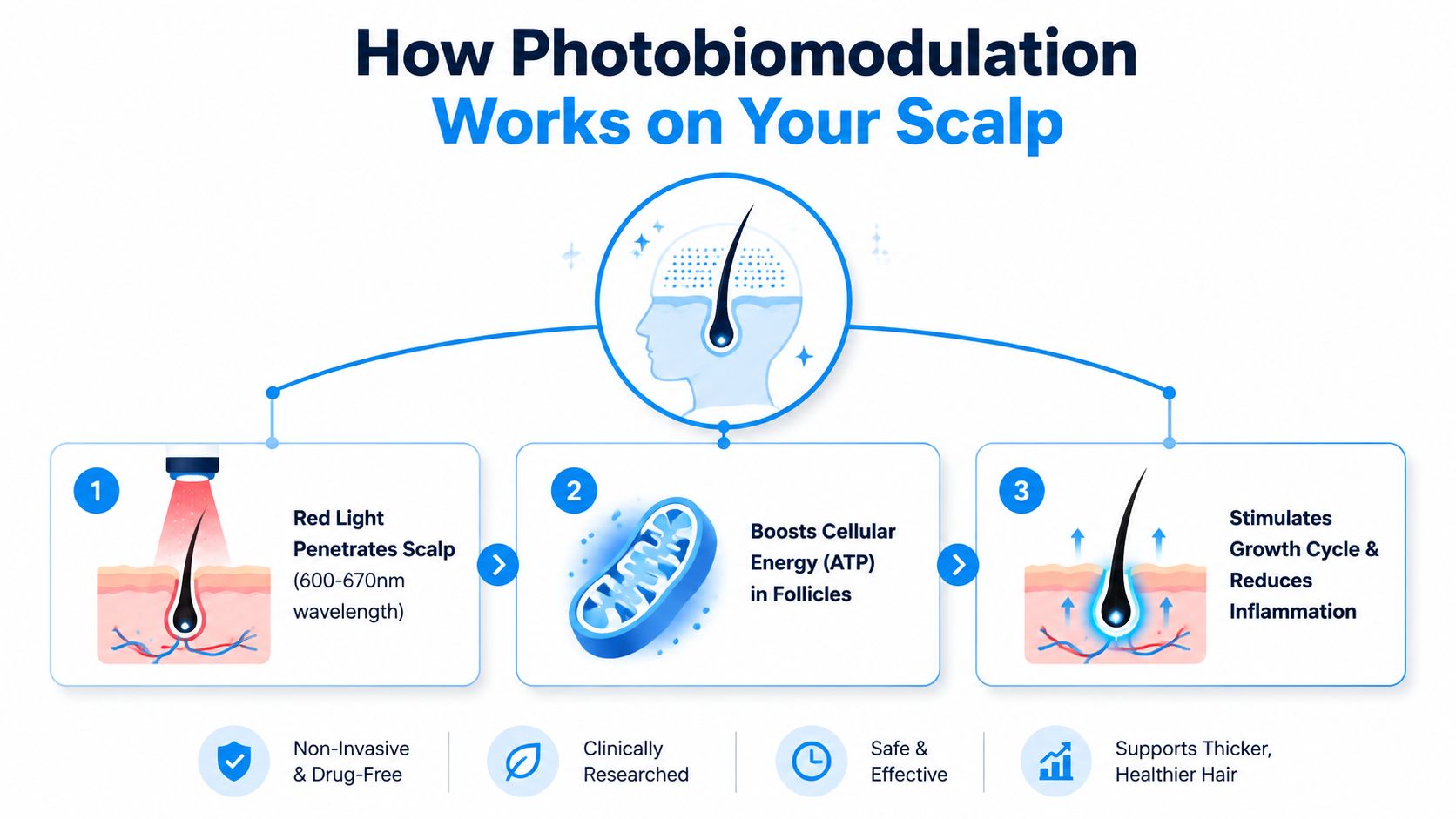
Photobiomodulation uses low-intensity light to influence biological activity rather than heat tissue aggressively or remove skin. In scalp applications, the target is the hair follicle and its surrounding tissue. Specific red or near-infrared wavelengths can reach the scalp and interact with cellular structures involved in energy production and tissue signaling.
The proposed mechanism centers on mitochondrial activity. Mitochondria help cells produce adenosine triphosphate, or ATP, which supplies energy for cellular work. When follicle cells receive an appropriate light stimulus, the treatment may support the environment needed for active growth, cellular repair, and regulation of local inflammatory signaling. That biological rationale is more precise than saying red light “feeds” the hair.
Wavelength and dose shape the response
Published scalp LLLT protocols commonly use red light in the 630 to 680 nanometer range, with 650 nm frequently identified as the most studied or optimal peak wavelength for follicle stimulation (clinical wavelength discussion for low-level laser therapy). A device that merely says “red light” without clearly stating its wavelength, output, treatment area, and instructions gives you too little information to compare it with clinical research.
The evidence also suggests that the response isn't just a case of more exposure producing more growth. The 2019 meta-analysis reported a larger effect with lower treatment frequency, SMD 1.555, than with higher-frequency regimens, SMD 0.949 (meta-analysis of LLLT frequency and hair density). This finding supports a dose-sensitive model. More sessions aren't automatically better, and exceeding the manufacturer's instructions may add inconvenience without adding benefit.
For a patient-friendly overview of the cellular concepts, how red light therapy works for hair offers additional background. The useful takeaway is that photobiomodulation is a targeted biological intervention, not just a cosmetic light exposure.
Choosing the Right Device and Treatment Parameters
Device selection should begin with the medical indication, then move to engineering details. A cap, comb, helmet, panel, or handheld unit may use lasers, LEDs, or a combination. These technologies shouldn't be treated as interchangeable because wavelength, light distribution, power, coverage, contact distance, and treatment schedule all affect whether the device resembles the protocols studied in clinical trials.
A practical comparison can keep the purchase decision grounded:
| Parameter | Evidence-Based Recommendation | Why It Matters |
|---|---|---|
| Intended indication | Look for a device specifically cleared or designed for androgenetic alopecia | A broad wellness claim doesn't establish effectiveness for pattern hair loss |
| Light source | Review whether the device uses low-level lasers, LEDs, or both | Broader reviews suggest laser-based devices may outperform mixed laser and LED approaches |
| Wavelength | Prefer clearly stated red-light specifications within the studied 630 to 680 nm range, with 650 nm commonly studied | Wavelength determines whether the device resembles published scalp protocols |
| Coverage | Choose a format that reaches the thinning regions consistently | Uncovered follicles won't receive the intended exposure |
| Schedule | Follow the manufacturer's medical-use instructions rather than adding unsupervised sessions | Research indicates that more frequent use isn't automatically more effective |
| Documentation | Check treatment time, positioning, safety instructions, and regulatory status | Transparent specifications make expectations and adherence more realistic |
FDA clearance and device quality
FDA clearance for androgenetic alopecia is a meaningful distinction because it reflects a regulated device pathway for a defined use. It still isn't proof that every cleared product, or every consumer device with similar colors, will produce the same result. Ask what indication was cleared, whether the device uses laser or LED technology, and whether its wavelength and schedule are clearly disclosed.
Consumer comparisons can help you understand differences in design and features, but they aren't substitutes for medical evaluation. For example, a general guide to compare top LED skin devices may be useful when reviewing form factors, yet a skin-focused device may not be appropriate for scalp hair loss.
Avoid the “strongest device” mindset
A higher-intensity product isn't automatically a better product. The available evidence supports matching the device to studied parameters and using it consistently, rather than chasing maximum brightness or daily exposure. Patients with extensive baldness should also be cautious about claims of full restoration. The evidence is strongest where follicles remain capable of producing thinner or miniaturized hairs, especially in early-to-moderate pattern loss.
Building a Consistent Session Routine
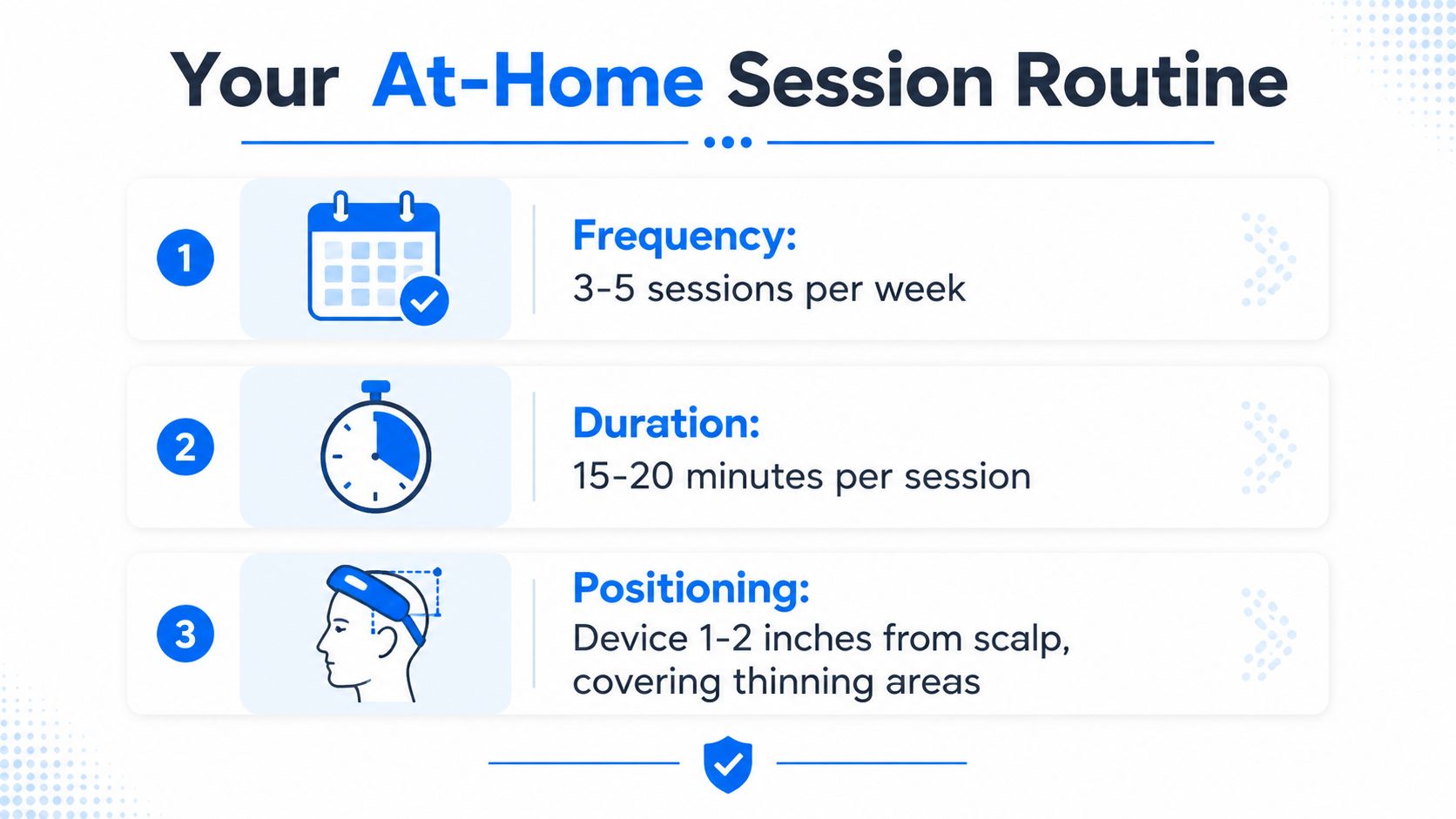
The most effective home routine is usually the one you can repeat without disrupting your life. Clinical studies of scalp photobiomodulation commonly evaluate red or red/infrared devices worn on the scalp several times per week for approximately 4 to 26 weeks (meta-analysis of home photobiomodulation for androgenetic alopecia). Follow the specific schedule supplied with your device because session length and positioning vary between products.
Begin with clean, accessible scalp areas. Part dense hair when needed so the light can reach the thinning regions, position the device exactly as directed, and avoid improvising distance or exposure time. If the device is a cap or helmet, the treatment surface should sit where the manufacturer intended. If it's a comb or handheld unit, move it methodically across the prescribed areas instead of repeatedly treating one spot.
Make adherence easier
Use a recurring calendar reminder and attach sessions to an established habit, such as an evening skincare routine or a particular television program. Keep the device where you'll see it, but store it safely and protect it from heat, moisture, and damage. If you travel, plan around the device's size and charging requirements rather than assuming missed sessions can be compensated for with extra exposure.
A simple weekly template might involve sessions on nonconsecutive days, with rest days between treatments. That approach can make the routine easier to sustain while remaining consistent with the broader pattern of several weekly sessions studied in clinical research. Don't add extra treatments to make up for missed use unless the device instructions or clinician specifically support that adjustment.
Adherence matters more than enthusiasm: A moderate, repeatable schedule over months is more useful than intense use for a short burst.
Combining treatments requires coordination
Red light therapy may complement other hair-loss approaches, but combination treatment should be individualized. Topical medications, oral therapies, procedures, and regenerative treatments can have their own contraindications, timing considerations, and monitoring needs. Tell your clinician about every device, medication, supplement, and scalp product you use, especially if you develop irritation, pain, scaling, or worsening shedding.
Setting Realistic Expectations and Measuring Progress
Patients often judge hair growth by looking in the mirror from day to day. That method is unreliable because lighting, hairstyle, hair length, shedding cycles, and scalp oil can change the appearance. A better approach records the baseline and measures change under comparable conditions.
In a 24-week randomized, double-blind, self-comparison trial, the treated side achieved greater hair coverage than the sham side by week 24, 14.2% versus 11.8%, with p<.001. The trial also reported improvements in hair thickness, hair count, and investigator ratings at 12 and 24 weeks (randomized trial of scalp LLLT). These findings illustrate the pace of treatment. A response develops over time, not after a handful of sessions.
What a meaningful response looks like
A dual-wavelength LED cap study reported 28.5 more hairs per square centimeter versus sham (review of light-based devices for hair loss). That is clinically measurable, but it isn't the same as a dramatic transformation or restoration of a completely bald area. Broader reviews emphasize that outcomes are generally strongest in early-to-moderate androgenetic alopecia, where follicles may still be active but miniaturized.
The same review highlights common reasons results disappoint: inconsistent wear time, use outside the studied wavelength or dose range, and expectations of regrowth in areas where viable follicles may no longer remain (review of practical expectations and device evidence). A good outcome may mean slower progression, improved coverage, or thicker existing hairs rather than a complete return to a prior hairline.
Track change objectively
Take baseline photographs from the front, top, and both sides using the same room, lighting, camera distance, hairstyle, and hair dryness. Repeat them at regular intervals rather than daily. A clinician can also assess density, shaft caliber, scalp condition, and whether the pattern still fits androgenetic alopecia.
For patients who want to explore contributing factors beyond the visible symptom, root-cause care may provide a broader framework for discussing health history, nutrition, hormones, immune activity, and environmental exposures. It shouldn't replace a focused scalp examination, but it can help prevent a narrow device decision from overlooking relevant medical context.
Integrative Evaluation and Personalized Hair Restoration at Sunridge Medical
Starting with an evaluation is especially important when the hair loss doesn't follow a familiar pattern. At Sunridge Medical, an integrative assessment can consider the history of shedding, family pattern, scalp symptoms, medications, hormonal context, nutrition, autoimmune concerns, and other contributors that may affect hair and follicle health. The purpose isn't to label every case with a hidden cause. It's to avoid treating an uncertain diagnosis with a device that may not address it.
Patients in Scottsdale, Phoenix, Paradise Valley, Tempe, Mesa, Chandler, Gilbert, and the greater Phoenix metropolitan area may be seeking a plan that combines conventional assessment with complementary care. Depending on the clinical picture, red light therapy may be discussed alongside evidence-informed options such as nutritional IV therapy, hormone optimization, or regenerative approaches. Those options aren't interchangeable, and each requires a review of medical history, risks, expected benefits, and appropriate monitoring.
A broader plan can clarify the role of light
Red light therapy should generally be considered an adjunct for pattern hair loss, not a replacement for diagnosis or standard therapies. The clinic also offers platelet-rich plasma treatment information for patients exploring regenerative options, although suitability depends on the individual and no procedure guarantees regrowth.
Light-based care is also used in other medical and cosmetic settings, so patients may encounter resources about light therapy for skin rejuvenation. Skin applications and scalp hair-loss protocols aren't automatically equivalent. Wavelength, dose, device design, treatment goal, and diagnosis all matter.
A consultation is appropriate if hair loss is sudden, patchy, painful, inflamed, associated with scaling or pustules, or continuing despite a consistent routine. It's also reasonable before purchasing a device when you're unsure whether the pattern represents androgenetic alopecia or another condition. An individualized plan can establish whether scalp photobiomodulation belongs in your care, what results would count as meaningful, and how to monitor progress safely.
Sunridge Medical offers individualized integrative evaluations in Scottsdale for patients considering red light therapy on the scalp and other hair-restoration options. Contact Sunridge Medical to discuss your hair-loss pattern, review potential contributing factors, and determine whether a consultation is appropriate.