


When autoimmune symptoms worsen, the safest first step may not be adding another supplement. It may be understanding what has changed. Online advice about alternative therapies for autoimmune flare ups can blur the line between supportive care and unproven claims. A new or severe symptom may need prompt medical attention, not a home remedy.
You deserve clear guidance, not pressure to choose between conventional care and complementary approaches. This article explains what supportive therapies may contribute to symptom management, where evidence is limited, and why safety depends on your condition, medications, and overall care plan. It also covers when worsening symptoms call for prompt attention and what to record before speaking with a clinician.
Sunridge Medical’s individualized approach to autoimmune disease management considers conventional care alongside research-based alternatives, with clinical planning and ongoing monitoring. The aim is to explore options thoughtfully, not to treat them as substitutes for prescribed treatment or promise they will prevent or resolve a flare.
Key Takeaways
- Worsening symptoms don’t automatically mean a flare. Consider other possible causes and recognize when symptoms need prompt medical attention.
- Understand how alternative therapies for autoimmune flare ups differ from complementary approaches used alongside medical treatment.
- Compare lifestyle practices and supplements by their intended supportive role, evidence limitations, and potential safety considerations.
- Prepare for a clinician conversation by tracking symptom changes, timing, possible triggers, medication changes, and effects on daily activities.
- Individualized integrative care can consider your diagnosis, treatment history, symptoms, and goals together.
What Is an Autoimmune Flare-Up, and What Should You Do First?
A flare is a worsening or return of symptoms associated with an autoimmune condition, beyond a person’s usual pattern. What qualifies as a flare varies by disease. Symptoms may intensify gradually or change suddenly, and their significance depends on your diagnosis and personal baseline. Ordinary fluctuations can happen, too. Fatigue, pain, stiffness, or other changes may have causes unrelated to autoimmune activity, so a symptom alone cannot confirm a flare.
That distinction matters before trying alternative therapies for autoimmune flare ups. Rest, pacing, or other supportive measures may help you cope with symptoms, but they are not the same as treatment intended to control the disease. Don’t stop, reduce, or replace prescribed medication without guidance from the clinician managing your care. A general overview of understanding autoimmune disease can provide background, but it can’t determine what a change in your symptoms means for you.
How can you recognize a possible flare?
Look for a meaningful change from your own baseline rather than comparing yourself with a generic checklist. Patterns differ by condition and by person. Record what changed and how it affects daily life. This gives your clinician a clearer starting point without asking you to diagnose yourself.
- When symptoms began and whether they appeared suddenly or gradually.
- Which symptoms changed, how severe they feel, and whether they are improving, stable, or worsening.
- How long symptoms last and which everyday activities have become difficult.
- Recent changes in medication, sleep, stress, routine, or other possible triggers.
A laboratory result may be useful in context, but one result or symptom checklist cannot establish a flare on its own. Clinical interpretation considers the full picture, including your condition, history, examination, and any appropriate testing.
When does worsening need prompt medical attention?
Seek urgent clinical assessment for symptoms that are severe, rapidly worsening, or unfamiliar to you. Don’t assume a new problem is simply part of a known autoimmune condition. Infection, medication effects, or another health issue may also need consideration. If symptoms could be life-threatening, use emergency services rather than waiting for a routine appointment or trying a supportive therapy first.
For a change that isn’t an emergency, follow your existing care plan and contact the clinician responsible for your treatment. Share your symptom notes and explain what differs from your usual pattern. This helps the clinician assess whether the change may reflect disease activity or another cause, and whether your plan needs review. Start with careful assessment, not an unverified remedy.
How Do Complementary Therapies Fit Into Autoimmune Flare Support?
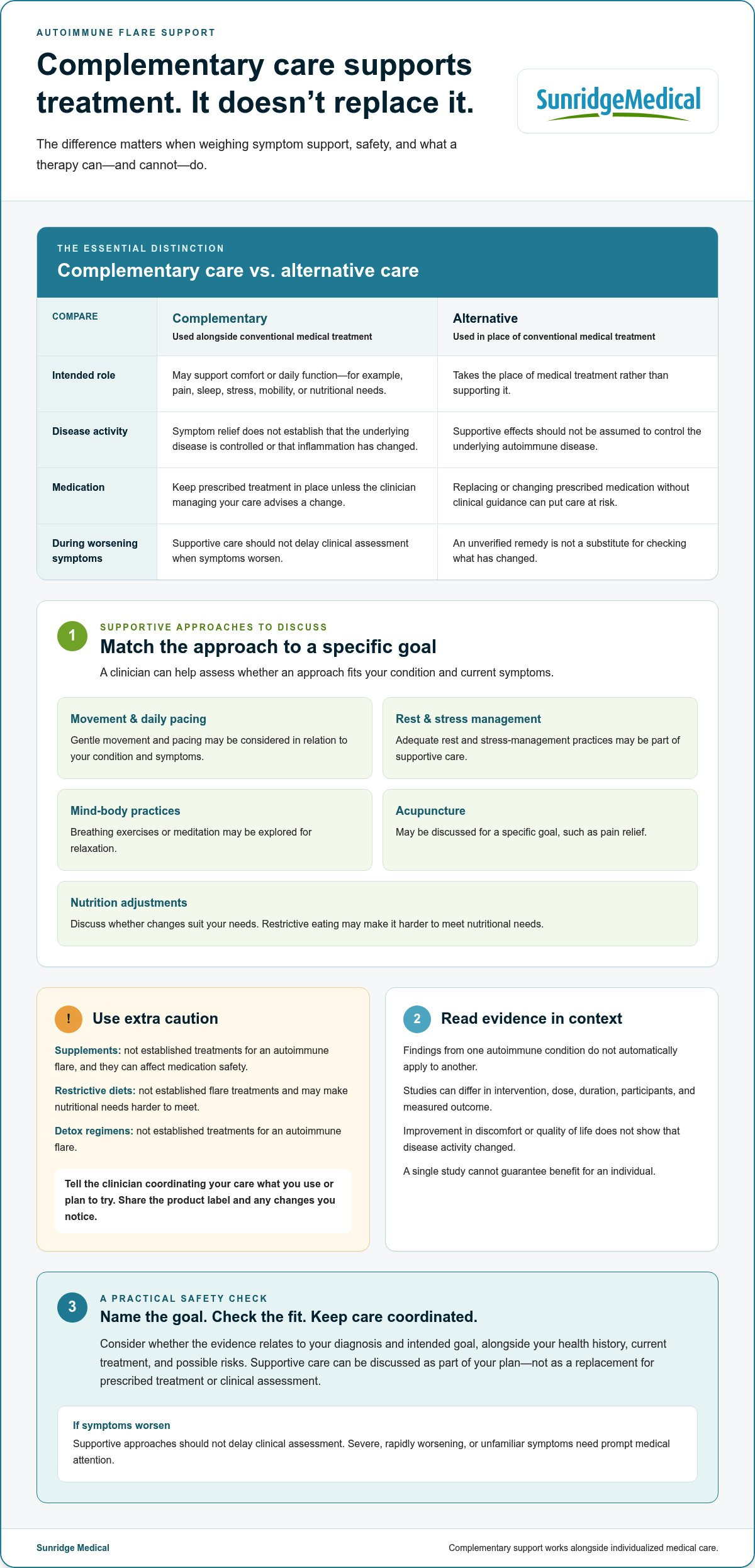
Complementary care is used alongside conventional medical treatment. Alternative care, by contrast, is used in its place. The distinction matters during a flare: an approach that supports comfort or daily function may have a role in care, but that doesn’t establish that it controls the underlying autoimmune disease. Complementary approaches should support, not replace, prescribed autoimmune treatment. Don’t stop or change medication because of an online claim or a temporary change in symptoms.
The potential value of supportive care is specific, not universal. A practice might be considered for pain, sleep, stress, mobility, or nutritional needs, while medical treatment addresses disease activity. Those are different goals. Even an improvement in comfort doesn’t prove that inflammation or organ involvement has changed, and supportive care shouldn’t delay clinical assessment when symptoms worsen.
What kinds of supportive approaches may be discussed?
A clinician can help assess whether gentle movement, pacing, adequate rest, stress-management practices, or nutrition adjustments suit your condition and current symptoms. Mind-body practices such as breathing exercises or meditation may be explored for relaxation. Acupuncture may be discussed for a specific goal, such as pain relief. Be clear about the reason for considering each approach and what you hope it will help with.
Supplements, restrictive diets, and detox regimens aren’t established treatments for an autoimmune flare. Supplements can also affect medication safety, while restrictive eating may make it harder to meet nutritional needs. Tell the clinician coordinating your care what you use or plan to try, including the product label and any changes you notice.
Why does evidence need to be interpreted carefully?
Research findings don’t automatically apply from one autoimmune condition to another. Studies can differ in the intervention, dose, duration, participants, and outcome measured. A result about discomfort or quality of life may not show that a therapy changes disease activity. Before applying a claim to your situation, consider whether the evidence is relevant to your diagnosis and the goal you have in mind.
Broad claims that a therapy “works for autoimmune disease” deserve caution. Evidence may be promising for one outcome and uncertain for another, or too limited to support a firm conclusion. A single study can’t guarantee benefit for an individual. Weigh the quality and relevance of the evidence alongside your health history, current treatment, and possible risks.
For a useful discussion, name the goal you hope to address, such as easing discomfort or supporting sleep, and ask how progress and unwanted effects would be monitored. Sunridge Medical’s individualized autoimmune disease management considers supportive options alongside conventional therapies and ongoing clinical monitoring. This keeps complementary choices connected to medical care rather than treating them as substitutes.
How Do You Compare Alternative Therapies for Safety and Usefulness?
There’s no universally best option for everyone with an autoimmune condition. A practical comparison starts with the purpose of an approach, the strength and relevance of its evidence, and how it fits your health circumstances. Lifestyle practices and supplements belong in different categories: a pacing strategy is not equivalent to taking a concentrated product, and each has distinct considerations.
Use the table as a discussion guide, not a treatment ranking. Evidence can vary by diagnosis, symptom, and how an approach is studied. “Natural” doesn’t mean risk-free, and safety may depend on your condition, medications, pregnancy status, and other individual factors.
| Approach | Possible supportive goal | Evidence limitations | Safety questions |
|---|---|---|---|
| Gentle movement or pacing | Support mobility, stamina, or daily function | Suitable activity and potential benefit can differ by condition and current symptoms. | What level of activity is appropriate now? Which symptoms mean I should pause? |
| Rest and stress-management practices | Support recovery, relaxation, or coping | Feeling calmer or better rested doesn’t establish a change in disease activity. | Is this practice manageable, and could it interfere with needed care? |
| Nutrition changes | Support general nutrition or address a specific dietary need | A dietary approach shouldn’t be assumed to treat a flare. Restrictive plans may not suit everyone. | Can I meet my nutritional needs, and is there a clear reason for this change? |
| Acupuncture or other mind-body practices | Explore support for a defined symptom, such as discomfort or stress | Findings may not apply across conditions, outcomes, or individuals. | What symptom is the goal, and how will benefit or adverse effects be assessed? |
| Supplements or herbal products | Address a specific nutritional or symptom-related question | Evidence for a product may be limited, mixed, or unrelated to autoimmune flare treatment. | Could ingredients interact with my medicines or condition? Is the dose appropriate? |
Which questions help assess a therapy?
For any alternative therapies for autoimmune flare ups you’re considering, ask what outcome the approach is intended to support and how you’ll assess it. Is the claim based on research in people with your condition, or mainly on testimonials and promotional language? Be cautious of cure claims or promises to replace prescribed care. Also consider the time, effort, access, cost, risks, and whether the approach fits your existing plan.
Could supplements or popular remedies interact with treatment?
They can. Products marketed as natural may affect medicines or be unsuitable for particular health conditions. Give your treating clinician the product name, full ingredient list, and dose, including blends or remedies you use only occasionally. For related clinical context on IV approaches, see this IV therapy for autoimmune disease guide. Sunridge Medical’s autoimmune disease management considers options within an individualized care plan.
What Practical Steps Can Help You Navigate a Flare Safely?
When symptoms change, a clear process can make the next decision less overwhelming. Assess urgency, document what’s changed, follow your existing care plan, and contact your clinician for guidance. This sequence keeps decisions grounded in your health history rather than a one-size-fits-all checklist or an online claim about alternative therapies for autoimmune flare ups.
- Assess urgency. If symptoms are severe, rapidly worsening, unfamiliar, or potentially life-threatening, seek prompt assessment or use emergency services as appropriate. Don’t assume a new symptom is caused by your autoimmune condition.
- Make a concise record. Note what changed and when, along with possible triggers or effects on daily activities. A brief record can help you describe the pattern clearly.
- Follow your current plan. Continue medication as prescribed unless your clinician advises otherwise. Don’t start, stop, or change a medication or supplement on your own, even if a remedy is described as natural.
- Contact your clinician. Share the changes and ask what next steps fit your diagnosis and treatment history. If you’re considering a new supportive approach, discuss it before adding it to your routine.
What information should you record during a flare?
A short daily log is usually more useful than trying to reconstruct several difficult days from memory. Record symptoms and severity, when they began, sleep, activity, and changes in your ability to manage everyday tasks. Note medication or supplement changes, possible triggers, and relevant illness or stressors. Keep entries brief and bring them to your next clinical discussion. The goal is a clear pattern, not a perfect diary.
How can you prepare for a treatment conversation?
For each therapy you’re considering, write down its name, the benefit you hope for, where the supporting evidence comes from, and any known risks. Ask whether the goal is relevant to your diagnosis and how the approach fits with your current treatment plan. If your question is specifically about hormone-related symptoms or care, the hormone optimization for autoimmune disease guide offers related context.
Bring the product label for any supplement and list its ingredients and dose. Mention changes even if you haven’t started the product yet. This gives your clinician an opportunity to consider potential interactions and clarify what should be monitored. You can also ask what would count as a meaningful benefit, what unwanted effects to watch for, and when to revisit the decision.
Sunridge Medical’s individualized autoimmune disease management brings symptoms, treatment history, and supportive options into a coordinated clinical plan with ongoing monitoring. Explore individualized autoimmune disease management to learn how an integrative approach can place potential options in context.
How Can Individualized Integrative Care Support Autoimmune Disease Management?
Supportive care is easier to assess when considered alongside the full clinical picture. Symptoms, diagnosis, treatment history, current therapies, and personal priorities can all shape whether an option is appropriate. An individualized evaluation brings these factors together instead of assuming the same approach fits every person or every stage of an autoimmune condition.
Sunridge Medical’s integrative approach combines conventional therapies with research-based alternatives. Physician evaluation and treatment planning can help place potential options alongside your existing care, including consideration of possible interactions and changing clinical needs. Ongoing monitoring provides a way to review how the plan is working and whether it needs adjustment. The aim is thoughtful management, not a promise that a therapy will prevent flares or produce remission.
What does individualized autoimmune care consider?
A clinical discussion can bring together your symptom pattern, medical history, current therapies, and goals. For example, you may want to focus on daily function or discuss whether a complementary approach fits alongside your current treatment. Those priorities make the conversation specific, while clinical context guides decisions about potential risks, interactions, and changes in care.
Care planning is not a one-time decision. Symptoms and treatment needs can change, so ongoing clinical monitoring can help keep options aligned with your circumstances. Sunridge Medical provides evaluation, treatment planning, clinical therapy administration, and monitoring as part of its autoimmune disease management approach.
How can patients take a next step with confidence?
Before a clinical evaluation, gather a concise symptom record, an up-to-date medication and supplement list, and the questions you most want answered. Include what you hope a supportive approach might help with, such as a specific symptom or daily activity. If you’re considering alternative therapies for autoimmune flare ups, note the evidence or claims you’ve encountered so they can be discussed in context.
- Bring details about symptom changes and their effect on daily life.
- List medications, supplements, and recent changes to them.
- Ask how a proposed option fits your diagnosis and current treatment plan.
- Discuss what would be monitored and when the plan should be reviewed.
For a broader perspective on coordinated approaches to chronic illness, the integrative medicine for chronic illness guide offers related context. Supportive therapies are best considered within a coordinated plan, not as substitutes for medical care. To explore an individualized approach, explore individualized autoimmune disease care.
Take Your Next Step With a Clear, Personal Goal
You don’t have to make every possible change at once. Choose one concern to address, then use it to guide a focused conversation about whether a supportive approach fits your circumstances. For example, discuss a specific daily challenge and how you’ll judge whether an option is useful, manageable, and safe to continue. This can make decisions about alternative therapies for autoimmune flare ups more grounded and less influenced by sweeping online promises.
Sunridge Medical’s individualized autoimmune disease care brings conventional therapies and research-based alternatives into a coordinated clinical plan. Physician evaluation and continued monitoring keep the discussion connected to your needs as they evolve, without promising a particular outcome.
Explore individualized autoimmune disease care and take a thoughtful next step toward care that reflects your priorities.
Frequently Asked Questions
Can alternative therapies stop an autoimmune flare-up?
No alternative approach can be relied on to stop a flare, and claims of a guaranteed cure or rapid reversal warrant caution. Some complementary practices may help with a particular concern, such as coping with stress or maintaining comfortable movement, but that doesn’t show they’re changing the disease itself. Discuss any option with your clinician before trying it, especially if you’re considering it instead of a prescribed treatment.
Is it safe to take supplements during an autoimmune flare?
Not necessarily. A supplement’s safety can depend on its ingredients, dose, your condition, and your medications. A multi-ingredient product may contain substances that aren’t obvious from its front label. Share the full product name, ingredient panel, and dose with your treating clinician or pharmacist before starting it. If you’ve already taken a product and develop a concerning reaction, seek appropriate medical advice promptly.
Can stress trigger an autoimmune flare-up?
Stress may coincide with symptom worsening, but it’s difficult to determine whether it caused a flare in an individual. Poor sleep, changes in routine, or an illness occurring at the same time can also affect how you feel. If symptoms intensify during a stressful period, note the timing and discuss the pattern with your clinician. Relaxation strategies may support coping, but they shouldn’t be treated as disease control.
How long does an autoimmune flare-up usually last?
There isn’t one typical duration that applies across autoimmune diseases. A period of worsening may resolve relatively quickly for one person, while another person’s symptoms persist or change over time. Your diagnosis, the symptoms involved, and the cause of the worsening all matter. If symptoms last longer than usual, get worse, or disrupt basic activities, contact your clinician rather than waiting for a general timeframe to pass.
What should I do if my usual treatment is not helping during a flare?
Contact the clinician managing your condition and explain which symptoms have changed, what treatment you’re taking, and how the change affects daily life. Don’t increase, reduce, or stop medication on your own. If a dose was missed or a treatment was delayed, mention that too. Your clinician can assess whether the plan needs review or whether another cause should be considered, rather than relying on guesswork or adding a remedy.
Can diet changes help during an autoimmune flare-up?
Diet changes may help address an individual nutritional need or make eating more manageable, but no single diet is established as a treatment for every autoimmune flare. A sudden restrictive plan can make it harder to maintain adequate nutrition, particularly if appetite or energy is already affected. Before eliminating major food groups or using a special diet, discuss the reason for the change and how to meet your nutritional needs with your care team.
When should I seek urgent care for a possible flare?
Seek urgent assessment for severe, rapidly worsening, or unfamiliar symptoms. For potentially life-threatening symptoms, such as difficulty breathing, severe chest pain, or sudden confusion, use emergency services. Don’t assume a new symptom is part of a known autoimmune condition, since other health problems may need prompt attention. If you’re unsure how urgent a change is, follow your existing care instructions or contact a medical professional for direction.