


If two people have stage 2B triple-negative breast cancer, does that mean their treatment and outlook will be the same? Not necessarily. The stage describes where the cancer has been found, while tumor biology and the response to treatment help the oncology team understand what may happen next.
For a newly diagnosed patient, the most useful starting point isn't a single survival percentage. It's understanding how tumor size, lymph-node findings, receptor testing, and surgical pathology fit together, then using those findings to make an individualized treatment plan.
Table of Contents
- What Stage 2B Means in Triple Negative Breast Cancer
- Standard Treatment Options and How They Are Sequenced
- Survival Numbers and What They Mean for You
- What Happens After Surgery and During Follow-Up
- Integrative Therapies Alongside Standard Care
- Individualized Evaluation and When a Second Opinion Helps
What Stage 2B Means in Triple Negative Breast Cancer
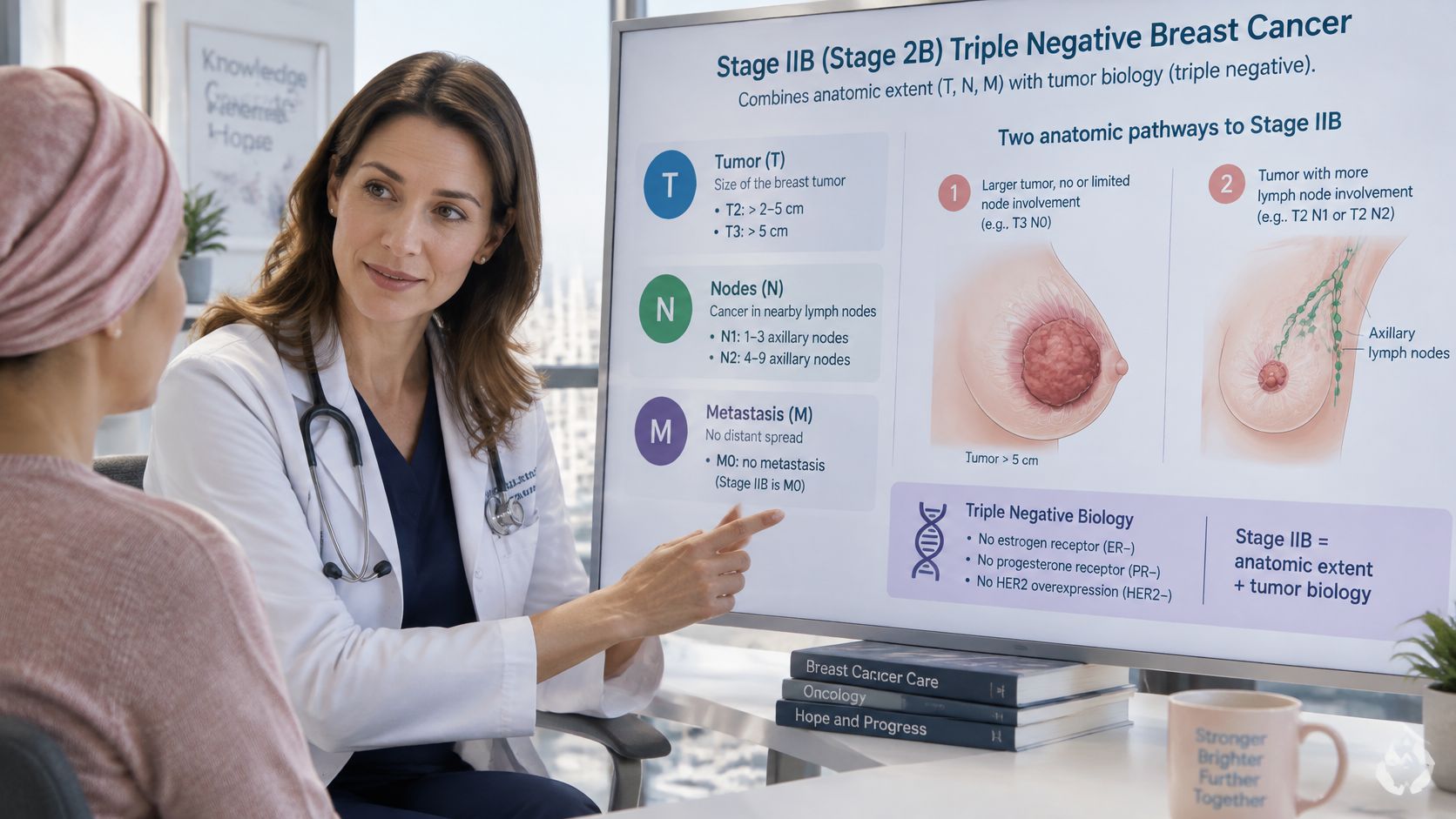
Stage IIB describes anatomic extent; triple-negative describes tumor biology. These are related but separate pieces of the diagnosis. Together, they help the oncology team select treatment, but neither tells the whole story alone.
The T, N, and M categories describe the primary tumor, regional lymph nodes, and distant spread. Under the AJCC anatomic framework, the combinations below define stage IIB, as described in the National Cancer Institute staging terminology.
Stage IIB anatomic combinations
| Combination | Primary tumor (T) | Lymph nodes (N) | Distant spread (M) |
|---|---|---|---|
| T2 N1 M0 | Larger than 20 mm, up to 50 mm | Regional spread to movable same-side level I or II axillary nodes | No clinical or radiographic evidence of distant metastasis |
| T3 N0 M0 | Larger than 50 mm | No regional lymph-node metastasis | No clinical or radiographic evidence of distant metastasis |
This means a patient can have stage IIB disease with a smaller tumor and involved regional nodes, or a larger tumor without regional node involvement. Lymph-node involvement isn't the same as distant metastasis. Both combinations in the table are nonmetastatic.
The designation M0 means distant metastasis hasn't been identified through the clinical evaluation and imaging. It doesn't mean that recurrence risk is absent or that treatment beyond surgery is unnecessary.
Why the biology belongs beside the stage
A shipping label describes both a package's size and its contents. Similarly, the anatomic stage describes the cancer's extent, while receptor testing identifies biological features that affect treatment choices.
Triple-negative breast cancer, or TNBC, lacks estrogen receptors, progesterone receptors, and excess HER2 expression. Hormone-blocking therapy and conventional HER2-directed treatment therefore aren't treatment options for this subtype. Triple-negative doesn't mean that no effective treatments exist.
Another potential source of confusion is anatomic versus prognostic staging. AJCC prognostic staging incorporates grade and biological features, so a report may show a prognostic stage that differs from the anatomic label. Sunridge's overview of cancer diagnosis and stages provides additional context for those distinctions.
Before the next oncology visit, useful records include:
- The pathology report, including receptor results and tumor grade.
- The staging imaging reports, documenting the evaluation for disease elsewhere.
- The lymph-node assessment, including biopsy results when available.
Standard Treatment Options and How They Are Sequenced
Standard treatment components for stage IIB TNBC
| Component | Purpose | Typical timing | Key consideration |
|---|---|---|---|
| Neoadjuvant chemotherapy with pembrolizumab | Shrink the tumor and treat possible micrometastases | Before surgery | Platinum-based regimen; heart and organ function assessed first |
| Surgery, breast-conserving or mastectomy | Remove residual tumor and assess pathologic response | After neoadjuvant therapy | Pathology findings guide next steps |
| Radiation therapy | Lower local and regional recurrence risk | After surgery, when indicated | Nodal involvement, surgery type, and margins inform the recommendation |
| Adjuvant pembrolizumab | Continue immune-based treatment | After surgery | Treatment course and side effects reviewed with the oncologist |
| Adjuvant olaparib | Targeted option for selected eligible patients | After surgery, if criteria are met | Requires germline BRCA1/2 testing; residual disease informs eligibility after neoadjuvant therapy |
For newly diagnosed, high-risk early TNBC, including eligible stage II disease, pembrolizumab is FDA-approved with chemotherapy before surgery and continued alone afterward, according to the Oncology Nursing Society approval summary. Neoadjuvant means before surgery; adjuvant means after surgery.
Before surgery
The medical oncology team determines whether the patient is a candidate for chemotherapy with pembrolizumab. The KEYNOTE-522 approach uses platinum-containing chemotherapy, followed by an anthracycline/cyclophosphamide phase, with assessment of cardiac risk, organ function, genetics, and overall treatment suitability, as outlined in the NCI breast cancer treatment guidance.
Starting with systemic treatment allows the team to treat disease beyond the visible tumor and assess how the cancer responds. A tumor becoming smaller is encouraging, but the surgical specimen provides information that examination and imaging can't fully supply.
The oncologist also sets the infusion schedule and explains when laboratory checks or treatment adjustments may be needed. Sunridge's explanation of how chemotherapy schedules are organized can help patients prepare scheduling questions.
Surgery and postoperative decisions
The breast surgeon determines whether breast-conserving surgery or mastectomy is appropriate, considering disease extent, response, genetics, and patient preferences. A mastectomy isn't automatically required because a cancer is triple-negative.
For patients considering reconstruction with mastectomy, the OC Breast Surgery immediate reconstruction guide offers background for a discussion with the surgical team. Reconstruction timing should be coordinated with anticipated radiation and the overall cancer treatment schedule.
After surgery, the oncology team uses the pathology findings to finalize the postoperative plan. The radiation oncologist evaluates local and regional risk, while the medical oncologist assesses systemic treatment options. Olaparib isn't a general treatment for everyone with TNBC; eligibility requires an inherited, or germline, BRCA1/2 mutation and other clinical criteria.
Planning principle: The oncology team should explain what each treatment contributes and which findings could change the sequence.
Useful questions for the treating oncologist include:
- Sequence: Why is this order recommended for this cancer?
- Side effects: Which symptoms should trigger a call, and which require urgent evaluation?
- Response: How will treatment response be measured before surgery?
- Alternatives: Is an appropriate clinical trial available?
Survival Numbers and What They Mean for You
KEYNOTE-522 outcomes versus chemotherapy alone
The trial enrolled previously untreated patients with high-risk early TNBC, including stage II disease. The KEYNOTE-522 response summary reports the complete-response figures, while the updated trial results report the survival figures below.
| Outcome | Pembrolizumab plus chemotherapy | Chemotherapy alone | Difference |
|---|---|---|---|
| Pathologic complete response | 63% | 56% | 7 percentage points |
| 60-month event-free survival | 81.3% | 72.3% | 9.0 percentage points |
| 5-year overall survival | 86.6% | 81.7% | 4.9 percentage points |
These results compare treatment groups, not individual patients with stage IIB disease. The pembrolizumab strategy included treatment before surgery and continuation afterward. Eligibility, tumor characteristics, treatment completion, and follow-up all influence how closely a trial population resembles a particular patient.
What the outcomes actually measure
Pathologic complete response, or pCR, means no residual invasive cancer is found in the breast or regional lymph nodes after preoperative treatment. Residual in-situ disease may still be present. A complete response is favorable, but it isn't a guarantee that cancer can never return.
Event-free survival measures time without specified events. In this trial, those events included progression preventing definitive surgery, local or distant recurrence, a second primary cancer, or death from any cause.
Overall survival measures whether participants remain alive, regardless of cause of death. A percentage-point difference compares the groups directly; it isn't the same as a percentage reduction in an individual patient's risk.
A trial result can support a treatment decision without becoming a personal prediction.
Why residual cancer burden matters
Surgical pathology helps refine the outlook beyond the initial stage. Residual cancer burden, or RCB, describes the amount of invasive cancer remaining after neoadjuvant treatment, incorporating findings in the breast and lymph nodes.
Patients achieving pCR generally have more favorable outcomes, while moderate or extensive residual disease signals greater recurrence risk, as discussed in the JNCI review of response assessment and emerging biomarkers. Residual disease should prompt an individualized discussion, not an assumption that treatment has failed.
Stromal tumor-infiltrating lymphocytes, immune cells within tumor-associated tissue, and genomic signatures are being studied as response predictors. These approaches aren't established tools for independently choosing or skipping immunotherapy.
Questions for the pathologist and oncologist include:
- Response result: Was pCR achieved, and was invasive cancer found in any lymph nodes?
- RCB assessment: Was residual cancer burden calculated, and what does the category mean in this case?
- Treatment implications: Does the result change postoperative treatment or clinical-trial eligibility?
What Happens After Surgery and During Follow-Up
The post-surgery plan follows the pathology result. Follow-up then needs to address both recovery and the possibility of recurrence, with clear instructions about appointments, breast imaging, and symptoms that shouldn't wait until the next scheduled visit.
Investigational treatment shouldn't be confused with established postoperative care. A 2025 EMJ Reviews discussion of A-BRAVE describes a trial that included resected stage IIB TNBC: one year of adjuvant avelumab showed a trend toward improved disease-free survival, but the result wasn't statistically significant. That finding doesn't establish avelumab as standard adjuvant treatment for this setting.
A negative blood test isn't an all-clear
Circulating tumor DNA, or ctDNA, refers to tumor-derived genetic material detected in blood. Testing may help identify minimal residual disease, but its usefulness for directing routine early-TNBC care remains unproven, according to the review indexed by PubMed.
A negative result can't exclude relapse. Tumors may shed little DNA, and test sensitivity and timing affect detection. A positive result also doesn't automatically identify a visible, curable recurrence or establish which treatment should follow.
Before testing, the clinician should explain what each possible result would change. Testing is best considered within a clinical trial or a clinician-supervised plan with a defined response to the findings.
Before ordering a test: There should be a plan for interpreting the result, not simply a hope that more testing will provide certainty.
Recovery and symptom reporting
Follow-up typically includes clinical visits, mammography when appropriate for remaining breast tissue, and additional imaging as directed by the clinician. Mammography evaluates breast findings; it is not an all-encompassing test for distant recurrence.
For patients recovering from reconstruction, the Georgia Plastic & Reconstructive Surgery recovery overview can support questions about activity and healing, while the treating surgeon's instructions remain controlling. Sunridge's recovery after chemotherapy and radiation resource provides additional recovery context.
Symptoms needing prompt medical attention include:
- A new lump or thickening in the breast, chest wall, or underarm.
- Persistent bone pain, especially when unexplained or worsening.
- An unresolved cough or a meaningful change in breathing.
- New neurologic symptoms, including weakness, numbness, or confusion. Sudden symptoms require emergency assessment.
Integrative Therapies Alongside Standard Care
Integrative support should complement cancer treatment, not delay or replace it. The oncology team needs to know about supplements, infusions, dietary changes, and complementary therapies before they begin. An intervention intended for symptom relief should be judged differently from one marketed as a tumor treatment.
Separate symptom support from anticancer claims
Integrative approaches by role and evidence
| Approach | Typical role | Evidence status | Main caution |
|---|---|---|---|
| Structured exercise | Fatigue, mood, and physical function during and after treatment | Supported by trials for fatigue and quality of life in cancer populations | Timing and intensity coordinated around surgery, infusions, and current health |
| Mindfulness and CBT-based stress programs | Anxiety, sleep, and distress | Evidence for symptom relief in cancer care | Doesn't replace cancer treatment or treatment decisions |
| Acupuncture | Pain, nausea, or neuropathy symptoms | Mixed evidence; potential benefit for selected symptoms only | Coordinate with blood counts and anticoagulant use |
| High-dose IV vitamin C | Proposed anticancer effect | Investigational; not established for TNBC | Kidney and electrolyte considerations; not a substitute for treatment |
| Insulin potentiation therapy | Proposed enhanced chemotherapy uptake | Investigational; limited human evidence | Hypoglycemia risk; requires screening |
| Restrictive or ketogenic diets | Weight and metabolic goals | Not established as cancer treatment | Malnutrition risk during chemotherapy |
Structured activity and psychological support focus on functioning and coping. Exercise may need modification for postoperative restrictions, significant fatigue, balance problems, or other treatment effects. More intense isn't automatically more helpful.
Mindfulness and cognitive behavioral therapy-based programs can address distress without suggesting that emotions caused the cancer. Persistent anxiety, depression, or insomnia deserves clinical attention rather than an expectation that the patient should cope better.
Acupuncture is also symptom-focused, not an anticancer treatment. The clinician should assess the specific symptom, likely benefit, infection or bleeding considerations, and whether another medical problem needs evaluation first.
Investigational approaches need a different conversation
High-dose IV vitamin C, insulin-related protocols, and restrictive diets shouldn't be presented as demonstrated methods of controlling stage IIB TNBC. A proposed mechanism doesn't establish a clinical benefit, and a treatment's availability doesn't prove that it improves survival.
Insulin-related protocols can cause low blood sugar. High-dose intravenous nutrients require attention to kidney function and electrolyte balance, while restrictive diets can make adequate nutrition harder during chemotherapy. These concerns require clinical assessment, not a do-it-yourself protocol.
For patients considering cannabis-derived products, HempWell USA's understanding CBD alongside chemotherapy provides background for a medication-review discussion, not proof of benefit or safety. CBD can interact with medicines, so the oncology pharmacist or treating clinician should review any proposed product.
Sunridge's integrative medicine for breast cancer clinical guide offers context for coordinated care. Before any supportive intervention begins, the discussion should address:
- Evidence: What supports this approach for the intended symptom or goal?
- Interactions: Could it affect current medications or planned treatment?
- Stopping rules: Which side effects mean the intervention should be paused or stopped?
Individualized Evaluation and When a Second Opinion Helps
Sunridge Medical's safest starting point is a case review, not selecting a therapy from a list. For stage IIB TNBC, the important question is how the diagnosis, completed treatment, current findings, and personal goals fit together. A treatment menu can't answer that question safely.
Sunridge Medical is an experienced integrative clinic in Scottsdale, Arizona, using individualized, evidence-informed evaluation. Before outlining options, the clinic reviews cancer type, stage, pathology, previous treatment, molecular information when available, organ function, medications, symptoms, and individual goals.

What an individualized review should clarify
The first task is to establish which findings are confirmed and which questions remain unresolved. For example, an incomplete receptor report presents a different problem from a completed surgical report showing residual disease. The records review should distinguish those situations before any supportive recommendation is considered.
The next task is to evaluate safety. Sunridge states that not all treatments are appropriate for every cancer patient: diagnosis, stage, biomarkers, treatment history, medications, laboratory findings, and current health affect what may be reasonable. Options should therefore be discussed with their evidence, uncertainties, and limitations rather than presented as a single protocol.
Any supportive suggestion should be coordinated with the patient's oncologist, breast surgeon, and radiation team. The practical plan needs to fit scheduled treatment and avoid conflicting instructions. Patients should understand which clinician is responsible for cancer treatment decisions and whom to contact about adverse effects.
When another review can be useful
A second opinion may help confirm the stage, clarify a pathology discrepancy, interpret residual disease, compare preoperative and surgical plans, or explore clinical trials. It doesn't require rejecting the current oncology team. A focused consultation can produce specific questions to bring back to that team.
Sunridge's breast cancer second-opinion information provides a starting point for patients considering a records-based discussion. Patients in Phoenix, the greater Phoenix area, elsewhere in Arizona, or traveling for care can ask what documentation is needed before scheduling.
Useful records to gather include:
- Pathology and biomarker reports, including biopsy and surgical findings.
- Imaging and staging reports, with access to the images when requested.
- A treatment summary, including completed treatment, interruptions, and significant reactions.
- A medication and supplement list, including nonprescription products.
- Recent laboratory results, particularly those relevant to treatment safety.
A first evaluation generally centers on reviewing records, discussing reasonable options and their limits, and identifying questions for the treating team. The patient retains the final decision after an informed discussion, and suitability for additional care is determined only through individualized evaluation.
New chest pain, shortness of breath, or sudden neurologic changes require emergency care first. Sunridge Medical doesn't replace emergency care, an oncologist, or medically necessary standard treatment, and it doesn't promise cures or guaranteed outcomes.
Sunridge Medical offers individualized case review and coordinated integrative support for patients navigating stage IIB triple-negative breast cancer. Visit Sunridge Medical to contact the Scottsdale clinic and discuss whether a consultation or second opinion is appropriate; suitability is determined after an individualized evaluation.