


What if the goal isn’t to convince your family, but to make room for an honest conversation? If you’re searching for how to convince family to try alternative medicine, you may be hoping to help someone you love while worrying they’ll dismiss the idea or feel pressured. A respectful discussion starts with listening, not asking for agreement.
It’s understandable to want every possible option considered, especially when someone’s health journey feels difficult. It’s also reasonable to question whether a proposed approach is safe or supported by credible evidence. Alternative treatments vary, and they shouldn’t replace or delay conventional medical care without guidance from qualified clinicians.
This article offers practical ways to discuss an approach, respect the patient’s autonomy, and assess potential benefits, risks, and interactions with a clinician. You’ll find ways to sort reliable information from unsupported promises and choose a manageable next step, whether that’s gathering questions, reviewing evidence, or deciding to wait. The aim isn’t to guarantee a treatment will work, but to protect trust while making an informed choice.
Key Takeaways
- Understand how “alternative,” “complementary,” and “integrative” approaches differ before discussing a specific option.
- Assess a therapy by its intended purpose, supporting evidence, uncertainties, and potential risks, not by its label.
- Use a calm, permission-based conversation to share concerns and hopes while leaving room for the patient to decide.
- To learn how to convince family to try alternative medicine without pressure, focus on questions and informed choice rather than securing agreement.
- Compare a proposed approach with the current care plan and discuss evidence, risks, and fit with conventional treatment with qualified clinicians.
Why conversations about alternative medicine can become difficult
Treatment conversations can bring up fear, hope, and frustration, and family members may experience them differently. One person may be searching for options after a difficult stretch of care. Another may worry about harm, cost, or whether a new approach could interfere with medical treatment. Those concerns don’t necessarily mean someone is unsupportive. Often, they reflect uncertainty and a desire to protect the person at the center of the decision.
Start by moving from broad labels to specifics. “Alternative medicine” can refer to very different practices, and the terminology can be confusing. A neutral overview of complementary and alternative medicine describes how these approaches are categorized. But a label alone can’t tell you whether a particular therapy is supported by evidence, suitable for an individual, or safe alongside their care.
What does “alternative medicine” mean in this conversation?
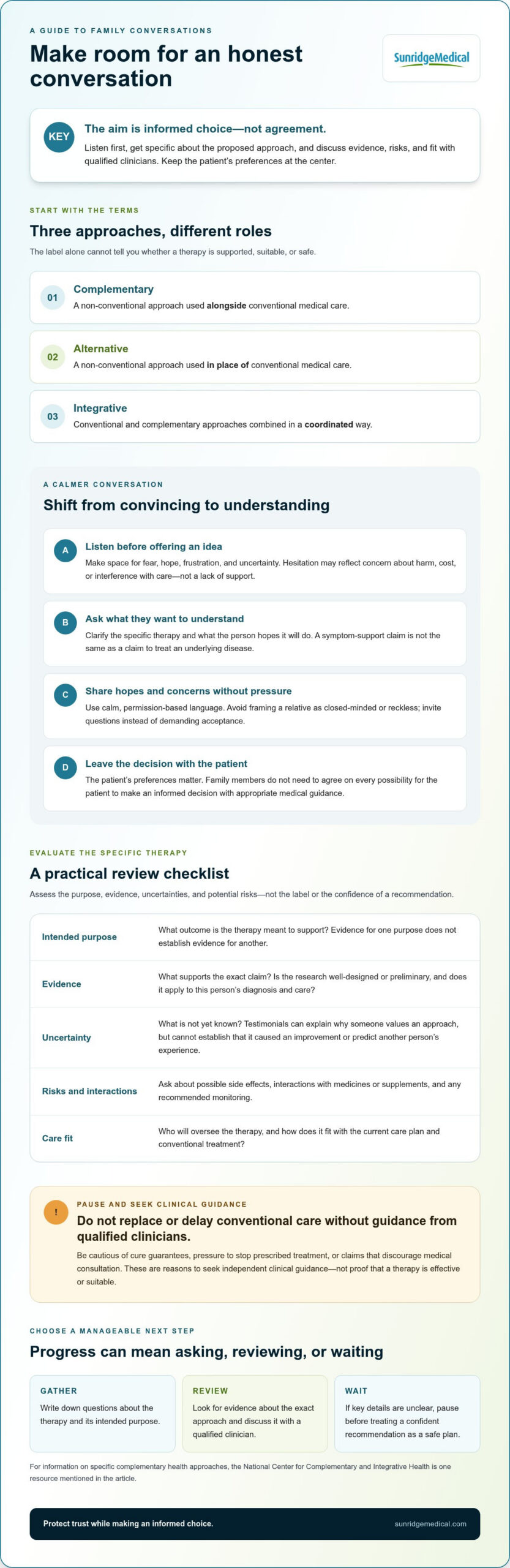
Ask which specific therapy or practice the person is considering and what they hope it will do. “Complementary” generally describes an approach used alongside conventional medical care. “Alternative” refers to using a non-conventional approach in place of it. “Integrative” care combines conventional and complementary approaches in a coordinated way. These terms aren’t interchangeable, and none tells you whether a particular treatment is suitable.
For example, a family might be discussing an approach intended to support comfort while someone continues prescribed care, or a proposal to stop that care and use something else instead. Those are different decisions, with different questions to ask. Clarifying the plan helps the family discuss its purpose, evidence, uncertainties, and possible risks instead of debating a broad category.
Why family members may disagree about treatment
Someone who favors a therapy may be motivated by hope or a wish to explore every option. Someone who hesitates may be concerned about side effects, interactions with medicines, expense, or missed or delayed medical care. Either person may be trying to help. Accusing a relative of being closed-minded or reckless can turn uncertainty into conflict.
If you’re wondering how to convince family to try alternative medicine, consider reframing the goal: invite an informed discussion, not acceptance. Ask what the patient wants to understand, listen without taking sides, and identify questions for a qualified clinician. The patient’s preferences matter. Family members don’t need to agree on every possibility before the patient can make a decision with appropriate medical guidance.
How to assess an alternative treatment before recommending it
Before sharing a treatment idea with family, identify the specific therapy and the outcome it’s intended to support. A claim about easing a symptom is not the same as a claim about treating the underlying disease. Evidence for one purpose doesn’t establish evidence for another, and results from a different condition or patient group may not apply to the person you hope to help.
Look beyond testimonials and confident language. Personal stories can explain why someone values an approach, but they can’t establish that it caused an improvement or predict what another person will experience. Check whether the evidence comes from well-designed research, whether it’s preliminary, and what remains uncertain. The National Center for Complementary and Integrative Health is one resource for reviewing information about specific complementary health approaches.
Questions to ask about evidence and safety
Bring specific questions to the patient’s treating clinician or another qualified medical professional. Ask what evidence supports the intended outcome and whether it applies to this person’s diagnosis and current care. Discuss potential side effects, interactions with medicines or supplements, recommended monitoring, and who will oversee the therapy. If these details aren’t clear, pause before treating a confident recommendation as a safe plan.
Be cautious of cure guarantees, pressure to stop prescribed treatment, or claims that discourage medical consultation. These are reasons to seek independent clinical guidance, not proof that a therapy is effective or suitable. Ask for evidence behind the exact claim, and distinguish established findings from early research, marketing language, or individual accounts.
How to discuss conventional care without creating a false choice
Exploring an additional approach doesn’t require rejecting the current care plan. The patient can ask whether a proposed therapy might fit alongside their treatment, what risks or interactions need review, and how clinicians would monitor it. They should speak with their clinician before changing or stopping prescribed care. An approach isn’t automatically safer or more effective because it’s described as natural or non-conventional.
Family discussions are more productive when everyone works from clear information and keeps the patient’s goals central. The American Medical Association offers guidance for families who disagree on treatment, including ways to build trust and identify shared values. Rather than asking relatives to commit in advance, suggest reviewing the evidence and risks together.
A medical discussion can help clarify questions, but it can’t guarantee a particular result. For another perspective, families can review Sunridge Medical’s approach to individualized care, which the center describes as combining conventional therapies with research-based alternative treatments.
How to talk with family about trying alternative medicine
A thoughtful conversation is more likely to preserve trust than a pitch designed to win agreement. Choose a calm, private time when no one is rushing or already upset. Ask permission to raise the subject, explain why you’d like to discuss it, and give others space to respond before presenting articles or a preferred option.
Use “I” statements to describe your own hopes and concerns without assuming what relatives think. For example, “I’m trying to understand whether this approach could fit with the current care plan” invites discussion. “You’re against anything that might help” assigns a motive and can make someone defensive. Before sharing information, ask what questions or worries they want addressed.
A respectful script for starting the conversation
You might say: “I’m considering this and would value hearing what concerns you most. Would you be open to writing down questions and reviewing them with the patient’s clinician?” This makes your request clear without suggesting that the treatment is proven, appropriate, or something the family must accept. Keep the discussion focused on learning about the specific approach and its place, if any, in the patient’s care.
Then listen for the concern behind the first reaction. A relative may want to know about safety, evidence, cost, or whether the patient would continue prescribed treatment. Reflect what you heard before responding: “It sounds like you’re worried this could interfere with the care already in place. Have I understood you?” Acknowledging a concern doesn’t mean you have to agree with every conclusion.
How to respond when relatives say no
If someone declines to discuss the idea, avoid turning the moment into a debate or demanding an immediate answer. You could ask, “What information would help you feel that your concern has been heard?” They may not want to continue, and respecting that boundary can leave room for a calmer conversation later. The patient can still bring questions to a qualified clinician independently.
Family members can offer perspective, but they shouldn’t pressure the patient toward or away from a treatment. The patient’s decision should be informed by reliable information and appropriate clinical guidance. If you’re thinking about how to convince family to try alternative medicine, shift the aim from securing a yes to agreeing on a careful next step, such as gathering questions for the clinician.
Listen first, verify claims, and decide without pressure. This keeps the discussion centered on the person receiving care, even when relatives reach different conclusions.
How to compare options and agree on safe next steps
A shared decision can begin with a written comparison, not a vote on which treatment “wins.” Record the patient’s current care plan and the proposed therapy separately. Use the comparison to clarify goals, evidence, risks, and questions for a clinician. It doesn’t mean the options are medically equivalent or that there’s enough information to choose between them.
A family decision table that keeps questions visible
Use the table to capture what’s known and what still needs professional review. Write “unknown” rather than filling gaps with assumptions, testimonials, or promotional claims. Then note who will seek each answer and when the family will revisit the discussion.
| Option | Intended goal | Evidence to verify | Possible risks | Questions for the clinician |
|---|---|---|---|---|
| Current care plan | What is it intended to address? | What evidence supports its use for this patient? | What known risks or monitoring needs should be recorded? | Who can clarify its goals and how progress is assessed? |
| Proposed therapy | Is the goal symptom support, quality of life, or disease treatment? | What evidence supports that specific outcome, and what remains uncertain? | Could it cause harm or interact with current care? | Is it appropriate for this patient, and how would it be coordinated? |
Under the table, note who will find each answer and a date to review the information together. If the proposed therapy is for cancer, focus on its specific intended role and ask the oncology team how any claims relate to the patient’s established treatment plan. Don’t assume that evidence for symptom support proves an effect on the cancer itself.
When to involve a clinician or seek another opinion
Bring a qualified clinician into the discussion if a therapy could interact with current treatment, involves changing care, or has unclear evidence or safety information. Ask the treating team how to evaluate the claims and coordinate any proposed approach. The patient shouldn’t stop, postpone, or alter prescribed treatment without first discussing the change with their treating clinician.
If the patient wants another medical perspective, they can seek one from a qualified provider and share their current care plan and questions. A practical next step is agreeing to gather answers, not to commit to treatment. Contact Sunridge Medical to discuss questions about individualized care, which the center describes as combining conventional therapies with research-based alternative treatments. A discussion can inform decisions, but it can’t guarantee a particular outcome.
How Sunridge Medical can support an informed conversation
A medical consultation can give a patient space to ask focused questions about a proposed approach. Sunridge Medical is one option to consider, not a required step or a universally suitable choice. The center describes its care model as individualized, combining conventional therapies with research-based alternative treatments. That description doesn’t establish that a particular therapy will be appropriate or effective for every person.
Whether speaking with Sunridge Medical or another clinic, the patient can bring a current treatment list, relevant health information, and questions gathered with family. Clear answers should help the patient understand what is known, what remains uncertain, and how a proposal may fit with existing care. A consultation is for discussion and assessment, not proof of a treatment outcome.
What to ask during a medical consultation
Consider asking direct questions that help distinguish an individualized plan from a general promise:
- What evidence supports each proposed treatment for the specific goal, and how do you assess whether it suits this patient?
- How would the proposed care coordinate with the patient’s existing clinicians and prescribed treatment?
- What monitoring may be involved, what potential interactions or risks should be discussed, and how will uncertainties be explained?
- What are the limits of the clinic’s services, and which questions should be addressed by the patient’s treating clinician?
It’s reasonable to ask for explanations in plain language and take time to consider the answers. The patient can also share the information with their current care team. Keeping that team informed supports a fuller discussion of how different parts of care may fit together. Don’t make changes to prescribed treatment without first discussing them with the treating clinician.
A next step that respects the patient’s decision
Family members can offer to organize questions or attend a conversation if the patient wants their support. The decision to seek a consultation, continue exploring an option, or pause belongs to the patient. If relatives are asking how to convince family to try alternative medicine, the more respectful path is to support informed questions without treating agreement as the goal.
If the patient would find it helpful, they can learn more about Sunridge Medical’s approach to individualized care as one possible resource for discussion. Whatever they decide, encourage them to keep their treating clinician informed and seek clear answers about evidence, risks, and coordination before making care decisions.
Make the Next Conversation Informed and Respectful
A productive family discussion doesn’t depend on everyone agreeing. It begins by clarifying the specific therapy being considered, checking evidence and safety with qualified clinicians, and giving the patient room to make an informed decision. If you’re wondering how to convince family to try alternative medicine, focus on inviting questions and agreeing on a practical next step without pressure.
Keep the patient’s treating clinician informed, especially before making changes to prescribed care. A discussion with another medical provider can help clarify questions, but it can’t guarantee a particular treatment will be suitable or effective.
Sunridge Medical describes its approach as individualized care that combines conventional therapies with research-based alternative treatments. If learning more would be useful to the patient, explore Sunridge Medical’s approach to individualized care as one option for further discussion.
Move forward at the patient’s pace. Calm questions, careful review, and respect for their choices can help protect trust while keeping the focus on informed care.
Frequently Asked Questions
How do I talk to my family about alternative medicine?
Choose a calm time, ask if they’re open to talking, and explain what you’re considering without asking for immediate agreement. You might say, “I’m looking into this and would value hearing your concerns.” Listen first, then identify questions to review with a qualified clinician. If you’re wondering how to convince family to try alternative medicine, aim for an informed conversation that respects the patient’s choice, not a promise to persuade them.
Can alternative medicine be used alongside conventional treatment?
Some complementary approaches may be considered alongside conventional care, but suitability depends on the specific therapy and the patient’s circumstances. “Alternative” usually refers to an approach used in place of conventional treatment, while “complementary” refers to one used alongside it. Discuss the proposed therapy with the patient’s treating clinician, including its purpose, evidence, potential risks, and possible interactions, before adding it to a care plan.
What should I do if my family thinks alternative medicine is unsafe?
Ask what specific risk concerns them, such as side effects, interactions, cost, or a possible delay in medical care. Then discuss the exact therapy with a qualified clinician rather than relying on broad claims or reassurance alone. You can acknowledge that their concern may come from wanting to protect the patient. If important safety questions remain unanswered, pause and seek reliable guidance before proceeding.
How can I tell whether an alternative treatment is evidence-based?
Look for evidence about the specific treatment and the outcome being claimed. Research that suggests possible symptom support doesn’t necessarily show that a therapy treats the underlying disease. Ask whether findings are preliminary, whether they apply to the patient’s condition, and what uncertainties remain. Testimonials and confident marketing claims aren’t substitutes for clinical evidence. A qualified clinician can help assess the information alongside the patient’s current care plan.
Should I stop conventional treatment to try alternative medicine?
Don’t stop, postpone, or change prescribed treatment without first discussing the decision with the treating clinician. A proposed approach may have risks, interactions, or uncertain benefits, and the clinician can help assess how it might affect the current plan. Ask specific questions about the therapy’s evidence, intended role, and safety. If considering a change, make sure the patient understands the potential consequences and has medical guidance.
What if a family member refuses to consider alternative medicine?
Respect their decision and avoid turning the conversation into a debate or demanding agreement. You can ask whether there’s information they’d like clarified, then offer to bring questions to the patient’s clinician. The patient doesn’t need every relative’s approval to ask for medical guidance or make an informed choice. Keep communication open and focus on shared concerns such as safety, wellbeing, and maintaining trust.
Can I ask a doctor to review an alternative treatment?
Yes. The patient can ask their treating clinician or another qualified medical professional to review a specific therapy. Bring details about what it is, what it’s intended to do, and any available information about ingredients or administration. Ask about evidence, possible side effects, interactions, monitoring, and how it may fit with current care. A review can inform a decision, but it can’t guarantee that a treatment is safe or effective for everyone. To discuss individualized care, contact Sunridge Medical and bring questions about the proposed approach and the patient’s current care plan.