


A toxin test is a clue, not a verdict. Testing for environmental toxin exposure measures chemical markers in samples such as urine or blood and indicates exposure levels, not a pass-or-fail result or a diagnosis on its own. What a result means depends on the substance tested, the sample, and when it was collected.
If you’re looking for a clear answer about possible exposure, it makes sense to want more than a list of numbers. A result is most useful when interpreted alongside your exposure history, symptoms, and other relevant health information.
This guide explains what environmental toxin screening can measure, how samples are collected and results interpreted, and why a test may not capture your full exposure history. It also covers how targeted exposure-reduction guidance and follow-up testing can help inform your next steps.
Key Takeaways
- Understand why blood, serum, plasma, or urine may be selected based on the substance and the information a test is intended to provide.
- Learn which chemical groups environmental panels may measure, and why panel coverage varies between tests.
- Interpret laboratory findings as exposure markers, not as a diagnosis on their own.
- Recognize why timing, sample type, symptoms, and exposure history matter when evaluating a result.
- See how targeted exposure-reduction guidance and follow-up testing can help inform the next steps.
How Does Sample Collection Work?
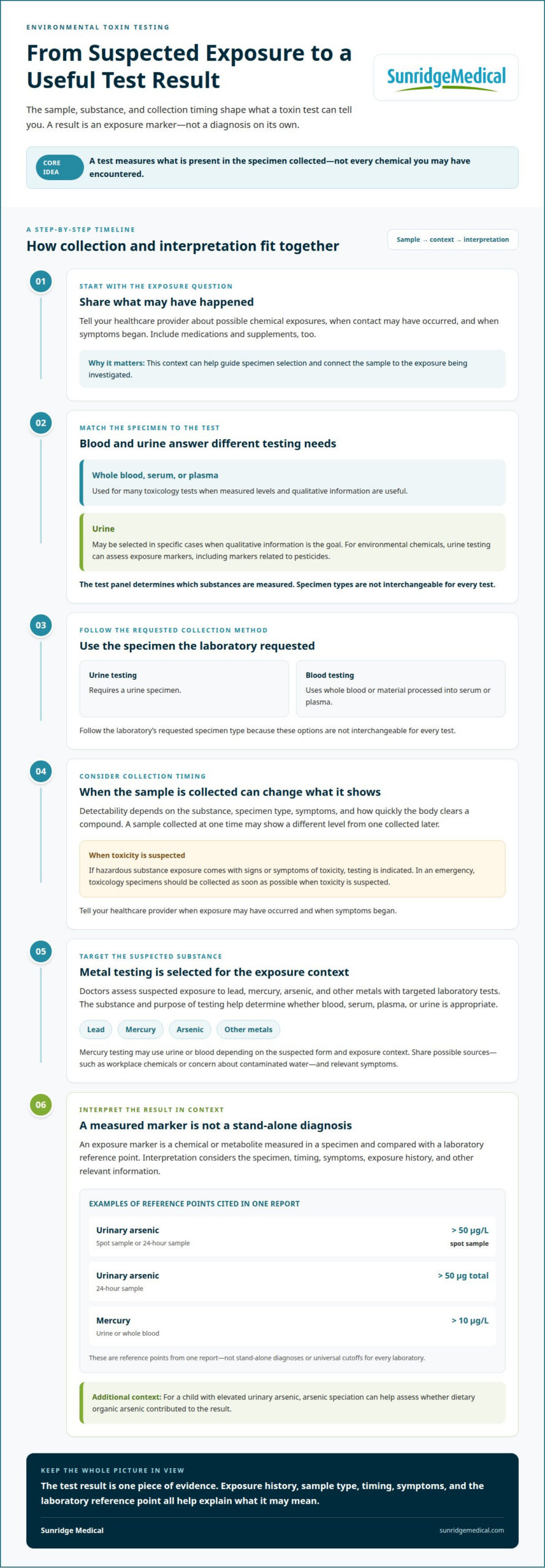
The specimen depends on the substance, suspected exposure, and question the test is intended to answer. Whole blood, serum, or plasma can provide quantitative and qualitative information in many types of toxicology testing.
Choosing a Specimen Type
Whole blood, serum, plasma, and urine are distinct specimen options, each suited to different testing needs. The sample matters because a result reflects the substance measured in that specimen, not every chemical you may have encountered.
Blood, serum, or plasma is preferred for many toxicology tests when measured levels and qualitative information are useful. Urine may be selected in specific cases when qualitative information is the goal. For environmental chemicals, urine testing can assess exposure markers, including markers related to pesticides, but the panel determines which substances are measured.
Collecting Urine and Blood Samples
Urine testing requires a urine specimen; blood testing uses whole blood or material processed into serum or plasma. Follow the laboratory’s requested specimen type, since these options aren’t interchangeable for every test.
Before testing, tell your healthcare provider about medications, supplements, and recent chemical exposures. These details help put the result in context and connect the sample to the exposure being investigated. For example, reporting recent pesticide exposure gives the care team context when considering a urine test for relevant chemical markers.
Timing Tests After Suspected Exposure
Testing timing is the point at which a sample is collected relative to a suspected exposure. If a hazardous substance exposure comes with signs or symptoms of toxicity, testing is indicated; in an emergency, collect toxicology specimens as soon as possible when toxicity is suspected.
The substance, sample type, symptoms, and how quickly the body clears a compound all affect when a test can detect it. A sample collected at one time may show a different level from one collected later. Tell your healthcare provider when exposure may have occurred and when symptoms began, so this information can guide specimen selection and interpretation.
Testing for Heavy Metals
Doctors assess suspected exposure to lead, mercury, arsenic, and other metals with targeted laboratory tests. Blood, serum, plasma, or urine may be selected according to the substance and purpose of the test. The specimen determines what information the result can provide.
Mercury testing may use urine or blood, depending on the suspected form and exposure context. Lead and arsenic testing also requires a test suited to the suspected exposure. Tell your healthcare provider about the possible source and timing of contact, such as a workplace chemical or concern about contaminated water, along with relevant symptoms. This context helps determine which substances to assess and how the findings relate to your health.
Interpreting exposure markers and laboratory reference points
A laboratory result is an exposure marker, not a diagnosis by itself. Reference points, specimen type, timing, and symptoms help explain what a measured concentration may indicate.
Interpreting Exposure Markers
An exposure marker is a chemical or metabolite measured in a specimen and compared with a laboratory reference point. This comparison can help identify a result that merits closer clinical assessment or needs to be interpreted alongside other evidence.
Examples show why the substance and specimen matter. One report identifies urinary arsenic above 50 µg/L in a spot sample, or above 50 µg total in a 24-hour sample, as elevated. It identifies mercury above 10 µg/L in urine or whole blood as elevated. These are reference points, not stand-alone diagnoses or universal cutoffs for every laboratory.
For a child with elevated urinary arsenic, arsenic speciation can help assess whether dietary organic arsenic contributed to the result. A clinician also considers exposure history, symptoms, sample timing, and medications when interpreting toxicology findings.
Laboratory Endpoints and Case Classifications
A laboratory endpoint is a measurable response used to describe toxicity, and it can extend beyond death or visible illness. Some tests assess effects on enzyme systems, changes in animal behavior, or reduced egg production.
These endpoints characterize how a substance acts under defined test conditions. They don’t establish that a person has the same response. Clinical interpretation considers symptoms and exposure details alongside the laboratory result. For example, workplace contact provides context but does not by itself classify an illness.
Environmental laboratory testing also has competence considerations. The International Organization for Standardization identifies Standard 17025 as a typical competence requirement for environmental laboratory testing. Clinical laboratories are responsible for validating their tests in conjunction with guidelines established by the Clinical Laboratory Improvement Act. These validation and competence considerations describe laboratory processes, not a diagnosis or guarantee of clinical usefulness.
Test Reliability and Result Interpretation
There isn’t one FDA-clearance answer for every environmental toxin test; status depends on the individual test. A test is most useful when its accuracy suits the diagnostic decision it may inform and the laboratory method matches the suspected substance and sample.
Before testing, share sample timing, possible exposures, symptoms, medications, and supplements with your healthcare provider. Results are interpreted in light of the applicable therapeutic or toxic range, specimen type, detection window, and clinical picture. A concentration alone cannot show whether someone will develop an illness.
Reference points can differ by substance and specimen. For example, one report lists spot urine thallium below 0.5 µg/L as a reference level. It also identifies whole blood mercury above 10 µg/L as a biologic criterion for organic mercury. Such values should be read using the test’s stated context, rather than compared as if every result shared one scale.
If persistent symptoms accompany exposure concerns, environmental illness treatment can provide a broader clinical context for reviewing health concerns.
What Is Environmental Toxin Screening?
Environmental screening measures selected chemical markers in samples such as urine or blood. For testing for environmental toxin exposure, the panel determines which chemicals the report can assess.
Chemicals Measured by Toxin Panels
Environmental toxin panels measure selected synthetic chemicals and related markers, not every possible pollutant. Common targets include pesticides, herbicides, plasticizers, bisphenols, solvents, and volatile organic compounds.
Panel coverage varies by laboratory. One Environmental Toxins panel evaluates 38 urinary markers associated with environmental phenols, pesticides, herbicides, phthalates, and volatile organic compounds. Other panels may include glyphosate or pesticide metabolites. Heavy-metal and mycotoxin tests assess different exposure categories, so they aren’t interchangeable with a synthetic-chemical panel.
A clinician may recommend testing for environmental toxin exposure when symptoms or an exposure history raise a specific question. The markers listed for a panel show what it can assess, not every chemical a person may encounter.
Measuring Chemical Metabolites
A chemical metabolite is formed as the body processes an environmental chemical. Depending on the assay, a urine or blood test may measure the original compound, a metabolite, or another marker associated with exposure.
Laboratories can use mass spectrometry, gas chromatography, or immunoassays to identify substances in samples. The report provides measured marker levels, not a pass-or-fail verdict. For example, a panel measuring pesticide metabolites addresses its included markers, not every pesticide exposure. A marker may help clinicians consider exposure as one factor in chronic illness, but it does not establish that a chemical caused the illness or that detoxification is needed.
Laboratory Criteria for Chemical Poisoning
Laboratory criteria are measurements used to identify results that warrant further assessment. Their meaning depends on the chemical, sample type, and clinical context. One threshold doesn’t apply to every substance.
A laboratory result can indicate exposure, but it doesn’t diagnose disease by itself. For suspected poisoning, clinicians interpret findings alongside symptoms, exposure history, and the substance’s relevant toxic range. Environmental tests may also measure effects in a sample or test organism, rather than only death or sickness. The Agency for Toxic Substances and Disease Registry (ATSDR) notes that barium can be measured in bones, blood, urine, and feces using complex instruments.
Household and Occupational Exposures
Household exposure may involve chemicals in food packaging, canned foods, indoor air, or consumer products. Bisphenols are potential exposure sources associated with food packaging and canned foods.
Workplace exposure can involve industrial solvents such as toluene, xylene, and methanol. Chemicals may also reach people through food, water, or air. No single test detects every source; the suspected chemical and exposure setting guide which markers a panel should assess. A clinician can arrange testing through a clinical laboratory based on exposure history and symptoms. Testing charges depend on the panel, specimen, and laboratory; insurance coverage depends on the plan and test.
What Are the Limitations of the Test?
An environmental test measures selected substances in a specific sample, not a person’s entire exposure history. Its clinical value depends on whether it matches the exposure question and can inform care.
Clinical Usefulness and Testing Limits
Clinical usefulness means a test result can contribute meaningfully to diagnosis, management, or health outcomes. A targeted test is most informative when a patient’s environmental history and physical examination point to a substance or exposure source.
A broad panel may detect chemicals without showing whether they explain symptoms. Advances in laboratory analysis allow tests to detect hundreds of chemicals in human tissues, yet most have limited clinical utility. In one study at an environmental or occupational medicine clinic, 9% of patients had undergone inappropriate or unvalidated environmental testing before their clinic visit.
That distinction matters: detecting a chemical marker does not establish that it caused an illness. Poorly selected tests can cause stress and anxiety, and acting on results may lead to unnecessary treatment, procedures, and costs. For example, a result unrelated to a patient’s symptoms could prompt follow-up that does not improve diagnostic reasoning.
Laboratory selection also affects usefulness. Clinicians should choose tests with reliable diagnostic accuracy when results could affect patient management or outcomes. For suspected heavy-metal exposure, the test must match the metal and specimen; a result from one sample type may not answer a question about another.
Limits of Exposure Testing
An exposure test is a snapshot of measured levels at the time of collection, not a record of lifetime contact. Results can shift with recent diet, surroundings, and how quickly the body clears a compound.
Timing matters. A urine result may reflect recent exposure differently from a blood result, and neither necessarily describes earlier contact. For example, a sample collected after an environmental change may not reflect levels during the previous exposure. This limits what a single measurement can establish about chronic exposure.
Collection materials can also affect detection. Gel separator tubes aren’t recommended for toxicology testing because lipid-soluble drugs may be absorbed into the gel, producing falsely low results. This is a specimen-handling limitation, not evidence that no exposure occurred.
Panel scope sets another limit: a negative result means the tested markers weren’t detected at the reported level in that sample. It cannot rule out chemicals the panel didn’t measure, exposure outside the detection window, or pollutants assessed using different methods. Matching a targeted test to the exposure history helps prevent a limited result from being mistaken for a complete assessment.
Exposure-reduction guidance and follow-up testing
A result is more useful when it addresses a specific exposure question and informs a practical next step. Depending on the substance, sample, and health context, follow-up may combine targeted exposure-reduction guidance with repeat testing.
Start with the likely source. A clinician may review exposures at home and work, along with diet, water, and products, then consider which contact is ongoing. For example, agricultural runoff or industrial waste can raise concerns about water contamination. Identifying the suspected route helps focus reduction efforts instead of changing unrelated routines.
Exposure-reduction guidance should match the substance and route. A possible indoor-air source calls for a different response than a workplace chemical or food-related exposure. The aim is to reduce contact with the suspected source, then assess whether exposure markers change. A broad detoxification approach cannot replace identifying and addressing an ongoing source.
Follow-up testing is not automatically scheduled at a typical interval. The appropriate timing depends on the chemical, the first result, the sample used, whether exposure continues, and how quickly the body clears that substance. For decontamination or detoxification assessment, such as after acetaminophen poisoning, retest intervals are determined case by case. That differs from environmental toxicity experiments, where observations may be recorded every 24 hours; this is not a human retesting schedule.
Repeat testing may help determine whether an initial result was a fluke. Repeat testing may sometimes help assess whether an initial result is consistent. Repeating the same test is most informative when the specimen and collection conditions are comparable and the follow-up can guide a decision. If the first measurement doesn’t fit the exposure history or symptoms, repeating it may clarify the finding.
After reviewing results, a physician may discuss targeted exposure-reduction guidance and follow-up testing. The conversation can connect the measured marker with ongoing exposure, possible health effects, and the clinical question being assessed. A changing result may support a change in exposure, but it does not by itself establish the cause of disease or show that symptoms will resolve.
For a focused follow-up discussion, review your exposure results and next steps.
Sunridge Medical: Environmental Illness Treatment
Sunridge Medical offers Environmental Illness Treatment for people seeking a broader clinical perspective on persistent symptoms and possible environmental contributors. Exposure test results are one part of the picture; they can be considered alongside health history, symptoms, and existing conditions to inform an individualized care plan.
This approach may be relevant when ongoing health concerns overlap with complex chronic illness, autoimmune disorders, or neurologic symptoms. Sunridge Medical combines conventional therapies with research-informed alternative treatments in individualized care plans, while recognizing that a test result alone does not establish the cause of an illness.
If persistent health concerns leave you looking for support, contact Sunridge Medical to discuss an individualized clinical evaluation and care options.
Turn Exposure Concerns Into a Clearer Care Plan
A useful next step is to connect environmental concerns with the health questions that matter most to you. Testing for environmental toxin exposure can provide information, but its role depends on how the findings fit your symptoms and broader clinical picture.
Sunridge Medical offers Environmental Illness Treatment and care for complex conditions, including Alternative Cancer Treatment Protocols, Chronic Lyme Disease Treatment, and Autoimmune Disease Management. If persistent health concerns leave you unsure how possible exposure fits into your care, a conversation can help clarify what to address next. Testing alone does not establish the cause of symptoms, so keep the focus on a thoughtful, individualized assessment.
Contact Sunridge Medical to discuss testing and your environmental health concerns. A clear next step can begin with a conversation about your concerns.
Frequently Asked Questions
How should toxicology test results be interpreted?
Interpret the result alongside exposure history, symptoms, sample type, collection timing, and relevant medications. Check the report’s units and whether it describes a spot or timed sample, since these details affect comparisons with reference points. A clinician can consider whether the result fits the suspected exposure and whether another test would change care. A measured marker alone doesn’t establish a disease or its cause.
Is glyphosate or pesticide exposure included in the panel?
Some environmental toxin panels include glyphosate or pesticide metabolites, but coverage varies by panel and laboratory. A panel that measures selected pesticide markers won’t necessarily assess every pesticide or exposure route. Before interpreting a report, identify the chemicals or metabolites it names and compare them with the suspected source, such as produce, workplace contact, or another environmental setting. The panel’s contents determine what its findings can address.
What Are the Next Steps After Testing?
Use the results to guide a focused discussion about possible sources, ongoing contact, and relevant symptoms. If a likely source emerges, consider targeted ways to reduce exposure, then decide whether follow-up testing would answer a clinical question. Keep the laboratory report and note when the sample was collected. These details make later comparisons more meaningful than treating each result in isolation.
What Conditions and Exposures Can It Detect?
Environmental toxin tests detect selected chemical markers associated with exposure, not health conditions themselves. Depending on the panel, markers may relate to pesticides, solvents, herbicides, plasticizers, or other industrial chemicals. Possible sources include food, water, indoor air, household products, and workplaces. A result can help a clinician consider environmental exposure in a broader assessment, but it can’t confirm that a specific chemical caused a symptom or illness.
What Do the Results Mean?
A result reports whether a tested marker was measured and how its level compares with the laboratory’s reference points. An elevated value can prompt closer assessment, but it doesn’t automatically mean poisoning or explain symptoms. A result within the reference range also doesn’t rule out every possible exposure, especially if the chemical wasn’t included or the sample was collected outside its detection window. Interpretation depends on the report and clinical context.
What samples are used for toxin testing: blood, urine, hair, or other?
Common toxicology specimens include whole blood, serum, plasma, and urine. The appropriate sample depends on the substance and the test’s purpose. Hair is not interchangeable with these specimens; its suitability depends on the specific assay and question being assessed. Follow the laboratory’s collection instructions for the ordered test, and tell your healthcare provider about recent exposures, medicines, and supplements that may inform interpretation.
What are the risks and limitations of commercial toxin tests?
A commercial panel can detect markers with no clear clinical relevance to a person’s symptoms. Broad or poorly selected testing can create confusion, anxiety, and unnecessary follow-up. Results also reflect the sample collected, not a complete history of past exposures. Before acting on a finding, consider whether the test addressed a specific exposure question and whether the result can meaningfully inform diagnosis or management.
What should I do if test results show a potentially dangerous toxin level?
Contact the healthcare professional who ordered the test and share the complete report, including specimen type and collection date. Describe any symptoms and possible ongoing exposure, such as contact at work or home. If suspected exposure comes with signs of toxicity, seek urgent medical attention. Don’t start a detoxification regimen or make major treatment changes based only on a laboratory value; first clarify what the result means clinically.