


Immune modulation isn’t a simple on-off switch. Thymosin alpha-1 is a naturally produced peptide made by the thymus, and thymosin alpha-1 for immune modulation is studied for its potential to influence immune-cell activity and signaling. It contains 28 amino acids and is not FDA-approved as a drug in the United States.
It’s reasonable to want a clear distinction between a biological mechanism and a proven treatment. Thymosin alpha-1 has been investigated in different clinical settings, but research findings don’t establish that it works the same way for every condition or person.
This article explains what the peptide is, how it may affect T cells, natural killer cells, and inflammatory signals, and what clinical research says about its studied uses. It also explains how to interpret the evidence and its limits when considering immune-focused care.
Key Takeaways
- Learn what thymosin alpha-1 is and why researchers study its influence on immune signaling.
- See how it may affect T cells and natural killer cells, and what those mechanisms could mean for immune responses.
- Compare findings across cancer, vaccine, COVID-19, and sepsis research, including where clinical outcomes have been mixed.
- Understand the distinction between a treatment being studied for immune effects and being FDA-approved as a drug in the United States.
- Explore which conditions have been studied and how to interpret the evidence when considering immune-focused care.
Evidence in cancer, vaccines, COVID-19, and sepsis
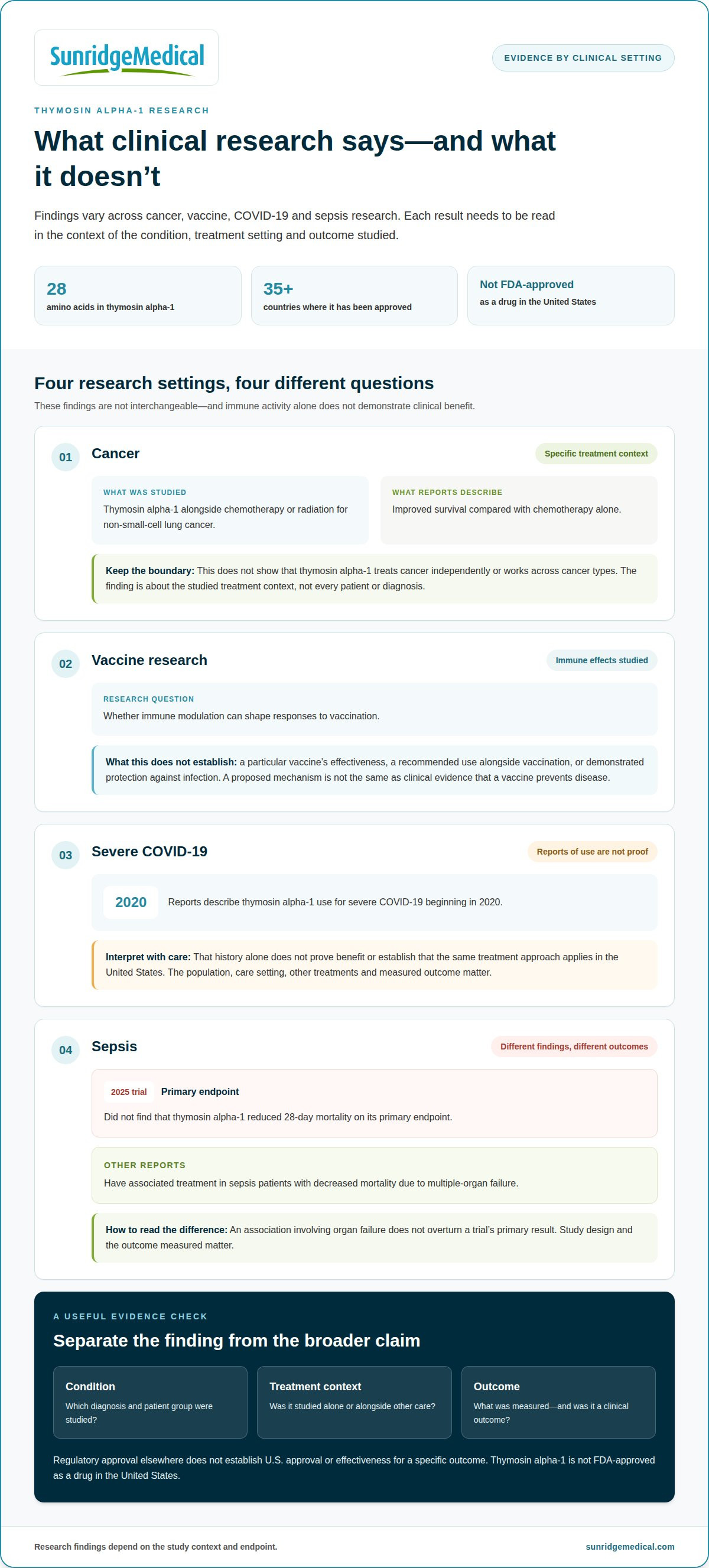
Thymosin alpha-1 has been studied across several clinical settings, but findings differ by disease and outcome. An immune effect or promising result in one study doesn’t establish therapeutic benefit for every patient. Research spans cancer treatment, vaccine-related questions, severe COVID-19, and sepsis, with distinct outcomes assessed in each area.
In cancer, researchers have examined thymosin alpha-1 alongside chemotherapy or radiation for non-small-cell lung cancer. Reports describe improved survival compared with chemotherapy alone. This finding concerns a specific treatment context; it doesn’t prove the peptide treats cancer independently or works across cancer types. Patients should distinguish evidence involving non-small-cell lung cancer from research relevant to hepatocellular carcinoma or another diagnosis.
Vaccine research asks whether immune modulation can shape responses to vaccination. Thymosin alpha-1 has been studied for immune effects, but such investigation doesn’t establish a particular vaccine’s effectiveness or a recommended use alongside vaccination. A proposed mechanism is not equivalent to demonstrated protection against infection. Patients should distinguish immune-response research from clinical evidence that a vaccine prevents disease.
Reports describe thymosin alpha-1 use for severe COVID-19 beginning in 2020. That history alone doesn’t prove benefit or establish that the same treatment approach applies in the United States. The clinical setting, other treatments, and measured outcome all affect interpretation. Findings should be read in the context of the population and care setting studied, rather than as a general COVID-19 treatment claim.
Sepsis findings also require careful interpretation. A 2025 trial did not find that thymosin alpha-1 reduced 28-day mortality on its primary endpoint. Other reports have associated treatment in sepsis patients with decreased mortality due to multiple-organ failure. These statements address different outcomes: an association involving organ failure doesn’t overturn a trial’s primary result. Study design and endpoints matter.
Regulatory status is separate from clinical evidence. Thymosin alpha-1 has been approved in more than 35 countries, but it is not FDA-approved as a drug in the United States. Approval elsewhere doesn’t establish US approval or effectiveness for a particular cancer, vaccine, COVID-19, or sepsis outcome. Interpret each finding within its study context; immune activity alone doesn’t demonstrate clinical benefit.
The reported survival improvement should therefore be read as evidence about the studied treatment context in non-small-cell lung cancer, not as a result for thymosin alpha-1 on its own. The comparison was with chemotherapy alone, while thymosin alpha-1 was studied as an adjunct to chemotherapy or radiation. Keeping those conditions together avoids turning a context-specific comparison into a broader claim about cancer care; the finding does not establish benefit for every patient.
Immune-system regulation
In the United States, thymosin alpha-1 has no single treatment cost: expenses depend on formulation, treatment duration, clinical oversight, and monitoring, with pricing provided after a quote request. Insurance coverage depends on the plan and clinical indication, so there is no universal coverage answer. Its regulatory status also matters: thymosin alpha-1 is not FDA-approved as a drug in the United States, although it has been approved in more than 35 countries.
That distinction separates regulatory authorization from biological activity. Thymosin alpha-1 is a peptide naturally produced by the thymus gland. Its role is discussed as immune regulation, not simply as a broad command to increase immune function. A useful example is the difference between supporting a targeted response and amplifying inflammation indiscriminately. The intended effect depends on how immune cells and signaling pathways respond in a particular clinical context.
The immune system includes innate defenses, which respond rapidly, and adaptive immune responses, which involve more specialized recognition. Thymosin alpha-1 has been studied for effects across immune signaling, so its potential mechanism concerns coordination between these processes. That concept does not mean the peptide replaces immune cells, removes a pathogen, or treats a carcinoma by itself. Those are separate clinical outcomes requiring condition-specific evidence.
Regulation also involves signals that can move in different directions. Research describes changes in cytokines associated with immune activity and inflammation, including IL-2, IL-10, IL-12, interferon-alpha, interferon-gamma, IL-1 beta, and tumor necrosis factor-alpha. These signals have distinct roles; a change in one marker cannot stand in for a complete measure of immune function. Interpreting the mechanism therefore requires attention to the disease setting and the outcome being assessed.
For example, an immune response relevant to infection may have different implications in autoimmune disease, where immune activity can contribute to tissue injury. Any proposed regulatory effect must be considered in light of the clinical goal: supporting defense, managing inflammation, or assessing a treatment alongside standard care. A change measured in a laboratory does not establish that patients feel better or have improved disease outcomes.
In practice, regulatory status, evidence for the condition, and the treatment’s intended role are separate considerations. The FDA approval status describes authorization in the United States; it does not by itself explain every research finding or determine individual insurance benefits. A careful clinical discussion can place immune findings beside the diagnosis and treatment plan. For readers considering broader care options, individualized care planning can help connect those questions to the condition being addressed.
T-cell and natural killer cell activity
Thymosin alpha-1 has been studied for effects on specific immune cells, not just broad immune activity. Its reported actions include T-cell development, natural killer cell activation, and Toll-like receptor engagement.
T-Cell Activity
T-cell activity is the work of immune cells that recognize targets and coordinate or carry out responses. Thymosin alpha-1 has been reported to promote the differentiation of immature progenitor T cells. This matters because T-cell development influences the body’s capacity to organize adaptive immune responses. The peptide has also been described as activating CD8+ T cells, a subset associated with killing virus-infected cells.
That mechanism gives researchers a way to study how thymosin alpha-1 may influence cell activity. It doesn’t show, by itself, that a patient will clear an infection or experience a better clinical outcome. Those questions require evidence about the specific disease and treatment setting. For example, a measured change in T-cell activity is a biological finding; demonstrating improved health requires assessing outcomes beyond the cell response.
Natural Killer Cell Activity
Natural killer cells are immune cells that can help identify and kill virus-infected cells. Thymosin alpha-1 has been reported to activate natural killer cells, alongside CD8+ T cells. This is relevant because the two cell types are distinct parts of immune defense, even though both can act against infected cells. Studying their activity helps clarify which responses a peptide may influence.
These effects should be understood as proposed or observed immune mechanisms, not proof of protection against a particular virus. Natural killer cell activation alone does not show that an infection will be prevented, shortened, or successfully treated. Clinical research must connect changes in cell activity to patient outcomes in the condition being studied. This distinction helps prevent immune measurements from being mistaken for treatment results.
Toll-like receptors provide another part of the proposed mechanism. Thymosin alpha-1 has been shown to act as an agonist of Toll-like receptor 2 and Toll-like receptor 9. An agonist activates a receptor, which can initiate immune signaling. These named receptors help frame how the peptide may interact with immune sensing, rather than acting only through T cells or natural killer cells.
Viewed together, T-cell differentiation, natural killer cell activation, and Toll-like receptor engagement describe several biological effects under investigation. They don’t mean every immune pathway changes in the same way, or that more activity is always beneficial. A useful interpretation asks which cell or receptor was measured, what response changed, and whether that change corresponded with a meaningful clinical result. These distinctions are central to evaluating thymosin alpha-1 research.
Clinical evidence and studied indications
Clinical studies have examined thymosin alpha-1 across viral infections and other immune-related conditions. Research on thymosin alpha-1 for immune modulation includes different populations, protocols, and measured outcomes, so findings need condition-specific interpretation.
Clinical Evidence
Clinical evidence describes how a treatment has been tested in people, including its indication, schedule, and measured outcomes. More than 80 clinical trials have studied thymosin alpha-1, and research has involved more than 11,000 patients. Those figures show the breadth of investigation, but they don’t establish one result across every condition. For individuals, the diagnosis and outcome measured are essential context.
Study design also shapes what findings demonstrate. A trial measuring immune markers answers a different question from one measuring symptoms, infection rates, or survival. For example, a laboratory change may support a biological effect without demonstrating a meaningful clinical benefit. Comparing findings about thymosin alpha-1 for immune modulation therefore requires attention to the condition, treatment combination, and endpoint each study evaluated.
Studied Indications
Studied indications are the conditions researchers have investigated, not a guarantee that a treatment is appropriate for each one. According to the National Library of Medicine, thymosin α1 is an immunostimulatory peptide used as an immune enhancer and studied for hepatitis B and C virus infections. This places viral hepatitis among its clinical subjects, while outcomes remain specific to each study.
Research has also examined thymosin alpha-1 in settings involving cancer, severe infection, and immune response. These conditions differ substantially: chronic hepatitis, for example, is not interchangeable with acute sepsis or cancer treatment. A proper interpretation asks which individuals were included, whether the peptide was used alone or alongside another treatment, and what endpoint investigators assessed. The indication alone cannot establish effectiveness.
Studied Doses and Treatment Schedules
A studied dose and schedule describe how investigators administered thymosin alpha-1 in a particular treatment protocol. One reported adult regimen is 1.6 mg by injection under the skin, twice weekly. An initial course of 12–16 weeks has been described before reassessment, with follow-up 4–6 weeks after therapy begins. These details summarize a reported protocol, not an individualized prescription.
Monitoring is part of the approach described. Before therapy, baseline testing includes a CBC with differential, CMP, and appropriate immune markers. Regular blood tests may help clinicians assess response and monitor for possible side effects. Since testing schedules and findings depend on the indication studied, distinguish a published protocol from evidence demonstrated for a specific condition.
Thymosin alpha-1 and immune modulation
Thymosin alpha-1 is a thymus-derived peptide that may influence immune signaling and cell responses. Its reported effects include stimulating some immune pathways while moderating inflammatory signals.
Immune-Modulating Mechanism
Immune modulation means altering immune activity rather than simply switching it on or off. Thymosin alpha-1 is a 28-amino-acid peptide that may affect cytokines, dendritic cells, and immune-cell responses.
Reported effects include increased IL-2, IL-10, IL-12, interferon-alpha, and interferon-gamma, alongside negative effects on IL-1 beta and tumor necrosis factor-alpha. The peptide may also prime dendritic cells and enhance Th1 and Treg cells during antifungal responses. These mechanisms help explain why researchers study it, but a change in signaling does not by itself demonstrate improved outcomes for an infection or autoimmune condition.
Comparison With Other Immune-Modulating Treatments
Thymosin alpha-1 differs from other immune-modulating treatments in its studied focus on thymic peptide signaling and immune-cell responses. Treatments in this broad category can act through different targets, so a useful comparison considers the mechanism, condition, and measured outcome.
There is no single comparison that establishes thymosin alpha-1 as more effective than other approaches. For example, a study of cytokine changes cannot be directly compared with a trial measuring infection outcomes. For readers, the practical distinction is whether evidence addresses the same disease and clinical goal, rather than whether both treatments carry an “immune-modulating” label.
Cautions and Reasons to Avoid Treatment
Commonly reported adverse events include injection-site reactions, fatigue, and flu-like symptoms. Consider these effects when weighing treatment burden, especially if they overlap with symptoms of an existing illness.
There is no specific patient group identified here as needing to avoid thymosin alpha-1 outright. People with autoimmune disease or active inflammatory concerns should consider its immune effects within a supervised clinical relationship, rather than using it independently. The evidence supports caution and individualized assessment, not a blanket rule that every person with an autoimmune diagnosis must avoid it.
Pay careful attention to potential serious risks. The adverse events described here include injection-site reactions, fatigue, and flu-like symptoms. Regular blood tests are recommended to evaluate response and monitor side effects; baseline tests before therapy include a CBC with differential, CMP, and appropriate immune markers. These steps help put immune changes and symptoms in clinical context.
For people weighing immune-focused care, thymosin alpha-1’s potential value depends on the condition, treatment goal, and available clinical evidence. Consider discussing individualized immune-related care within a supervised clinical relationship.
Sunridge Medical: Alternative Cancer Treatment Protocols
Sunridge Medical offers Alternative Cancer Treatment Protocols for people exploring care options alongside complex cancer diagnoses. If research on thymosin alpha-1 has raised questions about immune effects or treatment evidence, the next step is to discuss those questions within the context of your diagnosis and broader care plan. Sunridge Medical combines conventional therapies with research-based alternative treatments in individualized plans. Its care also includes Autoimmune Disease Management and Chronic Lyme Disease Treatment, which may be relevant to readers considering immune-focused care for different conditions. The research discussed here does not establish thymosin alpha-1 as an appropriate treatment for every person or diagnosis. Contact Sunridge Medical to discuss your health concerns and care options.
Make your next care decision with clarity
Choosing an immune-focused approach starts with defining the clinical goal: supporting infection-related defenses, addressing an ongoing condition, or considering options within a cancer care plan. For people exploring thymosin alpha-1 for immune modulation, the key is connecting the proposed mechanism to evidence relevant to their diagnosis and treatment priorities. A careful discussion can also clarify how an option fits alongside existing care, what outcomes matter, and how progress would be assessed.
Sunridge Medical offers Alternative Cancer Treatment Protocols, Chronic Lyme Disease Treatment, and Autoimmune Disease Management. The right next step depends on your health history, diagnosis, and goals. You can contact Sunridge Medical to discuss your options and consider a thoughtful path forward.
Frequently Asked Questions
What is thymosin alpha-1?
Thymosin alpha-1 is a peptide naturally produced by the thymus and made up of 28 amino acids. Researchers study how it influences immune signaling and cell responses. It isn’t an immune cell or a vaccine; it’s a biological molecule investigated for its potential effects on immune function. That distinction helps readers separate a proposed mechanism from evidence that a treatment improves a specific health outcome.
What conditions has thymosin alpha-1 been studied or approved to treat?
Studies have investigated thymosin alpha-1 for hepatitis B and C, cancer-related treatment, COVID-19, and sepsis. The National Library of Medicine describes it as an immunostimulatory peptide used as an immune enhancer and studied for hepatitis B and C virus infections. It has been approved in more than 35 countries, but approval does not mean every condition has an approved indication in each country.
What is the clinical evidence for thymosin alpha-1 in immune modulation?
Clinical evidence varies by condition and outcome, so no single finding establishes effectiveness across all uses. For example, a 2025 sepsis trial did not reduce 28-day mortality on its primary endpoint. Research in other settings has examined immune responses and treatment combinations. To interpret a study, look at who was enrolled, what treatment was compared, and whether researchers measured laboratory changes or outcomes patients experience.
Is thymosin alpha-1 FDA-approved or available by prescription in the United States?
Thymosin alpha-1 is not FDA-approved as a drug in the United States. That answers the approval question, but approval and access through a particular clinical pathway are not identical. Its use should be considered within a supervised clinical relationship, where the proposed purpose, treatment context, and monitoring plan are reviewed. Patients should distinguish this from an FDA-approved prescription drug with an established US indication.
How can patients assess the safety and quality of thymosin alpha-1 products?
Use clinical supervision rather than taking a self-directed approach. Before treatment, the described protocol includes baseline blood tests, such as a CBC with differential, CMP, and appropriate immune markers, followed by regular testing to assess response and monitor side effects. Patients can also record the product identity, dose, and administration dates, and discuss symptoms, including injection-site reactions, fatigue, or flu-like symptoms, with their clinician.