


A “normal” lab result can be reassuring, but it may not explain how your body is functioning. Understanding advanced functional medicine testing means learning what tests assess, such as hormones, nutrients, metabolism, and digestive health, and how findings relate to symptoms and health history. Functional testing can complement conventional labs, but it does not replace a diagnosis or make every result conclusive.
If you’re trying to understand what a test measures, why its range may differ from a standard lab range, or whether a finding is useful, the distinction matters. This article explains what functional testing can assess, how practitioners interpret functional and conventional ranges, and the strengths and limitations of each approach. A test result is best understood as one part of a broader clinical picture, not an answer on its own.
Key Takeaways
- Functional testing can assess hormones, metabolism, nutrients, and digestive health, with test selection shaped by symptoms and health history.
- Functional ranges may be narrower than standard reference ranges, so a result needs context rather than interpretation in isolation.
- Blood, urine, saliva, and stool tests each measure different aspects of health; the sample type depends on the question being assessed.
- Conventional testing remains important for identifying disease, while specialized tests can offer additional clues about possible imbalances and patterns.
- Some emerging assessments have limitations, so understanding a test’s evidence and purpose helps put its findings in perspective.
How is functional lab testing different from conventional testing?
Conventional testing often focuses on identifying or monitoring a specific disease. Functional testing can assess patterns in hormone, nutrient, and metabolic markers alongside symptoms and health history.
Advanced Hormone Testing
Advanced hormone testing examines several markers together, including thyroid hormones, cortisol, estrogen, and testosterone. This broader view may be relevant when concerns such as chronic fatigue or cycle changes persist despite results within a standard reference range. A panel can show related markers for clinical interpretation, but a result alone does not establish the cause of symptoms or a diagnosis.
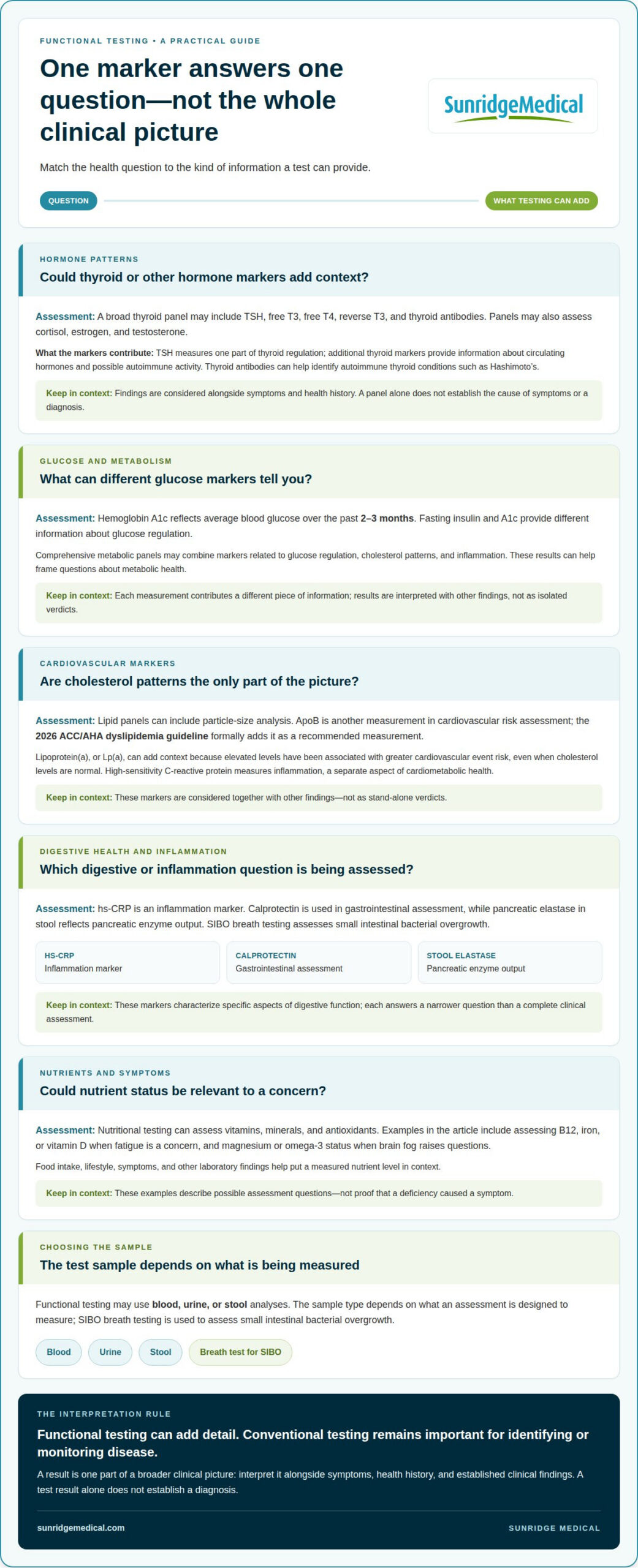
For thyroid assessment, a broad panel may include TSH, free T3, free T4, reverse T3, and thyroid antibodies. TSH alone measures one part of thyroid regulation; the additional markers provide other information about circulating hormones and possible autoimmune activity. Thyroid antibodies can help identify autoimmune thyroid conditions such as Hashimoto’s. A practitioner considers these results alongside symptoms and medical history to assess possible dysfunction.
Hormone testing may also be relevant to adrenal and sex hormone concerns. Functional medicine hormone panels may assess cortisol, estrogen, and testosterone, while thyroid markers assess a separate hormone system. For someone experiencing chronic fatigue, these results may help organize questions about hormone patterns and other factors. They do not prove a hormone imbalance caused the fatigue or rule out other conditions.
Nutrient, Hormone, and Metabolic Assessments
These assessments combine selected laboratory markers to examine nutrient status, hormone patterns, and metabolic function. Their value lies in relating findings to a person’s symptoms and health history, rather than treating one result as a complete explanation. For example, an assessment may consider nutrient levels alongside hormone markers when fatigue or other concerns persist.
Functional testing may use blood, urine, or stool analyses, depending on what an assessment is designed to measure. Nutrient tests can assess vitamins, minerals, and antioxidants; metabolic markers can examine glucose regulation and cholesterol patterns. Digestive assessments may look for gut bacteria imbalances, inflammation, or food sensitivities. These areas may matter for people with persistent digestive or autoimmune concerns, but each test addresses a specific question.
Functional medicine testing can be tailored to health history, lifestyle, and genetic factors. That context helps determine which markers are relevant when symptoms overlap, such as fatigue alongside digestive changes. The aim is to assess patterns across body systems and interpret them alongside established clinical findings. Conventional testing remains important for confirming or monitoring disease, while functional testing can add detail to the broader assessment.
Metabolic, nutrient, gut, and detoxification testing
These tests examine selected systems using markers related to metabolism, nutrition, digestion, and inflammation. Interpreted alongside health history and lifestyle, the results can add detail to a personalized assessment.
Comprehensive Metabolic and Inflammatory Panels
Comprehensive metabolic and inflammatory panels combine markers that help assess glucose regulation, cholesterol patterns, and inflammation. Hemoglobin A1c reflects average blood glucose over the past 2-3 months, while high-sensitivity C-reactive protein, or hs-CRP, is an inflammation marker. Together, these results can offer different information from a single measurement and help frame questions about metabolic health.
Other markers address specific concerns. Calprotectin is used in gastrointestinal assessment, while pancreatic elastase in stool reflects pancreatic enzyme output. These findings can help characterize digestive function, but each marker answers a narrower question than a complete clinical assessment.
Metabolic and Cardiovascular Biomarkers
Metabolic and cardiovascular biomarkers assess patterns associated with glucose and lipid metabolism. Fasting insulin and A1c provide different information about glucose regulation; lipid panels can include particle-size analysis. The 2026 ACC/AHA dyslipidemia guideline formally adds ApoB as a recommended measurement, bringing another marker into cardiovascular risk assessment.
Lipoprotein(a), or Lp(a), can add context because elevated levels have been associated with greater cardiovascular event risk, even when cholesterol levels are normal. High-sensitivity C-reactive protein measures inflammation, a separate aspect of cardiometabolic health. These markers are interpreted together with other findings, not as isolated verdicts.
Nutritional and Metabolic Testing
Nutritional testing can assess vitamins, minerals, and antioxidants, while metabolic markers examine glucose regulation, cholesterol ratios, and detoxification pathways. For example, fatigue may prompt assessment of B12, iron, or vitamin D; brain fog may raise questions about magnesium or omega-3 status. These examples illustrate possible findings, not proof that a deficiency caused a symptom.
Results gain meaning through context. Food intake, lifestyle, symptoms, and other laboratory findings can help explain whether a measured nutrient level is relevant. A personalized assessment considers these factors before connecting a marker to a health concern.
Commonly Used Functional Tests
Common assessments may include hs-CRP, homocysteine, fasting insulin, hemoglobin A1c, comprehensive lipid panels with particle-size analysis, and oxidative stress markers. SIBO breath testing is used to assess small intestinal bacterial overgrowth. Blood, urine, saliva, or stool samples may be collected in a lab or, in some cases, at home.
Stool and microbiome panels may examine gut bacteria and digestive markers, though evidence for these emerging tests is still maturing. Testing for detoxification pathways also requires careful interpretation, since a marker reflects a specific measured process rather than overall health. For persistent concerns, an individualized medical assessment can help place results in context.
Interpreting functional ranges alongside standard lab ranges
A lab result’s meaning depends on the range used and the person’s clinical context. Functional interpretation may consider narrower optimal ranges, while conventional ranges help identify results outside established reference intervals.
Optimal and Conventional Reference Ranges
Conventional reference ranges describe how a result compares with a defined population, while functional ranges may use narrower targets. This distinction matters when a result is labeled normal but symptoms, such as fatigue, remain unexplained.
For example, a TSH level of 4.2 mIU/L might be considered normal by conventional standards. A functional assessment may consider whether symptoms warrant further thyroid analysis, rather than treating the reference interval as a complete answer. A TSH level of 3.8 may also fall within a conventional range, even when symptoms suggest further evaluation could be useful.
Population Reference Ranges for Biomarkers
Population reference ranges show how a biomarker compares with values observed in a reference group. They help clinicians identify results outside the expected interval, but a “normal” result does not automatically show what is optimal for every person.
Age, health history, symptoms, and other laboratory findings shape interpretation. For instance, fasting glucose of 95 mg/dL is an example within the normal range, yet pairing it with fasting insulin of 15 mIU/L may suggest early insulin resistance. The two markers together can provide more context than glucose alone.
Biomarkers and Optimal Functional Ranges
Optimal functional ranges are narrower interpretive targets used to assess how biomarkers relate to function and symptoms. A practitioner may consider a result alongside concerns such as fatigue, rather than relying only on whether it falls within a conventional interval.
For thyroid assessment, a patient may function best with TSH closer to 1.0 to 2.0 mIU/L, though that target must be considered with other findings. TSH alone doesn’t describe every aspect of thyroid function. An analysis that includes symptoms and related markers can help distinguish a lab value from a complete clinical picture.
Different ranges do not mean conventional testing is unhelpful or that every narrower target indicates a diagnosis. They serve different interpretive purposes: conventional ranges flag results outside population intervals, while functional analysis may explore patterns within those intervals. Results still need to be considered alongside symptoms, medical history, and other biomarkers.
The 2019 Cleveland Clinic study compared 5,657 conventional primary care patients with patients at the Center for Functional Medicine. This comparison provides context for evaluating care approaches, but a study comparison doesn’t determine what an individual’s lab result means. For a person with persistent fatigue or possible immune concerns, clinicians weigh specific findings and the overall pattern before drawing conclusions.
Benefits and limitations of each testing approach
Conventional and functional testing answer different clinical questions. Their value depends on the concern being assessed, the evidence behind each test, and how results may inform care.
Potential Benefits of Functional Testing
Functional testing can add detail about patterns that standard testing may not assess, helping clinicians explore possible contributors to persistent symptoms. For example, a nutrient assessment could identify a B12, iron, or vitamin D deficiency in someone experiencing fatigue. This finding can guide a more focused discussion, but it doesn’t by itself prove the deficiency caused the symptom.
For clinicians, a broader set of markers can organize information about chronic conditions, including metabolic, digestive, and inflammatory concerns. Findings can prompt questions about potential contributing factors and inform personalized follow-up. However, a wider panel is useful only when its markers address a relevant clinical question. Ordering more tests does not automatically produce a clearer diagnosis or better care.
Evidence also requires careful interpretation. In a 2019 Cleveland Clinic study, 31% of patients in the functional medicine group improved their PROMIS global physical health scores by at least 5 points, compared with 22% of primary care patients. These findings describe outcomes in the study groups; they don’t establish that every patient will experience the same change.
Benefits for Patients
People with persistent symptoms or chronic conditions may value testing that examines several relevant factors together. Someone with fatigue, for instance, could discuss nutrient status and metabolic markers rather than focusing on one result alone. This broader view can support a more specific conversation about possible causes, symptoms, and next steps.
Functional medicine visits also emphasize individualized interpretation, which can help patients understand how test findings relate to their health history. Specialized functional assessments may not be covered by insurance, so access can depend on coverage and the tests selected. Results also require sound clinical context: a marker outside an optimal range is not automatically a disease diagnosis.
Some tests have important limitations. Allergy organizations do not recommend IgG food sensitivity panels, and hair mineral analysis has limited reliability and requires cautious interpretation. Evidence for emerging stool and microbiome panels is still developing. These examples show why test selection matters: a detailed report can appear precise without providing dependable answers about symptoms or their causes.
Conventional testing remains valuable for detecting and monitoring specific diseases using established clinical markers. Functional testing can add context, while conventional results help anchor decisions in recognized diagnostic measures. For chronic conditions, clinicians can weigh both approaches, the reliability of each test, and whether a result would meaningfully inform care.
What tests are commonly used in functional medicine?
Functional medicine testing uses different laboratory methods to examine specific health questions. Test selection depends on the concern, such as glucose regulation, inflammation, digestion, or nutrient status. A useful panel connects each marker to a clinical purpose rather than treating a longer list of results as automatically more informative.
Blood work may include high-sensitivity C-reactive protein (hs-CRP), homocysteine, fasting insulin, and hemoglobin A1c. These markers address different aspects of health, including inflammation and glucose regulation. A1c reflects average blood glucose over the past 2-3 months, while fasting insulin adds a separate measurement. Practitioners may order these alongside standard comprehensive metabolic panel (CMP) and complete blood count (CBC) tests.
Cardiometabolic assessment may use a comprehensive lipid panel with particle-size analysis, as well as oxidative stress markers. These tests add detail beyond a basic cholesterol result by examining additional features of lipid patterns or oxidative stress. ApoB and lipoprotein(a), or Lp(a), may also be considered in cardiovascular assessment. Each marker contributes different information, so interpretation depends on the clinical question and other results.
Digestive testing may include SIBO breath testing and stool analysis. Breath testing may be used to assess possible small intestinal bacterial overgrowth. Stool tests may assess markers such as pancreatic elastase, which reflects pancreatic enzyme output, and calprotectin, a gastrointestinal-related marker. Stool and microbiome panels may also examine gut bacteria, but the evidence base is still developing. The specific test matters because these methods assess different digestive concerns.
Nutrient tests can assess vitamins, minerals, and antioxidants. For example, B12, iron, and vitamin D may be assessed when fatigue is a concern; magnesium or omega-3 status may be considered with brain fog. The result identifies a measured level, not necessarily the cause of a symptom. Lifestyle and health history help provide context for interpreting a nutrient finding.
Sample type varies by test. Functional testing may use blood, urine, saliva, or stool, collected in a laboratory or sometimes at home. The sample method depends on the marker being assessed: a blood test measures different features than a stool analysis. Test selection should match the health question, and emerging options such as microbiome panels call for careful consideration of evidence and interpretation.
If chronic Lyme disease is part of your health concerns, explore chronic Lyme disease treatment as a potential next step.
Sunridge Medical
Sunridge Medical helps people with complex health concerns consider their test results within a broader, individualized care plan. If chronic symptoms or an ongoing diagnosis leave unanswered questions, laboratory findings can contribute to a fuller discussion of health history and care options. Sunridge Medical offers care for cancer, chronic Lyme disease, autoimmune conditions, hormone concerns, environmental illness, and neurologic conditions. Testing is one source of clinical information, not a diagnosis on its own, and its relevance depends on the question being assessed. For people exploring care that combines conventional therapies with research-based alternative treatments, this broader approach may be relevant. Contact Sunridge Medical to discuss your health concerns and potential next steps.
Turn test findings into a clearer next step
Understanding advanced functional medicine testing can help you approach your health information with more precise questions. Before making decisions, identify what you want a clinical conversation to clarify: which symptoms need attention, what a result means in context, and how proposed next steps fit into your broader care. This keeps testing connected to a meaningful purpose rather than treating a report as a plan on its own.
If you’re considering care for a complex or persistent condition, bring your questions and relevant health information to a discussion with Sunridge Medical. A physician-led review can focus on your concerns and whether an individualized approach is appropriate for your situation. No single test result needs to define the whole picture.
Contact Sunridge Medical to discuss your health concerns and possible next steps. A thoughtful, informed conversation can be a constructive beginning.
Frequently Asked Questions
Are IgG food sensitivity tests accurate?
Allergy organizations do not recommend IgG food sensitivity panels for diagnosing food allergies or sensitivities. A positive result alone does not establish that a food causes symptoms or should be removed from your diet. If a result prompts dietary changes, consider its meaning alongside symptoms and other clinical information. Broad elimination based only on panel findings can make it harder to identify which changes are relevant.
What is the difference between optimal and normal lab ranges?
“Normal” usually describes a result within a laboratory’s reference interval; an “optimal” range is a narrower target some functional practitioners use when interpreting results. These terms do not mean every result outside an optimal target indicates disease. For example, a practitioner may consider symptoms and related markers before deciding whether a result merits attention. Ask what the range represents and how it informs the clinical interpretation.
What is advanced functional medicine testing?
A practical understanding of advanced functional medicine testing starts with its purpose: assessing selected markers to explore patterns across body functions. Depending on the clinical question, testing may assess hormones, nutrients, metabolic markers, or digestive health using blood, urine, saliva, or stool. Its value depends on whether the findings address a specific concern and are interpreted alongside symptoms and health history, rather than treated as a diagnosis by themselves.
How do functional medicine tests differ from standard medical tests?
Understanding advanced functional medicine testing also means recognizing how its purpose can differ from standard testing. Functional tests may assess related markers to explore patterns, while standard medical tests often focus on identifying or monitoring a specific disease. For example, a clinician might select broader measurements when one marker does not address the clinical question. The approaches can complement one another, each contributing information relevant to assessment and care.
What conditions can advanced functional medicine testing help evaluate?
Testing may help assess questions related to hormonal, metabolic, digestive, nutrient, or inflammatory function. For instance, a clinician may consider thyroid markers when evaluating a thyroid concern, or digestive markers when symptoms point to gastrointestinal issues. A test’s relevance depends on the condition being investigated and the information it can provide. Results can inform a clinical assessment, but they do not independently establish every diagnosis.
How accurate and scientifically validated are functional medicine tests?
Validation varies by test and intended use. Metabolic and thyroid panels are described as well-validated assessments, and SIBO breath testing is validated for diagnosing SIBO. By contrast, evidence for stool and microbiome panels is still developing, and hair mineral analysis has limited reliability. A test’s usefulness depends on whether it measures the intended marker reliably and can answer a relevant clinical question.
What are the risks and limitations of functional medicine testing?
Limitations include tests with developing evidence, results that can be misinterpreted, and specialized assessments that may not be covered by insurance. A finding can prompt concern without clarifying its cause, especially when a test’s reliability or clinical purpose is limited. IgG food sensitivity panels and hair mineral analysis illustrate why test selection matters. Interpreting results alongside symptoms and medical history helps keep a laboratory finding in perspective.
How do you prepare for functional medicine tests, and what happens afterward?
Preparation depends on the test; samples may include blood, urine, saliva, or stool and can sometimes be collected at home or in a lab. A practitioner may use results to guide dietary changes, supplements, or lifestyle modifications. Testing may be repeated every three to six months.