


What can cancer’s metabolism tell us, and what can’t it tell us? Understanding the metabolic approach to cancer means looking at how tumors use and adapt their energy pathways, and asking whether those differences can guide treatment. The science is promising, but it can be difficult to separate established findings from claims that go beyond the evidence.
If conflicting explanations have left you unsure what to believe, that’s understandable. Cancer cells can rewire how they use fuel, but they may also adapt when one pathway is blocked. This does not mean that changing diet or metabolism alone can treat cancer, or that standard care should be stopped or delayed. Asking about emerging approaches is a reasonable part of an informed conversation with your oncology team.
This article explains the core concepts, what current research can and cannot establish, and questions to raise with qualified clinicians. You’ll also learn how to consider metabolic ideas alongside your diagnosis and existing care plan, keeping evidence, safety, and treatment timing central.
Key Takeaways
- Understanding the metabolic approach to cancer starts with recognizing it as a broad area of research, not one standardized treatment.
- Tumors can change how they use energy and nutrients, but these patterns vary, so findings about one cancer may not apply to another.
- Evidence strength matters: promising results in laboratory or early-stage studies do not establish that an approach benefits patients in routine care.
- Before considering a metabolic strategy, ask how it relates to your diagnosis, treatment goals, standard options, and personal risks.
- Individualized, coordinated care can help put emerging ideas in context while keeping your oncology team and current treatment plan involved.
What Does the Metabolic Approach to Cancer Mean?
People researching cancer often encounter competing explanations of how tumors grow and use energy. Some focus on genetic changes; others emphasize how cancer cells process nutrients. Understanding the metabolic approach to cancer means seeing it as a broad research and clinical perspective on these processes, not as one established treatment or a single explanation for every cancer.
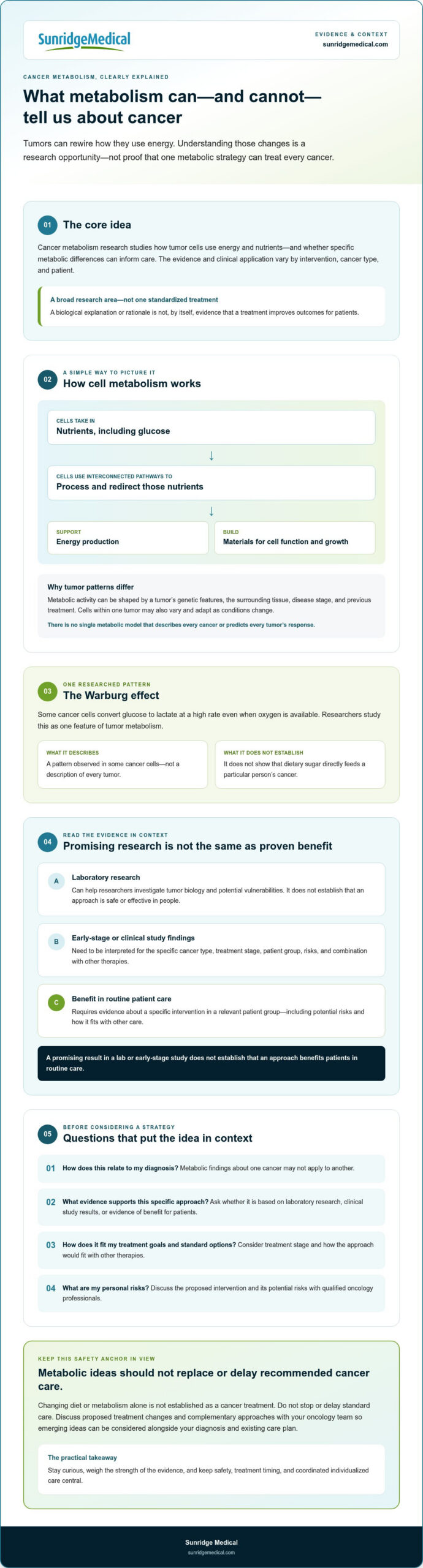
Concise definition: The metabolic approach to cancer studies how tumor cells use energy and nutrients, and whether specific metabolic differences can inform care. The evidence and clinical application vary by intervention, cancer type, and patient.
What Do Researchers Mean by Cancer Metabolism?
Cells take in nutrients and use interconnected biochemical pathways to produce energy and make the materials they need to function and grow. Glucose is one fuel source. Cells can process it through different pathways, including those that generate energy inside mitochondria. Cancer cells may alter glucose use and other metabolic processes to support growth, but patterns differ between tumors.
A frequently discussed observation is that some cancer cells take up and process glucose differently, including through a pathway associated with the Warburg effect. This is one area of cancer metabolism research, not a complete account of how every tumor behaves. Researchers also study how tumors use other nutrients and adapt to changing conditions. The field examines biology; it does not prescribe one universal diet or protocol.
How Is a Metabolic Perspective Different From a Treatment?
Studying tumor metabolism helps researchers investigate how cancer cells function and where potential vulnerabilities may exist. That perspective alone is not an intervention. A proposed treatment might involve a drug or another defined strategy intended to affect a particular process. A biological rationale does not, by itself, show that an approach improves outcomes for patients.
To establish clinical benefit, researchers need evidence about a specific intervention in a relevant patient group, including its potential risks and how it fits with other care. Laboratory research can guide further study, but it does not establish that an approach is safe or effective in people. Clinical study results also need to be interpreted in context: cancer type, treatment stage, and combination with other therapies all matter.
Metabolic research does not prove that conventional oncology has overlooked one underlying cause of cancer. Cancer is biologically complex, and metabolic changes are one area of investigation alongside other features of tumor biology. Patients can ask about these ideas without rejecting standard care. Discuss any proposed treatment change or complementary approach with qualified oncology professionals, and do not let it delay or replace recommended care.
How Cancer Metabolism Works, and Why Tumors Differ
Metabolism is the network of processes through which cells take in and use nutrients, make energy, and build the materials needed to grow and function. These processes are connected: a cell can redirect nutrients toward energy production, maintenance, or making new cellular components. Cancer cells may change how they use these pathways, but the changes are not uniform across cancers or even across all cells in one tumor.
Those differences matter. A tumor’s genetic features, the tissue around it, its stage, and previous treatment can influence which pathways are active. Cancer type, tumor genetics, local nutrient and oxygen conditions, disease stage, and treatment history can all shape metabolic activity. No single metabolic model describes every cancer or predicts an individual tumor’s response.
What Is the Warburg Effect?
The Warburg effect describes a pattern observed in some cancer cells: they convert glucose to lactate at a high rate even when oxygen is available, rather than relying only on oxygen-dependent energy production. Researchers study this form of aerobic glycolysis as one feature of tumor metabolism. It does not mean every tumor uses glucose in the same way, or that dietary sugar directly feeds a particular person’s cancer.
Why Tumor Metabolism Is Not One-Size-Fits-All
Different cancers can rely on different combinations of fuels and biochemical pathways. Even within a single tumor, cells may vary: some may use a pathway more heavily than nearby cells. Cancer cells can also shift their fuel use as conditions change, including when nutrients are limited or treatment alters the tumor environment. This capacity to adapt is one reason researchers view metabolism as complex rather than a single switch.
These differences are central to understanding the metabolic approach to cancer. A finding in one tumor type or laboratory model may not translate into an effective treatment for another cancer or person. Lab studies help identify possible mechanisms and guide further research, but they do not show by themselves that changing a pathway will improve patient outcomes. Clinical evidence must establish whether a defined intervention is appropriate and beneficial in a specific setting.
For patients, the practical step is to ask how a metabolic claim relates to their diagnosis and evidence-based treatment options. An oncology professional can help put tumor biology, treatment history, and individual goals in context. Sunridge Medical describes individualized cancer care that considers conventional therapies alongside research-based alternatives. A conversation with its team may help you explore your questions while keeping your oncology care involved. Learn more about individualized cancer care.
Is the Metabolic Approach to Cancer Proven? What Evidence Can Tell Us
Short answer: cancer metabolism is an active area of research, but broad metabolic theories do not establish one proven treatment for cancer. Some targeted medicines that affect metabolic pathways have clinical uses in specific settings, while many other proposed metabolic strategies remain under investigation. Evidence for one drug or cancer type does not prove that a different intervention, such as a diet or supplement, will help another patient.
Scientific plausibility is a reason to investigate a treatment, not proof that it benefits patients. When assessing a metabolic strategy, look at the evidence for the exact intervention being discussed:
- Cell studies examine cancer cells under controlled laboratory conditions. They can suggest how a pathway works, but do not show whether a treatment is safe or effective in people.
- Animal research can test how an intervention behaves in a living system, but findings may not translate to human cancer.
- Early clinical studies assess a treatment in people, often to learn about safety and whether further study is warranted. Early signals are not definitive proof of benefit.
- Established clinical evidence comes from human research that evaluates meaningful outcomes and risks in a defined patient group. The evidence applies to the intervention and context studied, not automatically to every cancer.
How to Read Claims About Metabolic Cancer Treatments
Ask what kind of research supports the claim and whether it involved people with the same cancer and treatment circumstances. Look for a clearly described intervention, patient group, comparison when appropriate, measured outcomes, and limitations. Be cautious if a claim relies only on a mechanism or laboratory result, promises a cure or guaranteed outcome, or urges you to abandon oncology care. Pause and seek qualified medical guidance if you encounter these warning signs.
Can Diet or Supplements Change Cancer Metabolism?
Dietary changes and supplements are not established substitutes for cancer treatment. Nutrition needs can vary with diagnosis, treatment, symptoms, and overall health; a restrictive eating plan may not be appropriate for every patient. Supplements can also have risks, including possible interactions with medicines or treatment. Before starting a supplement or making a major diet change, discuss it with your oncology team so they can consider your care plan and nutritional needs.
Rather than asking only, “Does this affect metabolism?” ask: “What evidence supports this specific approach for my cancer, what are its risks, and how would it fit with my current treatment?” This keeps promising research in view without mistaking possibility for proven benefit.
Questions to Ask Before Considering a Metabolic Cancer Approach
Exploring a metabolic approach does not require making decisions alone or putting established care on hold. Bring the idea to a qualified oncology professional and ask how it applies to your diagnosis, treatment goals, and current plan. These questions can turn broad claims into a more specific, safer discussion.
How to Evaluate a Proposed Intervention
Start by clarifying exactly what is being proposed. A general claim about “targeting metabolism” is not enough to assess safety or likely benefit. Ask for the intervention’s name and purpose, the evidence behind it, and whether that evidence relates to your cancer type and situation.
- What is the intervention, and what is it intended to do? Is it a medicine, supplement, dietary change, or another approach?
- What evidence supports it for my cancer? Was it studied in people, and were those patients similar to me?
- What are the known risks or interactions? Could it affect my medications, symptoms, nutrition, or planned treatment?
- Who will oversee it, and what monitoring is needed? Clarify which clinician is responsible for follow-up and safety checks.
- How will we measure whether it’s helping? Ask what outcomes matter and what findings would prompt a change in the plan.
- How does it fit with standard options and timing? Discuss whether considering it could interfere with, postpone, or complicate time-sensitive cancer care.
These questions support understanding the metabolic approach to cancer without treating a compelling theory as a personal recommendation. If answers are unclear, ask for the evidence or rationale in writing and review it with your care team before making a decision.
How to Keep Your Oncology Team Involved
Share the exact names and doses of any supplements, medicines, or therapies you are considering, along with details about major dietary changes. Your treating oncologist can review possible interactions with current or planned care. Keep a written list of questions and unanswered concerns. If you need more clarity, seeking another qualified medical opinion is reasonable.
Do not stop, delay, or change prescribed cancer treatment while waiting to evaluate a complementary approach. If a recommendation urges you to leave oncology care or postpone treatment, discuss that promptly with your treating team. Sunridge Medical describes individualized care that considers conventional therapies alongside research-based alternatives. You can discuss individualized cancer care as a potential consultation, while keeping your oncology professionals involved in decisions about treatment and timing.
How Individualized Integrative Cancer Care Can Put Metabolic Questions in Context
Metabolic research can raise useful questions, but its relevance depends on the person and clinical situation. An individualized evaluation considers the cancer diagnosis, medical history, current and planned treatment, personal goals, and preferences. This wider context helps distinguish a general theory from an option that may be appropriate to discuss for a particular patient.
Integrative care means considering conventional and complementary approaches in a coordinated way, with attention to evidence, safety, and how treatments may interact. It does not mean that every complementary strategy is suitable or proven, and it should not be a reason to step away from an established oncology team. A consultation also cannot guarantee a particular treatment recommendation or outcome.
What an Individualized Consultation Can Help Clarify
A clinician may review medical records, current care, relevant health history, and the questions a patient or caregiver wants to address. That review can help clarify what is known about a proposed approach, what remains uncertain, and what additional information may be needed. Suitability and safety depend on the individual clinical picture, including current therapies and other health considerations. Do not assume a specific metabolic protocol or benefit before that assessment.
Understanding the metabolic approach to cancer is more useful when linked to practical questions: Does the proposed intervention relate to this diagnosis? What evidence supports it? Could it conflict with current treatment or affect the patient’s health in another way? A careful discussion can help patients weigh options without treating an emerging idea as a replacement for recommended oncology care.
A Supportive Next Step for Patients and Caregivers
Preparation can make a medical conversation clearer. Consider bringing available records, a current medication and supplement list with doses, details of any proposed dietary changes, and written questions. Include what matters most to the patient, such as treatment goals, concerns about side effects, or preferences about complementary approaches. Ask how any option would be coordinated with the established oncology team, and share the discussion with that team before making changes.
Sunridge Medical describes individualized cancer care that considers conventional therapies alongside research-based alternative treatments. Patients and caregivers can ask whether a metabolic approach is relevant to an individual evaluation; its suitability should be confirmed rather than assumed. For a calm, informed conversation about your questions, Contact Sunridge Medical to discuss your questions, while continuing to coordinate decisions with your treating oncology professionals.
Use Metabolic Questions to Support Informed Care
Understanding the metabolic approach to cancer means recognizing both its promise as a field of research and its limits as a guide to treatment. Cancer cells can use energy and nutrients differently, but those patterns vary, and a biological theory alone does not prove that a particular intervention benefits patients.
Evaluate each proposed option on its own evidence, risks, and relevance to your diagnosis. Ask your oncology team how it fits with your treatment goals and current care, and discuss supplements or major dietary changes before making them. Emerging ideas deserve thoughtful questions, not decisions that delay or replace recommended cancer treatment.
Sunridge Medical describes individualized care plans and an approach that combines conventional therapies with research-based alternative treatments. Whether a metabolic approach is relevant depends on an individual evaluation; no consultation can guarantee an outcome or replace coordination with your treating oncology professionals. If you’d like to discuss your questions, contact Sunridge Medical. With clear information and the right clinicians involved, you can explore your options with greater confidence.
Frequently Asked Questions
What is the metabolic approach to cancer?
The metabolic approach to cancer is a broad way of studying how cancer cells use energy and nutrients, and how these processes may differ from those in healthy cells. It does not refer to one standardized treatment. Researchers investigate metabolic changes to understand tumor biology and possible treatment targets, but a biological theory or laboratory finding alone does not establish that a specific intervention improves outcomes for patients.
Is the metabolic approach to cancer proven?
Not as one general treatment approach. Cancer metabolism is an active research area, but evidence varies by intervention, cancer type, and study. Laboratory results can help researchers identify ideas to investigate, but they are not proof of benefit in people. Ask an oncology professional to review the evidence for a proposed therapy, including whether it has been studied in people with your cancer and how it fits with established treatment options.
Does sugar cause cancer cells to grow?
No simple claim about eating sugar can predict how an individual tumor will behave. Cells, including cancer cells, use nutrients for energy and other functions, but this does not mean that eating sugar directly causes a person’s tumor to grow. Tumors can use different metabolic pathways, and cancer metabolism is complex. Do not make major dietary changes based on simplified claims. Discuss nutrition questions with your oncology team, especially during treatment.
Can diet alone treat or cure cancer?
No. Diet alone is not an established substitute for cancer treatment, and claims that a particular diet cures cancer require strong clinical evidence. Nutrition can support general health and help address individual needs during care, but needs vary with diagnosis, treatment, symptoms, and overall health. Restrictive diets may carry risks, particularly during treatment. Before making substantial dietary changes, discuss the plan with your oncologist or a qualified oncology dietitian.
Can metabolic cancer treatments replace chemotherapy or other standard treatments?
No metabolic theory or online claim is a safe reason to stop, delay, or replace prescribed cancer treatment. Treatment decisions depend on the diagnosis and individual circumstances. If you are considering a complementary approach, share its exact details with your oncology team and ask about the supporting evidence, possible interactions, risks, and safety monitoring. Also ask whether it could affect your current care plan or treatment timing before making any changes.
What should I ask a doctor about a metabolic cancer protocol?
Ask what the protocol involves, what evidence supports it for your specific cancer, and whether that evidence comes from human clinical studies. Discuss potential risks, interactions, monitoring, and how the approach would coordinate with your current treatment. Ask how outcomes would be assessed and what could prompt a change in the plan. A qualified clinician should explain what remains uncertain and should not guarantee a cure or advise abandoning oncology care.
How is metabolic cancer research different from integrative oncology?
Metabolic cancer research investigates how cancer cells use energy and nutrients. Integrative oncology describes coordinating conventional cancer care with selected complementary approaches, with attention to evidence and safety. The terms are not interchangeable, and neither automatically validates a specific therapy. Whether a complementary option is relevant depends on the patient’s clinical circumstances and current care. A qualified clinician can help assess those factors and support communication with the established oncology team.