


What does an integrative cancer care plan include, and how can you estimate its cost? The cost of integrative cancer treatment in the US 2026 depends on a person’s needs and the therapies proposed, so a single figure may not tell the whole story. Consultations, treatment administration, and ongoing monitoring may all contribute to the total. Understanding each component can make budgeting more practical.
It’s reasonable to want a clear estimate and to understand what insurance may cover. Coverage varies by plan and service, so some integrative therapies may involve out-of-pocket costs. A written, itemized estimate can show what is included and help you identify questions to address before moving forward.
This guide explains the factors that can shape costs, the expenses to consider, and how to compare estimates. At Sunridge Medical, physician evaluation and individualized treatment planning provide a starting point for understanding potential care needs. Integrative therapies should be considered alongside conventional cancer care, with your oncology team kept informed.
Key Takeaways
- The cost of integrative cancer treatment in the US 2026 depends on an individualized plan, not a universal price tag.
- Review the proposed services, treatment duration, administration, and monitoring to understand what may shape expenses.
- Compare estimates by checking service scope, visit types, follow-up, exclusions, and assumptions rather than focusing on the total alone.
- Organize your financial plan by separating known fees from variable, optional, or not-yet-scheduled items.
- Use physician evaluation and clinical assessment to clarify care needs, and keep your oncology team informed as you consider integrative therapies.
Factors Affecting 2026 US Integrative Cancer Costs
There is no single cost that applies to every integrative cancer treatment plan. The cost of integrative cancer treatment in the US 2026 depends on the services proposed, how long care continues, what monitoring is recommended, and a person’s clinical needs. A plan may begin with physician evaluation and treatment planning, followed by selected clinical therapies and ongoing assessment. Since the components and schedule are specific to the individual, another person’s plan is not a reliable price template.
A broad figure described as the cost of an “integrative program” may not cover the same services as individualized clinical care. A fixed package may include a defined set of services over a set period, while an individual plan is developed around the person’s circumstances and clinical recommendations. This guide offers budgeting context, not a personal estimate or medical advice, and does not predict which therapies an individual may need.
Why is there no single nationwide price for integrative cancer treatment?
Diagnosis, treatment goals, medical history, current care, and clinical recommendations can all shape a proposed plan. The initial evaluation and treatment-plan development are distinct from expenses that may arise during ongoing care. Clinical administration and monitoring may also be part of later phases, depending on the recommendations. Not everyone receives the same therapies or follows the same schedule.
What does an individualized cost estimate need to clarify?
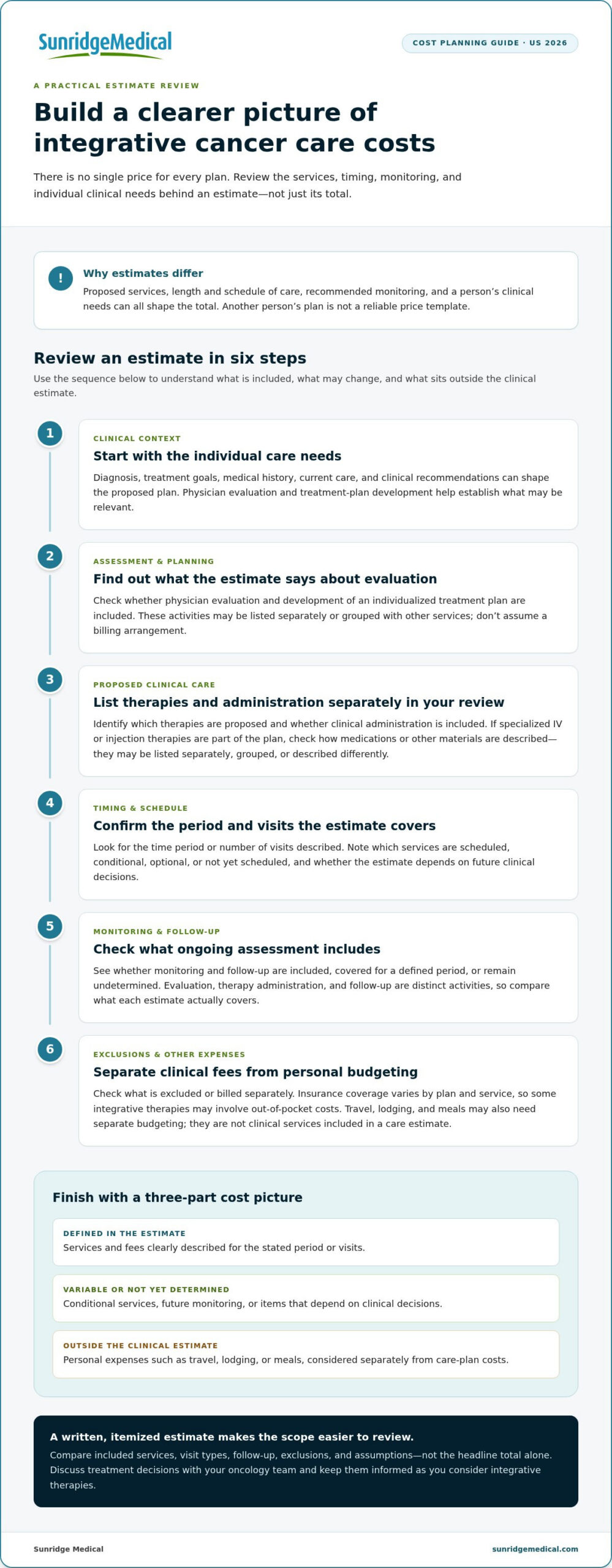
A useful estimate describes the care it covers, rather than offering only a headline total. Look for details about evaluation and planning, proposed therapies, clinical administration, monitoring, and follow-up. Check the period covered, which services are scheduled or conditional, and whether anything is excluded or billed separately. This helps distinguish the estimate’s defined scope from costs that could change as care progresses.
Cost variation comes down to the services included, the length and schedule of care, the monitoring required, and the patient’s individual clinical needs. A written, itemized estimate makes these factors easier to review. It can also show what is known now and what may depend on future clinical decisions.
- Included services: Which evaluations, therapies, administration, and follow-up are covered?
- Timing: What period or number of visits does the estimate describe?
- Variable items: Which services are conditional, optional, or not yet scheduled?
Use these questions to build a clearer planning picture, then discuss treatment decisions with your oncology team and the clinicians involved in your care.
Which Services and Care Components Can Shape Integrative Cancer Treatment Costs?
The cost of integrative cancer treatment in the US 2026 may reflect several clinical activities, not just the therapies themselves. A physician evaluation establishes clinical context, while treatment-plan development translates that assessment into proposed next steps. Clinical administration and ongoing monitoring may also contribute, depending on the plan. An estimate may list these activities separately or group some together.
Can consultations, treatment planning, and monitoring have separate fees?
Evaluation, plan development, therapy administration, and follow-up are distinct activities. To understand an estimate, check which it includes and what falls outside its stated scope. Don’t assume each activity is billed separately or that all are bundled. The estimate should explain what its figures represent, the period they cover, and whether future follow-up or monitoring is included or remains undetermined.
Sort the estimate’s entries by purpose to see what the fees relate to:
- Assessment and planning: physician evaluation and development of an individualized treatment plan.
- Clinical care: administration of therapies included in the plan.
- Monitoring and follow-up: ongoing assessment and subsequent care activities described in the estimate.
This breakdown helps you judge whether estimates cover comparable services without assuming a particular schedule or billing arrangement.
How can IV and injection therapies affect an individualized plan?
Specialized IV or injection therapies may be included when they are part of an individual clinical plan. If proposed, check whether the estimate distinguishes clinical administration from medications or other materials. These items may be listed separately, grouped, or described differently, so focus on what the estimate actually includes. The inclusion of a therapy does not guarantee a particular outcome.
Some expenses associated with receiving care are not clinical fees. Depending on your circumstances, you may also need to budget separately for travel, lodging, or meals. These are personal budgeting considerations, not services included in a clinical estimate. Keeping personal expenses separate from care-plan costs makes the overall picture easier to organize.
At Sunridge Medical, physician evaluations and individualized treatment planning help clarify which clinical components are relevant to your circumstances. Explore individualized cancer care to understand the proposed services and how clinical administration and monitoring may fit into a plan.
How to Compare Integrative Cancer Treatment Costs Without Comparing Unlike Plans
A lower total does not necessarily mean a plan costs less for comparable care. One estimate may cover a shorter period, fewer visits, or less monitoring than another. To compare the cost of integrative cancer treatment in the US 2026 meaningfully, review what each written estimate includes, what it excludes, and the assumptions behind the total. The goal is to understand the scope, not rank providers by a single figure.
Which line items should patients compare in written estimates?
Record the same categories for each estimate. If an item is not described, mark it as unknown rather than assuming it is included. Note the estimate date, timeframe, and any stated assumptions, such as services that depend on later clinical recommendations.
| Category | What to compare | What to record |
|---|---|---|
| Evaluation and care planning | Whether physician evaluation and individualized plan development are included | Included, separate, or unclear |
| Visit types | Which consultation or care visits the estimate covers | Visit types and stated timeframe |
| Therapy administration | Which proposed therapies and administration activities are included | Included services and any exclusions |
| Monitoring | Whether ongoing assessment is included and under what assumptions | Included, variable, or not specified |
| Follow-up | Whether follow-up care is part of the estimate or addressed separately | Scope and expected timeframe |
Compare the estimates side by side. A total covering evaluation, therapy administration, and follow-up over one period is not directly comparable with a figure covering selected services or a different timeframe. Record exclusions and variable or unscheduled items so they remain part of your budget planning.
Could insurance cover integrative cancer treatment services?
Coverage and reimbursement depend on the specific service, your individual plan, and its current terms. Don’t assume coverage for one type of care applies to another, or that a service will be reimbursed. Ask your insurer about the specific service and review current written benefit information, including applicable conditions, limitations, or cost-sharing terms.
Keep the insurer’s response with the estimate and note whether it addresses the exact service being proposed. This gives you a clearer basis for financial planning while leaving room to discuss clinical questions with your care team.
How to Plan for Integrative Cancer Treatment Expenses in 2026
A structured approach can turn an uncertain financial picture into practical questions for your care team. Start with current medical information, then organize proposed services and estimates so you can distinguish known fees from items that may change. This can help you discuss the cost of integrative cancer treatment in the US 2026 while keeping decisions connected to your broader cancer care.
What information should you prepare before discussing costs?
Gather current treatment details, relevant medical records, and a short list of care priorities. If you’re considering how clinical recommendations may relate to your diagnosis, the integrative cancer treatment guide by stage offers additional context to discuss with your clinicians.
Use this three-step process to organize the financial conversation:
- Gather current care information. Note your cancer diagnosis, treatments underway or planned, relevant history, and questions about how proposed care fits alongside your oncology plan.
- List proposed services. Record evaluations, treatment-plan development, therapies, administration, monitoring, and follow-up, along with anticipated timing. Mark each item as known, variable, optional, or not yet scheduled.
- Organize the estimates. Keep written estimates together and note their dates, timeframes, assumptions, and exclusions. Prepare questions about included fees, payment timing, and whether your plan may cover any proposed service.
This method helps prevent uncertain or future items from being mistaken for confirmed fees. Coverage depends on plan terms and the service, so review current written benefit information and discuss specific coverage questions with your insurer.
How can you keep cost planning connected to safe cancer care?
Share the proposed integrative plan with your treating oncology team and keep communication open among the clinicians involved. This allows the team to consider the proposed care alongside your current treatment and medical circumstances. For broader clinical context, read this integrative cancer treatment guide. Don’t delay or discontinue prescribed cancer care based on cost information in an article. Discuss treatment changes with your oncology team.
For a discussion grounded in your circumstances, explore individualized cancer care planning through physician evaluation, clinical assessment, and treatment-plan development.
Discuss an Individualized Integrative Cancer Care Plan with Sunridge Medical
A written estimate is more meaningful when it reflects recommendations shaped around your clinical circumstances. At Sunridge Medical, physician evaluation and clinical assessment inform individualized treatment planning. Depending on individual needs, a plan may include selected therapies, clinical administration, and ongoing monitoring rather than a standard package for every patient.
What can an individualized clinical discussion help clarify?
An evaluation can help identify which care components are relevant to your situation and which questions need further discussion. Bring current treatment information, care priorities, and financial questions. Use the conversation to clarify:
- Which services are proposed and how they relate to your clinical assessment.
- What clinical administration and monitoring may involve.
- Which items are defined in an estimate and which remain variable or depend on future recommendations.
- What questions to take to your insurer about specific services and current plan terms.
This discussion can provide a more individualized basis for understanding the cost of integrative cancer treatment in the US 2026. It is not a promise of eligibility, insurance coverage, a particular result, or a fixed total. The scope and cost of care depend on the plan developed for the individual.
What should patients keep in mind before taking the next step?
Integrative care should be considered in coordination with your oncology team. Sunridge Medical develops individualized plans that combine conventional therapies with research-based alternative treatments. Integrative services should not be treated as a substitute for prescribed cancer care. Share proposed therapies with your oncology team and discuss any treatment changes with the clinicians responsible for your care.
Before a discussion, write down your main care and financial questions. Bring available medical records and current treatment details, then review proposed services and estimate assumptions. A clear conversation can help you understand the clinical plan and identify what still needs clarification.
If you’re ready to discuss an individualized care plan, contact Sunridge Medical to take the next step.
Take the Next Step with a Clearer Care Plan
The cost of integrative cancer treatment in the US 2026 depends on the services, timing, and monitoring in an individualized plan, so a single headline figure may not tell the whole story. Compare written estimates by scope, timeframe, and exclusions, and separate confirmed fees from items that may change. Keep your oncology team informed as you consider integrative care.
At Sunridge Medical, physician evaluation and clinical assessment guide personalized treatment planning. Care plans are tailored to the individual and combine conventional therapies with research-based alternative treatments.
If you’re ready to discuss your care and financial questions, contact Sunridge Medical to discuss an individualized care plan. A conversation can help you understand potential next steps and prepare informed questions for your care team.
Frequently Asked Questions
How much does integrative cancer treatment cost in the US in 2026?
There’s no single price that applies to every individualized plan. The cost of integrative cancer treatment in the US 2026 depends on the services recommended, treatment duration, clinical administration, monitoring, and personal clinical needs. A broad program price may cover different services or a different timeframe from an individualized plan. For practical budgeting, review a written estimate that identifies included services, exclusions, assumptions, and items that may vary.
What factors affect the cost of integrative cancer treatment?
Costs can depend on a person’s diagnosis, treatment goals, medical history, and clinical recommendations, as well as the services and duration of the proposed plan. Physician evaluation and treatment planning, therapy administration, and ongoing monitoring may all be relevant components. The therapies and schedule can differ from person to person. Review each proposed service and its timeframe to understand what contributes to an estimate and what remains subject to future decisions.
Does insurance cover integrative cancer treatment?
Coverage depends on the specific service, the terms of your individual plan, and applicable policy requirements. Don’t assume that coverage for one service means another will be covered or that reimbursement is assured. Ask your insurer about the exact service being considered and review current written benefit information. Note any applicable limitations, conditions, or cost-sharing terms, then compare that information with the services in your care estimate.
Are consultations and treatment therapies billed separately?
They may be listed separately or grouped, depending on the estimate’s structure, so don’t assume a particular billing arrangement. Physician evaluation, treatment-plan development, clinical administration, and follow-up are distinct activities. Review which activities the estimate includes, what timeframe it covers, and whether monitoring or future visits are addressed. If an item is unclear, record it as unknown rather than assuming it is included in the total.
Can integrative cancer treatment be used alongside conventional cancer care?
Integrative care can be considered alongside conventional cancer care, with coordination among the clinicians involved. Sunridge Medical develops individualized plans that combine conventional therapies with research-based alternative treatments. Share proposed therapies with your oncology team so they can consider them in the context of your current care and medical circumstances. Don’t delay or stop prescribed cancer treatment based on general information. Discuss possible changes with your treating clinicians.
How can I compare integrative cancer treatment estimates?
Compare the scope of each estimate, not just its total. Check whether physician evaluation, care planning, therapy administration, monitoring, and follow-up are included, then record the estimate date, timeframe, exclusions, and assumptions. Mark variable, optional, or unscheduled services clearly. A lower total may describe fewer services or a shorter period, so it may not represent comparable care. Keep insurance information separate and confirm coverage for each service with your plan.
Does Sunridge Medical offer a fixed-price cancer treatment package?
Sunridge Medical develops individualized care plans through physician evaluation and clinical assessment rather than using one standardized plan for every patient. Treatment planning, clinical administration, and monitoring are shaped by individual circumstances and recommendations. A personal discussion can help clarify which care components are relevant and which financial questions to address. A fixed total, insurance coverage, eligibility, or treatment outcome should not be assumed before an individualized plan is developed.