

A cancer diagnosis often sends patients searching for options beyond the standard treatment plan. You may have heard that tumors thrive in low-oxygen environments, that hyperbaric oxygen therapy can make radiation work better, or that ozone infusions can “oxygenate” the body and attack cancer directly. Those ideas sound related, but they describe very different therapies with very different levels of evidence.
Cancer oxygen therapy isn't one treatment. It may refer to medically supervised hyperbaric oxygen therapy, ozone-based procedures, experimental combinations with radiation, or even nonmedical methods marketed as ways to raise oxygen levels. The useful question isn't whether oxygen helps cancer. It's which therapy, for which cancer or treatment complication, with what goal, and under whose supervision.
Table of Contents
- Why Patients Start Asking About Oxygen and Cancer
- What Oxygen-Based Cancer Therapy Actually Means
- How Raising Tumor Oxygen Pressure May Help Treatment
- What the Evidence Actually Shows by Use Case
- The Line Between Adjunctive Support and a Cancer Cure
- Comparing Hyperbaric Oxygen and Ozone-Related Modalities
- Safety Considerations and Questions to Ask a Clinic
- How an Integrative Evaluation in Scottsdale Approaches Oxygen Therapy
Why Patients Start Asking About Oxygen and Cancer
A 58-year-old patient midway through radiation for head and neck cancer may arrive with painful mucositis, difficulty eating, and growing anxiety about the treatment ahead. Someone in a support group has mentioned hyperbaric oxygen. An integrative clinic has offered weekly IV ozone. The patient wants to know whether changing oxygen levels can help the cancer itself, make treatment easier to tolerate, or repair the damage after radiation.
That question usually comes through one of three pathways. Some patients are looking for an alternative to surgery, chemotherapy, radiation, or immunotherapy. Others want to reduce treatment-related toxicity, preserve function, or recover from complications that persist after treatment. A third group has heard that tumors grow in low-oxygen conditions and has made a reasonable but incomplete leap: if low oxygen supports cancer, more oxygen must cure it.
The biology is more complicated. Tumor oxygenation may influence how some treatments work, particularly radiation, but that doesn't mean breathing extra oxygen or receiving an oxygen-related procedure directly eliminates a tumor. A therapy can improve tissue healing without controlling malignant cells. It can also be biologically plausible while remaining unproven in patients.
A practical distinction: Ask whether the proposed treatment is intended to target the tumor, repair treatment-related injury, or support the patient's overall function. Those are separate goals and require separate evidence.
The most responsible conversation separates established care, plausible adjunctive care, and marketing claims. Hyperbaric oxygen has a recognized role for selected radiation injuries and compromised tissues. Its direct anti-tumor role remains investigational. Ozone-related treatments may be offered in integrative settings, but claims that they cure cancer or reliably shrink tumors aren't supported by established clinical evidence.
What Oxygen-Based Cancer Therapy Actually Means
Think of oxygen as a delivery system. Three questions matter: how much oxygen is carried in the blood, how it's transported, and whether it reaches tissue that needs it. Changing one part of that system doesn't automatically change the oxygen environment inside a tumor.
Hyperbaric oxygen therapy
Hyperbaric oxygen therapy, or HBOT, involves breathing 100% oxygen inside a chamber where pressure is higher than ordinary atmospheric pressure. The pressure increases the amount of oxygen dissolved in plasma, allowing oxygen to reach some tissues more effectively. Medical HBOT is delivered with defined equipment, physician-directed screening, monitoring, and protocols.
That's different from a mild hyperbaric bag or a wellness chamber operating at relatively low pressure. Patients should ask what device is being used, who supervises treatment, and which recognized indication supports the recommendation. A useful overview of the equipment and business environment is this resource on pressure chamber therapy for healthcare growth, but commercial information shouldn't substitute for a medical assessment.
Ozone and other oxygen-related approaches
Ozone-related procedures aren't the same as HBOT. Integrative practices may use major autohemotherapy, in which blood is withdrawn, exposed to an oxygen-ozone mixture, and reinfused; rectal insufflation; or other delivery methods. IV hydrogen peroxide protocols are also marketed in some settings, although they involve a different substance and carry their own safety concerns.
Some clinics also group exercise-based oxygenation, hyperthermia-oxygen combinations, and oxidative medicine under the broad label of oxygen therapy. These approaches may be based on theories involving oxidative signaling or preconditioning rather than delivering more oxygen to a tumor.
For a broader discussion of how an integrative plan should be organized, see Sunridge Medical's clinical framework for building an integrative cancer treatment plan.
The key point is simple: “oxygen therapy” is a marketing umbrella, not a single medical intervention. Evidence for HBOT can't automatically be transferred to ozone, and a proposed mechanism can't be treated as proof of tumor control.
How Raising Tumor Oxygen Pressure May Help Treatment
The strongest technical rationale for oxygen in oncology involves hypoxia and radiotherapy. Many tumors contain regions with limited oxygen. Radiation damages DNA, and oxygen helps stabilize that damage so the cell can't repair it as easily. A hypoxic tumor region may therefore be less sensitive to radiation.
HBOT may temporarily raise oxygen pressure in tissues. One review described oxygen partial pressure in hypoxic tumor tissue increasing from about 5 mmHg under hypoxia to 30 to 50 mmHg after HBOT in its discussion of the mechanism. That finding explains why researchers have studied HBOT as a radiosensitizer. It doesn't establish that the approach improves survival or replaces standard treatment.
Three mechanisms, three different claims
Radiosensitization is the first mechanism. Reoxygenating a tumor may make radiation more effective in selected circumstances. The clinical question is whether that biological change translates into better local control without adding unacceptable harm.
Tissue repair is a separate mechanism. HBOT can support the biology of damaged tissue by improving oxygen availability and stimulating processes involved in healing, including new blood-vessel formation and fibroblast activity. That rationale applies to radiation-induced injury, osteoradionecrosis, soft-tissue damage, and selected wound complications. It describes recovery of injured tissue, not direct destruction of cancer.
Direct oxidative anti-tumor activity is the most speculative claim. Laboratory and animal research has explored whether oxygen or ozone can create oxidative stress, alter immune signaling, or affect the tumor microenvironment. Reviews of the literature, however, have not established a reliable direct cancer-killing effect in humans.
Experimental cancer protocols have described HBOT sessions of about 90 minutes daily for 3 to 7 days in the review's discussion of investigational settings. Those schedules are research observations, not universal clinical standards.
Raising oxygen pressure may change treatment sensitivity or healing biology. It doesn't turn oxygen into a stand-alone chemotherapy drug.
What the Evidence Actually Shows by Use Case
The evidence becomes clearer when oxygen therapy is organized by purpose rather than by the word “cancer.”
Radiation-related injury
The most established oncology use is HBOT for selected radiation tissue injuries, including osteoradionecrosis and soft-tissue radionecrosis. Patients may develop delayed injury in the jaw, bladder, pelvis, breast, or other irradiated tissues. In these situations, the target is damaged tissue and impaired healing, not an untreated tumor.
A Cochrane review included 19 randomized trials with 2,286 participants, with 1,103 assigned to HBOT and 1,153 to control Cochrane review. The review found potential benefits in selected cancer-related outcomes, but it also reported higher severe radiation tissue injury and more seizures during therapy. That combination is important. A treatment can show a signal of benefit and still require careful patient selection.
Radiosensitization
HBOT has also been studied alongside radiation, especially for head and neck tumors. The Cochrane review reported lower risk of death at one year, with a risk ratio of 0.83, and at five years, with a risk ratio of 0.82, in head and neck cancer. It also reported improved immediate local tumor control, with a risk ratio of 0.58, and lower local recurrence at one year, with a risk ratio of 0.66 same review.
Those findings don't justify presenting HBOT as a cure. The same review reported more severe radiation tissue injury, with a risk ratio of 2.35, and more seizures during therapy, with a risk ratio of 6.76 same review. A later review described Grade B or C evidence for reducing late radiation injuries and noted a possible increase in radiation effectiveness in head and neck tumors, while emphasizing uncertainty and safety concerns 2021 review.
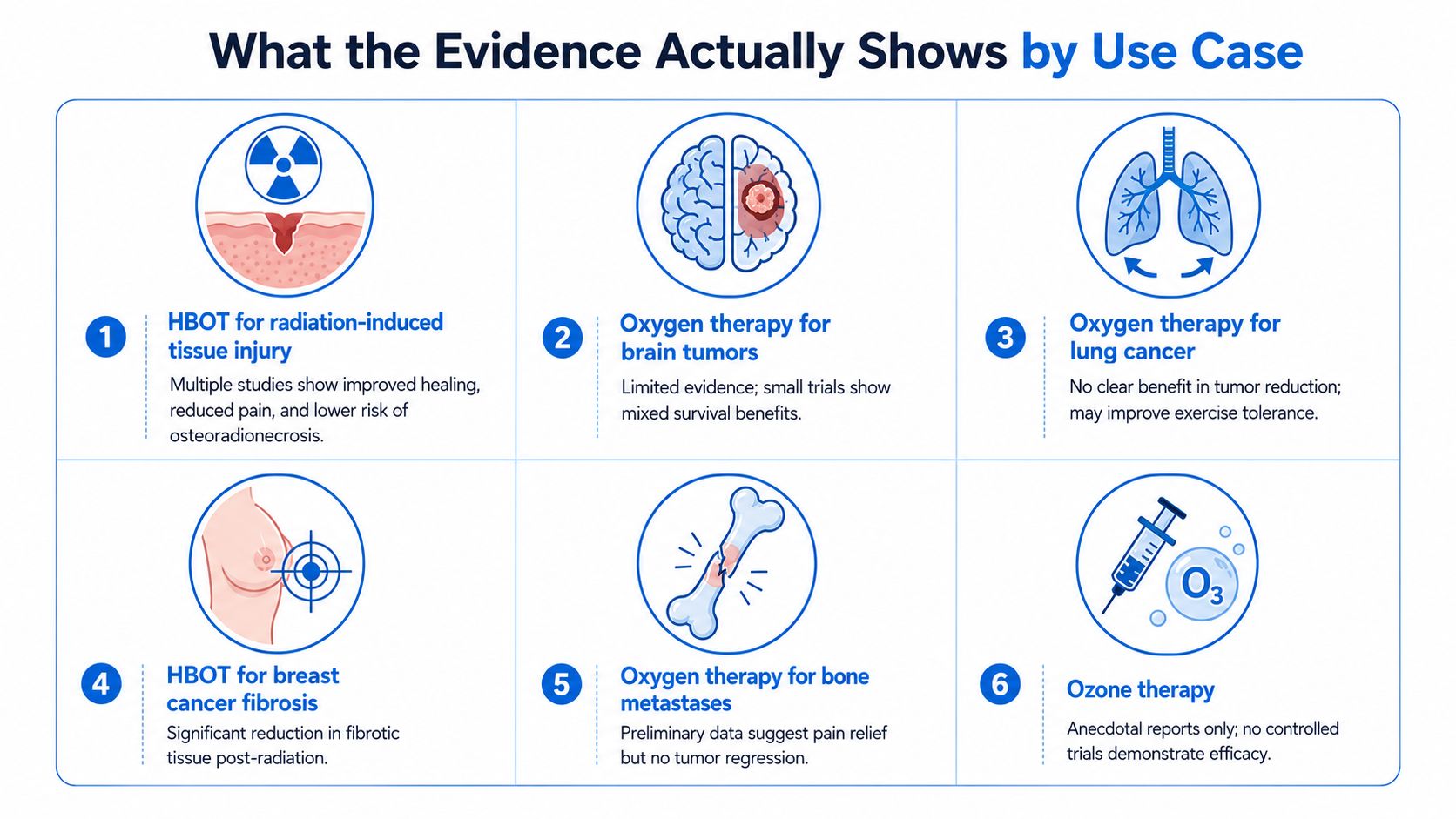
Other uses remain less certain. Evidence for preventing radiation-related dry mouth, combining HBOT with chemotherapy for sarcomas, or using ozone for direct tumor control is limited. A 2025 head-and-neck review included 17 studies and 640 patients, found positive outcomes in 14 of 17 studies, but also identified low-quality evidence, substantial bias risk, small samples, and inconsistent outcome measures systematic review.
The honest gradient is this: tissue repair has the clearest clinical role, radiosensitization is promising but selective, and direct anti-tumor oxygen claims remain investigational. No phase III randomized trial has demonstrated improved overall survival for a solid tumor from HBOT alone or established it as a replacement for conventional cancer treatment evidence review.
The Line Between Adjunctive Support and a Cancer Cure
The most common misunderstanding is that a tumor's low-oxygen environment proves that adding oxygen will directly cure the cancer. The Warburg hypothesis, which concerns how cancer cells produce energy, is often simplified into a slogan about cancer “feeding” on particular fuel sources. That shortcut leaves out tumor diversity, blood flow, immune biology, genetics, and the fact that oxygen affects normal tissue as well as malignant tissue.
HBOT's most defensible oncology role is adjunctive. It may help selected patients recover from radiation injury, support compromised tissue, or potentially improve sensitivity to radiation in a carefully defined treatment setting. It isn't a substitute for tumor-directed care such as surgery, radiation, systemic therapy, or an appropriately selected clinical trial.
A patient finishing head and neck radiation who receives HBOT for threatened jawbone or soft-tissue injury is pursuing supportive care with a specific tissue-healing goal. A patient paying for ozone infusions because a clinic promises that oxidation will directly kill a tumor is being offered a much stronger claim than the evidence supports. Relief of pain, improved function, or better wound healing can matter greatly, but those outcomes don't prove tumor regression.
Use this three-part framework before agreeing to any oxygen-based treatment:
- Tumor target: Is the therapy intended to shrink or control cancer? Ask for human clinical evidence using meaningful cancer outcomes.
- Treatment complication: Is it addressing radiation injury, delayed healing, fibrosis, or another defined adverse effect? Ask whether the indication is recognized and whether your oncology team agrees.
- Patient resilience: Is the goal better function, nutrition, symptom control, or recovery? Those goals deserve tracking, but they shouldn't be marketed as cancer treatment.
Patients considering supportive infusions may also review vitamin C infusions for cancer, while keeping the same distinction between supportive care and proven tumor control.
Comparing Hyperbaric Oxygen and Ozone-Related Modalities
Patients often need a direct comparison because clinics may use similar language for therapies that differ in delivery, physiology, regulation, and evidence.
| Dimension | Hyperbaric Oxygen Therapy, HBOT | Ozone-Related Oxygenation Approaches |
|---|---|---|
| Delivery | Breathing 100% oxygen in a pressurized chamber | Exposure of blood or another route to an oxygen-ozone mixture, depending on the procedure |
| Typical oncology protocols | Commonly described as 2 to 2.5 ATA, with sessions of 90 to 120 minutes over 20 to 40 sessions in clinical practice, although the appropriate protocol depends on the indication | No single standardized cancer protocol applies across autohemotherapy, rectal insufflation, or other methods |
| Primary intended use | Defined tissue-healing indications, including selected radiation injuries and compromised wounds | Complementary or investigational support, often framed around oxidative signaling or immune effects |
| Oxygen payload | Raises dissolved oxygen through pressure and inhaled oxygen | Doesn't simply deliver oxygen directly to a tumor. Proposed effects involve reactions between ozone and biological molecules |
| Evidence base | Clinical trials, systematic reviews, and specialty guidance exist for selected indications | Cancer-relevant evidence is generally limited, with direct anti-tumor claims not established |
| Regulatory and reimbursement questions | Formal medical indications and reimbursement pathways may apply to qualifying conditions, but coverage depends on the diagnosis and policy | Often offered as complementary medicine, with coverage and oversight varying by setting |
| Questions that should prompt caution | A clinic promises tumor eradication, avoids oncology coordination, or can't explain the indication | A clinic guarantees tumor shrinkage, discourages standard treatment, or doesn't disclose procedural risks |
The numbers in the HBOT row describe commonly discussed clinical parameters, not a recommendation for any individual. Pressure, duration, and total sessions must be selected by a qualified medical team after reviewing the cancer history, medications, pulmonary status, and treatment objective.
Ozone-related procedures should not inherit HBOT's evidence by association. Patients exploring ozone therapy as an alternative cancer treatment should ask whether the proposed goal is symptom support or direct tumor treatment, what human evidence supports that goal, and how the clinician will coordinate with the treating oncologist.
Safety Considerations and Questions to Ask a Clinic
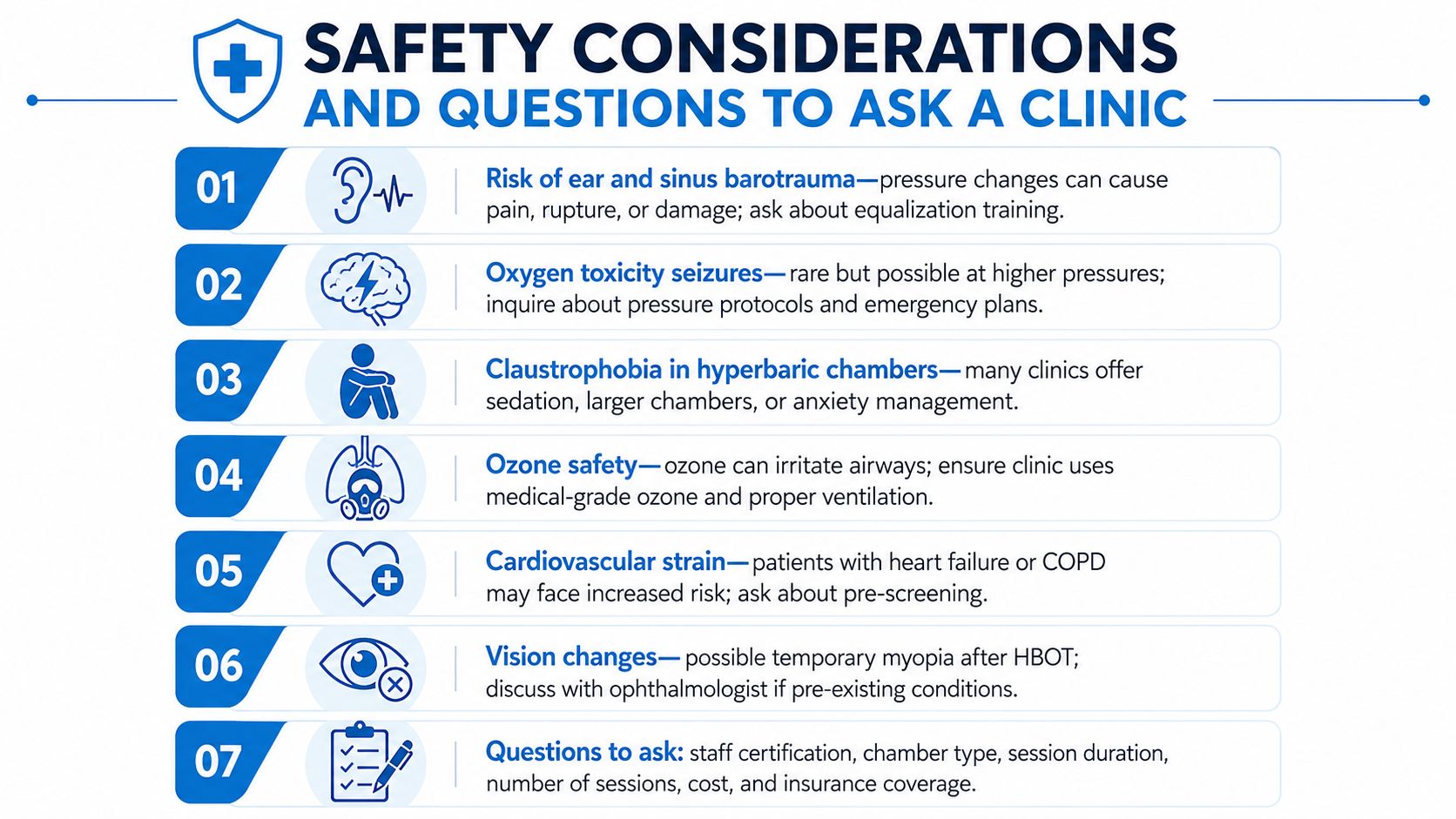
HBOT has a recognized safety profile when appropriately prescribed, but it isn't risk-free. Pressure changes can cause ear or sinus barotrauma, and patients may experience claustrophobia. Oxygen toxicity can produce seizures, particularly at higher pressures, and the Cochrane review identified seizures as a more frequent adverse event during therapy review evidence. Pressurized oxygen environments also require strict fire-safety procedures.
Ozone-based procedures have a different risk profile. Intravenous ozone-related treatment can raise concerns about hemolysis, embolism, and infection if blood handling or sterile technique is inadequate. Patients with pulmonary disease, heart failure, or complex cardiopulmonary conditions may need additional screening. Some chemotherapy agents, including bleomycin and doxorubicin, may change the risk-benefit discussion, so the full medication list must be reviewed before treatment.
Questions worth asking before the first session
- Which indication applies? Is the recommendation for a recognized radiation injury, wound complication, treatment support, or an investigational cancer claim?
- Who supervises care? Is a physician responsible for screening, protocol selection, and emergency response?
- What protocol is planned? Ask about chamber type, pressure, session duration, number of sessions, and monitoring.
- How will the clinic handle complications? Ask about emergency equipment, transfer arrangements, and communication with your oncology team.
- How will benefit be measured? A responsible plan should identify outcomes such as wound closure, pain, swallowing, bladder symptoms, fibrosis, or functional capacity rather than relying on general promises.
- What should you avoid? Ask specifically about chemotherapy timing, implanted devices, lung conditions, seizure history, and prior radiation.
Consent should include documented evidence disclosure, not just reassurance that a procedure is “natural” or “safe.”
How an Integrative Evaluation in Scottsdale Approaches Oxygen Therapy
An integrative consultation should begin with the cancer, not the device. The clinician reviews pathology, staging information, imaging, prior treatments, current medications, and the active oncology plan. That review prevents an adjunctive therapy from displacing treatment that has a clearer role in controlling the disease.
The next question is whether there's a defined problem oxygen-based therapy might address. Examples include radiation fibrosis, delayed wound healing, osteoradionecrosis, soft-tissue injury, or selected treatment-related symptoms. The team also clarifies the patient's goal: symptom support, improved function, possible radiosensitization within a coordinated plan, or recovery after treatment.
A decision-support process
A practical evaluation may include:
- Review of treatment timing: Radiation, chemotherapy, surgery, and immunotherapy schedules can affect safety and coordination.
- Assessment of tissue and organ function: Pulmonary history, cardiovascular status, wound healing, nutrition, and functional symptoms all matter.
- Evidence matching: HBOT may be considered for an appropriate treatment complication. Direct ozone-based anti-tumor claims aren't recommended as established care outside research protocols.
- Outcome planning: The patient should know what will be monitored, when the plan will be reassessed, and what would lead the team to stop or change treatment.
Sunridge Medical is an integrative medical clinic in Scottsdale that evaluates conventional and adjunctive options within individualized cancer plans. Its approach can include coordination around evidence-aligned supportive therapies, while recognizing that investigational oxygen-based methods require clear consent and shouldn't be presented as cures. Patients seeking a broader framework can review the role of integrative oncology in modern cancer care.
A Scottsdale consultation should leave you with a written plan, not a sales pitch. That plan should state whether oxygen therapy fits your goals, how it will complement your primary oncologist's recommendations, what risks apply, and how progress will be monitored.
Sunridge Medical offers individualized integrative oncology consultations in Scottsdale for patients evaluating hyperbaric, ozone-related, and other supportive options alongside conventional cancer care. Contact Sunridge Medical to discuss your diagnosis, current treatment plan, and whether an evidence-informed evaluation is appropriate.