


A new cancer diagnosis can make every decision feel urgent. You may have a pathology report in one hand, a treatment recommendation in the other, and a list of questions that didn't come to mind until after you left the appointment. For patients in Scottsdale, Phoenix, Paradise Valley, and throughout the Valley, a cancer second opinion Scottsdale consultation can provide a structured review before a major treatment decision becomes difficult to change.
A useful second opinion isn't another doctor repeating the first plan. It may involve pathology and imaging re-review, stage confirmation, biomarker assessment, clinical-trial screening, and a careful discussion of conventional treatment alongside appropriate supportive or integrative care. The purpose is not to create confusion or promise an alternative cure. It's to help you understand what you're treating, why a particular plan has been recommended, and what should happen next.
Table of Contents
- When a Cancer Second Opinion Makes the Difference
- Gathering Your Medical Records and Imaging
- Choosing the Right Scottsdale Clinic for Your Case
- Key Questions to Ask During the Second Opinion
- How the Evaluation and Treatment Plan Actually Work
- Insurance, Costs, and Travel Logistics
- Comparing Opinions and Making Your Decision
When a Cancer Second Opinion Makes the Difference
A 58-year-old Phoenix-area patient receives a diagnosis of Stage II colon cancer. Surgery goes ahead, recovery is steady, and the initial follow-up plan seems clear. A year later, a scan shows unexpected progression. The oncologist recommends chemotherapy, but the patient isn't sure whether to start immediately or pause long enough to ask another team to review the pathology, imaging, and treatment history.
That pause can be clinically meaningful when it is organized and time-bounded. A second opinion deserves particular consideration when the pathology is ambiguous, the tumor is rare, the scan shows an unexpected change, or the proposed regimen carries substantial toxicity. The question isn't whether the first oncologist is competent. The question is whether the diagnosis, stage, biomarkers, and treatment sequence have been examined from the right subspecialty perspective.
A major systematic review of oncology second opinions found reported seeking rates ranging from 1% to 88%, while disagreement between first and second opinions ranged from 2% to 51% across studies. More recent survey-based reviews narrowed seeking rates to 6.5% to 42%, reflecting differences by country, cancer type, and study design. These findings support a practical conclusion, second opinions are a recognized part of cancer decision-making, not an unusual rejection of the first physician's care. The oncology systematic review explains why disagreement can occur when diagnosis, staging, or treatment options are complex.
Situations that warrant a closer review
A second opinion may help when:
- The pathology is uncertain: A re-review can clarify tumor subtype, grade, margins, or other features that influence treatment.
- The disease is uncommon: A specialist who regularly evaluates the specific tumor type may identify options that a general oncology practice doesn't routinely use.
- The scan changes the picture: Unexpected progression, recurrence, or a surprising metastasis should prompt a careful comparison of prior and current imaging.
- The treatment burden is high: Surgery, chemotherapy, radiation, immunotherapy, or combined treatment can create significant trade-offs involving side effects, timing, and quality of life.
- You're considering complementary care: An integrative evaluation can distinguish supportive therapies that may fit alongside conventional treatment from approaches that could interfere with it.
The potential value is more than theoretical. One oncology review reported clinically meaningful treatment changes in 42 of 120 cases, with disease-group-specific figures ranging from 23% to 57%, and found negative short-term effects in only 2 patients who sought another opinion. A separate multidisciplinary review changed the diagnosis for 43% of 70 breast cancer patients, including additional cancers that had not been detected originally. The clinical review of management changes describes why reassessment can be most useful before a first treatment or after an unexpected development.
For a patient seeking care in Scottsdale, the practical goal is a coordinated review without abandoning the current oncology team. A focused service such as a pancreatic cancer second opinion illustrates the broader principle. The right review should answer a defined clinical question, produce a written rationale, and preserve continuity while you decide.
Gathering Your Medical Records and Imaging
A meaningful second opinion starts with the original evidence, not a short visit summary. The reviewing clinician needs the tissue, images, laboratory results, operative details, and treatment history used to reach the initial recommendation.
Begin by contacting the hospital, pathology department, radiology department, surgeon, and oncology office involved in your care. Ask how each department releases records and whether a signed authorization is required. Phoenix-area health systems commonly provide reports through patient portals, but original pathology material and imaging files may need separate requests.
Request the complete record set
Ask for:
- Pathology materials: The final pathology report, glass slides when available, paraffin tissue blocks, and unstained slides. The report alone may not be enough for a specialist re-review.
- Imaging files: CT, PET, MRI, mammography, ultrasound, and other relevant studies in DICOM format, preferably on disc or through a secure image-sharing system. A radiology report doesn't replace the images.
- Molecular results: Include KRAS, BRAF, MSI, hormone receptors, PD-L1, and any next-generation sequencing panel relevant to the cancer type.
- Treatment documents: Operative notes, chemotherapy summaries, radiation plans, medication lists, prior treatment responses, and discharge records.
- Laboratory data: Recent blood counts, metabolic panels, organ-function tests, and tumor markers when they have been ordered as part of your care.
- A personal timeline: List the date of diagnosis, procedures, scan dates, treatment cycles, significant side effects, and the reason treatment changed.
Pathology blocks may require a separate release and courier coordination. Imaging discs should carry your identifiers and study dates, and requesting a duplicate can prevent a lost disc from disrupting the appointment. Keep a personal copy of every report and upload confirmation.
Practical rule: A second opinion is only as complete as the materials the second team can actually review.
A review of oncology second-opinion workflows emphasizes the importance of obtaining pathology slides or blocks, DICOM imaging, operative notes, molecular reports, and treatment summaries before changing management. Incomplete transfer can contribute to diagnostic or therapeutic discrepancies ranging from 2% to 51% across studies. The oncology workflow review explains why sending original materials matters.
Records checklist for a cancer second opinion
| Record Type | Format to Request | Typical Turnaround |
|---|---|---|
| Pathology | Report, slides, blocks, and unstained slides | Varies by pathology department |
| Imaging | DICOM files, not only written reports | Often available through radiology release systems |
| Molecular testing | Full laboratory report and assay details | Depends on the testing laboratory |
| Operative and treatment notes | Complete signed reports and summaries | Usually requested from each treating office |
| Laboratory results | Recent results and relevant historical trends | Often available through the patient portal |
| Personal timeline | One-page dated summary | Prepare before the consultation |
If you're arranging a Scottsdale consultation, ask the intake team whether records can be uploaded securely before the visit and whether missing documents will prevent a complete review. That simple conversation can reduce repeat appointments and help the consulting clinician focus on the decision you need to make.
Choosing the Right Scottsdale Clinic for Your Case
The right second-opinion setting depends on the cancer type, treatment question, urgency, and role you want complementary medicine to play. A hospital-affiliated oncology program, a focused second-opinion service, and an integrative clinic can each be appropriate, but they don't offer the same depth or purpose.
A high-volume academic or hospital program may be the strongest match for rare tumors, complex surgery, difficult radiation planning, or clinical-trial access. A dedicated oncology second-opinion service may offer a more focused pathology review and a consultation. An integrative clinic may suit patients who want conventional treatment decisions considered alongside nutrition, lifestyle medicine, IV nutrient support, or other adjunctive therapies.
Compare the clinical capabilities
| Clinic Type | Best For | Integrative Options | Trial Access |
|---|---|---|---|
| Academic or hospital-affiliated oncology program | Rare cancers, complex surgery, advanced subspecialty care | Usually through supportive-care departments | Often broad, but eligibility varies |
| Dedicated oncology second-opinion service | Fast focused review and specialist interpretation | May be limited or separately coordinated | May screen for trials without providing them |
| Integrative medical clinic | Coordinating standard oncology decisions with supportive and complementary care | May include nutrition counseling, IV therapies, lifestyle care, and selected adjunctive approaches | May identify trial questions, but direct access varies |
Ask whether the team reviews the actual pathology and imaging, has access to tumor-board discussion, evaluates molecular findings, and will communicate with your original oncologist. Also confirm whether the clinic can continue monitoring you, coordinate treatment elsewhere, or provide only an opinion document.
Sunridge Medical is an integrative clinic in Scottsdale that evaluates cancer cases through a combined conventional and complementary-care lens. Its model may be relevant to patients asking how nutrition, IV nutrient support, mistletoe protocols, hyperthermia, or lifestyle measures could fit around standard treatment, provided those options are reviewed for safety and aren't presented as replacements for proven cancer therapy. Patients comparing care environments may also find it useful to visit reVIBE Mental Health when emotional support and clinic-selection guidance are part of the broader care plan.
Geography matters, but it shouldn't be the only filter. Patients traveling from Phoenix, Tempe, Mesa, Chandler, Gilbert, or outside Arizona may value telehealth intake, secure records transfer, and help coordinating local treatment. Some families combine an academic oncology opinion for disease-specific confirmation with an integrative consultation for supportive planning. That isn't contradictory. It can be a sensible way to answer different clinical questions.
For a more detailed screening framework, review this clinical checklist for finding an integrative oncologist. Look for transparent explanations of evidence, risks, interactions, costs, and who remains responsible for treatment decisions.
Key Questions to Ask During the Second Opinion
Bring questions in writing. Cancer consultations move quickly, and patients often remember the emotional impact of a recommendation more clearly than the details about stage, biomarkers, treatment sequence, or alternatives.
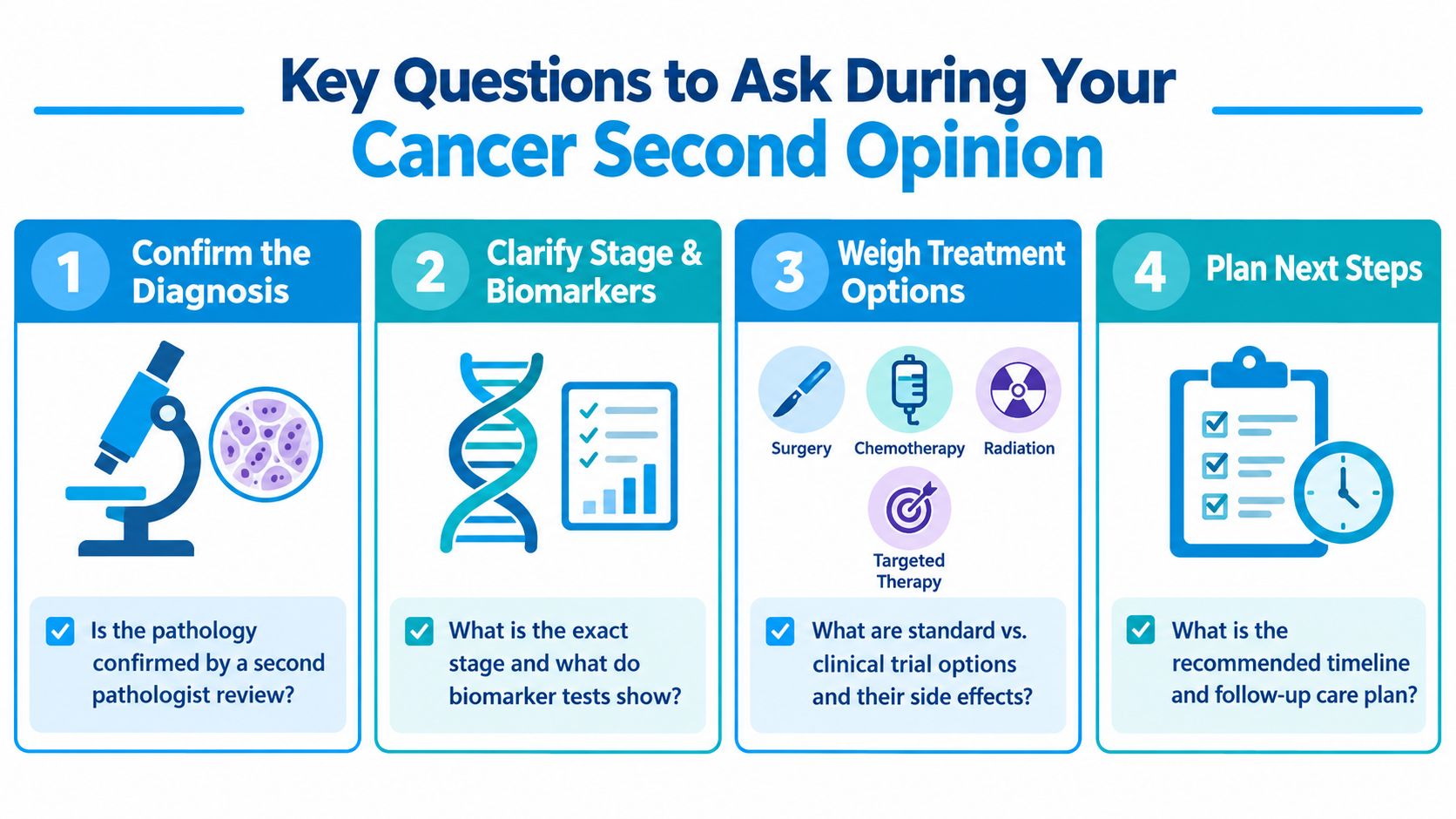
Confirm the diagnosis
Ask:
- Has another pathologist reviewed the original tissue?
- Is the tumor type, grade, and subtype confirmed?
- Do the margins, lymph nodes, or other pathology details change the recommendation?
- Is additional staining or tissue testing needed?
- Did the original team and the second team review the same specimen?
A diagnostic change can alter treatment, not merely rename the disease. In one oncology review, 13 of 42 clinically meaningful treatment changes were driven by clinically meaningful diagnostic changes. The report on diagnostic and treatment changes shows why tissue review deserves direct attention.
Clarify stage and biomarkers
Use plain questions:
- What is the exact stage, and what findings support it?
- Is the current imaging sufficient to establish the stage?
- Which molecular tests apply to this cancer?
- Do results such as KRAS, BRAF, MSI, hormone receptors, PD-L1, or an NGS panel change treatment?
- Should the tissue be tested again because the disease has progressed or recurred?
Compare treatment paths
Ask the physician to place the two plans side by side:
- What is the recommended sequence for surgery, chemotherapy, radiation, targeted therapy, or immunotherapy?
- What benefit is expected, and what are the important short- and long-term risks?
- What would change if treatment were delayed, modified, or declined?
- Is there a reasonable alternative with a different quality-of-life profile?
- Which parts of the original plan would you keep, and which would you change?
Discuss trials and integrative support
Specific questions prevent vague promises:
- Am I eligible for a clinical trial now, or only after another treatment?
- Could molecular testing identify a trial or targeted option?
- Can nutrition counseling support treatment without interfering with it?
- Are IV nutrient support, mistletoe therapy, hyperthermia, or naturopathic oncology appropriate for my situation?
- Which complementary therapies should be avoided during chemotherapy, radiation, surgery, or immunotherapy?
Ask permission before recording, or bring a companion to take notes. The goal is a plan you can explain later, not a consultation you barely remember.
How the Evaluation and Treatment Plan Actually Work
A thorough cancer second opinion follows a sequence. The clinician first defines the question, then verifies the underlying evidence, then compares treatment options. A quick conversation based only on copied reports may be useful for orientation, but it can't answer the same questions as a complete record and tissue review.
The clinical sequence
- Records intake: The team receives reports, images, pathology materials, laboratory results, and treatment summaries. Staff identify missing items before the physician finalizes the review.
- Pathology review: A second pathologist examines tissue samples to confirm the diagnosis, grade, subtype, margins, and relevant features.
- Imaging re-read: A subspecialty radiologist reviews the actual CT, PET, MRI, mammography, or other DICOM studies rather than relying only on the original interpretation.
- Molecular assessment: When indicated, the team considers immunohistochemistry, FISH, next-generation sequencing, or liquid biopsy. Testing should answer a clinical question, not be ordered because it is available.
- Multidisciplinary planning: Specialists discuss how diagnosis, stage, biomarkers, prior treatment, medical history, and patient priorities fit together.
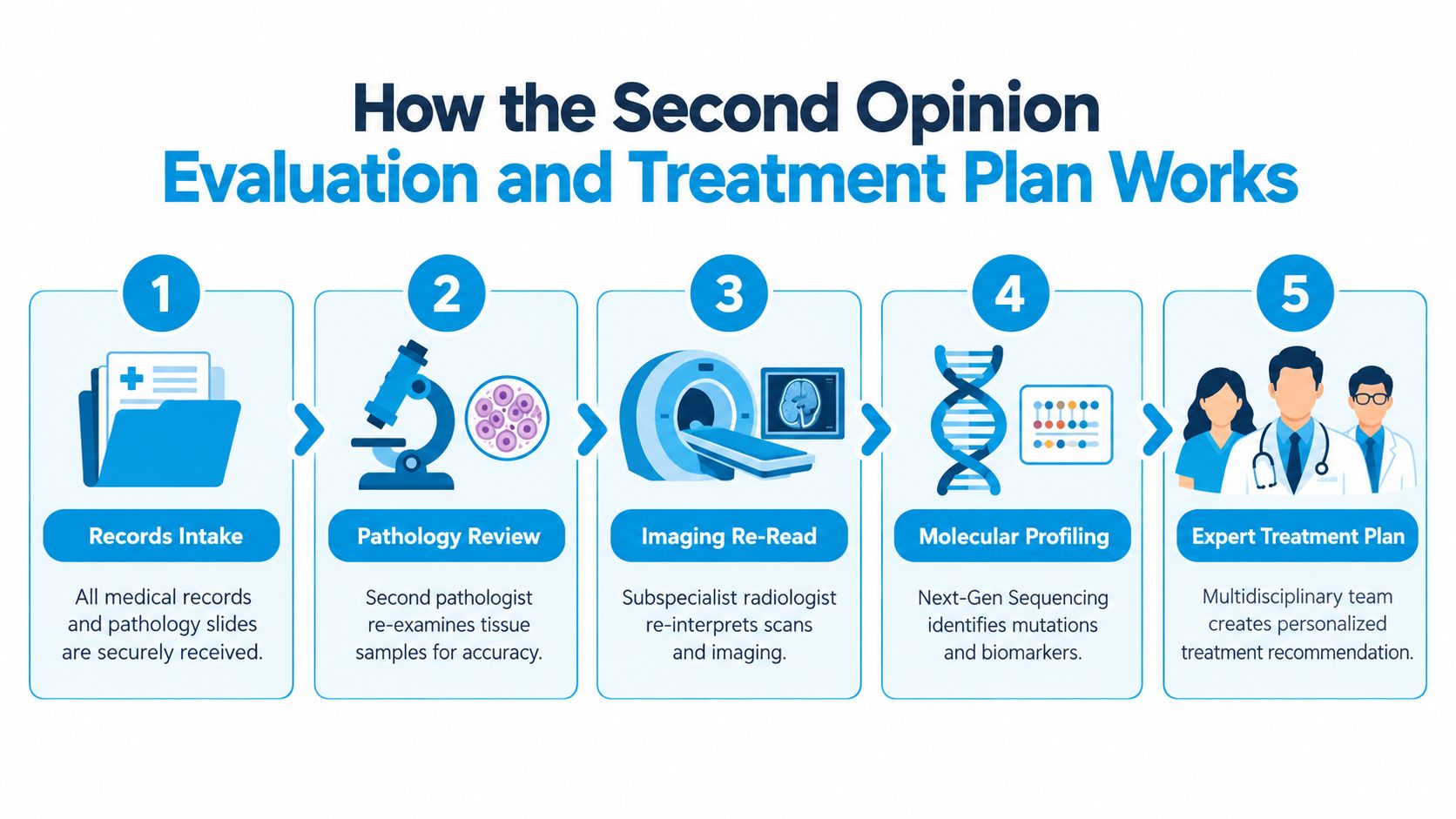
A complete written opinion usually takes 7 to 14 days when the record set is complete. That timeframe can vary with pathology transport, additional testing, specialist availability, and the urgency of the case. If treatment is medically urgent, ask whether the review can be expedited and what care should continue while it is underway.
The written report should state the confirmed diagnosis, stage, biomarker interpretation, recommended treatment sequence, alternatives, risks, unanswered questions, and follow-up needs. It should also clarify whether the opinion is based on a full review or on limited records.
Watch the accompanying explanation for a visual overview of how clinical review and individualized planning can be organized.
Integrative recommendations should be layered around conventional oncology, not used to replace treatment with established benefit. Nutrition, exercise within medical limits, sleep support, symptom management, and carefully selected adjunctive therapies may help address tolerance and function. IV therapies, mistletoe, hyperthermia, oxidative approaches, or other modalities require individualized review because timing, drug interactions, organ function, and evidence quality differ.
A practical framework for combining these elements appears in this clinical approach to building an integrative cancer treatment plan. The treating oncology team should receive the final report so decisions remain coordinated.
Insurance, Costs, and Travel Logistics
Cost questions shouldn't be postponed until after the appointment is scheduled. Ask who bills for the consultation, whether pathology and imaging review are included, and whether molecular testing or follow-up discussions are separate charges.
Insurance often covers specialist second opinions within cancer-care benefits, but authorization rules differ. Some plans require a referral or prior authorization, and an integrative clinic or out-of-network clinician may not be reimbursed in the same way as a participating oncology practice. Confirm coverage with the insurer and the clinic's billing office rather than assuming that a covered cancer diagnosis makes every service covered.
Ask for a written estimate
| Cost Category | Typical Coverage | Patient Action |
|---|---|---|
| Physician consultation | May be covered when medically necessary | Ask about network status and authorization |
| Pathology re-review | May be billed separately | Confirm whether slides, blocks, and interpretation are included |
| Imaging review | May be separate from the physician visit | Ask whether DICOM review has an additional charge |
| Molecular testing | Coverage depends on the test and indication | Ask who orders it and whether prior authorization is needed |
| Integrative services | Often limited when out of network or complementary | Request an itemized estimate before scheduling |
| Follow-up visit | May have its own copay or self-pay charge | Clarify whether report review is included |
Scottsdale is accessible to patients from Phoenix and the wider metropolitan area, while travelers can coordinate transportation from Phoenix Sky Harbor International Airport. Ask the clinic about telehealth intake, lodging, records delivery, and whether an in-person examination is necessary. A remote first conversation may help determine case fit, but it doesn't replace an examination when one is clinically needed.
Patients with substantial travel resources may arrange specialized transportation, including a private jet service in Scottsdale, though the medical team should determine whether travel is appropriate. Don't stop active treatment without discussing timing with the treating oncologist. A second opinion should protect treatment momentum, not create an unplanned gap.
For financial questions about supportive or alternative services, use Sunridge Medical's financial-aid guide for alternative cancer care as a starting point, then request a case-specific estimate. Coverage and eligibility remain individual.
Comparing Opinions and Making Your Decision
Two opinions can sound different even when the underlying recommendations are compatible. One physician may emphasize surgery first, while another discusses systemic treatment before surgery. One may recommend molecular testing immediately, while another believes existing results are sufficient. Before choosing, determine whether the teams reviewed the same pathology, imaging, laboratory results, and treatment history.
Start with a side-by-side comparison. Don't compare only the final treatment names. Compare the assumptions that produced them.
| Comparison Factor | Opinion A | Opinion B |
|---|---|---|
| Confirmed diagnosis | ||
| Stage and disease extent | ||
| Pathology reviewer and materials examined | ||
| Imaging studies reviewed | ||
| Biomarkers and molecular tests | ||
| Recommended treatment sequence | ||
| Urgency and acceptable timing | ||
| Expected benefits and major risks | ||
| Clinical-trial possibilities | ||
| Integrative or supportive measures | ||
| Follow-up and monitoring plan |
Resolve the source of disagreement
Many apparent conflicts come from different information. One team may have reviewed the original slides while the other relied on the pathology report. One may have access to a newer scan or molecular result. One may interpret a biomarker as actionable, while the other considers the evidence insufficient for the specific cancer subtype.
Ask each physician:
- Which findings are certain?
- Which conclusions depend on an assumption?
- What additional test would resolve the disagreement?
- Does the recommendation align with recognized oncology guidelines?
- What evidence supports the proposed sequence?
- How much experience does the team have with this rare subtype?
- What happens if the disease responds poorly?
The strength of evidence matters. A recommendation supported by randomized clinical-trial data carries a different level of certainty than a small retrospective series, an institutional practice pattern, or an emerging therapy. Integrative treatments also require this distinction. Nutrition support and symptom-focused lifestyle care may complement standard treatment, while other modalities may have limited or evolving evidence, require careful timing, or carry interaction risks.
Put quality of life into the decision
The most aggressive plan isn't automatically the most appropriate plan for every patient. Consider the likely effect on work, caregiving, mobility, pain, cognition, appetite, sleep, and independence. Then ask whether a less intensive option changes expected benefit, and whether a supportive strategy can make the recommended treatment more tolerable.
Advanced disease can make this discussion especially important. In a remote oncology second-opinion cohort of 657 patients, 77.2% had Stage III or IV disease, and physicians recommended a minor or major treatment change in 53.8% of reviewed cases. The reported virtual oncology cohort illustrates why remote access can matter for patients traveling to Scottsdale or Phoenix, particularly when advanced disease makes long-distance travel difficult.
Bring the original oncologist into the conversation
Don't treat the second opinion as a contest. Send the written report to the original oncologist and ask for a collaborative discussion. Most doctors understand why patients seek confirmation, and your existing team may be best positioned to explain how a proposed change would affect scheduling, medication access, surgery dates, radiation planning, or monitoring.
A decision is stronger when you can explain:
- Why this diagnosis is established: You know which tissue and imaging were reviewed.
- Why this treatment is recommended: You understand the expected benefit and main risks.
- Why the timing is appropriate: You know what can safely wait and what cannot.
- How biomarkers influence care: You understand whether testing changes the plan.
- How supportive care fits: You know which integrative options are compatible and who will monitor them.
- What happens next: You have a named clinician, a follow-up date, and a plan for new symptoms or results.
Patients preparing for a Scottsdale consultation should request the full record set from the diagnosing facility, including pathology slides, imaging files, laboratory results, and operative notes. Send those materials before the appointment, then bring a written question list and a companion if possible. Ask for a written rationale rather than relying on memory.
A structured integrative second opinion may include pathology re-review, molecular analysis when indicated, and discussion of complementary therapies alongside conventional oncology. It may also clarify what the clinic can provide directly and what must remain with your surgical, medical, or radiation oncology team. That division of responsibility is a safeguard, not a limitation.
Before scheduling, ask the Scottsdale office about case fit, record submission, consultation timing, included services, and estimated costs. If the review identifies a meaningful change, coordinate that change with the original oncologist instead of making medication or treatment decisions independently.
The literature supports treating a second opinion as a decision checkpoint, especially before first treatment, after recurrence, or when the proposed path carries substantial consequences. It doesn't require rejecting the first recommendation. Sometimes the most valuable result is confirmation, with a clearer explanation and a safer supportive plan.
Sunridge Medical offers integrative cancer second-opinion evaluations in Scottsdale that can review the available diagnosis, staging, molecular information, treatment options, and appropriate complementary support. Contact Sunridge Medical to discuss your case, records, timing, and whether a consultation is appropriate.