


What if a polished website or impressive title tells you less about a practitioner’s credibility than their willingness to answer hard questions? Finding a credible alternative medicine practitioner can feel difficult when online claims conflict and training is not always easy to assess. It’s reasonable to want care that respects your experience while also protecting your health.
A trustworthy practitioner should explain their qualifications, relevant clinical experience, the evidence and limits behind proposed treatments, and possible risks. They should welcome questions and support coordination with your existing medical team, not pressure you to stop conventional treatment or promise a cure.
This guide offers a practical way to check credentials and licensing, evaluate treatment claims, and prepare questions before agreeing to care. You’ll also learn how to discuss your circumstances, clarify how a proposed approach fits alongside other treatment, and recognize warning signs. The goal isn’t to dismiss complementary care or accept it uncritically. It’s to make an informed decision grounded in transparency, safety, and shared decision-making.
Key Takeaways
- Start finding a credible alternative medicine practitioner by identifying their specific credentials and checking any required license with the relevant state board.
- Ask about experience with your condition and what evidence supports each proposed treatment, including its limitations and potential risks.
- Compare care plans by qualifications, condition-specific experience, evidence, costs, monitoring, and coordination with your current clinicians.
- Be cautious of guaranteed outcomes, vague credentials, pressure to act quickly, or advice to avoid discussing care with other clinicians.
- Before deciding, review the plan with your medical team and keep copies of test results, medication lists, and follow-up instructions.
Finding a credible alternative medicine practitioner
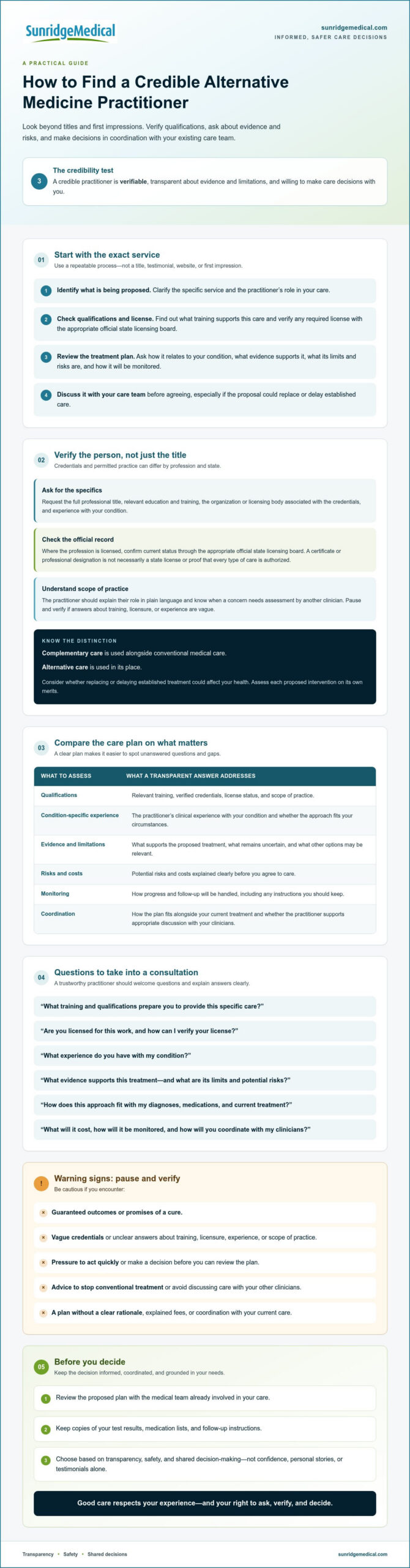
Use a repeatable process rather than judging a practitioner by a title, testimonial, or first impression. First, identify the exact service being proposed. Then verify the practitioner’s qualifications, ask how the treatment applies to your condition, and review its evidence, risks, costs, and monitoring plan. Before agreeing, discuss the proposal with the clinicians already involved in your care.
These steps help you compare options on details you can check. They also make it easier to spot gaps, such as a treatment recommendation that has no clear rationale, fees that have not been explained, or a plan that does not address coordination with your current care.
What Makes an Alternative Medicine Practitioner Credible?
Credibility is more than a reassuring manner or a confident explanation. A credible practitioner can show relevant qualifications, explain their experience with your condition, discuss what is known and uncertain about a proposed treatment, and respect your right to make an informed choice. In short: a credible practitioner is verifiable, transparent about evidence and limitations, and willing to make care decisions with you.
The terms “complementary” and “alternative” describe different approaches to care. Complementary care is used alongside conventional medical care; alternative care is used in its place. The distinction matters, particularly if delaying or replacing established treatment could affect your health. For background on what complementary and alternative medicine includes, consider how varied the practices are and assess each proposed intervention on its own merits.
A practitioner’s confidence, personal story, or patient testimonials may help you understand their perspective, but these alone don’t establish that a treatment is effective or appropriate for your circumstances. Look for clear explanations and a willingness to discuss uncertainty, risks, and other options. Assess both the care and the person offering it, rather than relying on promises or presentation.
How do credentials and scope of practice establish credibility?
Ask what education and training qualify the practitioner to provide the specific care being proposed, whether they hold an active professional license, and what clinical experience they have with your condition. Verify license status through the appropriate official state licensing board. Requirements and permitted titles vary by profession and state, so don’t assume a certificate or professional designation is equivalent to a license or authorizes every type of care.
A qualified practitioner should be able to explain their scope of practice in plain language, including when a concern requires assessment by another clinician. If answers about training, licensure, or experience are vague, pause and verify the details before proceeding.
What does patient-centered integrative care look like?
Patient-centered care starts with your individual health picture, not a standardized protocol. A practitioner should ask about your diagnoses, medications, treatment history, and goals before recommending an approach. They should explain how the proposal relates to your needs and invite questions about its rationale, evidence, and limits.
Coordination matters. A practitioner who supports informed care will welcome appropriate discussion with your existing clinicians and won’t pressure you to conceal treatment or stop prescribed care. Sharing information can help you and your medical team consider potential conflicts and make decisions with a fuller understanding of your options.
How to Verify Qualifications, Experience, and Treatment Claims
Use a consistent check rather than relying on a title, website, or persuasive consultation. The steps below can help you separate verifiable information from claims that need closer review.
- Identify the credentials. Ask for the practitioner’s full professional title, relevant education and training, and the organization or licensing body associated with those credentials. Clarify what role they’ll have in your care and whether that role fits the service being proposed.
- Confirm licensure. If the profession is licensed where you live, check the practitioner’s current status through the appropriate official state licensing board. Titles, licensing requirements, and authorized scopes of practice can vary by profession and state. A voluntary certificate is not necessarily the same as a state license.
- Review relevant experience. Ask about clinical experience with your specific condition and treatment goals. General experience may not establish familiarity with the health concern or intervention you’re considering. Ask what the practitioner typically monitors and when they would recommend involving another clinician.
- Assess the treatment claims. Ask what evidence supports the proposed intervention for your condition and the outcome being discussed. Request published research you can review, and ask about its limitations.
Credentials establish training, not proof that every treatment works. A practitioner may have relevant qualifications while a particular intervention still has limited evidence for a specific condition or outcome. Likewise, a biological explanation or early-stage research can offer a rationale to investigate, but it doesn’t by itself demonstrate a clinical benefit for patients.
Which qualifications and experience should patients check?
Ask direct questions: “What training prepared you to provide this care?” and “How does your experience relate to my condition?” If a title is unfamiliar, verify what it means and whether it authorizes the services being offered. The answers should be specific enough for you to check independently, rather than relying only on the practitioner’s description.
How can patients evaluate research and treatment claims?
Check whether the cited research concerns the same intervention, condition, and intended outcome. Ask whether the evidence comes from preliminary research or studies in people, and whether it supports the specific claim being made. Guaranteed cures, secret methods that can’t be explained, or claims that dismiss all conventional care are serious warning signs.
Before adding a therapy, supplement, or other intervention, discuss possible interactions with prescribed medicines and ongoing conventional treatment with a qualified clinician or pharmacist. Bring the proposed plan and product details, if available, so they can consider your circumstances. If you’re considering individualized integrative care planning, you can review Sunridge Medical’s approach to care and confirm current services directly with the center.
How to Compare Practitioners, Evidence, and Care Plans
Once you’ve checked a practitioner’s background and considered the claims, compare the proposed care with your priorities and existing clinician recommendations. A structured comparison makes differences in rationale, safety, and communication easier to see. More tests or therapies don’t automatically make a plan more effective or appropriate. Integrative care is an approach to evaluate, not an assurance of better outcomes.
| What to compare | Questions to ask |
|---|---|
| Qualifications | Are the training and credentials relevant to the proposed care, and can you verify them? |
| Condition-specific experience | Has the practitioner worked with people whose condition and goals are similar to yours? |
| Evidence and rationale | What supports each intervention for your situation, and what remains uncertain? |
| Risks and monitoring | What potential risks or medicine interactions should be reviewed, and how will progress be assessed? |
| Costs and services | Can you get written information about fees and what each consultation or treatment service includes? |
| Coordination | Will the practitioner communicate with your existing clinicians, with your permission? |
What should a practitioner comparison checklist include?
Compare more than the initial recommendation. Ask what the plan is intended to address, how and when progress will be reviewed, and what would prompt the practitioner to revise or stop an intervention. Clear answers help you judge whether the plan aligns with your goals and whether its next steps are understandable. Request written details about services and fees before committing, so you can review what’s included and clarify anything uncertain.
How should conventional and complementary care fit together?
Ask whether the practitioner is willing to coordinate with the clinicians already managing your condition. Discuss timing, possible risks, and potential interactions between proposed therapies and prescribed medicines with qualified members of your care team. Share relevant recommendations rather than assuming separate providers have the same information.
If you’re comparing care approaches for cancer, this integrative cancer treatment guide offers condition-specific context to consider alongside advice from your clinicians. Ultimately, choose a plan you can understand, question, and assess against your needs, not simply the one with the most components.
Questions and Red Flags to Watch for at a Consultation
A consultation should leave you better informed, not rushed into a decision. Prepare questions in advance, take notes, and consider bringing someone you trust to help listen and remember details. If you need time to review the plan or discuss it with your clinicians, ask for it. A practitioner who supports informed decision-making should let you consider your options without pressure.
What should I ask before starting a treatment plan?
Use questions like these to understand the proposed care and how it would fit your circumstances:
- What is the treatment intended to do, and how does it relate to my diagnosis and goals?
- What evidence supports that intended role, and what remains uncertain?
- What risks or side effects are known? Could it interact with my prescribed medicines or ongoing treatment?
- What alternatives could I consider, including continuing my current care without this intervention?
- How will you monitor my response, and what would lead you to change or stop the plan?
- Will you coordinate with my existing clinicians, with my permission, and when should I contact the care team about a concern?
- What are the expected fees for the services being proposed, and are follow-up visits included?
Ask for written details about the plan and its costs before agreeing. This gives you something concrete to review later and helps prevent misunderstandings about what is included.
Which warning signs deserve extra scrutiny?
Pause and ask for clarification if a practitioner guarantees a cure or outcome, uses credentials you can’t verify, or cannot explain the basis for a treatment recommendation. Be especially cautious if you’re urged to stop prescribed treatment without first consulting the clinician responsible for it, or discouraged from discussing the proposed care with other members of your medical team.
Promises, pressure, or resistance to reasonable questions are reasons to pause and verify, not automatic proof of misconduct. One unclear answer may have an explanation; repeated evasiveness about qualifications, risks, fees, or evidence deserves closer scrutiny. If important points remain unresolved, don’t feel obliged to commit during the consultation.
Keep your notes, the written plan, and any follow-up instructions together so you can review them with your clinicians. Credibility depends not only on what is recommended, but also on how openly the practitioner responds to your questions.
If you’re considering individualized consultation and treatment planning, review Sunridge Medical’s care options and confirm current services directly with the center.
Choosing a Practitioner and Taking a Safe Next Step
A thoughtful decision doesn’t need to happen in one appointment. Use a patient-led sequence: verify the practitioner’s qualifications, compare the proposed plan with your needs and other options, discuss it with the clinicians already involved in your care, then decide without pressure. This keeps your priorities central while making room for careful review.
How can patients prepare for an initial consultation?
Bring the information a practitioner needs to understand your health history and coordinate recommendations. Useful records include:
- Diagnoses, relevant test results, and treatment history
- A current list of medicines and supplements, along with known allergies
- Your main priorities, questions, concerns, and the outcomes that matter most to you
Ask how recommendations will be coordinated with your existing clinicians and what information the practitioner needs to communicate with them, with your permission. Keep copies of the written treatment plan, test results, medication list, and follow-up instructions. These records make it easier to share accurate information across your care team and revisit decisions later.
What does a considered next step look like?
Before consenting, take time to review written recommendations and ask for clarification about anything you don’t understand. You can also discuss the plan with your treating clinicians, particularly if it could affect prescribed medicines or ongoing treatment. A sound decision is one you understand and can make freely, not one made because you feel rushed or promised a particular result.
For another perspective on broader care approaches, explore integrative care for chronic illness. Sunridge Medical is a medical center that offers individualized care for cancer and complex chronic conditions, combining conventional therapies with research-based alternative approaches. Its care planning can be one option to assess as you consider what fits your circumstances. Ask questions about the approach, its evidence and limitations, and how it may be discussed with your current medical team.
Finding a credible alternative medicine practitioner is a process of careful evaluation, not a search for certainty or a guaranteed outcome. If you’d like information about Sunridge Medical’s consultation process, contact Sunridge Medical to discuss whether a consultation may fit your needs. Verify current consultation details directly with the center, and take the time you need to decide on any next step.
Make Your Next Care Decision With Confidence
Finding a credible alternative medicine practitioner starts with a few steady steps: verify qualifications and relevant experience, ask what evidence supports the proposed care, and compare its risks and costs with your priorities. Discuss possible interactions and treatment changes with your existing clinicians before deciding. A practitioner who welcomes questions and supports coordination can help you make a more informed choice, without pressure or promises of a guaranteed outcome.
Sunridge Medical is a medical center that focuses on cancer and complex chronic conditions, combining conventional therapies with research-based alternative treatments to develop individualized care plans. The center is led by Medical Director Dr. Steven S. Isaacman. An individualized consultation may help you understand the center’s approach and consider whether it fits your circumstances.
Learn about Sunridge Medical’s individualized consultation approach, and ask how a consultation could support your care decisions. Take the time you need, keep your clinicians informed, and move forward with your needs at the center.
Frequently Asked Questions
How can I tell if an alternative medicine practitioner is credible?
Look for verifiable qualifications, relevant experience with your condition, transparent explanations, and respect for your decisions. Check any required license with the appropriate state licensing board, and ask what evidence supports the proposed care, including its risks and limitations. A credible practitioner welcomes questions and supports coordination with your existing clinicians. Evaluate both their background and the specific treatment being recommended.
What credentials should an alternative medicine practitioner have?
The appropriate credentials depend on the practitioner’s profession, the care offered, and the rules where you live. Ask for the full professional title, relevant education, licensing body, and experience related to your health concern. If the profession is licensed in your state, verify active status through the official licensing board. A voluntary certificate or membership may indicate additional training, but it isn’t automatically equivalent to state licensure or authority to provide every type of care.
Can an alternative medicine practitioner work with my regular doctor?
Yes, a practitioner may be able to coordinate with your doctor or other clinicians, with your permission. Ask whether they’re willing to share relevant treatment details and communicate about potential interactions or changes to your care plan. You can help by providing an accurate medication and supplement list and sharing recommendations between providers. Coordination supports informed decisions, but don’t assume separate clinicians already have the same information about your care.
What questions should I ask before choosing an alternative medicine practitioner?
Ask what the proposed treatment is intended to do, what evidence supports that role, and what is still uncertain. Clarify possible risks, interactions with medicines, alternatives, and how progress will be monitored. Ask about the practitioner’s relevant experience and how they’ll coordinate with your existing clinicians. Before agreeing, request written details of the proposed services and fees, including whether follow-up is included, so you can review the plan at your own pace.
What are red flags when choosing an alternative medicine practitioner?
Take extra care if a practitioner guarantees a cure or specific outcome, pressures you to decide immediately, or discourages you from consulting your existing clinicians. Vague answers about credentials, treatment rationale, risks, or fees also deserve follow-up. One concern alone doesn’t prove misconduct, but repeated evasiveness or pressure is a reason to pause, verify information independently, and seek another opinion before committing to care.
Is alternative medicine the same as integrative medicine?
No. “Alternative” generally refers to care used instead of conventional medical care, while “complementary” refers to care used alongside it. “Integrative” commonly describes an approach that considers conventional and complementary methods together, with attention to the individual’s health needs. The label alone doesn’t establish that a treatment is effective or suitable. Ask how each proposed intervention fits with your current care and what evidence and limitations the practitioner recognizes.
How do I compare treatment claims from different practitioners?
Compare claims for the same treatment, condition, and intended outcome. Ask each practitioner for the evidence behind the recommendation and whether it comes from early research or studies demonstrating clinical benefit. Consider risks, monitoring, costs, and how the plan fits with your existing clinician’s recommendations. Be cautious if one practitioner promises results while another explains uncertainty; confidence or testimonials alone can’t establish that a treatment works for your situation.