


What if a therapy’s precise-sounding mechanism tells you less about its effectiveness than the evidence behind it? That’s an important question when considering supportive oligonucleotide therapy (SOT), which is promoted as an individualized approach for targeting cancer-related cells or other biological targets. It’s understandable to want promising, personalized options, especially when cancer care feels complex. But a plausible mechanism or encouraging early report isn’t the same as reliable proof that a treatment works or is safe.
This guide explains what SOT refers to, what its proponents claim, and how to assess those claims alongside preliminary research. It also compares SOT with established oligonucleotide medicines, outlines safety and interaction questions, and suggests what to discuss with your oncology clinician. The goal is to help you consider any proposed therapy in the context of your diagnosis, current treatment, and overall health, so decisions are informed and coordinated.
Key Takeaways
- Learn what the term supportive oligonucleotide therapy refers to and how to separate proposed mechanisms from demonstrated clinical effects.
- Assess what preliminary findings can and can’t tell you about SOT’s potential role in cancer care.
- Compare SOT with established oligonucleotide medicines by looking at the evidence and intended use behind each.
- Use practical questions to discuss possible safety concerns, interactions, and your current treatment plan with your oncology clinician.
- Consider how an individualized evaluation can place therapy questions within the context of your diagnosis and overall care.
What Is Supportive Oligonucleotide Therapy, and What Does the Name Mean?
Patients may encounter SOT on a clinic webpage, during a treatment discussion, or while researching options after a cancer diagnosis. The terminology can sound precise, but the name alone doesn’t tell you exactly what is given or what evidence supports it. Usage can vary, so ask what a provider means by “supportive oligonucleotide therapy” and distinguish the label from the specific product and protocol.
Quotable definition: Supportive oligonucleotide therapy is a name used for a proposed treatment approach involving designed nucleic-acid strands; the term itself does not establish that the approach is effective, safe, standardized, or approved.
What are oligonucleotides in medicine?
Oligonucleotides are short, designed strands of nucleic-acid material, the molecular language cells use to store or act on genetic instructions. Some are developed to bind a specific RNA sequence and influence how its message is used. Antisense oligonucleotides and small interfering RNA (siRNA) are distinct categories studied and used in medicine. Their effects depend on the sequence, target, delivery method, and intended use.
Evidence for one oligonucleotide medicine doesn’t automatically establish evidence for another. Products can target different molecules, act through different biological pathways, and be studied for different conditions. Belonging to a familiar scientific category doesn’t prove that a particular therapy has been tested or shown to help with cancer.
What does the word supportive imply?
“Supportive” is a description, not a clinical result or regulatory designation. In cancer care, supportive care generally refers to measures intended to ease symptoms, manage treatment effects, and support quality of life. A therapy described as supportive may instead be promoted as acting on a disease-related target. Those are different claims, and the wording alone doesn’t show that either benefit has been demonstrated.
Similarly, “personalized” or “targeted” may describe how a therapy is selected or designed, but those terms don’t establish clinical effectiveness. Ask for the exact product name and composition, the target it is intended to affect, and the human research supporting that use.
SOT is not a single, standardized drug class or an established cancer-care protocol. Clinics may use the term for approaches that differ in testing, design, preparation, or administration. The proposed approach is sometimes described as using a patient’s sample to identify a target and create an oligonucleotide intended to affect its genetic activity. That explanation is a proposed rationale, not proof that the treatment reaches the target in the body or improves outcomes.
As of October 2026, SOT itself is not FDA-approved. That status differs from that of established oligonucleotide medicines that have undergone clinical evaluation for specific uses. When a treatment is discussed, focus on the exact product and evidence for the proposed indication, not just its broad scientific category or reassuring name.
How Is SOT Said to Work, and What Does the Evidence Show?
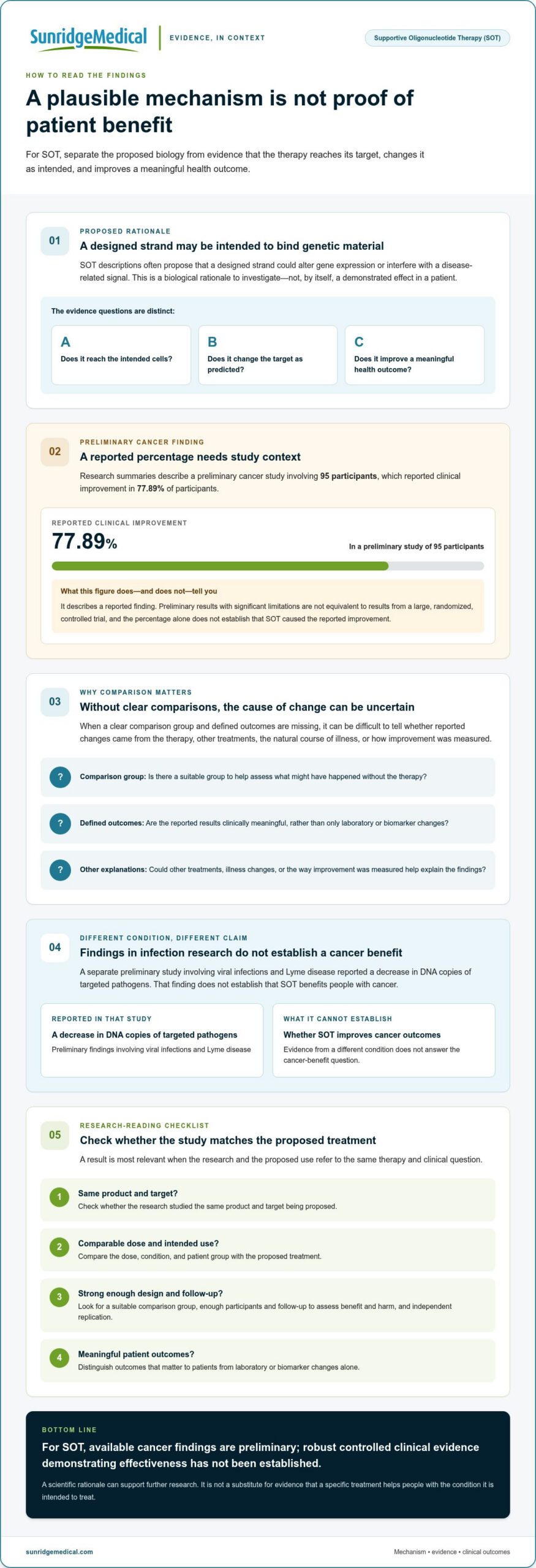
Descriptions of supportive oligonucleotide therapy often propose that a designed strand can bind to genetic material associated with a target, then alter gene expression or interfere with a disease-related signal. That is a biological rationale to investigate, not a demonstrated effect in a patient. Whether a molecule reaches the intended cells, changes the target as predicted, and improves a meaningful health outcome are separate questions that require evidence at each step.
Evidence summary: A plausible molecular mechanism can justify research, but it doesn’t establish patient benefit. For SOT, the available cancer findings are preliminary; robust controlled clinical evidence demonstrating effectiveness has not been established.
How to assess research behind SOT claims
Start by checking whether the research studied the same product and target being proposed to you, at a comparable dose, for the same condition and patient group. Results from a laboratory experiment, a different oligonucleotide, or a study of an infection cannot by themselves show that SOT benefits people with cancer.
Research summaries describe a preliminary cancer study involving 95 participants, which reported clinical improvement in 77.89% of participants. That figure needs context: preliminary findings with significant limitations aren’t equivalent to results from a large, randomized, controlled trial. Without a clear comparison group and defined outcomes, it can be difficult to determine whether reported changes came from the therapy, other treatments, the natural course of illness, or how improvement was measured. A separate preliminary study involving viral infections and Lyme disease reported a decrease in DNA copies of targeted pathogens, but that finding doesn’t establish a cancer benefit.
Case reports and uncontrolled observations can raise useful questions, but they can’t reliably separate a treatment effect from other explanations. When reviewing a study, look for:
- A clearly described product, target, dose, and patient population.
- A suitable comparison group and clinically meaningful outcomes, not only laboratory or biomarker changes.
- Enough participants and follow-up to assess benefit and harm, plus independent replication.
What regulatory status and evidence can, and cannot, tell you
As of October 2026, SOT itself is not approved by the U.S. Food and Drug Administration (FDA). This applies to SOT, not to every oligonucleotide medicine: regulatory status is specific to a product and its intended use. Check current FDA records for the exact product being discussed. A listing on ClinicalTrials.gov means a study has been registered; it doesn’t certify that the treatment works, is safe, or is FDA-approved. Review trial records for study status, design, and results rather than treating them as endorsements.
For a careful next step, bring the study or product information into an individualized cancer-care discussion. Sunridge Medical considers conventional therapies alongside research-based alternative treatments within each patient’s clinical context. Individualized cancer-care planning can help frame questions around diagnosis and current treatment, without treating a proposed mechanism as proof or a reason to change established care.
SOT Compared With Established Oligonucleotide Medicines and Cancer Care
A shared molecular category doesn’t make two therapies interchangeable. Evidence and regulatory status apply to a specific product used for a specific purpose. The comparison below is educational, not a treatment recommendation; it can’t determine what’s appropriate for an individual diagnosis.
| Approach | Intended use | Evidence and regulatory status | Place in oncology care |
|---|---|---|---|
| Proposed SOT | Marketed as a personalized approach intended to act on a selected biological target. | Evidence for cancer use is preliminary. SOT itself is not FDA-approved. | Any proposed adjunctive role requires discussion with the oncology team; it shouldn’t replace established treatment. |
| Established oligonucleotide medicines | Specific uses defined for each product. | Product-specific clinical evidence and FDA-approved indications. For example, FDA prescribing information indicates nusinersen (Spinraza) for spinal muscular atrophy and patisiran (Onpattro) for polyneuropathy of hereditary transthyretin-mediated amyloidosis in adults. | These examples treat their approved conditions, not cancer generally. Their evidence doesn’t transfer to SOT. |
| Standard oncology treatment | Treatment of cancer, selected according to factors such as cancer type and stage. | Evidence and regulatory status vary by treatment and indication; care may include surgery, radiation, or drug therapy. | Forms the oncology plan. Changes or additions should be coordinated with the treating team. |
SOT and approved oligonucleotide medicines are not interchangeable terms
Nusinersen and patisiran illustrate why specificity matters. Their FDA-approved uses are stated in product labeling, and the medicines were evaluated for those particular conditions. They aren’t evidence that another product, sequence, dose, or target will have the same effects. A claim that SOT uses a similar molecular principle isn’t a substitute for clinical studies of the SOT product itself in people with cancer.
Check the exact product name and indication against current FDA information. “Oligonucleotide” describes a broad scientific category, not one treatment with a shared approval or evidence base. Design, target, delivery, and intended use can differ even among products in this category.
How adjunctive claims differ from cancer treatment evidence
Supportive care aims to help manage symptoms, treatment effects, or quality of life. A claim that a therapy treats, controls, or cures cancer is different and needs evidence measuring outcomes such as tumor response or survival. Calling SOT “adjunctive” doesn’t, by itself, show that it improves either outcome or makes standard treatment more effective.
If you’re considering supportive oligonucleotide therapy alongside cancer treatment, share the exact product information and any research cited with your oncology clinician. Coordination allows the discussion to account for your diagnosis, current therapies, and overall health. This comparison provides context, not an individualized treatment plan, and shouldn’t be used as a reason to stop or delay established care.
Safety, Interactions, and Questions to Discuss Before Considering SOT
Safety can’t be assessed from a therapy’s name alone. It depends on the specific product and protocol, the patient’s health, and the cancer treatments or other therapies being used. Comprehensive safety information for SOT is limited, so don’t assume a reported experience or safety claim applies to every product or person. A discussion with your oncology clinician can help identify what is known, what remains uncertain, and how a proposed approach fits your care.
Questions that clarify the proposed treatment
Bring written information about the proposed therapy to your appointment, including product details and any research provided by the clinic or practitioner. These questions can make the discussion more specific and useful:
- What exactly is being proposed? Ask for the product or protocol name, its ingredients or design, intended target, dose, route, and source.
- What evidence supports this use? Ask whether the evidence concerns the same product, target, cancer type, and patient group, and whether it comes from controlled human research or less conclusive reports.
- What outcomes will be monitored? Clarify how response, side effects, and changes in your condition will be assessed, and when the plan would be reviewed.
- How does this fit with my oncology plan? Discuss proposed timing alongside surgery, radiation, drug treatment, or follow-up, and identify who will coordinate decisions with your oncologist.
- What uncertainties or risks apply to me? Ask what is known about adverse effects and interactions for this specific product, and what remains unstudied.
Why monitoring and care coordination matter
Your oncology team needs a complete picture to consider a proposed therapy in context. Share an up-to-date list of prescription medicines, over-the-counter drugs, vitamins, supplements, and other treatments. Include allergies, prior reactions, relevant medical history, and upcoming procedures. Don’t stop, change, or postpone prescribed cancer care based on a therapy proposal without guidance from the clinician responsible for that care.
Reliable product-specific evidence may not predict how SOT interacts with a particular medicine or cancer treatment. That uncertainty is a reason to review the details together, not to assume an interaction will occur or that none is possible. Agree in advance on whom to contact if you notice a new or worsening symptom after starting any therapy, and report concerns promptly. If symptoms feel urgent, seek immediate medical attention.
These steps can support an informed conversation without presuming that supportive oligonucleotide therapy is appropriate or proven. Sunridge Medical’s individualized cancer-care approach considers diagnosis, current treatment, and overall clinical context alongside research-based alternatives. Discuss an individualized cancer-care evaluation to organize questions and consider care coordination.
How Individualized Integrative Cancer Care Can Guide the Next Conversation
A therapy question is best considered within the full picture of a person’s cancer care, not in isolation. The relevance of supportive oligonucleotide therapy or any proposed alternative depends on the diagnosis, pathology, current treatment, health history, and patient’s goals. An individualized medical evaluation can help clarify what is known, what remains uncertain, and how a proposed approach may fit alongside the existing oncology plan.
Sunridge Medical develops individualized care plans that combine conventional therapies with research-based alternative treatments. This means considering the full clinical picture rather than judging an approach by a mechanism claim or broad treatment label. It doesn’t mean assuming every proposed therapy is appropriate. The discussion should be transparent about evidence and uncertainty, and coordinated with the clinicians overseeing cancer treatment.
Bring the right information to an integrative-care discussion
Preparation can make the conversation more specific and productive. Bring diagnosis details, pathology reports, relevant imaging or test summaries, and your current oncology treatment plan. Include a complete list of prescription medicines, over-the-counter products, and supplements, along with relevant medical history and known allergies.
If you’ve encountered SOT through a clinic page, treatment discussion, or research summary, bring the exact materials rather than relying on memory. The specific product, target, and claims matter. Ask which findings apply to your situation and which remain uncertain. For broader context on how conventional and integrative approaches may be considered together, explore this integrative cancer treatment guide.
Build a coordinated plan around informed decisions
A coordinated discussion can help put a proposed therapy alongside the care already underway. Clinicians can consider how it relates to the diagnosis and current treatment, what the patient hopes to achieve, and what monitoring may be needed. Goals may differ, from understanding treatment options to prioritizing symptom support or quality of life. Naming those priorities helps keep decisions personal and realistic.
Clear communication matters after a decision, too. Make sure the clinicians involved know about therapies being considered or started, and establish how new symptoms or changes will be reported and reviewed. Uncertainty should be discussed openly, not hidden behind confident-sounding terminology. A plan can be revisited as the clinical picture or patient priorities change. This integrative cancer care by stage guide offers additional context for thinking about care in relation to cancer stage.
A measured next step is to discuss an individualized care plan that considers your diagnosis, current care, health history, and goals. Consider any proposed alternative in coordination with your oncology team, not as a reason to stop or postpone prescribed cancer treatment.
Make Your Next Cancer-Care Conversation More Informed
Considering supportive oligonucleotide therapy doesn’t require you to decide alone or immediately. Turn uncertainty into a focused conversation: bring the information you’ve found, name the outcomes that matter to you, and make space to discuss what remains unknown. You deserve an explanation that respects both your questions and the seriousness of your care.
Sunridge Medical works with patients facing cancer and complex conditions through individualized care planning. Its approach brings conventional therapies and research-based alternatives into the discussion, with attention to each patient’s circumstances. This creates space for thoughtful questions while keeping decisions grounded in the overall clinical context.
If you’re ready to consider your options with care and clarity, discuss an individualized cancer-care plan. A measured conversation can help you identify questions, understand uncertainties, and take your next step with greater confidence.
Frequently Asked Questions
Is supportive oligonucleotide therapy FDA-approved?
FDA approval is specific to a product and indication, so the SOT label alone can’t establish regulatory status. The SOT approach discussed here isn’t FDA-approved as a cancer treatment, but the label may be used inconsistently and may not identify one standardized product. Search current FDA information using the exact product name and intended use. A trial listing or a clinic’s use of a therapy isn’t the same as approval; discuss what you find with your oncology team.
Can supportive oligonucleotide therapy treat or cure cancer?
Reliable clinical evidence would be needed to show that a specific SOT product treats cancer in a particular clinical context. A proposed molecular target, patient testimonial, or early research finding doesn’t prove tumor response, longer survival, or cure. If a claim relies on a laboratory result, ask whether the same benefit has been demonstrated in people with your cancer type. Don’t replace or delay established care; discuss any proposed add-on with your treating oncologist.
How is supportive oligonucleotide therapy different from siRNA or antisense medicines?
siRNA and antisense describe distinct approaches within the broader oligonucleotide field, while SOT is a label used for a proposed protocol and may not identify one uniform product. Medicines approved for other conditions were evaluated for their own product, dose, and indication. Their evidence doesn’t validate SOT. To compare claims, request the exact product name, target, intended use, and human clinical studies relevant to that use.
What should I ask a clinician before considering SOT?
Ask for the exact product or protocol, the evidence for your diagnosis, known risks, and the plan for monitoring outcomes and adverse effects. Clarify who will communicate with your oncology team and how your progress will be assessed. Bring a current medication and supplement list, including doses if available, and note allergies or prior reactions. Keep the conversation collaborative, and make treatment changes only with guidance from your oncology team.
Can SOT be used alongside chemotherapy or immunotherapy?
Compatibility can’t be assumed; it depends on the specific product, your health, and your treatment plan. Interaction evidence may be limited or specific to a particular product, so a general claim of compatibility isn’t enough to guide your decision. Before starting anything new, share the product details and a complete list of medicines and supplements with your oncology team. Don’t pause, change, or reschedule prescribed chemotherapy or immunotherapy without clinician guidance.
Does registering a study prove that supportive oligonucleotide therapy works?
No. Registration makes study information publicly searchable, but it doesn’t establish that a therapy is effective or safe. On ClinicalTrials.gov, check whether results are posted, how participants were selected, what the study compared, and which outcomes it measured. A small or uncontrolled study may offer limited insight, even if its findings sound promising. Ask a qualified clinician to help interpret the record and whether its results apply to your situation.