


What if persistent symptoms after Lyme treatment call for a broader medical evaluation, rather than an automatic assumption that infection is still active? Ongoing fatigue, pain, or cognitive changes can be disruptive and real, but symptoms alone don’t confirm their cause. The CDC uses the term Post-Treatment Lyme Disease Syndrome for symptoms that persist after treatment, while recognizing that their underlying cause may be uncertain.
If you’re seeking specialized care for persistent Lyme symptoms, it’s understandable to want a clinician to consider your full history, not just one test or symptom. A thoughtful evaluation can help distinguish persistent symptoms from a confirmed ongoing infection and consider other possible explanations. This article explains what physician-led, individualized care may involve, which details can inform a medical assessment, and how to discuss care options and goals with your physician. At Sunridge Medical, recommendations depend on your diagnosis, medical history, laboratory findings, medications, organ function, symptoms, tolerance, and personal goals. Integrative care may be considered alongside appropriate conventional medical care, with decisions guided by clinical findings and your individual needs.
Key Takeaways
- Learn how established Lyme treatment, symptom-focused follow-up, and integrative supportive care can address different needs without being automatic alternatives.
- See why a careful assessment considers symptom timing, prior treatment, day-to-day impact, and test results in context.
- Understand what specialized care for persistent lyme may involve, and how a physician-led plan can be tailored to your circumstances.
- Prepare for a medical discussion by organizing your records, medication details, diagnoses, and a concise symptom timeline.
- Explore Sunridge Medical’s outpatient, hands-on approach, where recommendations can evolve with clinical findings, response, tolerance, and personal priorities.
Persistent Lyme Symptoms: What Specialized Care Can, and Cannot, Address
Symptoms that continue after Lyme disease treatment can affect work, relationships, sleep, and everyday independence. Uncertainty about their cause can add to the burden. A careful medical evaluation should take these concerns seriously without presuming a single explanation or treating one symptom as proof of infection.
Specialized care for persistent lyme means a physician-led, individualized assessment of a person’s situation and care needs. It can help organize clinical information, identify questions that need further evaluation, and support a discussion of options. It cannot promise a particular diagnosis or outcome. This guide offers context for that conversation, but doesn’t replace evaluation by a clinician familiar with your health history.
What do clinicians mean by persistent symptoms after Lyme disease?
Some people continue to experience or develop symptoms after Lyme disease treatment. Fatigue, pain, and difficulty concentrating are examples, but they can have multiple possible causes. The CDC uses the term Post-Treatment Lyme Disease Syndrome (PTLDS) for symptoms lasting more than six months after standard antibiotic treatment, while the cause of those symptoms remains uncertain. The term describes a pattern; it doesn’t establish what is happening in an individual case. A brief overview of Post-treatment Lyme disease syndrome provides background, but clinical interpretation belongs in a medical discussion.
Why does terminology matter when seeking care?
“Chronic Lyme disease” is used in different ways and isn’t a uniformly defined medical term. Some people use it to describe persistent symptoms; others use it to suggest ongoing infection. Those meanings aren’t interchangeable diagnoses. Continuing symptoms alone don’t confirm that bacteria remain active, just as uncertainty about the cause doesn’t make a patient’s experience less valid. Clear language helps a clinician understand your concerns and discuss what the available evidence can and cannot show.
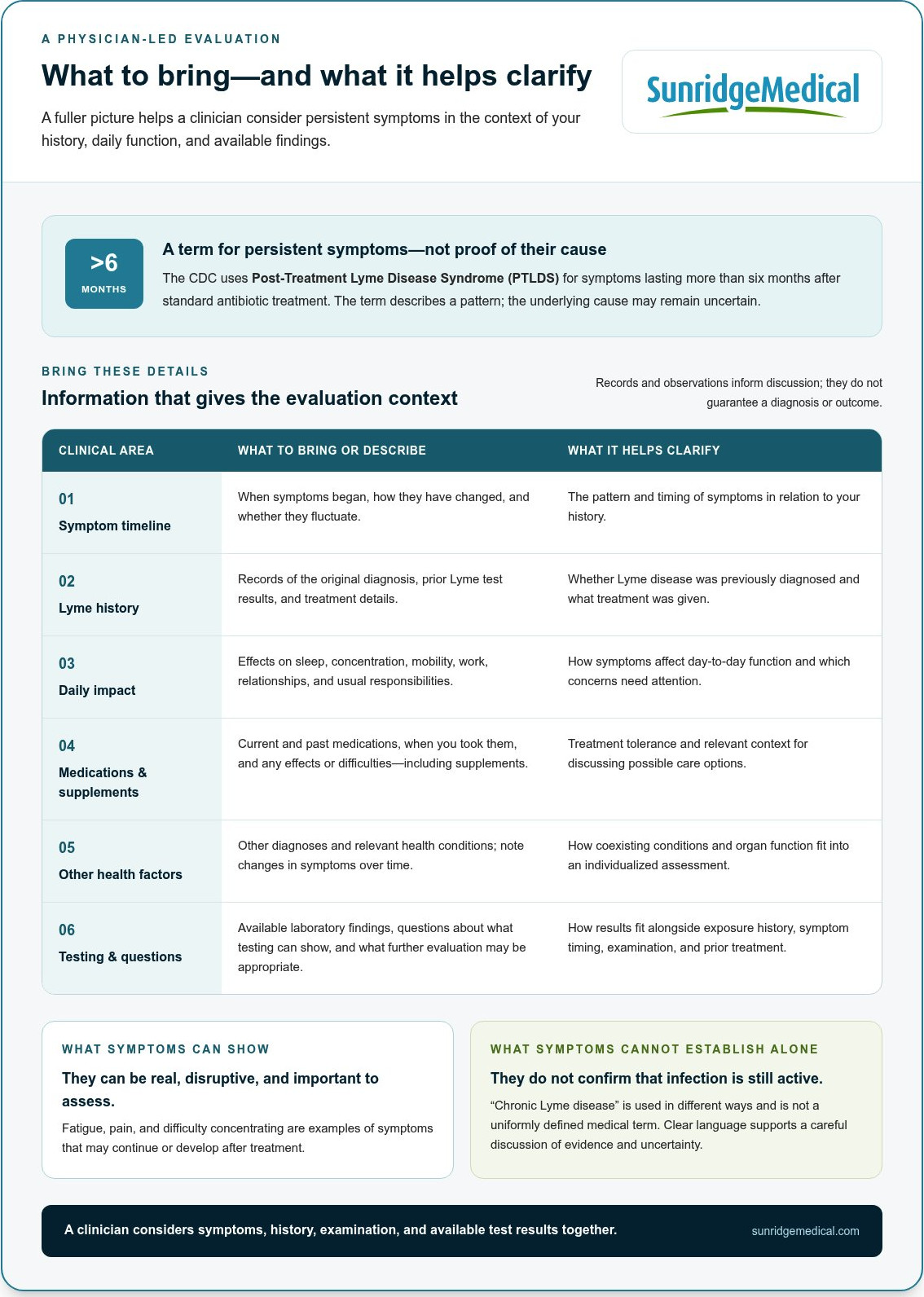
Describe your symptoms in your own words and explain what you’re concerned might be causing them. Bring records of the original diagnosis and treatment if available. Note when symptoms began, how they’ve changed, and which daily activities they affect. Useful questions include:
- What explanations fit my symptom pattern and medical history?
- What does my testing show, and what can’t it establish on its own?
- What should we evaluate next, and how will we discuss the benefits and risks of possible options?
A thoughtful assessment makes room for uncertainty and practical next steps. The goal isn’t to force symptoms into a label, but to support a respectful, evidence-informed discussion of your circumstances and care priorities.
How Physicians Evaluate Persistent Lyme Symptoms and the Wider Clinical Picture
A useful evaluation looks for patterns rather than a shortcut to a predetermined answer. The clinician considers when symptoms began, how they have changed, whether Lyme disease was previously diagnosed, what treatment was given, and how symptoms affect daily function. For example, disrupted sleep, reduced concentration, or difficulty completing usual activities can clarify the practical impact and help identify which concerns need attention.
Individualized evaluation brings a person’s symptoms, history, examination, and available test results together to inform a careful discussion of possible explanations and next steps. It doesn’t mean every symptom has one cause, or that an assessment guarantees a diagnosis or treatment outcome. This wider view is central to specialized care for persistent lyme.
What information can help make an evaluation more complete?
Organized records can make an appointment more productive. Gather prior Lyme test results, records of the original diagnosis, treatment details, and a current medication list, including supplements. A concise timeline can show when symptoms started, whether they fluctuate, and what has changed. Note effects on sleep, concentration, mobility, work, and other daily responsibilities. These details help a clinician interpret the available information in the context of your case.
- List current and past medications, including when you took them and any effects or difficulties you experienced.
- Record other diagnoses and relevant health conditions, along with changes in symptoms over time.
- Bring questions about how symptoms affect function and what further evaluation may be appropriate.
Care planning also takes account of medications, organ function, treatment tolerance, coexisting conditions, laboratory findings, and personal goals. An option that may be considered in one person’s circumstances may not suit another’s. The physician’s role is to review the full picture, explain the reasoning, and discuss choices in light of individual clinical needs.
How should patients understand testing and uncertainty?
Laboratory results contribute evidence, but they don’t interpret themselves. Lyme antibody testing is generally performed using a two-step process; results need to be considered alongside exposure history, symptom timing, examination, and prior treatment. Antibody tests may be negative early in infection, and antibodies can remain detectable after treatment. A result alone therefore cannot establish that symptoms are caused by an active infection or confirm that treatment has cured an infection.
Clinical guidelines can provide useful context. The IDSA Lyme Disease Guidelines discuss diagnosis and treatment, including recommendations relevant to persistent symptoms. Your clinician can explain how guideline information applies to your history and what remains uncertain. Uncertainty isn’t dismissal: persistent symptoms deserve attention, even when a test doesn’t provide a complete explanation.
Bring forward what matters most to you, whether that’s pain, mental clarity, energy, or returning to a daily activity. Sunridge Medical provides Chronic Lyme Disease Treatment through a physician-led, individualized approach. Recommendations are shaped by diagnosis, history, findings, medications, organ function, tolerance, symptoms, and goals. Learn more about Sunridge Medical’s Lyme care.
Comparing Care Pathways for Persistent Lyme Symptoms Without False Choices
Persistent symptoms can raise different questions: Is there evidence of Lyme disease requiring treatment? What support may help address day-to-day concerns? Are there broader health factors to consider? These questions don’t always call for one pathway alone. Comparing the purpose and limits of each can help patients and physicians discuss care without treating conventional and supportive approaches as automatic opposites.
| Care pathway | Primary focus | Important limit |
|---|---|---|
| Established Lyme treatment | Diagnosing and treating Lyme disease according to clinical findings and current guidance. | Medication decisions depend on the patient’s case and belong with the treating clinician. |
| Symptom-focused follow-up | Assessing persistent concerns and their effects on function, while considering appropriate evaluation and support. | Addressing symptoms does not, by itself, identify their underlying cause. |
| Integrative supportive care | Considering the wider health picture, individual goals, and research-informed options alongside medical care. | Supportive care doesn’t establish active infection or guarantee symptom improvement. |
These pathways can address distinct needs and may be coordinated as appropriate. The right discussion depends on the person’s diagnosis, medical history, laboratory findings, medications, organ function, symptoms, tolerance, and goals. Specialized care for persistent lyme should support informed decisions, not force a choice based on labels alone.
What is the role of conventional Lyme disease treatment?
Antibiotics are the standard treatment for Lyme disease. The medication and approach depend on the clinical presentation; for example, treatment for early Lyme disease differs from care for certain neurologic or cardiac complications. Clinical guidance, including recommendations from the Infectious Diseases Society of America, helps frame these decisions. This article can’t determine whether a particular medication is appropriate for you. Don’t start, stop, or extend treatment based on general information; discuss medication decisions with the clinician who knows your case.
Where can integrative care fit alongside ongoing medical care?
Integrative care can offer a structured way to consider the whole health picture, including symptoms, coexisting conditions, treatment tolerance, and personal priorities. A supportive plan may include individualized evaluation and options considered for their clinical relevance and safety. It should complement, not displace, appropriate conventional medical care. Supportive planning isn’t evidence that an active infection is present, and it can’t promise a particular response.
For a broader discussion of how care pathways may be considered, explore this clinical guide to Lyme disease specialists. Use that context to prepare focused questions for your physician: What is each proposed approach intended to address? How will risks and existing medications be considered? What would make the plan appropriate for your circumstances?
Preparing for a Specialized Lyme Care Discussion: Questions and Records to Bring
A focused appointment is easier when the details are ready to review. You don’t need to solve the medical questions in advance. Aim to give the physician a clear account of what has happened, what you’ve tried, and what matters most to you now. This preparation can make specialized care for persistent lyme a more productive, individualized discussion.
Which records and symptom details are useful to organize?
Gather what’s available, even if your records are incomplete. A brief, readable timeline can connect prior testing and treatment with changes in symptoms and daily function. Include relevant medical history and the names of clinicians currently involved in your care. These materials provide context, but they aren’t a substitute for the physician’s review.
- Collect key records. Bring laboratory reports, imaging results, prior diagnoses, and summaries of Lyme-related evaluations or treatment. Include dates when possible.
- List medications and supplements. Note current and past medications, doses if known, when you took them, and any effects or difficulties with tolerance.
- Outline your symptom timeline. Record when symptoms began, how they have changed, and whether anything appears to affect them.
- Describe functional impact. Note effects on sleep, concentration, work, mobility, and other activities that matter in your daily life.
- Identify your care team and priorities. List current clinicians and write down the outcomes or concerns you most want to discuss.
If you can’t locate every report, bring the information you do have and identify what’s missing. A concise timeline is often more useful in conversation than trying to recall every detail under pressure.
What questions help clarify a proposed care plan?
Questions can help you understand the reasoning behind recommendations, how they relate to your history and goals, and how care may fit with existing medical support. Choose the prompts most relevant to your situation; you don’t need to cover everything in one conversation.
- How do my diagnosis, history, symptoms, and laboratory findings inform this recommendation?
- What is the proposed approach intended to address, and what evidence supports considering it for my circumstances?
- What potential benefits, risks, uncertainties, or limits should I understand?
- How will medications, organ function, coexisting conditions, and treatment tolerance shape the plan?
- What findings or changes would guide monitoring or a discussion about adjusting the approach?
- How can this plan be coordinated with my current clinicians and other appropriate medical care?
Clear answers should make the plan’s purpose and boundaries understandable, without promising a particular result. For broader context on individualized approaches to chronic illness, see this integrative medicine guide for chronic illness. To discuss physician-led Lyme care and general questions with Sunridge Medical’s Patient Care Team, connect with the care team. An introductory call can address general questions, but it can’t diagnose or prescribe.
Sunridge Medical’s Physician-Led, Hands-On Approach to Complex Lyme Care
For people considering specialized care for persistent lyme, the setting and structure of care matter. Sunridge Medical provides Chronic Lyme Disease Treatment at an outpatient medical treatment facility, pairing physician-led evaluation with hands-on care delivered onsite by licensed clinical professionals and a full nursing team. This approach creates space to consider a person’s history, current concerns, and care priorities together, rather than relying on one symptom or test result to shape the discussion.
What does physician-led, hands-on care mean in practice?
Physicians guide individualized recommendations, with clinical professionals and nurses supporting onsite care. Dedicated infusion and treatment rooms are available within the outpatient facility. The specific approach depends on physician review of diagnosis, medical history, laboratory findings, medications, organ function, symptoms, tolerance, and personal goals. The Patient Care Team can answer general questions on an introductory call, but cannot diagnose or prescribe during that conversation.
Care options are considered in their research-informed context, including their safety and clinical relevance to the individual. Depending on physician review, discussions may include:
- IV & Nutrient Therapies, considered in the context of a person’s health and clinical needs.
- Oxidative & Redox Medicine, evaluated as a possible component of an individualized plan.
- Natural & Botanical Medicine, reviewed alongside medical history, medications, and other relevant factors.
These are options for physician consideration, not a standard package or a guarantee of benefit. Their suitability varies, and they don’t establish that an active infection is present or replace appropriate conventional medical care. A plan may evolve as the physician considers response, tolerance, new findings, and changing priorities. The aim is a thoughtful, clinically informed path, not a promised cure or outcome.
How can patients take a practical next step?
Start by gathering records and writing down the questions you most want answered. A physician’s evaluation is the point at which the full clinical picture can be reviewed. Recommendations are individualized, and an introductory call is intended for general questions, not diagnosis or prescribing.
Call the Patient Care Team at 1-800-923-7878 to discuss general questions about the care process. You can also explore individualized chronic Lyme care to learn more about the approach. A calm, informed conversation can help clarify what may be relevant to your circumstances, without assuming every option is right for every person.
Take the Next Step With a Clearer Care Goal
You don’t need to resolve every uncertainty before seeking a more focused conversation. Start with one priority: a symptom you hope to understand better, a daily activity you want to manage, or a question about how different care options fit your situation. Naming that priority can keep the discussion grounded in what matters to you, while leaving room for your physician to consider the broader clinical picture.
Exploring specialized care for persistent lyme can be a step toward informed decisions, not a commitment to a predetermined diagnosis or plan. Bring your questions, share what you’ve experienced, and take time to understand the reasoning behind recommendations. Sunridge Medical’s Patient Care Team can discuss general questions by phone at 1-800-923-7878. An introductory call can’t diagnose or prescribe, but it can help you learn about the care process and consider whether a physician-led evaluation may be a useful next step.
Call the Patient Care Team to discuss general questions and take a thoughtful, informed next step.
Frequently Asked Questions
Can Lyme symptoms persist after treatment?
Yes. Some people continue to experience symptoms such as fatigue, pain, or difficulty concentrating after Lyme disease treatment. The CDC uses the term Post-Treatment Lyme Disease Syndrome for symptoms lasting more than six months after standard antibiotic treatment, but that label doesn’t explain the cause in every individual case. If symptoms continue or change, record when they occur and how they affect daily activities to help guide a clinical discussion.
Does having persistent symptoms mean Lyme disease is still active?
No. Persistent symptoms alone don’t confirm an ongoing active infection. They may have different explanations, and determining what is relevant requires a clinician to consider your history, symptoms, examination, and available evidence. If you’re concerned about active Lyme disease, share what has changed, including any new exposure concerns, rather than relying on symptoms by themselves to settle the question. A clinician can discuss what further assessment may be appropriate.
Can a blood test confirm the cause of ongoing symptoms?
Not by itself. Lyme blood tests detect antibodies, which can remain present for months or years after infection, so a positive result doesn’t establish that current symptoms come from active infection. Testing can also be negative early in infection, before antibodies develop. A clinician interprets results alongside the timing of symptoms, exposure history, examination, and prior treatment. No single blood test can identify every possible cause of ongoing symptoms.
Can integrative care be considered alongside conventional Lyme treatment?
It may be considered as a complementary part of care, with decisions guided by your clinical circumstances and discussed with your treating clinicians. Integrative support can bring attention to broader health concerns and personal goals, but it doesn’t prove that infection is active or guarantee symptom improvement. Share all proposed therapies and supplements with your medical team so they can consider potential interactions, existing medications, and how an approach fits with appropriate conventional care.
What should I bring to an appointment about persistent Lyme symptoms?
Bring available test reports, prior diagnosis and treatment records, a current medication and supplement list, and notes about relevant health conditions. A short timeline can be especially useful: include when symptoms began, what has changed, and which activities are affected. If you have many records, mark the most relevant results or treatment dates. Also write down your main concerns so the appointment can address what matters most to you.
Can a first phone call diagnose Lyme disease or prescribe treatment?
No. Sunridge Medical’s Patient Care Team can answer general questions during an introductory call, but the call can’t provide a diagnosis or medication prescription. Diagnosis and recommendations require physician evaluation of the individual case. You can use the conversation to ask general questions about the care process and identify information to prepare, such as prior records or a medication list, for a later medical evaluation.
Can a family member or caregiver join an appointment?
Yes. A family member or caregiver may join an appointment if you would find their support helpful. They can help you remember questions, take notes, or describe changes they’ve observed in daily routines. Before the visit, consider agreeing on what you’d like them to contribute, while keeping your own concerns central. Their presence can support the conversation, but your clinician should hear directly how symptoms affect you and what goals matter to you.