


Why can two people with the same stage of lung cancer receive very different treatment recommendations? Stage 3 lung cancer treatment depends on more than the stage label. Whether surgery is realistic, what molecular testing reveals, and how the cancer responds to initial treatment can change both the medicines selected and the order of care.
For a newly diagnosed patient, the most useful starting point isn't a list of therapies. It's a clear explanation of which pathway fits the pathology, imaging, lung function, and overall health. The pathways below concern non-small-cell lung cancer (NSCLC). Small-cell lung cancer requires a different treatment discussion.
Table of Contents
- Choose the Treatment Pathway That Matches Your Stage
- Evaluation, Side Effects and Monitoring During Treatment
- How Surgery Candidacy Changes the Plan
- Biomarker Testing and Targeted Options
- Chemoradiation, Consolidation Immunotherapy and Trial Numbers
- When Disease Progresses After Chemoradiation
- Discuss Integrative Support With Your Oncology Team
Choose the Treatment Pathway That Matches Your Stage
Stage 3 lung cancer treatment pathways by scenario
| Scenario | Typical approach | Evidence anchor | Question to ask |
|---|---|---|---|
| Resectable IIIA, no actionable driver alteration | Neoadjuvant platinum chemotherapy plus immunotherapy, then surgery | Perioperative chemo-immunotherapy is an evidence-supported standard for eligible resectable disease without driver alterations | Is surgery realistic after staging and lung function testing? |
| Resectable, EGFR or ALK alteration | Surgery followed by adjuvant targeted therapy | Adjuvant targeted therapy may be preferred after surgery regardless of whether chemotherapy was given | Which biomarker results are confirmed and complete? |
| Unresectable, no progression after chemoradiation | Consolidation durvalumab after chemoradiation | PACIFIC trial; listed by the National Cancer Institute | Is the patient eligible given lung function, autoimmune history, and organ function? |
| Unresectable, EGFR exon 19 deletion or L858R, no progression after chemoradiation | Osimertinib | FDA approval on September 25, 2024, based on the LAURA trial | Has the tumor been tested for these specific mutations? |
| Progression during or after chemoradiation | Individualized systemic therapy, sometimes with radiation | Selection requires review of tumor biology, prior treatment, and fitness | Which options does the tumor board recommend next? |
The surgery-related approaches summarized in a review of biomarker-directed stage III care distinguish resectable tumors without actionable driver alterations from those with EGFR or ALK alterations. These aren't interchangeable categories. An actionable alteration is a tumor characteristic that may make a particular targeted medicine appropriate.
Read the pathway as a conditional plan
Neoadjuvant means treatment before surgery. Adjuvant means treatment after surgery. Consolidation describes additional treatment after the initial treatment phase, intended to build on the response already achieved.
Each row assumes that the patient meets the conditions for that approach. A tumor can be technically removable while the patient's heart or lung health makes a major operation unsafe. Likewise, completing chemoradiation doesn't automatically establish eligibility for every consolidation medicine.
The progression row is especially broad. It identifies a decision point, not a standard prescription, because the location of progression and the treatments already received matter.
Appointment preparation: Match the pathology and staging reports to a pathway, then ask the oncology team to confirm the match and explain any missing information.
Sunridge Medical's guide to cancer diagnosis and stages provides background for understanding the terminology in those reports. The practical goal is a written treatment sequence with the conditions for moving from one phase to the next.
Evaluation, Side Effects and Monitoring During Treatment
Before selecting treatment, the oncology team needs to establish both where the cancer is and what the patient can safely tolerate. Those are related questions, but they require different tests.
Pre-treatment evaluation items and what each one clarifies
| Evaluation | What It Clarifies | How It Shapes the Plan |
|---|---|---|
| PET/CT scan | Suspected spread to lymph nodes and distant sites | Helps confirm stage and whether a curative-intent pathway is appropriate |
| Brain MRI | Possible brain involvement | Can change local and systemic treatment planning |
| Invasive mediastinal staging, when needed | Cancer involvement in lymph nodes between the lungs | Helps determine resectability |
| Pulmonary function tests | Breathing capacity and lung reserve | Informs tolerance of surgery and radiation and assessment of pulmonary treatment risks |
| Autoimmune history and organ function review | Immune-related risks and organ strain | Helps determine immunotherapy suitability and monitoring |
Imaging findings sometimes require tissue confirmation before the team changes the stage or rules out surgery. The patient should receive an explanation of which findings are confirmed and which remain uncertain.
Separate expected symptoms from warning signs
Treatment monitoring isn't limited to whether a scan shows tumor shrinkage. Clinicians also assess breathing, swallowing, fatigue, blood counts, organ function, and the ability to manage daily activities.
Immune-related side effects can involve different organs. Pneumonitis, inflammation in the lungs, is particularly important after chest radiation and during immune-based treatment. Radiation may also irritate the esophagus, making swallowing uncomfortable, and contribute to fatigue.
New or worsening cough, shortness of breath, fever, chest pain, or trouble swallowing warrants urgent medical contact rather than waiting for the next appointment. Severe breathing difficulty or severe chest pain requires emergency assessment.
For general respiratory-health education between appointments, DME Superstore lung care advice can supplement the oncology team's instructions. It doesn't establish whether a symptom is safe to manage at home.
Make supportive care specific
Nutrition, rehabilitation, sleep, and symptom support should be discussed as individual needs, not presented as anticancer treatments. Difficulty swallowing may call for a different nutrition plan than nausea or poor appetite; reduced activity may require supervised rehabilitation rather than an unsupervised exercise target.
Supplements and herbal products need medication review because they can interact with cancer treatment or other medicines. Patients shouldn't start them on the assumption that natural means harmless.
Sunridge Medical's explanation of how chemotherapy scheduling works can help families organize questions about treatment visits. A symptom log and current medication and supplement list should accompany every appointment, including the symptom's start date, severity, and effect on eating, sleep, or activity.
How Surgery Candidacy Changes the Plan
Resectability is the first major branch point. It describes whether the cancer can be removed through an appropriate operation. Operability adds another question: whether the patient can safely undergo that operation.

For selected stage IIIA cancers, a surgical pathway may be realistic. The team considers the tumor's location, involvement of nearby structures, which lymph-node stations contain cancer, and cardiopulmonary fitness. A stage label by itself can't resolve those details.
A review of multidisciplinary stage III management emphasizes the importance of resectability assessment, mediastinal lymph-node mapping, pulmonary reserve, comorbidities, and patient goals. A thoracic-oncology consultation brings those findings together rather than treating the surgeon's, radiation oncologist's, and medical oncologist's opinions as separate plans.
Why treatment may begin before an operation
A recommendation for chemotherapy before surgery doesn't necessarily mean surgery has been abandoned. Treatment may begin with chemotherapy, with or without immunotherapy, or with chemoradiation, followed by reassessment.
The planned operation should be discussed before that first phase begins. Otherwise, a patient may hear that treatment could make surgery possible without knowing whether a thoracic surgeon has reviewed the case.
Consider a patient with a removable lung tumor but uncertain lymph-node involvement. Sampling the relevant nodes may change the surgical recommendation. In another patient, the cancer's anatomy may allow removal, but limited lung reserve may make the proposed operation too risky.
Obtain a documented resectability opinion
A short appointment checklist can clarify the recommendation:
- Team review: Has a multidisciplinary thoracic tumor board discussed the case?
- Specialist agreement: Have thoracic surgery and radiation oncology reviewed the imaging and pathology?
- Physical reserve: Does lung and heart function support the proposed operation?
- Reassessment plan: If treatment starts before surgery, what findings will determine whether surgery proceeds?
When surgery isn't feasible, treatment generally relies on chemotherapy and radiation rather than an operation alone. The National Cancer Institute's durvalumab information lists the medicine for eligible patients with stage III NSCLC that can't be removed surgically and hasn't worsened after platinum-based chemotherapy and radiation.
A second pathology or radiology review can clarify an uncertain finding. The useful result is a documented explanation of why surgery is or isn't appropriate, not simply another treatment list.
Biomarker Testing and Targeted Options
Could a tumor test change which treatment comes next? Stage describes how far the cancer has spread; biomarker testing identifies tumor features that may affect treatment selection. Both help the oncology team discuss a treatment pathway.

Ask whether testing includes EGFR and ALK status, other molecular alterations relevant to the tumor, and PD-L1 expression when it may inform immunotherapy choices. These are different kinds of results. A PD-L1 result does not replace molecular testing, or vice versa.
Ask whether the report is complete
Results can take days to weeks, depending on the tissue available and laboratory processing. Ask which findings are final, which remain pending, and whether the sample was adequate for testing.
If a test could not be completed, that is not the same as a negative result. The oncology team can explain whether another specimen or a different testing approach may be appropriate.
Sunridge Medical's guide to lung cancer biomarkers and targeted therapy offers terminology for this conversation. The practical question is: Which result changes the recommended medicine or the order of treatment? Bring that question, along with the report, to the oncology visit.
What the osimertinib evidence demonstrates
The FDA's September 25, 2024, osimertinib approval covers adults with unresectable stage III NSCLC whose tumors have EGFR exon 19 deletions or exon 21 L858R mutations and whose cancer has not progressed during or after concurrent or sequential platinum-based chemoradiation. In the LAURA trial supporting the decision, median progression-free survival was 39.1 months with osimertinib versus 5.6 months with placebo, with a hazard ratio of 0.16, as reported in the FDA's approval information.
Progression-free survival measures the time before cancer progresses or the patient dies. It is different from overall survival, which measures time until death from any cause. At approval, interim overall-survival results were still immature, so the progression-free survival finding does not establish an overall-survival benefit.
The result applies to the specified EGFR mutations and treatment setting. It does not establish the same benefit for tumors without those mutations, small-cell lung cancer, or resectable disease.
Keep the exact result: A written molecular report is more useful than a verbal summary that the tumor is mutation-positive.
Before treatment selection, ask for a written list of completed molecular results and how each affects the proposed sequence. Confirm who will follow up on pending tests.
Chemoradiation, Consolidation Immunotherapy and Trial Numbers
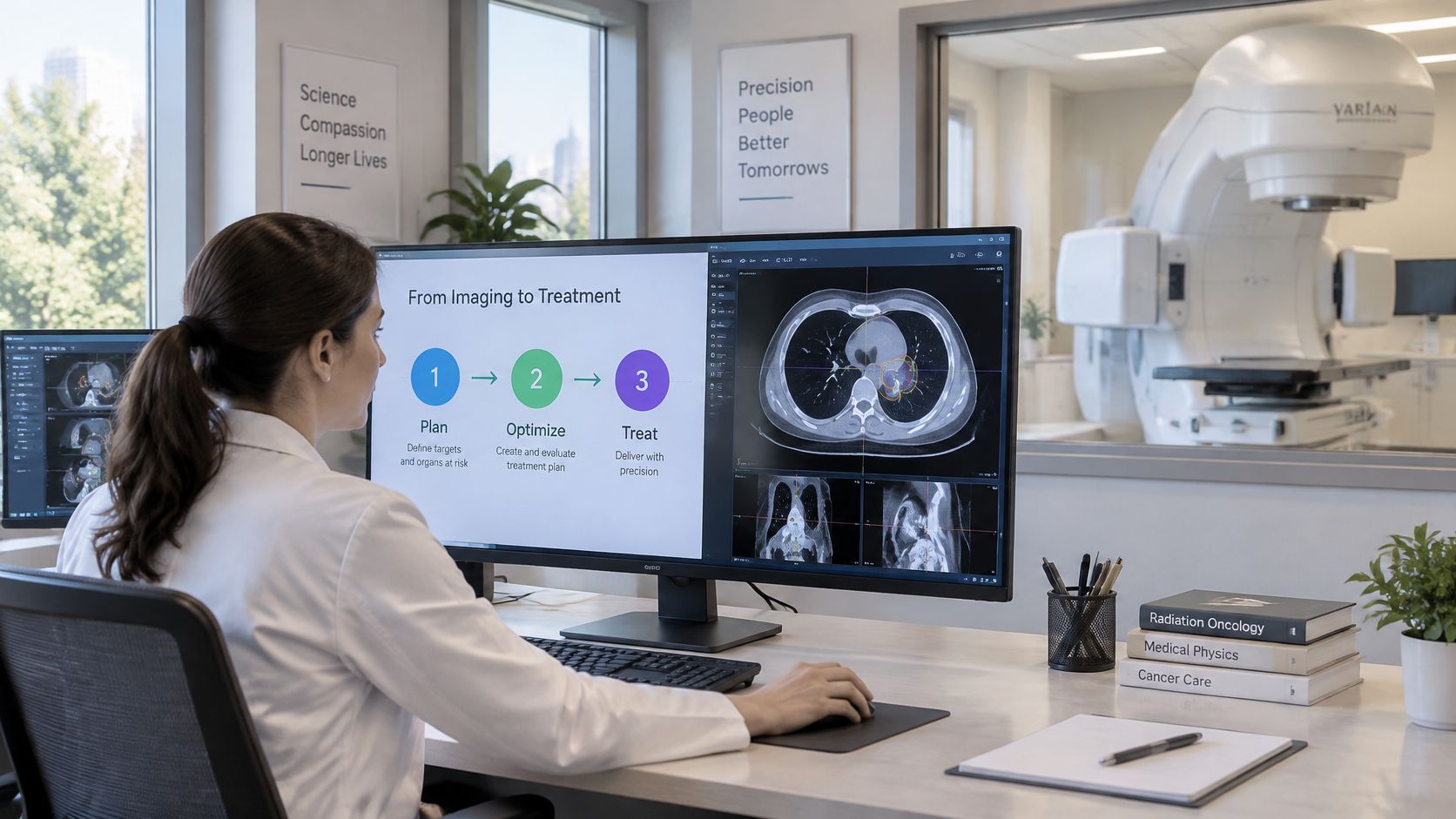
For unresectable stage III lung cancer, treatment often combines radiation to the chest with chemotherapy that also acts throughout the body. Concurrent chemoradiation means both treatments are given during the same treatment period. Whether surgery is feasible and what tumor biomarkers show can change what follows, so these questions belong early in the treatment discussion.
Follow the sequence, including reassessment
For patients whose cancer is unresectable and whose health supports this approach, decisions generally proceed in stages:
- Confirm the extent of disease. PET/CT, brain imaging, and, when needed, assessment of the mediastinum help define the treatment area. Biomarker results inform systemic treatment choices.
- Complete definitive chemoradiation. Platinum-based chemotherapy and radiation may be given with curative intent. That phrase describes the goal, not a guaranteed result.
- Reassess the cancer and recovery. Clinicians look for progression and review treatment effects, including pulmonary symptoms.
- Consider consolidation treatment. If the cancer has not progressed and the patient can tolerate immunotherapy, durvalumab may be appropriate. A relevant EGFR alteration can instead direct the discussion toward targeted treatment.
The surgery decision and biomarker report therefore shape the sequence, rather than serving as details to revisit after treatment. A patient who finishes radiation but develops significant lung inflammation needs reassessment before another treatment begins. Reaching the end of chemoradiation is therefore a checkpoint that requires reassessment before consolidation.
Read benefit measures accurately
In the PACIFIC trial analysis, median progression-free survival was 16.8 months with durvalumab versus 5.6 months with placebo, with a hazard ratio of 0.52. The reported overall-survival hazard ratio was 0.68, corresponding to a 32% relative reduction in the risk of death during that analysis.
A hazard ratio compares event risk over time between treatment groups. It does not give the percentage of patients cured or predict how long one person will live.
These findings apply to patients whose cancer had not progressed after concurrent chemoradiation. They do not establish durvalumab as suitable for every stage III presentation or for small-cell lung cancer. Pneumonitis risk, autoimmune disease, organ function, and performance status all affect whether immunotherapy may be appropriate.
Survival figures from the PACIFIC trial
| Trial | Comparison | Measure | Reported result |
|---|---|---|---|
| PACIFIC | Durvalumab vs placebo after chemoradiation | Median progression-free survival | 16.8 vs 5.6 months; hazard ratio 0.52 |
| PACIFIC | Durvalumab vs placebo after chemoradiation | Overall survival at 24 months | 66.3% vs 55.6% |
| PACIFIC | Durvalumab vs placebo after chemoradiation | Overall survival at three years | 57% vs 44% |
| PACIFIC | Durvalumab vs placebo after chemoradiation | Overall survival at five years | 42.9% vs 33.4% |
| PACIFIC | Durvalumab vs placebo after chemoradiation | Progression-free survival at five years | 33.1% vs 19.0% |
The New England Journal of Medicine PACIFIC report gives the 24-month overall-survival comparison, while the five-year PACIFIC analysis reports later overall- and progression-free-survival results shown in the table.
These are group results, not an individual prognosis. For a first oncology visit, ask whether the disease is considered resectable, which biomarker results are available, and how recovery and lung health affect consolidation choices. The answer may change which treatment follows chemoradiation.
When Disease Progresses After Chemoradiation
Progression changes the decision from consolidation to treatment of cancer that has grown or spread despite initial care. The evidence supporting the consolidation pathways doesn't automatically apply in this setting, and the available trial findings don't establish a single next regimen.
The oncology team first needs to clarify where progression occurred, whether the finding is confirmed, and whether the current stage or treatment goal has changed. A new finding in the treated chest may require a different assessment from cancer appearing at a distant site.
Require a reason for each proposed option
Further systemic treatment, and sometimes additional local radiation, requires individualized review of tumor biology, previous medicines, radiation exposure, and current fitness. Without a current guideline-supported case assessment, naming a particular regimen would create false precision.
Useful questions include:
- Testing completeness: Are molecular results complete, and would repeat testing clarify treatment selection?
- Evidence: Which guideline recommendation or clinical evidence supports the proposed option for this situation?
- Priority: Which option does the tumor board recommend first, and why?
- Daily function: How might treatment affect breathing, activity, symptoms, and appointment demands?
- Monitoring: Who will review scans, laboratory results, and symptoms between visits?
Sunridge Medical's resource on what to do when chemotherapy stops working can help organize a second-opinion discussion without assuming that every possible therapy is suitable.
Keep a decision record: Document the progression findings, proposed options, reasons for each recommendation, and unresolved questions.
That record helps the patient compare choices with the oncology team rather than relying on an isolated scan phrase or a treatment name.
Discuss Integrative Support With Your Oncology Team
Integrative support belongs alongside evidence-based cancer treatment, not in place of it. Surgery, chemoradiation, immunotherapy, and targeted therapy address different clinical needs. Complementary approaches shouldn't delay a medically necessary step or be credited with survival outcomes demonstrated by conventional treatment trials.
An appropriate discussion starts with the patient's actual difficulties: eating, sleep, fatigue, emotional distress, medication burden, or recovery after treatment. Each proposed measure needs a clear purpose, a safety review, and an explanation of the evidence and its limits.
Coordinate responsibilities before adding therapies
Sunridge Medical is an experienced integrative clinic in Scottsdale, Arizona, providing individualized, evidence-informed evaluation. Its safest starting point for a cancer patient is a case review, not selecting a therapy from a list.
Before outlining options, Sunridge Medical reviews cancer type, stage, pathology, previous treatment, molecular information when available, organ function, medications, symptoms, and individual goals. For patients in Scottsdale, Phoenix, and the greater Phoenix area, that process can help organize questions and identify information that still needs clarification.
The clinic's educational guide to integrative medicine for lung cancer provides context for coordinated care. It shouldn't be treated as proof that every integrative intervention is appropriate for every patient.
For emotional-health terminology, Thrive Counseling's integrative therapy overview explains integration in a counseling context. That use of the term is distinct from evidence for treating lung cancer.
Bring a focused question list
- Multidisciplinary review: Has a thoracic tumor board reviewed the case?
- Pending information: Which biomarker results or staging findings remain unresolved?
- Consolidation safety: Which option fits lung function and health history, including pneumonitis risk?
- Interactions: Could proposed supplements, nutrition changes, or integrative therapies interfere with treatment?
- Accountability: Who monitors laboratory results and symptoms between visits?
Coordination should leave the patient knowing which clinician manages each concern. Sunridge Medical doesn't replace an oncologist, emergency care, or medically necessary conventional treatment, and it doesn't promise cures or guaranteed outcomes.
Anyone with new breathing symptoms should seek urgent medical assessment before pursuing a routine integrative consultation. Supportive-care planning is most useful when immediate safety concerns have already been addressed.
Sunridge Medical offers cancer case review, second opinions, and individualized care alongside oncology treatment, including for advanced and difficult cases. Patients considering stage 3 lung cancer treatment can visit Sunridge Medical to contact the Scottsdale clinic and discuss whether a consultation or second opinion is appropriate. Suitability and any proposed care are determined only after individualized evaluation.