


What if the most responsible first step in integrative treatment for chronic fatigue syndrome isn’t adding another therapy, but finding care that respects your limits? When symptoms make ordinary routines hard to sustain, confident online claims can be tempting, while conflicting advice may leave you unsure what’s safe or credible. You deserve to have your experience taken seriously.
ME/CFS varies from person to person. Post-exertional malaise, a worsening of symptoms after physical, cognitive, or emotional effort, makes symptom-aware care especially important. There’s no cure, so treatment focuses on managing symptoms and supporting quality of life. Integrative approaches may be considered alongside standard medical care, but they aren’t all equally supported, suitable, or safe for every person.
This guide explains how ME/CFS is evaluated and managed, what pacing and other supportive approaches may involve, and how to assess claims, evidence, risks, and possible interactions. You’ll also find practical questions to take to a clinician, including how to discuss a manageable plan shaped around your symptoms and priorities. If you’re considering care at a particular clinic, first confirm whether it evaluates people with ME/CFS.
Key Takeaways
- Learn why persistent fatigue calls for an individualized medical assessment, not assumptions about its cause.
- Explore how integrative treatment for chronic fatigue syndrome can be considered alongside conventional care, with attention to evidence and safety.
- Use practical questions to weigh a treatment’s intended benefit, supporting evidence, risks, and monitoring plan.
- Build a manageable next-step plan around your priorities, and ask clinicians how they coordinate care and follow up.
- Before contacting Sunridge Medical, confirm whether the center evaluates your specific symptoms, since ME/CFS care isn’t listed as a service.
What integrative treatment for chronic fatigue syndrome means
Integrative treatment for chronic fatigue syndrome combines appropriate conventional medical evaluation and symptom care with selected supportive approaches, chosen to fit a person’s health needs and goals. ME/CFS, also called myalgic encephalomyelitis/chronic fatigue syndrome, is a complex, chronic illness that can substantially limit everyday activity. Symptoms may include post-exertional malaise, unrefreshing sleep, and cognitive difficulties. Its presentation varies, as summarized in this overview of myalgic encephalomyelitis/chronic fatigue syndrome.
Integrative care isn’t a promise of a cure, and it doesn’t mean replacing prescribed or standard medical care with alternative treatments. The aim is to assess the whole clinical picture, support symptom management and quality of life, and consider additional approaches only after weighing their evidence, risks, and relevance to the individual.
How ME/CFS differs from feeling tired
Ordinary tiredness may improve with rest. A defining feature of ME/CFS is post-exertional malaise (PEM), in which symptoms worsen after physical, cognitive, or emotional effort that may once have felt manageable. The worsening can disrupt daily plans, so describe it during an assessment, including what tends to trigger it and how it affects your activities.
Some people also experience unrefreshing sleep, trouble with memory or concentration, or orthostatic symptoms, such as feeling worse while upright. Not everyone has the same combination or severity of symptoms. A clinician needs to consider how symptoms change over time and affect function rather than assuming that persistent fatigue has one explanation.
Why an individualized assessment matters
Persistent fatigue can have multiple possible causes, and other conditions may occur alongside ME/CFS. A clinician can review medical history, symptom patterns, daily function, medications, and relevant examination or test findings to assess whether the person’s experience fits ME/CFS and whether other explanations need attention. There isn’t a single laboratory test that confirms ME/CFS. Testing may help investigate other conditions or coexisting concerns.
Bring a short account of the symptoms that affect you most, what tends to worsen them, and how they limit daily activities. If detailed tracking is too demanding, a few notes or a conversation with someone who knows your day-to-day experience may help. Sunridge Medical describes individualized care for complex chronic conditions, but its listed services don’t specifically confirm ME/CFS evaluation or treatment. Confirm whether a clinic can assess your concerns before arranging care. For a broader perspective on combining conventional and supportive approaches, see this clinical guide to integrative care for chronic illness.
Which parts of integrative ME/CFS care may support symptom management?
Supportive care is most useful when it starts with the person, not a fixed protocol. Priorities may include reducing symptom flare-ups, improving sleep, managing pain, or making essential daily activities more sustainable. A clinician can help set goals that reflect current function and medical history, then review whether an approach is helping, causing unwanted effects, or needs adjustment.
The CDC describes post-exertional malaise (PEM) as a worsening of symptoms after physical or mental activity that may have been tolerated before. Because exertion can trigger a setback, care planning should account for personal limits. Pacing and energy management are foundational strategies in ME/CFS guidance. Pacing means adjusting activity and rest to the individual’s capacity, not following a fixed exercise schedule or pushing through a flare. Discuss activity changes with a clinician, especially if symptoms shift. Graded exercise should not be treated as a universal solution.
Match support to the symptoms that matter most
Sleep, pain, cognitive difficulties, and symptoms that worsen while standing may each call for different evaluation and support. A clinician may review sleep patterns, pain characteristics, medication effects, or possible contributors to lightheadedness before discussing options. The aim is to address specific concerns without assuming one intervention suits everyone.
Keep observations manageable. A brief note about an activity, a symptom change, and its timing may reveal useful patterns without turning symptom tracking into another demanding task. Bring current medications and supplements to appointments. Any treatment decision should account for health history, potential risks, and interactions, and should be reviewed with a qualified clinician.
Separate symptom support from cure claims
Integrative treatment for chronic fatigue syndrome may include conventional symptom management alongside carefully selected supportive approaches. The strength of evidence varies: some approaches focus on practical symptom support, while others remain limited, mixed, or under investigation. A plausible explanation or personal testimonial isn’t proof that a treatment works. Ask what symptom an option is intended to address, what evidence supports it, what risks are known, and how benefit or harm will be monitored.
Supportive care can complement medical evaluation, but it shouldn’t be presented as a cure or a reason to stop prescribed treatment. Sunridge Medical describes individualized care for complex chronic conditions, but ME/CFS isn’t among its listed services. Before making arrangements, contact the center to ask whether it evaluates your specific symptoms.
How to evaluate integrative treatments for chronic fatigue syndrome
Integrative does not mean proven, risk-free, or a substitute for standard medical care. A careful decision starts with a specific concern and a clear discussion of what is known, what remains uncertain, and how the choice fits with your current care. For integrative treatment for chronic fatigue syndrome, judge each option on its own evidence and safety rather than assuming a broad “natural” or “holistic” label guarantees benefit.
Look for evidence that directly addresses the treatment and the symptom it claims to help. Clinical studies and evidence-based guidance can offer more reliable information than testimonials, personal stories, or a theory about how a treatment might work biologically. Those sources may raise questions worth exploring, but they can’t establish that a therapy is effective or appropriate for you. Ask whether the evidence concerns ME/CFS specifically, what limitations it has, and whether independent sources reach similar conclusions.
Questions to ask before starting a treatment
- What is the intended goal? Identify the symptom or everyday function the treatment is meant to address, and agree on how you’ll judge whether it helps.
- What supports its use? Ask what clinical evidence exists, how closely it applies to ME/CFS, and what uncertainties remain.
- What are the risks and costs? Discuss known adverse effects, the full expected cost, and whether the option could affect existing conditions or interact with medications or supplements.
- How will it be monitored? Clarify who will follow up, what changes should prompt reassessment, and whether trying it could delay needed evaluation or care.
Share a complete list of medications and supplements with a qualified clinician before starting something new. Supplements and other therapies can have contraindications or interact with treatment, even when they’re described as gentle or nonprescription. Don’t stop prescribed care without discussing it with the clinician who manages it.
Warning signs of unsupported treatment claims
Be cautious if a provider or seller guarantees a cure, says one intervention works for everyone, pressures you to stop prescribed treatment, or discourages questions. A credible discussion should allow room for uncertainty and explain possible adverse effects, costs, alternatives, and follow-up. Claims based mainly on testimonials or a proposed mechanism shouldn’t be presented as established clinical evidence.
A measured approach doesn’t dismiss your search for relief. It helps protect your options: assess one change at a time when possible, agree on a realistic goal with your clinician, and revisit the decision if symptoms worsen or the expected benefit doesn’t appear.
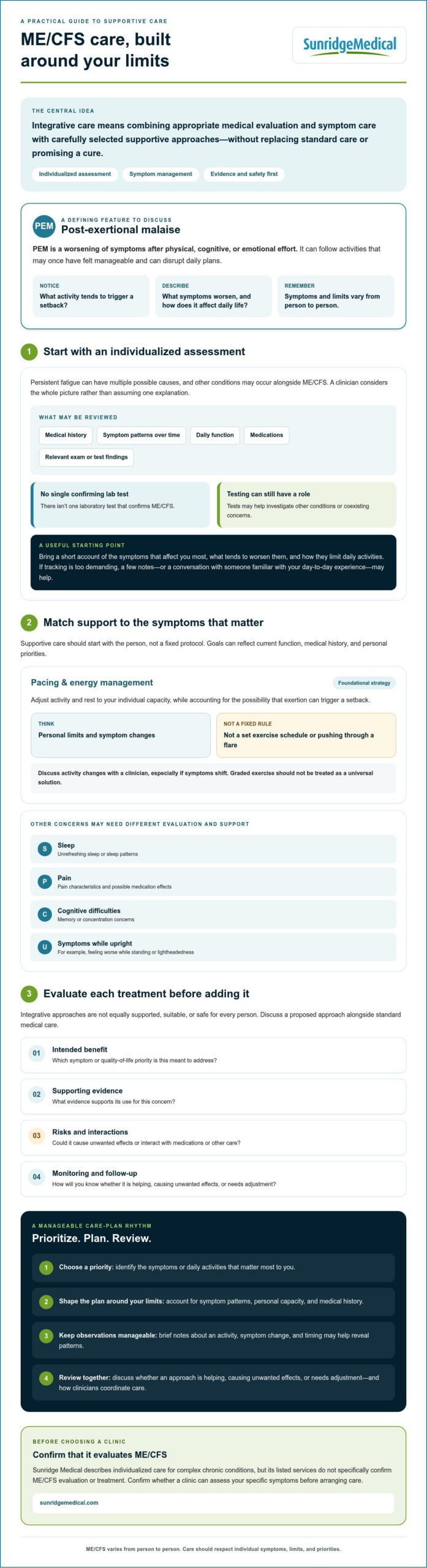
How to build a manageable ME/CFS care plan
A useful plan should make care easier to navigate, not add another demanding routine. Keep the process small and adaptable: identify the concerns that matter most, arrange an evaluation, review possible options with a clinician, and agree on how and when to follow up. Symptoms can fluctuate, so the plan may need to change with your capacity.
Prepare for a clinician appointment
Before the visit, gather only what feels manageable. A concise symptom timeline, current medication and supplement list, and records of prior evaluations can help the clinician understand your history. If writing everything down is too much, note your top concern and a few questions. You might ask how the clinician will assess your day-to-day function, symptom patterns, and possible coexisting conditions, and what the next step will be.
Appointments can take energy. Consider asking a trusted person to join, requesting breaks, or asking whether information can be shared in writing. These accommodations can help you communicate without needing to cover everything at once.
Keep the plan flexible and patient-led
After evaluation, review options in terms of your priorities, likely benefits, risks, and practical demands. Agree on a follow-up approach that doesn’t require intensive tracking. A brief note about a major symptom change or how a new care decision affects an important daily activity may be enough to guide the next conversation. If symptoms worsen or your circumstances change, revisit the plan with your clinician rather than feeling obligated to follow a routine that no longer fits.
Integrative treatment for chronic fatigue syndrome should support medical care and personal goals, not impose a standardized checklist. Priorities might include making meals easier, communicating with family, or preserving energy for a meaningful connection. Emotional support can also be part of care. Living with ongoing symptoms may bring grief, uncertainty, frustration, or isolation, though people’s experiences differ. A mental health professional may help with coping and adjustment. Seeking that support doesn’t mean symptoms are imagined or psychological in origin.
If Lyme disease is a concern, raise it with a clinician as part of an appropriate evaluation rather than assuming it explains your symptoms. This clinical guide to Lyme disease specialists may help you consider questions about that discussion.
Sunridge Medical describes individualized care for complex chronic conditions, but its listed services don’t specifically confirm ME/CFS evaluation or treatment. Contact Sunridge Medical to ask whether it evaluates your specific concerns before arranging care.
Choosing an Integrative Clinician and Next Steps
A useful first conversation should clarify whether a clinician can address your needs, how they make treatment decisions, and how your care will be coordinated. Integrative care should work alongside appropriate medical evaluation and existing care, not leave you managing conflicting recommendations on your own.
What a careful first conversation should cover
Ask directly whether the clinician has experience assessing ME/CFS symptoms and whether they can coordinate with your current clinicians. You can also ask what records would be helpful, what appointment formats are available, how follow-up is handled, and how treatment options are reviewed for evidence, risks, and interactions. Clear answers help you decide whether the approach fits your needs before making a commitment.
Sunridge Medical describes individualized care for complex chronic diseases and combines conventional therapies with research-based alternative approaches. However, its listed services don’t specifically document ME/CFS evaluation or treatment. Confirm directly whether the center can assess your concerns before scheduling. Asking about scope is a practical step, not a judgment about whether your symptoms deserve care.
Next steps that keep care patient-led
Continue appropriate medical care while you consider additional supportive options. You don’t need to pursue every possible intervention at once. Choose one manageable question to raise first, such as how your most disruptive symptom will be evaluated or how a proposed approach would fit with your current medications and care team.
Before agreeing to a plan, make sure you understand its purpose, potential risks, and follow-up process. You should feel able to ask questions, take time to consider recommendations, and discuss changes with the clinicians involved in your care. The right next step may simply be clarifying whether a provider can help with your specific needs.
If you’d like to ask about the center’s scope of care, contact Sunridge Medical to ask about your care needs. This conversation can help establish whether its services are relevant to you; it doesn’t guarantee eligibility or a particular treatment outcome.
Choose a Thoughtful Next Step for Your Care
Care for ME/CFS should reflect your symptoms, daily limits, and priorities. Integrative treatment for chronic fatigue syndrome is best approached with careful medical evaluation, attention to symptom management, and an honest review of each option’s evidence and risks. Supportive approaches should complement, not replace, appropriate medical care.
A manageable next step can be as simple as choosing one concern to discuss with a clinician. Ask how your symptoms will be assessed, how recommendations fit with your current care, and what follow-up would look like.
Sunridge Medical reports that it was founded in 2003 and describes its care for complex chronic diseases as individualized. Its listed services don’t specifically document ME/CFS treatment, so confirm whether its clinicians can address your needs before scheduling or changing existing care. The center states that patients can call its toll-free number to discuss appointments and support.
Contact Sunridge Medical to ask whether its clinicians can address your care needs. A clear conversation can help you decide what to explore next, at a pace that respects your needs.
Frequently Asked Questions
What is integrative treatment for chronic fatigue syndrome?
Integrative treatment for chronic fatigue syndrome combines appropriate medical evaluation with selected supportive approaches tailored to a person’s symptoms and goals. Care should consider post-exertional malaise, other symptoms, health history, and treatment safety. Integrative care doesn’t mean every alternative therapy is proven or suitable. Discuss proposed treatments with a qualified clinician, and don’t stop prescribed care without medical guidance. A thoughtful plan addresses individual needs rather than following a standard package.
Can integrative medicine cure ME/CFS?
No treatment should be presented as a guaranteed cure for ME/CFS. Integrative care may help organize symptom evaluation, support daily function, and guide discussion of options, but evidence and risks vary. Before starting a treatment, ask what it is intended to address, what evidence supports it, and how benefits or adverse effects will be monitored. Be cautious of anyone promising a cure or urging you to abandon standard medical care.
What treatments are used to manage chronic fatigue syndrome symptoms?
Care is individualized, so options depend on symptoms, health history, and tolerance. A clinician may assess sleep, pain, cognitive difficulties, orthostatic symptoms, and post-exertional malaise, then discuss support for specific concerns. Pacing may help some people adjust activity and rest to their limits. It isn’t a fixed exercise prescription, and a one-size-fits-all activity plan may not be appropriate. Review current options and safety with a qualified clinician.
Is exercise recommended for people with ME/CFS?
Exercise shouldn’t be prescribed as a universal solution for ME/CFS. Some people experience post-exertional malaise, in which symptoms worsen after exertion, so pushing through symptoms may be harmful. Discuss movement and everyday activity with a clinician who understands ME/CFS and your individual limits. Any plan should be adapted to your response and reviewed if symptoms change, rather than based on automatic, fixed increases in activity.
How can I tell whether an ME/CFS treatment claim is trustworthy?
Look for a clear explanation of the intended benefit, supporting evidence, uncertainties, possible harms, and follow-up plan. Ask whether the evidence applies to ME/CFS and how the clinician will monitor your response. Be wary of guaranteed cures, pressure to buy quickly, or advice to stop prescribed treatment. Testimonials and biological explanations alone don’t establish effectiveness. An independent qualified clinician can help assess whether an option fits your health history and current care.
What should I bring to an appointment about chronic fatigue symptoms?
Bring a brief symptom timeline, a current list of medications and supplements, relevant medical records, and a few priority questions. If exertion is followed by symptom worsening, mention it, but don’t create a burdensome tracking routine. Ask how the clinician will assess possible causes or coexisting conditions, discuss treatment evidence and risks, and coordinate with your existing care team. A support person may help you remember questions or communicate concerns.
Can emotional support be part of ME/CFS care?
Yes. Counseling, peer support, or help with practical adjustments may support wellbeing while someone lives with illness and uncertainty. This doesn’t mean ME/CFS symptoms are imagined or caused by emotions. Support should respect the person’s experience, preferences, and energy limits. It can complement appropriate medical evaluation and symptom-focused care, but shouldn’t replace them. A patient can choose the kind of support that feels useful, or decline it if it isn’t a priority.