


What if better care means coordinating fewer, more considered decisions rather than adding another treatment? When different clinicians focus on separate symptoms, it’s understandable to feel caught between conflicting recommendations. Comprehensive care for complex illness starts with a fuller view of your health, including your history, current treatments, and priorities.
You deserve to understand how recommendations fit together, what evidence supports them, and what risks or interactions to discuss with your medical team. A thoughtful plan can complement your existing care. It shouldn’t ask you to set aside established treatment or decide before you’re ready.
This guide explains how an individualized assessment and coordinated care plan can work, what to ask about evidence, safety, and communication between clinicians, and how to prepare for next steps. At Sunridge Medical, physician-led evaluations help organize care around each person’s circumstances, with an integrative approach to cancer and complex chronic conditions. The goal is clarity, not pressure, so you can make informed decisions at your own pace.
Key Takeaways
- Comprehensive care for complex illness considers your full health picture and overlapping needs, not just separate symptoms.
- A coordinated plan brings your medical history, current treatments, and personal goals into one considered discussion.
- Conventional and integrative care differ in approach. Integrative care may consider complementary options alongside conventional treatment.
- Prepare for a care discussion by gathering medication details, relevant records, symptom notes, and questions about evidence, risks, and monitoring.
- Sunridge Medical’s physician evaluations and individualized planning address cancer and complex chronic conditions without assuming one approach fits every person.
What Comprehensive Care for Complex Illness Means
Comprehensive care for complex illness is an individualized process for understanding a person’s full clinical picture and coordinating decisions around their diagnoses, treatments, needs, and goals. It does not promise a particular outcome. Instead, it aims to make care more coherent when health concerns overlap or require attention from multiple clinicians.
A complex illness may involve persistent symptoms, more than one diagnosis, or care needs that intersect. For example, someone managing a chronic condition while receiving treatment for cancer may need to keep several medications, specialists, and priorities in view. A symptom can have more than one possible explanation, and a treatment considered for one concern may affect another. The useful question is not simply what else can be added, but how each decision fits the overall picture.
More tests, referrals, or therapies do not automatically create better coordination. Care is better coordinated when relevant clinicians understand the patient’s history and current plan, recommendations are considered in context, and the patient understands the purpose and trade-offs of proposed next steps. The concept of integrated care, described in Integrated Care: A Foundation of Comprehensive Care, emphasizes bringing services and decisions together rather than allowing care to remain fragmented.
When a health concern calls for a broader clinical view
Persistent symptoms can make planning difficult, particularly when their causes are uncertain or several conditions may be contributing. Multiple diagnoses can also mean that different clinicians address distinct parts of a person’s health. Each recommendation may make sense in isolation, yet the patient may be left trying to reconcile them. Feeling overwhelmed in that situation is understandable; it does not mean earlier care was inadequate.
A broader review considers medical history, current and previous treatments, relevant records, and the patient’s priorities together. Those priorities help clarify what matters most, such as managing a specific symptom, understanding treatment options, or reducing conflicting demands. This context gives clinicians a stronger basis for discussing which questions need attention and how recommendations may relate to one another.
Comprehensive care is a process, not a promise
An individualized care plan can evolve as records are reviewed, new information emerges, or a patient’s circumstances change. It may include decisions about which approaches to pursue, which to defer, and what information would help guide the next discussion. A broad review does not mean every available test or therapy is suitable. Each option should have a clear rationale, with potential benefits, limitations, risks, and monitoring discussed with clinicians.
Goals should be realistic, specific enough to guide decisions, and revisited over time. A patient and clinician might agree to focus first on understanding a symptom pattern, then review whether the plan still fits after considering additional clinical information. This measured process supports informed choices without treating uncertainty as a reason to add interventions automatically.
How an Individualized Evaluation Builds a Coordinated Care Plan
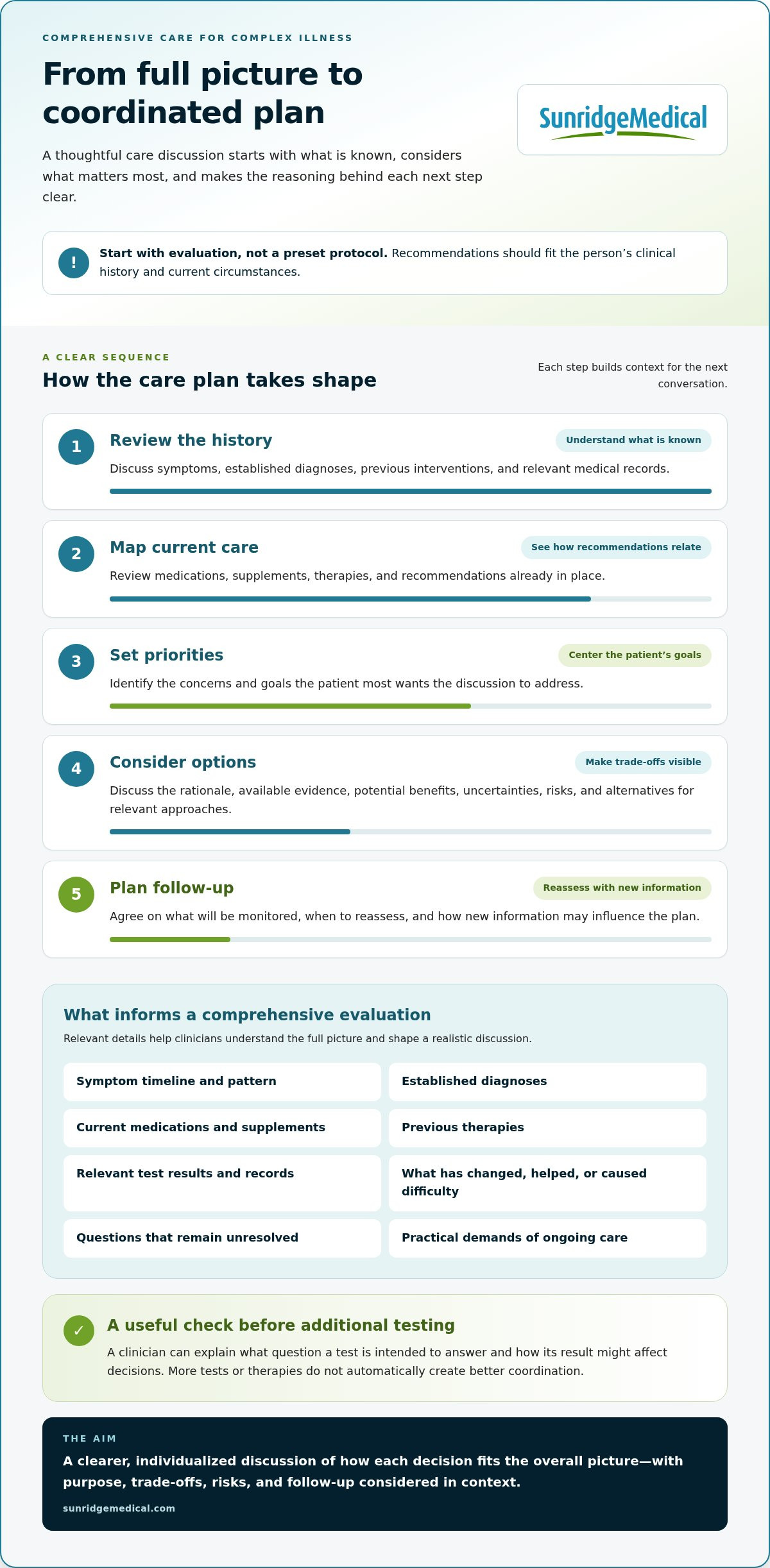
A coordinated plan begins by clarifying what is already known, what care is underway, and what matters most to the patient. Care planning should begin with evaluation, not a preset protocol, because recommendations need to fit the person’s clinical history and current circumstances. This sequence helps make the reasoning behind each proposed step clearer.
What clinicians consider during a comprehensive evaluation
A comprehensive evaluation may include the timeline and pattern of symptoms, established diagnoses, current medications and supplements, previous therapies, and relevant test results or medical records. Patients can help by sharing what has changed, what has helped or caused difficulties, and which questions remain unresolved. Practical considerations, such as the demands of ongoing care, can also help shape a realistic discussion.
Additional testing should have a clinical rationale. A clinician can explain what question a test is intended to answer and how its result might affect decisions. If records are incomplete, identifying what information is available and what may still be needed can clarify the next step without assuming that more testing is automatically better.
The planning process can be organized into a clear sequence:
- Review the history: Discuss symptoms, diagnoses, previous interventions, and relevant records.
- Map current care: Review medications, therapies, and recommendations already in place to understand how they relate.
- Set priorities: Identify the concerns and goals the patient most wants the care discussion to address.
- Consider options: Discuss the rationale, available evidence, potential benefits, uncertainties, risks, and alternatives for relevant approaches.
- Plan follow-up: Agree on what will be monitored, when to reassess, and how new information may influence the plan.
How goals, evidence, and follow-up shape the plan
Patient priorities guide the conversation, while clinical judgment helps assess which options are medically appropriate. A useful discussion makes room for both: the patient can explain what outcomes matter and what concerns they have, while clinicians interpret those goals alongside diagnoses, treatment history, and evidence. The research on comprehensive primary care for complex chronic diseases offers a point of reference for considering how care models are studied. Individual recommendations still require context-specific evaluation.
For people exploring complementary approaches alongside conventional care, Sunridge Medical’s clinical guide to integrative medicine for chronic illness provides further context. Integrative planning should make clear how a proposed approach fits with existing treatment, what is known and uncertain, and what safety considerations require discussion with the care team.
Follow-up keeps a plan responsive. Symptoms, test findings, treatment effects, or personal circumstances may change, so goals and recommendations may need review. Patients may leave an evaluation with questions to clarify, records to gather, or options to consider. Sunridge Medical’s individualized physician evaluations provide a way to explore a care plan shaped around a person’s history and priorities.
Comprehensive, Conventional, and Integrative Care: What Is the Difference?
These terms describe different aspects of care, not competing labels for a single treatment. Conventional care refers to established medical approaches to diagnosis and treatment. Integrative care considers appropriate conventional and complementary approaches together. Comprehensive care describes a broader, coordinated view of a person’s health and needs. In comprehensive care for complex illness, the central question is how decisions fit together, not how many treatments can be added.
| Approach | Primary focus | Coordination and decisions |
|---|---|---|
| Conventional care | Diagnosis, treatment, and management using established medical practice. | Decisions are guided by clinical evaluation and may involve one or more clinicians. |
| Comprehensive care | The person’s wider clinical picture, including overlapping conditions and needs. | Emphasizes connecting relevant information and aligning decisions with clinical context and patient priorities. |
| Integrative care | Considering appropriate conventional and complementary approaches together. | Options are assessed in context, including evidence, safety, suitability, and how they relate to current treatment. |
Comprehensive or integrative care does not automatically mean stopping established treatment. A patient may continue conventional care while discussing whether a complementary approach has a reasonable role alongside it. Discuss any change to prescribed treatment with the clinician responsible for that care. Coordination is intended to make choices more informed, not to displace necessary medical management.
What makes care integrative rather than simply alternative
Integration means considering suitable options together, with attention to how they may interact and whether they fit the patient’s health situation. It differs from treating a complementary approach as a replacement for established care without evaluating the consequences. For cancer-related decisions, Sunridge Medical’s integrative oncology guide offers further context on considering approaches within a clinical picture.
How to assess evidence, safety, and treatment interactions
Evidence, safety, and suitability vary by therapy and clinical situation. Ask what a proposed approach is intended to address, what evidence supports that use, where uncertainty remains, and what risks or alternatives deserve consideration. A careful discussion should distinguish evidence for a specific purpose from broad claims that a therapy can treat an illness.
Share all medications, supplements, and treatments with the care team, including complementary products. This helps clinicians consider possible interactions and assess the plan as a whole. The National Center for Complementary and Integrative Health (NCCIH) offers research information about complementary health approaches, while the U.S. Food and Drug Administration (FDA) provides safety information about regulated products. These resources can inform questions, but they don’t replace advice tailored to your medical history.
How to Prepare for a Complex-Illness Care Discussion
A little preparation can make a complex-care conversation more focused, even if you don’t have every record or answer. The aim isn’t to arrive with a diagnosis or decide on a treatment in advance. It’s to give clinicians a clear account of what you’re experiencing, what care is already underway, and what you hope to understand. That information can help shape a discussion of comprehensive care for complex illness around your actual circumstances.
Records and questions to bring to a consultation
Gather what’s readily available, and keep notes simple. A medication list should include prescriptions, over-the-counter products, and supplements. Bring relevant diagnoses, test results, visit summaries, and information about previous treatments if you have them. If you can’t obtain a record before the discussion, note where it may be held rather than delaying the conversation.
For symptoms, record when they began, how they change, and what effect they have on daily activities. Describe what you notice without trying to determine the cause. If a treatment seemed to help or caused a concern, note when that happened and share it as an observation.
- Bring: A current medication and supplement list, diagnoses, and available medical records or test results.
- Note: Symptom timing, changes, patterns you observe, and effects on sleep, work, or daily routines.
- Prioritize: The questions or concerns you most want addressed, so they don’t get lost in a long discussion.
How to discuss existing clinicians and ongoing treatment
Share a factual overview of your current treatment and the clinicians involved, including recent changes and any recommendations you’re following. This context helps make a coordination conversation more complete. Explain what you understand about your existing plan, where you have questions, and what you’d like the clinicians to clarify. Seeking another perspective doesn’t require dismissing established decisions or changing treatment on your own.
Consider asking:
- What is the rationale for this option, and what evidence supports its intended use?
- What uncertainties, risks, or alternatives should I understand?
- How would this fit with my current medications and treatments?
- What should be monitored, and when should the plan be reviewed?
- How can recommendations be shared or coordinated with my current clinicians?
If Lyme disease is part of your care history, Sunridge Medical’s clinical guide to Lyme disease specialists can help frame questions for an individualized discussion. Use any guide as preparation, not as a substitute for evaluating your own medical history with a clinician.
You don’t need to resolve every question in one visit. A useful next step may simply be identifying what information is missing and what you want clarified before making a decision. To explore an individualized physician evaluation, learn about care planning at Sunridge Medical.
Exploring Comprehensive Care at Sunridge Medical
Considering a new clinical perspective can bring questions as well as hope. At Sunridge Medical, physician-led evaluations consider an individual’s medical history, current care, and priorities when developing a care plan. The aim is to make options easier to understand and discuss, not to promise a particular outcome or assume the same approach suits everyone.
A physician-led approach to complex conditions
Led by Medical Director Dr. Steven S. Isaacman, Sunridge Medical has provided care for cancer and complex chronic conditions since its founding in 2003. An individualized plan may consider conventional therapies alongside research-based alternative approaches, with options discussed in the context of a patient’s clinical circumstances. This measured approach recognizes that the role, evidence, and suitability of any therapy can vary.
The center’s care includes cancer protocols and support for chronic Lyme disease, autoimmune conditions, hormone-related concerns, environmental illness, and neurologic conditions. These categories involve different clinical considerations. A person’s diagnosis, treatment history, medications, and goals help inform evaluation and planning. A protocol used for one patient should not be presumed appropriate for another. Discuss any proposed approach in terms of its purpose, evidence, uncertainties, and potential risks.
For people seeking comprehensive care for complex illness, an evaluation offers an opportunity to examine the full clinical context before considering options. It can also help clarify how an integrative approach relates to existing care. Exploring that possibility does not require setting aside established treatment or making a decision before you feel informed.
What to expect when taking the next step
An evaluation discussion can begin with your health history, diagnoses, current and previous treatments, relevant records, and the concerns you most want addressed. Explain what you hope to learn, what questions remain, and which practical considerations matter to you. A medication and supplement list or available medical records may help make the conversation more specific, but you can still raise questions if some information is not at hand.
From there, the discussion can focus on whether additional evaluation or a tailored plan may be appropriate, what options might be considered, and how those options relate to care already underway. Ask about the rationale for recommendations, what is known or uncertain, possible risks, and how clinicians would approach monitoring or reassessment. You can take time to consider the information and discuss relevant decisions with your current care team.
If you’re weighing whether an individualized evaluation is a suitable next step, Sunridge Medical welcomes you to start a conversation about your circumstances and questions. Contact Sunridge Medical to discuss an evaluation.
Take the Next Step at Your Own Pace
Exploring comprehensive care for complex illness doesn’t require you to commit to a new treatment plan right away. You can approach the next conversation as a chance to clarify what you want help understanding, what information may be useful, and whether an individualized evaluation feels appropriate for your situation.
Start with the question that matters most to you. You might want to understand how a proposed approach fits with current care, what evidence informs a recommendation, or what decisions can wait until you have more information. Bringing that question forward can make the first step feel more manageable, even if you’re still weighing your options.
Sunridge Medical offers individualized physician evaluations and care planning for people considering support for cancer and complex chronic conditions. If you’re ready to explore whether an evaluation could help you move forward with greater clarity, contact Sunridge Medical to discuss your next step. You deserve thoughtful care conversations, and you can take them one decision at a time.
Frequently Asked Questions
Is comprehensive care the same as integrative medicine?
No. Comprehensive care describes how a person’s health needs and decisions are considered together, while integrative medicine describes an approach that may consider conventional and complementary therapies together. A care plan can be comprehensive without including complementary therapies. For example, coordinating appointments and decisions among clinicians treating different conditions may be comprehensive, even if the plan relies only on conventional medical care.
Can complementary therapies be used alongside conventional treatment?
Sometimes, but suitability depends on the therapy, the condition, and the person’s other treatments. A supplement, for example, may affect how a medication works, so disclose it to the clinicians managing your care before starting or changing it. Ask what a complementary approach is intended to do, what evidence supports that purpose, and whether it could interfere with current treatment. Don’t stop prescribed care without discussing changes with your clinician.
What should I bring to a complex-illness consultation?
Bring a current list of medications and supplements, including doses if known, plus any relevant diagnoses, test results, or visit summaries you have. A short symptom timeline can be useful: note when a concern began, what changed, and how it affects daily activities. You might also write down your top questions and one or two goals for the visit. This makes it easier to use the appointment for the issues that matter most.
How do clinicians coordinate care when several conditions overlap?
Clinicians can review how diagnoses, symptoms, medications, and treatment recommendations relate, rather than considering each concern in isolation. You can help by giving a complete account of your care team and sharing relevant updates, such as a recent medication change. Ask which clinician is guiding each part of your care and how important updates should be communicated. This can make responsibilities clearer and help surface questions that need discussion between clinicians.
Does comprehensive care mean I need to try more treatments?
No. A comprehensive approach doesn’t require adding therapies. Sometimes the most useful decision is to maintain the current plan, gather more information, or defer an option while its risks and rationale are discussed. You can ask what decision needs to be made now, what can wait, and what the alternatives are. That helps keep care focused on your clinical needs rather than treating the number of interventions as a measure of progress.
Does Sunridge Medical provide emergency or inpatient care?
Emergency and inpatient needs call for prompt care through emergency services or a hospital. If you think you may be experiencing a medical emergency, contact local emergency services or go to an emergency department rather than waiting for a consultation. For urgent concerns that aren’t an emergency, follow the guidance of the clinicians currently responsible for your care.
Does Sunridge Medical bill standard health insurance?
Insurance coverage and payment depend on the terms of a health plan and the services involved. Review your plan’s terms before making a decision, and keep notes about the services discussed and any billing information you receive. This can help you understand your coverage and follow up on questions about payment.