

Everyone wants the easy story about glutathione IV drip benefits. Clinics and social media often sell it as a universal detox, a quick brightening fix, and an anti-aging shortcut. The evidence is narrower than that, and the difference matters if you're considering treatment in Scottsdale or anywhere in the Phoenix area.
What stands up best is not a broad wellness promise, but a small set of more defensible uses, plus a few cosmetic claims that are much weaker and often temporary. If you understand where the data is solid, where it's thin, and where the biology doesn't match the marketing, you can ask much better questions before you commit to an IV.
Table of Contents
- Why Glutathione IV Drips Get More Hype Than Evidence
- What Glutathione Actually Is and How Your Body Uses It
- The Glutathione IV Drip Benefits People Actually Ask About
- The Short Half-Life Problem Nobody Talks About
- Where IV Glutathione Has Real Clinical Evidence
- Safety, Dosing, and the IV Versus Oral Question
- How Sunridge Medical Approaches Glutathione IV Therapy
Why Glutathione IV Drips Get More Hype Than Evidence
The sales pitch is easy to understand. Get an IV, remove toxins, look brighter, feel younger. That message sounds active and reassuring, but the published evidence does not support that kind of universal promise. A 2024 review in PMC found that one randomized trial reported lighter skin in some people receiving 1,200 mg IV glutathione twice weekly for 6 weeks, but the effect was short-lived and faded by 6 months (PMC review).
That is the central gap with glutathione IV drip benefits. The clearest outcome in the literature is a temporary cosmetic change, not a durable clinical shift. That matters because patients are often told to expect detox support, higher energy, and better immunity from the same infusion. Those claims are broader than the evidence.
Practical rule: if a therapy is advertised for everything, the evidence is usually strongest for only a few things.
What the marketing skips
Many clinic pages present IV glutathione as if it automatically improves detox, energy, immune function, and aging. Neutral reviews are much narrower. A critical review in a recent dermatology review says the proposed anti-aging and dermatologic benefits rest mainly on small, uncontrolled studies or anecdotal reports, with no large randomized trials confirming validated aging outcomes.
That does not make glutathione meaningless. It means the claims need to be sorted by evidence, not by how often they appear in clinic brochures. In practice, an integrative clinic looks at the actual reason for considering the infusion, current medications, liver and kidney status, and whether the goal is antioxidant repletion, symptom support, or a cosmetic request that may not justify the cost and effort. If you are comparing options at Sunridge Medical's IV therapies page, that is the level of screening that should come before any drip is booked.
What Glutathione Actually Is and How Your Body Uses It
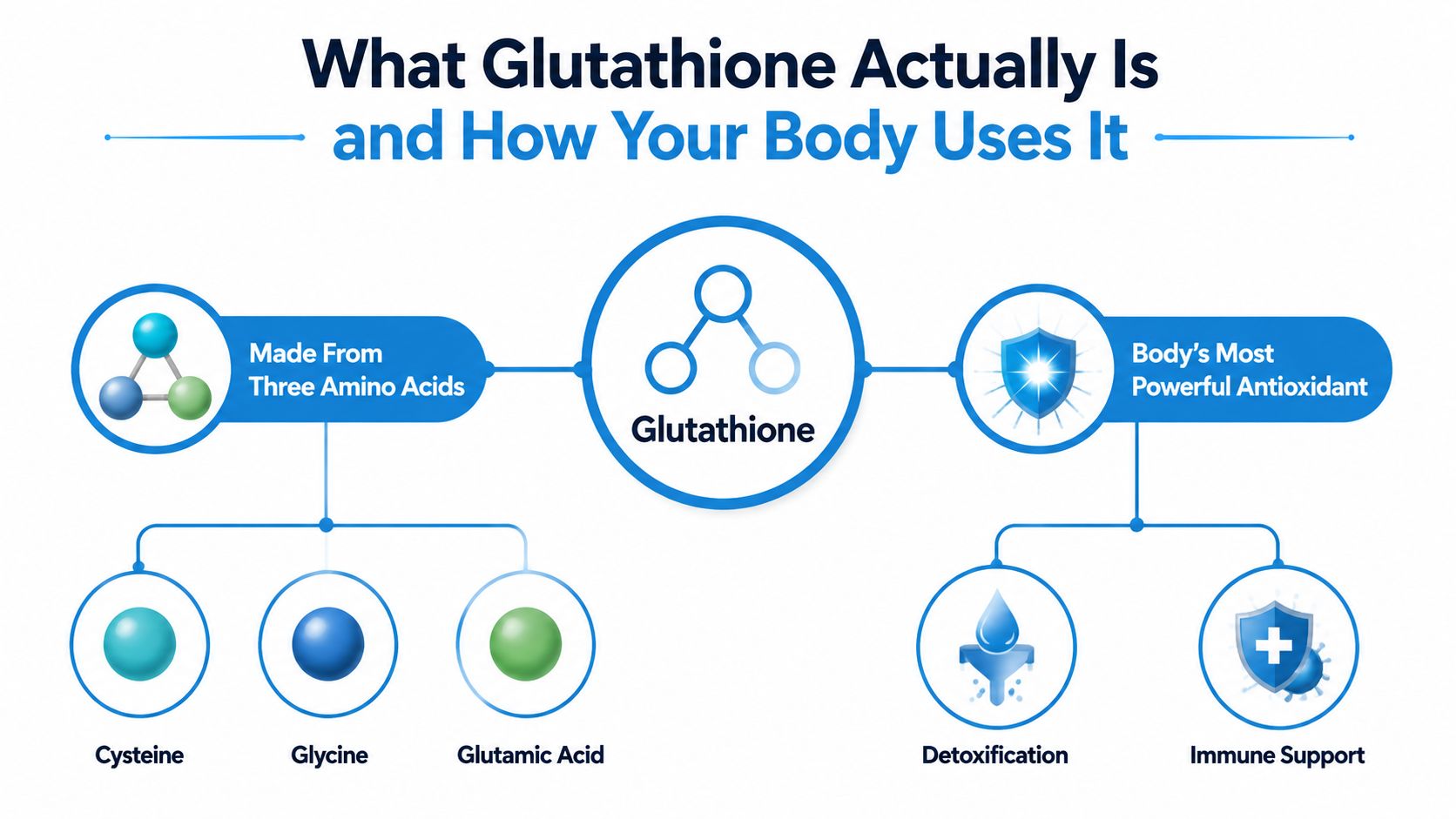
Glutathione is a tripeptide, made from three amino acids, and your cells use it constantly to manage oxidative stress. Think of it as part recycling crew, part cleanup crew. It helps neutralize reactive oxygen species and supports other antioxidant systems, including vitamins C and E, so the cell doesn't have to handle every stressor alone.
Made From Three Amino Acids
Those three building blocks are cysteine, glycine, and glutamic acid. The body makes glutathione on its own, so it's not a nutrient you're supposed to get only from a drip. Most of the discussion around supplementation exists because people wonder whether stress, illness, age, or toxin exposure can outpace the body's normal production.
For a technical look at peptide preparation, a useful reference is glutathione peptide preparation from PepFlow. It's not a clinical endorsement, but it does help show why formulation and delivery are separate questions from the biology of the molecule itself.
Why IV delivery gets attention
IV delivery bypasses digestion, which is why it gets used at all. In theory, that can create a more immediate rise in blood levels than oral intake. Sunridge Medical also discusses heavy metal detoxification therapy in the context of targeted detox support, and that's where glutathione often gets discussed in real clinical practice, as part of a broader plan rather than as a stand-alone cure.
The presence of an antioxidant in the bloodstream doesn't automatically translate into a meaningful outcome in the body. The body cares about time, dose, and the reason you're using it.
That's why the rest of the discussion has to separate mechanism from proof. Glutathione has a real biological role. The question is which uses have enough human data to justify an infusion, and which uses remain more marketing than medicine.
The Glutathione IV Drip Benefits People Actually Ask About
Patients usually ask about a handful of outcomes, not about biochemistry. They want to know whether glutathione helps with detox, skin brightening, energy, immune support, or anti-aging. Those are fair questions, but they do not deserve the same answer.
Evidence Snapshot for Common Glutathione IV Drip Benefits
| Claimed Benefit | Quality of Evidence | Realistic Verdict |
|---|---|---|
| Antioxidant support | Biologically plausible, limited direct outcome data | Reasonable as a mechanistic goal, not a guaranteed symptom fix |
| Hepatic detoxification support | More defensible than cosmetic claims, but still limited for IV use | Plausible adjunct in selected patients, not a proof of “detox” |
| Skin brightening | Some human data, including temporary change in one trial | Possible short-term change, durability is poor |
| Energy and mental clarity | Mostly anecdotal and indirect | Not a reliable primary reason to use IV glutathione |
| Immune support | Mechanistically plausible, weak clinical proof for broad wellness | May fit niche supportive care, not a universal immune booster |
| Anti-aging | Weakest category, little validated human outcome data | Marketing claim, not an evidence-based promise |
The strongest reading is that glutathione supports oxidative-stress management and may have a role where redox balance is part of the clinical picture. The weakest reading is that it works like a general anti-aging tonic. A recent dermatology review also notes little evidence that IV antioxidants outperform oral intake for cosmetic goals, which should make any skin-brightening claim feel more cautious than catchy (PubMed review).
What patients usually overestimate
“IV” does not mean stronger in every sense. It changes exposure, but it does not rescue a weak endpoint. Clinics that market glutathione for skin lightening should also be able to explain the trade-offs, including the fact that human review articles have raised concerns about poor efficacy and safety for cosmetic use.
A practical clinic also separates symptom-driven care from cosmetic promotion. If a patient is asking about brain fog, fatigue, or a broader infusion plan, that conversation belongs in a targeted medical framework such as IV therapy for brain fog, where the question is whether an infusion fits the problem rather than whether it sounds advanced.
The right question is simple. Does the therapy match the clinical problem, or is it just a polished version of the same marketing claim?
The Short Half-Life Problem Nobody Talks About
The pharmacokinetics explain a lot of the hype gap. After an infusion of 2 g, plasma glutathione and cysteine rose significantly, and glutathione excretion increased by about 300-fold in the 90 minutes after infusion, with an apparent half-life of 14.1 ± 9.2 minutes (research summary). That is a fast spike, not a long residence time.
Why that matters in real life
A treatment that rises quickly and clears quickly can still be useful, but it changes the burden of proof. If a clinic claims sustained detox, better energy for days, or durable skin change from one infusion, the biology should make you skeptical. Short exposure windows are one reason repeated dosing schedules show up in studies and in practice.
Biochemical change is not the same as clinical benefit
The bloodstream can change before the person changes. That's an important difference. A marker can move on a lab report while symptoms, function, or appearance stay the same.
Clinical takeaway: an IV can create a measurable spike without proving that the patient got a meaningful result.
This is why the question is never just “does glutathione get into the blood?” It does. The more important question is whether that transient exposure creates a lasting outcome that matters to the patient sitting in the chair. For some uses, especially narrow supportive roles, that may be enough. For broad wellness claims, it usually isn't.
Where IV Glutathione Has Real Clinical Evidence
The clearest defensible use in the literature is chemotherapy-related neuroprotection. IV glutathione given at 1.5 g/m² before each platinum chemotherapy cycle has been recognized for helping prevent cisplatin-associated neurotoxicity, which is a much narrower and more credible indication than generic wellness claims (clinical guide).
What that means for patients
Oncology support follows a different logic from cosmetic use. In that setting, the aim is not a vague promise that someone will “feel better.” The aim is to reduce a specific treatment toxicity while standard cancer care continues. That is a different evidentiary bar, and it is why IV glutathione belongs in serious integrative oncology discussions rather than in spa-style marketing.
For liver disease and general immune-function claims, the evidence is much weaker. Reviews note that there are no published RCTs supporting IV glutathione for those uses, and that matters because those are the claims patients hear most often (clinical guide). That does not prove the therapy has no effect. It does mean the common marketing language is out ahead of the data.
How to interpret the gap
One therapy can have a real role and several unsupported ones. That is the situation here. Patients with complex cancer care, multiple medications, or prior treatment toxicity need precision, not a broad “detox” label.
For patients who want a broader integrative frame, Sunridge Medical's oncology and chronic illness model is relevant because it evaluates therapies in the context of the full treatment plan, not as isolated wellness products. A therapy like glutathione can fit that approach, but only when the target is specific and the trade-offs are clear.
Safety, Dosing, and the IV Versus Oral Question
The safest answer to the IV versus oral question is not “IV is always better.” It's “better for what, and for whom?” Clinics use a wide range of doses, but there's no universally accepted protocol for all patient types, and that should make you cautious if a recommendation sounds automatic.
What patients should ask before starting
- Why this route: Ask why IV is preferred over oral glutathione or a precursor approach such as NAC for your specific goal.
- What the target is: Ask whether the aim is oxidative stress support, chemotherapy support, skin concerns, or something else.
- What monitoring is planned: Ask which labs or symptoms will be followed, and how response will be judged.
- What the stop point is: Ask when the treatment would be considered unhelpful, too risky, or not worth repeating.
A high-value resource for people comparing delivery forms is the guide to Quicksilver liposomal glutathione, which helps illustrate why oral and liposomal strategies are often discussed as practical alternatives rather than inferior afterthoughts.
IV or oral is not a simple upgrade
IV delivery does bypass digestion, but that doesn't make it the right choice for every patient. Oral or precursor-based options may be enough for maintenance goals, lower-intensity support, or situations where the main concern is convenience rather than immediate exposure. In a patient with cancer, neurologic disease, environmental toxicity, or a complicated medication list, the route decision should be individualized.
For patients comparing broader infusion strategies, Sunridge Medical's intravenous vitamin C therapy guide is helpful because it shows how a clinic can think about infusion therapy as part of a larger plan rather than a one-size-fits-all recommendation.
How Sunridge Medical Approaches Glutathione IV Therapy
At an integrative clinic in Scottsdale, the right question isn't whether glutathione is trendy. It's whether it fits the patient's diagnosis, medication list, symptom pattern, and treatment goals. That matters especially for people with cancer, autoimmune disease, neurologic symptoms, environmental exposure concerns, or fatigue that hasn't improved with standard care.
How a real evaluation changes the decision
Sunridge Medical's approach starts with the whole picture, not with the drip itself. A clinician reviews the reason for treatment, current therapies, and whether glutathione is being considered for antioxidant support, adjunctive detoxification support, or a narrower supportive role within a larger protocol. In some cases, that may include a broader IV strategy or oxidative medicine plan. In others, the more careful answer is to hold off or choose a different route.
The most useful candidates are usually patients with a defined clinical context, not people looking for a general wellness boost. Patients on active chemotherapy, people with complex multi-system illness, and those with concerns about tolerability or medication interactions deserve the most caution and the most individualized planning.
What a patient should expect to discuss
- Treatment goal: Is the infusion being used for support, symptom management, or protocol-based care?
- Medication review: Are there interactions or timing issues with current therapies?
- Risk profile: Is the patient a good fit for IV therapy at all, or would another approach make more sense?
- Follow-up plan: How will the team know whether the infusion is helping?
That is the practical difference between evidence-informed care and marketing. The first asks whether the treatment is justified in this person. The second assumes the drip is the answer.
If you're in Scottsdale, Phoenix, Paradise Valley, Tempe, Mesa, Chandler, Gilbert, or elsewhere in the greater Phoenix area and you're trying to figure out whether glutathione IV drip benefits are relevant to your situation, an integrative consultation can clarify the trade-offs. It's often the fastest way to determine whether an infusion belongs in your plan, or whether another option is more appropriate.
Sunridge Medical in Scottsdale evaluates glutathione IV therapy in the context of your diagnosis, medications, and goals, so you're not left guessing whether a drip is appropriate. If you're considering integrative support for cancer care, complex chronic illness, or a targeted IV protocol, visit Sunridge Medical to request a consultation and discuss whether this approach makes sense for your case.
Composed with Outrank tool