

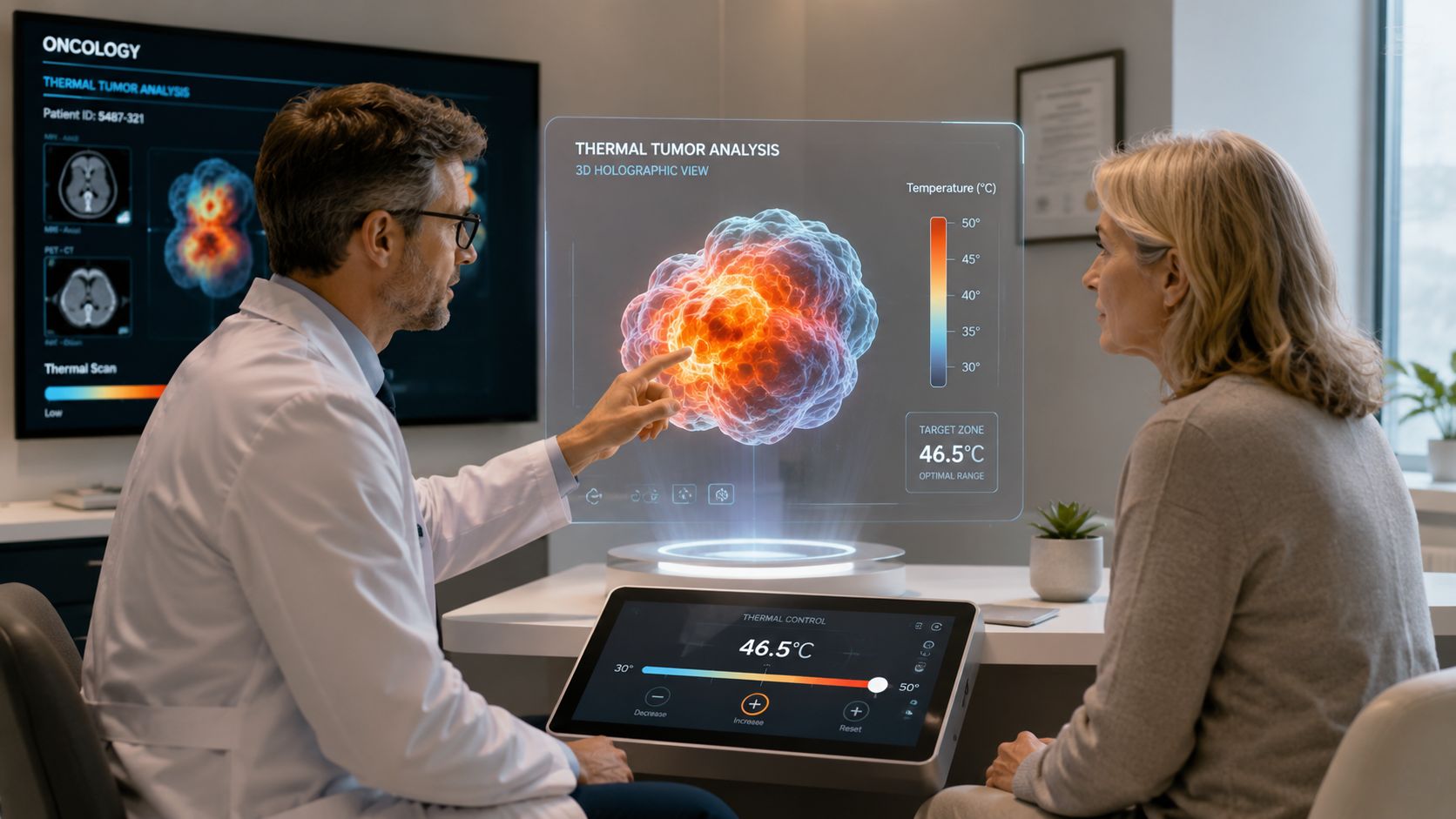
You've finished standard cancer treatment, or you're still moving through radiation or chemotherapy, and you're looking for additional options that are evidence-informed rather than experimental promises. A clinician may mention hyperthermia treatment planning, but the important question isn't whether heat can be used. It's whether your tumor's location, treatment history, overall health, and existing oncology schedule make a carefully designed plan reasonable.
Hyperthermia isn't one fixed procedure delivered the same way to every patient. Clinicians must decide who may benefit, how the target will be heated, how long each session should last, when treatment should occur relative to radiation or chemotherapy, and how the team will monitor both the tumor and nearby normal tissues. This patient-centered approach is especially important for people considering care in Scottsdale, Phoenix, or elsewhere in the greater Phoenix metropolitan area.
Table of Contents
- Why Planning Matters in Hyperthermia Cancer Treatment
- Who Is a Good Candidate for Hyperthermia
- Temperature Targets and Dosing in a Hyperthermia Plan
- Scheduling Hyperthermia With Radiation and Chemotherapy
- What Logistics Look Like During a Course of Treatment
- Safety Monitoring and the Limits of Temperature Measurement
- How Sunridge Medical Approaches Hyperthermia Treatment Planning
Why Planning Matters in Hyperthermia Cancer Treatment
A patient named Maria, for example, may have a recurrent lesion near the surface of the body after completing conventional treatment. She may hear that local hyperthermia could complement radiation and reasonably ask, “Will the heat reach the tumor, and how will you know?” Those questions belong in the consultation before treatment begins, not after the first session.
The treatment team reviews imaging, pathology, prior therapies, tumor depth, nearby organs, and the intended combination with standard oncology care. They then use those details to develop a patient-specific plan rather than applying heat broadly and hoping the target receives enough energy. The plan must balance a therapeutic temperature in the tumor against protection of skin, muscle, nerves, and other critical tissues.
The field moved toward this individualized model over time. An American Association of Physicists in Medicine report on hyperthermia treatment planning was published in 1989, and a widely cited review described the discipline's progression from basic technology into a structured clinical planning area. The 1992 ESHO/COMAC BME taskforce report became the first document summarizing techniques and measurement data needed for planning and validation, marking a shift from empirical heating toward simulation-based treatment design (historical review of hyperthermia treatment planning).
The questions a careful plan should answer
A meaningful consultation should clarify:
- Candidate selection: Is the tumor type, location, and extent appropriate for local heating?
- Thermal targets: What temperature range is being pursued, and how much of the tumor is expected to reach it?
- Treatment coordination: How will sessions fit with radiation, chemotherapy, surgery, or other care?
- Verification: What measurements and modeling will show whether the intended thermal dose was delivered?
- Safety: How will the team limit heating in normal tissue and respond to discomfort?
Patients researching outcomes can also review this educational discussion of hyperthermia cancer treatment success rates, while remembering that individual results depend on diagnosis, treatment combination, and technical execution. A well-designed plan can improve precision, but it can't guarantee a response or eliminate all uncertainty.
Who Is a Good Candidate for Hyperthermia
The first planning decision is whether local hyperthermia makes clinical sense for a particular patient. Current guidance describes the best-documented outcomes with hyperthermia combined with radiation in relatively small, superficial lesions. Local heating is less suited to a situation in which cancer is widespread throughout the body, and patients with widespread metastatic disease are unlikely to benefit from local hyperthermia as a treatment for all disease sites (clinical guidance on local and whole-body hyperthermia).
That doesn't mean a diagnosis alone determines eligibility. The physician also considers whether the target can be reached by the available heating system, whether surrounding anatomy can be protected, whether the patient can tolerate positioning, and how the proposed treatment fits with the primary oncology plan. Prior radiation, implanted devices, organ function, and cardiopulmonary status may also affect the discussion.
Access is another practical issue. The National Cancer Institute notes that only a small number of hospitals and cancer centers have the specialized machines and skilled staff required to provide hyperthermia. Patients in Scottsdale, Phoenix, Paradise Valley, Tempe, Mesa, Chandler, Gilbert, and surrounding communities may need to ask specifically about equipment, clinical experience, treatment monitoring, and coordination with their oncology team.
A practical comparison
| Clinical Situation | Role of Hyperthermia Planning |
|---|---|
| A relatively small superficial lesion considered for combination treatment | Planning may be especially relevant because the target can be defined and local heating can be coordinated with radiation. |
| A deep or difficult-to-reach target | Planning becomes more technically demanding, with greater attention to modeling, sensor placement, tissue variation, and protection of nearby structures. |
| Widespread metastatic disease | Local hyperthermia is unlikely to address disease throughout the body, so the physician must consider whether another treatment strategy is more appropriate. |
| A patient already receiving radiation or chemotherapy | The team must review the full calendar and determine whether the proposed combination has a reasonable clinical rationale. |
| A patient seeking treatment without a clear target | The physician may first need additional imaging, pathology review, or a second opinion before discussing a heating plan. |
A thoughtful patient should bring imaging reports, pathology, treatment summaries, medication lists, and the names of current oncology physicians. A consultation about integrative cancer treatment by stage can help organize those factors, but treatment decisions still require individualized medical review.
Temperature Targets and Dosing in a Hyperthermia Plan
Temperature language can sound more complicated than it is. A plan may refer to a general heating range, a target-volume goal, and measures such as T90 or T50. These terms describe not only the highest temperature reached, but also how consistently heat is distributed through the treated region.
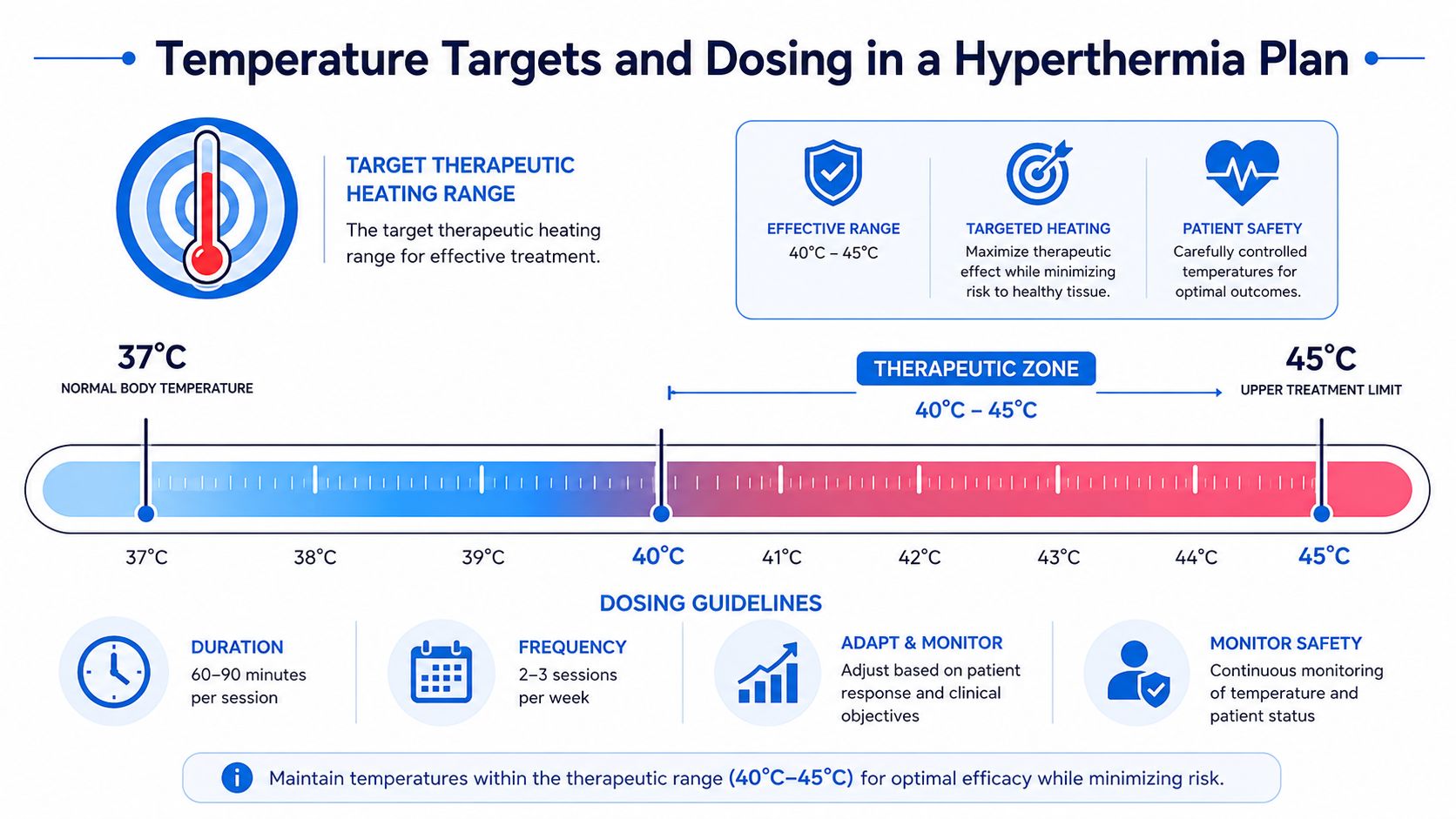
Clinical hyperthermia is generally delivered as local tumor heating in the range of 40 to 45°C. Planning guidance often aims for T90 above 40°C and T50 above 41°C, while keeping maximum temperatures around 43 to 45°C to support local tumor control and limit harm to normal tissue (thermal dose and temperature guidance).
What T90 and T50 mean
Think of the treatment area as a group of measured or modeled temperature points.
- T90 above 40°C means the temperature at which most of the target volume, represented by the lower-temperature portion of the distribution, is above 40°C.
- T50 above 41°C describes the midpoint of the temperature distribution, with half of the evaluated volume above that level and half below it.
- Maximum temperature limits help prevent the hottest area from exposing normal tissues to an unacceptable thermal dose.
The goal isn't to make every point equally hot. It's to create a useful and controlled temperature distribution in the tumor while avoiding excessive heating at the edges or in nearby sensitive structures.
How a course is usually described
A proposed plan may specify:
- Session duration: Quality-assurance guidance for interstitial hyperthermia recommends maintaining the target volume at 40 to 44°C for 30 to 60 minutes, while keeping critical normal tissues below their prescribed thermal dose limits (interstitial hyperthermia quality assurance guidance).
- Number of visits: Depending on the protocol, a course may involve roughly 8 to 12 treatments, not one isolated appointment (clinical review of hyperthermia treatment schedules).
- Temperature verification: The team should explain which points are directly measured and which temperatures are estimated through simulation.
- Tolerance and adjustments: The plan may be modified if positioning, discomfort, tissue response, or measured temperatures differ from expectations.
Ask the physician to translate the technical plan into plain language: “What temperature are you targeting, for how long, and how much of my tumor do you expect to reach that temperature?”
Scheduling Hyperthermia With Radiation and Chemotherapy
A treatment calendar is part of the clinical plan, not a clerical detail. Hyperthermia may need to fit around radiation fractions, chemotherapy administration, blood-count checks, recovery time, transportation, and other appointments. The appropriate schedule depends on the cancer, treatment combination, treatment goal, and protocols available at the treating center.
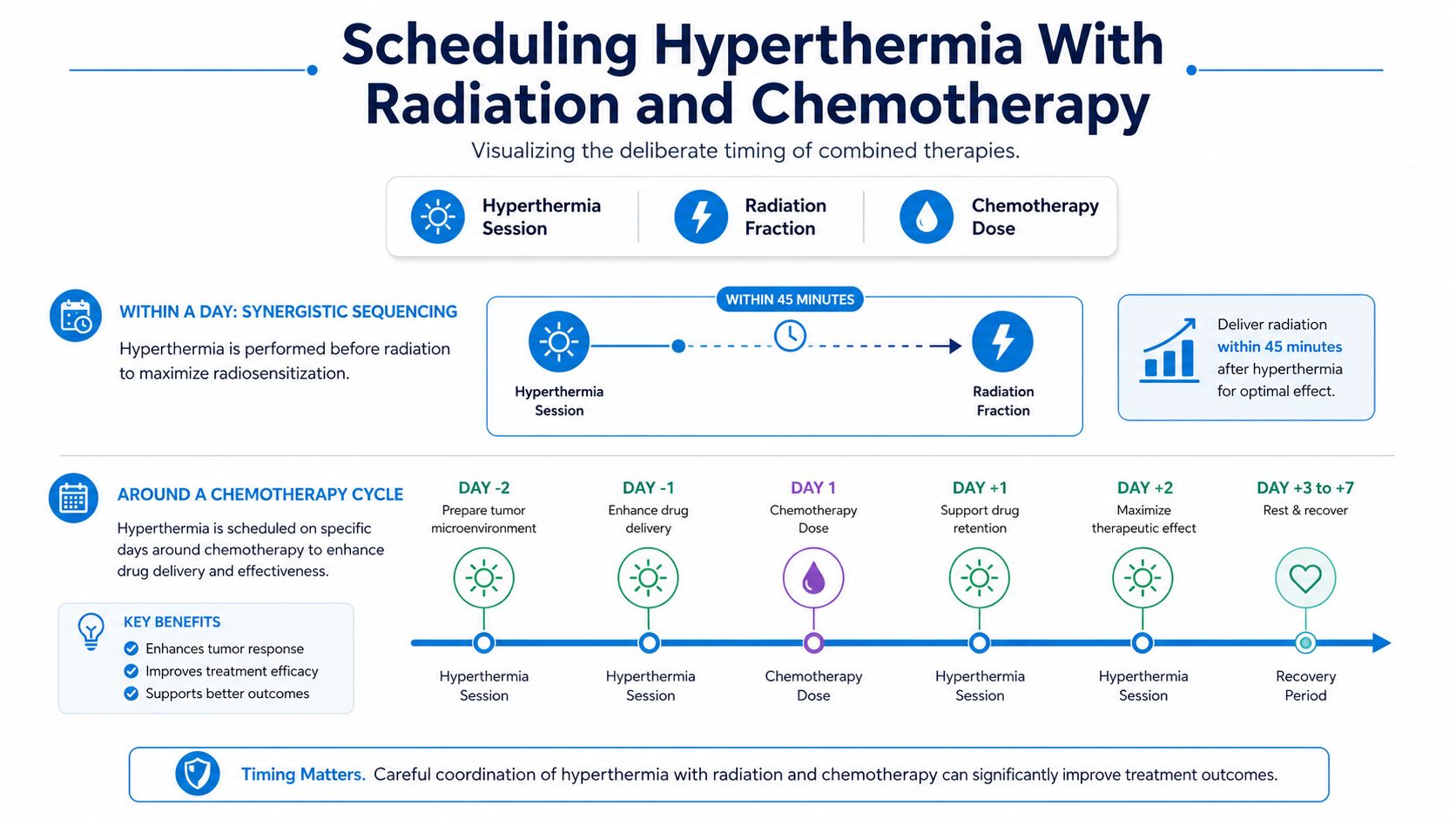
Published clinical descriptions include 60-minute sessions two times per week for about four to five weeks, or roughly 8 to 10 sessions. Other evidence-based guidance describes treatments often delivered every 72 hours for a total of 10 to 12 treatments (clinical evidence on hyperthermia schedules). These examples illustrate why there is no universal calendar. Your proposed schedule should be explained as a protocol-specific decision, not as a pattern every patient will follow.
Coordinating with radiation
Radiation oncology teams may coordinate hyperthermia with radiation as parts of one combined course. Ask which treatment comes first, whether both appointments should occur on the same day, and what happens if a radiation visit is delayed. The answer should be clear enough for you to understand how timing is expected to support the overall plan.
Coordinating with chemotherapy
Chemotherapy creates a different set of scheduling constraints. The oncology team may review blood counts, hydration, medication side effects, organ function, and the timing of each cycle before placing hyperthermia appointments. Patients can read this guide to chemotherapy frequency for general background, but the treating oncology team must set the individual calendar.
Before agreeing to treatment, ask:
- Who owns the calendar? Identify the clinician responsible for reconciling all appointments.
- What happens after a missed session? Ask whether it can be rescheduled and whether the course changes.
- Which symptoms require a call? Clarify how fever, dehydration, skin changes, pain, or unusual fatigue should be reported.
- How will records be shared? Confirm that the hyperthermia and conventional oncology teams can exchange relevant treatment information.
A well-planned schedule fits the patient's complete care pathway, including treatment timing, recovery, communication, and practical access to appointments.
What Logistics Look Like During a Course of Treatment
A hyperthermia appointment follows a repeatable sequence. The team positions you so the treatment area matches the plan, checks the equipment, and confirms that heating can begin safely. Consistent positioning matters because even small changes can alter where energy is deposited. Staff may use treatment marks, cushions, masks, or other supports to help reproduce the planned setup at each visit.

During heating, expect sustained warmth, pressure from positioning equipment, or localized discomfort. Report pain, a sudden change in sensation, or difficulty remaining still right away. The team can check the applicator and readings, adjust the setup, or stop the session if needed.
The heating period is only one part of the visit. Plan for check-in, positioning, equipment checks, treatment, and a brief review afterward. Ask how the clinic groups appointments and whether the schedule lets you return home between sessions if you are traveling to Scottsdale from Phoenix or elsewhere in the greater Phoenix area.
Out-of-town planning may include lodging near the clinic, transportation, medication organization, and a support person when appropriate. Before the first appointment, ask which conventional oncology records are required, how urgent symptoms are handled outside clinic hours, and whom to contact with questions.
Practical rule: A carefully designed plan works only when positioning stays consistent, symptoms are communicated promptly, and treatment records remain accurate at every visit.
Safety Monitoring and the Limits of Temperature Measurement
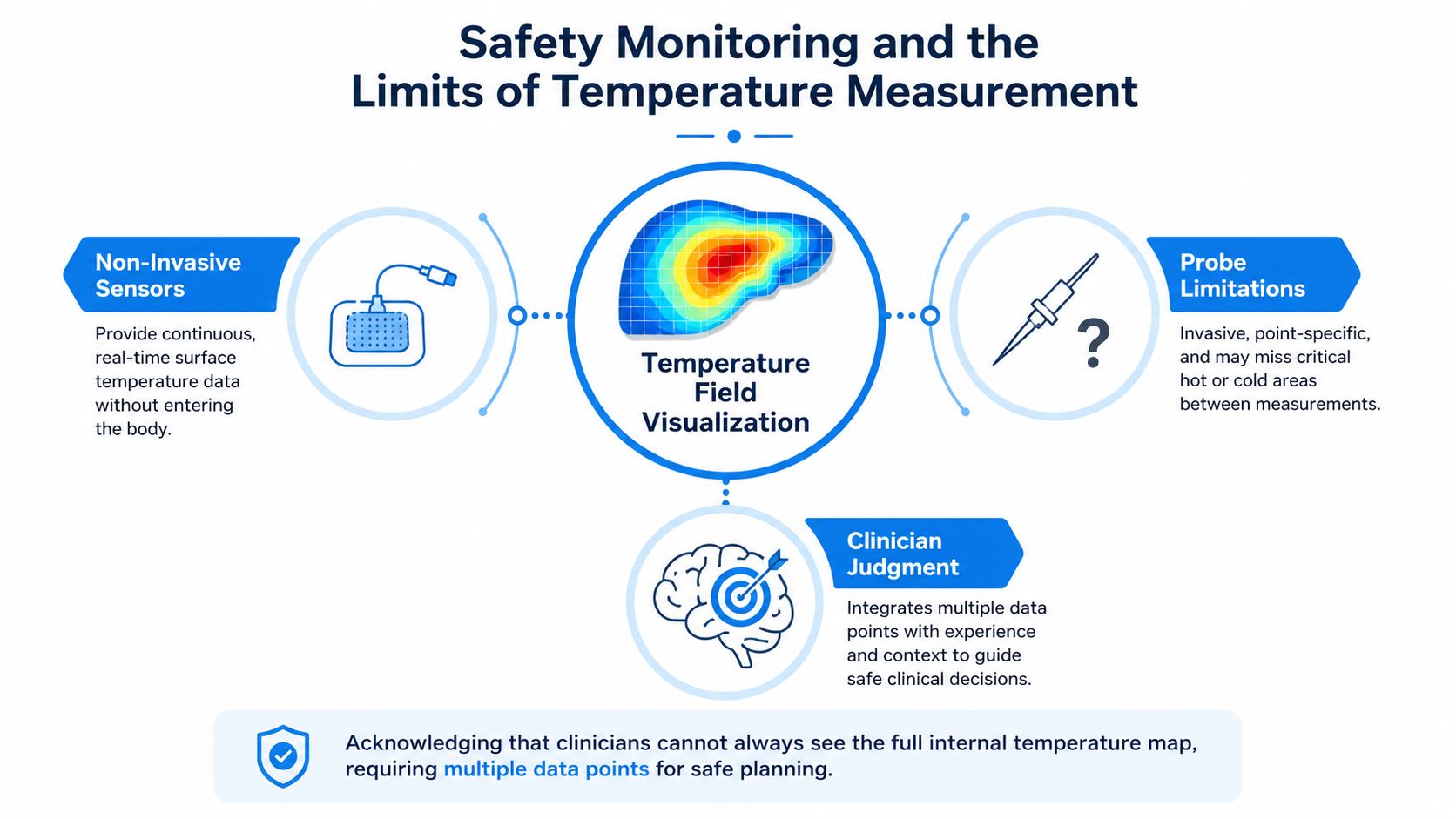
A patient may feel warmth at the skin while deeper tumor tissue remains unevenly heated. Hyperthermia planning therefore uses more than a thermometer near the treatment surface. Planning software can model electromagnetic fields, estimate temperature distribution, and support phase-amplitude optimization for phased-array systems. These calculations help clinicians predict how energy may move through the patient's anatomy and where heating may concentrate.
A model remains a prediction, not a live view of every part of the tumor. The field still lacks a method that displays a real-time temperature map across an entire treated region. In 2025, microwave hyperthermia research combined patient-specific simulations with limited catheter readings to reconstruct three-dimensional temperature maps in real time, showing both the promise of this approach and the technical work still required (2025 research on real-time temperature reconstruction).
How teams manage incomplete information
Clinicians compare several types of information:
- Patient-specific anatomy: Imaging and segmentation define the target and nearby structures.
- Electromagnetic modeling: Software estimates how the device's energy interacts with different tissues.
- Bioheat modeling: The plan accounts for heat transfer and physiological responses.
- Direct readings: Catheters or other sensors measure temperature at selected locations.
- Clinical observation: The team monitors comfort, skin response, positioning, equipment performance, and treatment changes.
Tissue differences, patient motion, catheter placement, and assumptions about the body's boundaries can all separate the modeled plan from the temperatures inside the body. Improved software can narrow that gap, but it cannot remove every uncertainty.
The question patients should ask
“If only one or two points were measured, how did the team estimate whether the rest of the tumor reached the intended thermal dose?”
There may be no single perfect answer. The clinician should explain the model, the measured locations, the expected temperature distribution, the limits for normal tissue, and the response when readings differ from the plan.
Operator training and equipment checks also affect safety. Ask who operates the system, who reviews the plan, how measurements are validated, and which thresholds prompt an adjustment or pause. A technically detailed plan still depends on consistent positioning, accurate records, clear symptom reporting, and careful interpretation of incomplete temperature data. Honest counseling should address what current monitoring can show and what it cannot confirm.
How Sunridge Medical Approaches Hyperthermia Treatment Planning
At Sunridge Medical, an integrative oncology consultation in Scottsdale begins with the patient's actual clinical record, not a generalized treatment menu. Physicians review the diagnosis, pathology, imaging, prior chemotherapy or radiation, current medications, overall health, and goals of care before discussing whether hyperthermia could reasonably complement conventional treatment.
That distinction matters. Hyperthermia is not automatically appropriate for every tumor, stage, or treatment combination, and it shouldn't replace established oncology care without a clear medical rationale. The team may coordinate with a patient's radiation oncologist, medical oncologist, surgeon, or other specialists so that any proposed plan fits the broader course of care.
Patients may also benefit from a structured review of the role of integrative oncology in modern cancer care, particularly when they're seeking a second opinion or considering supportive and adjunctive options. For residents of Phoenix, Paradise Valley, Tempe, Mesa, Chandler, and Gilbert, the clinic can help organize records and treatment questions. Out-of-town patients can ask about appointment coordination and travel planning before committing to a multi-visit course.
Sunridge Medical offers physician-directed integrative oncology evaluations that can include a careful review of whether hyperthermia fits alongside your existing cancer treatment plan. Contact Sunridge Medical in Scottsdale to discuss an appropriate consultation, and review every treatment decision with a qualified healthcare professional familiar with your case.