


One lab result decides whether immunotherapy enters the conversation for stage 4 pancreatic cancer: testing that shows MSI-H, dMMR, or TMB-high disease after earlier treatment. A small fraction of tumors carry one of these findings, so checkpoint drugs reach a narrow subgroup rather than the average patient.
That single result draws the line between three kinds of care. An approved biomarker-matched checkpoint inhibitor carries a defined evidence base. Combinations and vaccines remain investigational. Integrative support sits alongside oncology treatment and never replaces it.
Table of Contents
- Why Stage 4 Pancreatic Cancer Rarely Gets Immunotherapy First
- Biomarkers That Open an Approved Immunotherapy Option
- Response and Survival Figures Patients Should Expect
- How to Read Combination and Vaccine Trial Headlines
- Side Effects and Care That Should Not Wait
- Preparing for a Trial or Second Opinion Review
Why Stage 4 Pancreatic Cancer Rarely Gets Immunotherapy First
Immunotherapy isn't a general first-line substitute for chemotherapy in metastatic pancreatic cancer. An American Society of Clinical Oncology guideline reports that approximately 0.8% of pancreatic tumors have mismatch-repair deficiency, explaining why an important treatment opportunity applies to an uncommon subgroup.
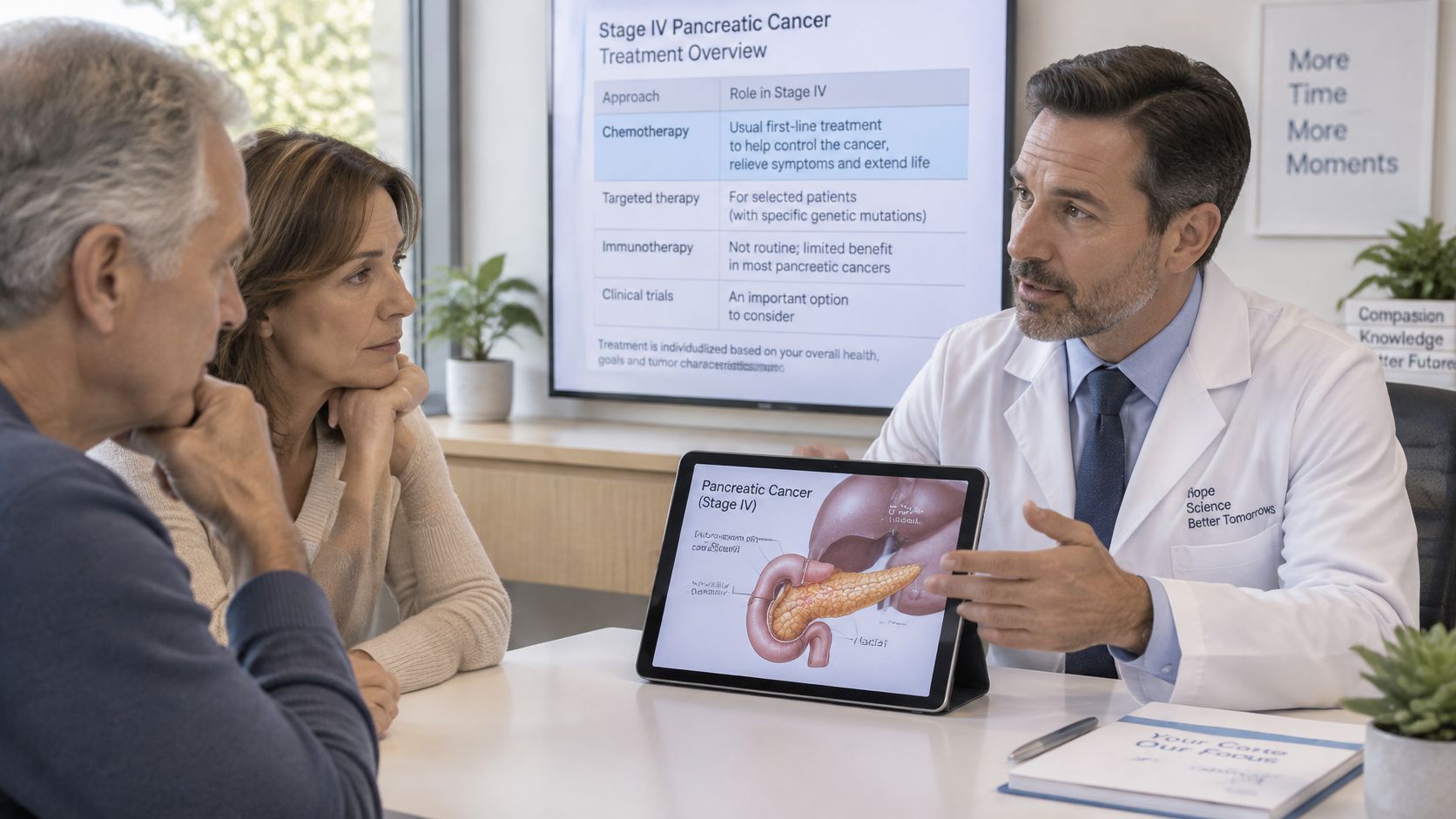
Consider a family arriving at an oncology visit after scans show that pancreatic cancer has spread to the liver. They've heard that immunotherapy can produce lasting responses in other cancers. The oncologist's next question isn't whether the cancer is advanced, but whether testing identifies a feature that supports checkpoint treatment.
Why releasing an immune brake may not be enough
Checkpoint inhibitors release signals that restrain immune cells called T cells. But pancreatic tumors can surround themselves with dense supporting tissue, called stroma, and immune-suppressive cells. Releasing a brake doesn't necessarily clear the road.
T cells may be present without being able to reach or effectively attack the cancer. That helps explain why a checkpoint drug alone usually doesn't overcome the barriers in pancreatic ductal adenocarcinoma, or PDAC.
Practical rule: The cancer's stage describes its spread. Its biomarkers help determine whether checkpoint immunotherapy belongs in the treatment discussion.
The usual treatment path
Stage 4 means cancer has spread beyond the pancreas, often to the liver, lungs, or abdominal lining. Care generally involves systemic chemotherapy directed by a medical oncologist, alongside pain control, nutrition, symptom management, and treatment of bile-duct problems when needed.
The pathology diagnosis also matters. Families can use Sunridge Medical's overview of pancreatic adenocarcinoma to organize questions about the specific cancer type rather than treating every pancreatic tumor as the same disease.
A useful question for the oncology appointment is: Has tumor testing assessed MSI, mismatch repair, and tumor mutational burden? The answer helps distinguish an established biomarker-directed option from research treatments. Testing is worth discussing even when the expected result is negative, because an actionable finding can't be identified without looking for it.
Biomarkers That Open an Approved Immunotherapy Option
MSI-H, or microsatellite instability-high, and dMMR, or deficient mismatch repair, describe related abnormalities in DNA repair. Repair defects can generate small mutations and new cancer-associated markers, called neoantigens, that make tumor cells easier for T cells to recognize.
The pathway matters to a small minority of patients. A pancreatic cancer review discussing NCCN-supported options describes about 0.8% of pancreatic tumors as dMMR, and identifies pembrolizumab as an option for metastatic PDAC with MSI-H, dMMR, or TMB-high findings. The review also discusses additional biomarker-selected checkpoint options, including dostarlimab and selected combination regimens. These medicines aren't automatically interchangeable, and guideline inclusion isn't the same as a pancreas-specific regulatory approval.
TMB-high is a separate category. The FDA pembrolizumab approval framework defines it as at least 10 mutations per megabase on an FDA-approved test, with treatment considered after progression on prior therapy when no satisfactory alternative exists.
TMB measures mutation load rather than the same repair abnormality assessed by MSI or MMR testing. Laboratory platform, tumor purity, sequencing coverage, and cutoff definitions can affect the result. A positive label therefore needs clinical interpretation, not just recognition of the word high.
What an actionable report needs to establish
For immunotherapy for pancreatic cancer stage 4, a usable report must connect a finding to an appropriate treatment setting. The oncology team should clarify:
- Sample adequacy: Whether testing used sufficient tumor tissue or an appropriate validated blood sample.
- Treatment eligibility: Whether prior therapy, current health, and regulatory criteria support the proposed drug.
- Other opportunities: Whether broad profiling or germline testing identifies another treatment-relevant alteration.
- Negative-result meaning: Whether standard treatment should continue while suitable trials are reviewed.
How the biomarker situations line up
| Situation | How common or applicable | Drugs discussed | What to keep in context |
|---|---|---|---|
| MSI-H or dMMR | Uncommon in pancreatic cancer | Pembrolizumab; dostarlimab for MSI-H disease | Confirm the test type and interpretation with the oncology team; outcome figures need pancreatic-specific context |
| TMB-high, at least 10 mutations per megabase | Uncommon and not interchangeable with MSI | Pembrolizumab; nivolumab plus ipilimumab for selected TMB-high cancers | Platform, tumor purity, sequencing coverage, and cutoff can change classification |
| No MSI-H, dMMR, or TMB-high | Most stage 4 pancreatic ductal adenocarcinomas | Checkpoint inhibitors aren't a routine NCCN option | A clinical trial may still be worth reviewing |
| Progressed after prior treatment with no satisfactory alternative | Labeling condition for tumor-agnostic pembrolizumab | Applies only when MSI-H, dMMR, or TMB-high is present | Doesn't replace chemotherapy when a satisfactory standard option exists |
Sunridge Medical's integrated oncology testing information can provide context for a discussion about existing reports and unanswered testing questions. Testing decisions should remain coordinated with the treating oncology team and shouldn't postpone appropriate systemic therapy.
Accurate documentation also helps when several clinicians share care. For practices organizing molecular findings, treatment history, and follow-up questions, PatientNotes' clinical note tools for oncology offer a documentation resource, not a substitute for specialist interpretation.
Response and Survival Figures Patients Should Expect
Three questions decide whether a survival figure applies to one patient or describes a very different group:
- Selection: Were participants chosen because they carried a specific biomarker?
- Population: Was the result pancreatic-specific or pooled across many tumor types?
- Comparison: Did the study randomize patients against chemotherapy, or did everyone receive the experimental drug?
Four groups of results show how differently the answers can turn out.
| Population | Patients | Response | Time results |
|---|---|---|---|
| Mixed metastatic pancreatic immunotherapy studies through 2025 | 834 across 17 studies | ORR 16% (95% CI 9% to 26%); partial response 13%; stable disease 28% | Median OS 7.9 months; median PFS 4.6 months, reported in the systematic review and meta-analysis |
| Previously treated MSI-H or dMMR pancreatic cancer in KEYNOTE-158 | 22 | Objective response 18.2% | Median PFS 2.1 months; median OS about 4 months; median response duration 13.4 months, described in the pancreatic immunotherapy review |
| MSI-H or dMMR cancers of many types | 149 | Reported overall response 36.9%; complete response 7% | Not a pancreas-only estimate, discussed in the review of biomarker-directed immunotherapy |
| TMB-high solid tumors in KEYNOTE-158 | Pan-cancer cohort | Objective responses reported in a minority of patients | Reflects the tumor-agnostic FDA framework rather than pancreatic-specific outcomes |
What the pooled figures actually describe
The pooled pancreatic studies included vaccines, checkpoint inhibitors, engineered T cells, natural-killer-cell approaches, and other immune treatments. They also differed in prior treatment, eligibility requirements, and patient selection. Pooling them works like averaging test scores from several different exams: the result shows the spread of research activity, not what a single available medicine will do.
Objective response rate, or ORR, means the proportion of patients whose tumors shrank enough to meet the study's response criteria. A partial response is qualifying shrinkage. A complete response means disappearance of detectable cancer under those criteria. Neither term automatically establishes a cure.
Stable disease means the cancer met neither the criteria for sufficient shrinkage nor the criteria for progression during the assessment period. It can matter to an individual patient, but it shouldn't be counted as tumor shrinkage.
Why long responses can coexist with short survival medians
The biomarker-selected pancreatic cohort illustrates a difficult but important distinction. Some responding patients experienced prolonged benefit, while many participants didn't respond. Response duration describes the responding subgroup, not everyone who started treatment.
Median overall survival, or OS, describes the midpoint of survival in a study population. Median progression-free survival, or PFS, describes the midpoint of time before progression or death. Neither is an individual deadline.
A long-lasting response among responders doesn't mean a long-lasting response is the typical outcome for everyone receiving the drug.
The mixed-cancer rows require even more caution. Results across several organs can support a tumor-agnostic treatment framework, but they don't establish the pancreatic-specific chance of benefit.
The biomarker-defined rows point toward the approved checkpoint setting, while the pooled and pan-cancer rows provide research context. For families weighing broader stage 4 cancer treatment options, the useful comparison is between choices appropriate to the same diagnosis, treatment history, and health status.
How to Read Combination and Vaccine Trial Headlines
| Study | Design | Reported result | How to read it |
|---|---|---|---|
| Pembrolizumab plus XL888 | Phase Ib/II, 16 metastatic patients | No objective responses; stable disease 13.3%; median PFS 2.0 months; median OS 4.4 months in the published combination study | Measurable immune changes in blood did not produce tumor responses |
| Plerixafor plus cemiplimab, 2025 | Phase 2, 21 previously treated metastatic patients | No objective responses; disease control 9.5% in the investigator-initiated study | A plausible combination can still have little clinical activity |
| Mitazalimab plus FOLFIRINOX, OPTIMIZE-1 | Phase 1b/2 metastatic PDAC | Objective response rate 40%, as reported in 2024 by the Vall d'Hebron Institute of Oncology | Promising investigational signal, not an established replacement for standard care |
Biological activity isn't the same as clinical benefit
The pembrolizumab and XL888 study shows why laboratory findings and patient outcomes need separate consideration. Investigators measured immune changes in blood, yet the study reported no objective tumor responses. A laboratory signal can show that a drug affects a biological pathway without showing that tumors shrink.
The plerixafor and cemiplimab report makes a related point: a scientific rationale does not guarantee meaningful clinical activity. In OPTIMIZE-1, FOLFIRINOX was the chemotherapy backbone. Because the early-phase study did not include a randomized chemotherapy comparison, it cannot establish how much benefit came from adding mitazalimab, a CD40 agonist.
The three studies therefore answer different questions. Early signals may justify further investigation, while a randomized comparison is needed to determine whether adding an investigational treatment improves outcomes over an appropriate standard.
Where personalized vaccines fit
Personalized cancer vaccines aim to teach immune cells to recognize targets specific to a tumor. A result from one treatment setting, such as treatment after surgery, does not establish benefit for metastatic disease. The study population and treatment context matter.
Questions to bring to a trial team:
- Treatment type: Is the study testing a checkpoint inhibitor alone, a combination, or a personalized vaccine?
- Control treatment: Is there a comparison group, and what care does that group receive?
- Metastatic outcomes: What response, progression-free-survival, and serious-toxicity results were reported specifically for metastatic patients?
- Timing: Could screening or participation delay needed standard treatment?
Sunridge Medical's cancer clinical trial resources can help families organize questions for a study discussion. The trial site must confirm current enrollment, eligibility, required testing, and visit demands.
An FDA-approved biomarker-matched drug and an investigational regimen are different treatment pathways. Immune activation measured in a laboratory does not by itself establish tumor control or longer survival.
Side Effects and Care That Should Not Wait
Checkpoint immunotherapy can cause the immune system to inflame healthy organs. These risks differ from a conventional chemotherapy side-effect list and require oncology monitoring during treatment and afterward.
Clinicians watch for colitis affecting the bowel, hepatitis affecting the liver, pneumonitis affecting the lungs, and endocrinopathies affecting hormone-producing glands. Thyroid or pituitary inflammation can cause symptoms that initially resemble ordinary fatigue or illness, and complications may appear weeks after a dose.
Symptoms that need prompt assessment
| Symptom | Who to contact |
|---|---|
| Trouble breathing or new chest pain | Emergency care now |
| Confusion, fainting, or new severe weakness | Emergency care now |
| Yellowing of the skin or eyes, or jaundice | Same-day oncology contact; emergency care if severe |
| Severe or persistent diarrhea | Oncology team the same day; emergency care if dehydrated or unwell |
| Fever or chills during treatment | Oncology team the same day |
| Rapidly worsening abdominal or back pain | Oncology team the same day; emergency care if severe |
| Vomiting that prevents fluids or medicines | Oncology team the same day |
These symptoms shouldn't be diagnosed at home as an expected treatment reaction. Jaundice, for example, could reflect liver inflammation or a blocked bile duct. Pancreatic cancer can also obstruct the intestine, and an immune drug doesn't correct those emergencies.
Safety review extends beyond the biomarker
Treatment suitability includes functional status, organ function, autoimmune history, steroid use, and the validity of the molecular result. Combinations that include another immune drug, such as CTLA-4 blockade, can have a different and sometimes more difficult toxicity profile.
Patients shouldn't stop prescribed medicines, change steroid treatment, or restart an interrupted cancer drug without the treating clinician's direction. A full supplement list matters because complementary products can have interactions or complicate the interpretation of new symptoms.
The National Cancer Institute's pancreatic cancer trial listing describes immune-based research with chemotherapy intended to assess safety, dosing, side effects, and preliminary effectiveness. A study's inclusion in a trial directory doesn't establish a survival benefit.
Appropriate chemotherapy, pain and nausea control, biliary drainage, nutrition, and suitable trial screening shouldn't be paused for an unproven immune approach. Complementary care needs clinician oversight and coordination with the medical oncologist.
Preparing for a Trial or Second Opinion Review
Families can prepare for a trial or second opinion in five steps: gather records, define the decision, understand the study design, coordinate timing with the oncology team, and list every medication and supplement. This keeps the review focused while the patient's current care continues.

A practical preparation sequence
Collect the clinical record. Include pathology, stage, recent imaging reports, previous treatment regimens with dates, and genomic reports. Add MSI, MMR, and TMB results if available, along with the laboratory's interpretation. Identify missing results rather than assuming they were negative.
Write one decision question. For example: Does a biomarker create an approved treatment option, or might a specific clinical trial fit the patient's situation? A focused question helps distinguish an approved biomarker-matched option from an investigational approach.
Clarify the study design. Ask whether the trial primarily evaluates safety, preliminary activity, or a randomized comparison. Families should also understand the control treatment, required biopsies, visit schedule, and what happens if the cancer progresses.
Coordinate timing with the oncology team. Ask whether screening can happen without delaying needed chemotherapy, biliary drainage or stent care, and pain control. Any proposed treatment interruption should have a medical reason and a clear plan.
Bring every medication and supplement. List prescription medicines, nonprescription products, vitamins, herbs, and infusions. Exact product names help clinicians assess potential interactions and distinguish treatment toxicity from other causes of symptoms.
Travel planning can be part of the discussion before enrollment or scheduling. Families considering transportation assistance can review this guide to no-cost travel options for cancer care, then confirm eligibility and arrangements directly with the relevant program.
How Sunridge Medical approaches a case review
Sunridge Medical is an integrative medical clinic in Scottsdale, Arizona, serving local patients, the greater Phoenix area, and people who travel for care. Its recommended starting point for cancer patients is a case review, rather than choosing a therapy from a list.
Before outlining options, the medical team reviews the cancer type and stage, pathology, previous treatment, molecular information when available, organ function, medications, symptoms, and individual goals. This helps clarify what is known, what remains uncertain, and which questions belong with the treating oncologist or trial team.
Many Sunridge Medical patients continue care with an outside oncology team while receiving physician-directed integrative support. Others seek a second opinion or a careful review of additional options. Treatment planning considers conventional, nutritional, metabolic, immune-supportive, and complementary strategies together, based on the individual case.
What a consultation can and cannot establish
A pancreatic cancer second-opinion review can help organize the diagnosis, treatment history, and questions about additional care. A consultation does not establish eligibility for immunotherapy or access to an investigational study.
Not every supportive or immune-focused approach is appropriate for every patient. Sunridge Medical does not replace the patient's oncologist, emergency care, or medically necessary conventional treatment, and it does not promise a response, disease control, or survival benefit.
The goal is a clearer understanding of possible next steps: whether an existing result needs interpretation, more information is needed, or a consultation or trial discussion fits the patient's goals. Suitability depends on individualized clinical evaluation.
Sunridge Medical offers individualized case review, second opinions, and coordinated integrative support for patients navigating advanced pancreatic cancer and questions about immunotherapy. Patients and families can contact Sunridge Medical to discuss whether a consultation may be appropriate. The next step is a conversation about fit after review of the individual case, not a commitment to any therapy.