


You've just received a cancer diagnosis, or you're facing recurrence, and the testing plan feels like a list of disconnected procedures. One report discusses pathology, another mentions biomarkers, and someone suggests a blood-based genomic test. The practical question is simple: Which result could change your care?
An integrated oncology test menu answers that question by organizing diagnostics around clinical decisions, not impressive-sounding technologies. Screening, diagnosis, treatment selection, resistance monitoring, and inherited-risk evaluation each require a different testing strategy. At Sunridge Medical in Scottsdale, Arizona, this distinction can help patients and families review conventional oncology records, consider complementary options responsibly, and avoid testing that adds information without adding a useful next step.
Table of Contents
- Why Precision Diagnostics Matter in Modern Cancer Care
- The Evolution of Companion Diagnostics
- Structuring Tests by Clinical Decision Points
- Tissue Biopsy vs Liquid Biopsy Applications
- Somatic Tumor Profiling Versus Germline Testing
- Laboratory Quality and Governance Standards
- Sunridge Medical Integration Approach
- Next Steps for Evaluating Your Care Options
Why Precision Diagnostics Matter in Modern Cancer Care
A patient may hear that a tumor is “breast cancer,” “lung cancer,” or “colon cancer,” then discover that those labels don't fully explain treatment choices. Two tumors in the same organ can carry different molecular changes, respond differently to therapy, and require different confirmatory tests. The diagnosis names the location and general disease, while integrated diagnostics help clarify the biology driving its behavior.
Consider a patient who has already completed standard treatment but now faces progression. A broad request for “every cancer test” sounds thorough, yet it can create confusion if no one has defined the decision each test is meant to support. A more useful review asks whether the available tissue is adequate, whether the tumor has been tested for relevant mutations or fusions, whether mismatch-repair status has been assessed, and whether a result could identify an approved therapy or clinical-trial option.

From a general label to a treatment map
The modern integrated oncology test menu brings together several forms of information:
- Pathology: Confirms what the tumor looks like under the microscope and establishes cellular features.
- Immunohistochemistry: Measures protein expression, such as HER2 or hormone receptors, when those findings influence treatment.
- Molecular profiling: Looks for mutations, copy-number changes, fusions, and other alterations that may affect therapy.
- Blood-based diagnostics: May identify circulating tumor DNA or other tumor-derived material when tissue is limited or serial monitoring is being considered.
- Inherited-risk evaluation: Determines whether a finding may reflect a hereditary predisposition rather than only a change acquired by the tumor.
The value doesn't come from ordering the largest possible panel. It comes from connecting each result to the patient's diagnosis, stage, previous treatment, symptoms, imaging, and available options. A mutation may be predictive of response to a particular drug, prognostic without selecting a treatment, uncertain in meaning, or irrelevant to the current decision.
Practical rule: A test belongs in a clinical plan when the care team can explain what action a positive, negative, or indeterminate result would prompt.
That framework supports both conventional oncology and carefully selected integrative care. Patients seeking a broader perspective can review the role of integrative oncology in modern cancer care while keeping pathology, staging, and evidence-based treatment decisions at the center of the discussion.
The Evolution of Companion Diagnostics
The companion-diagnostic model changed the relationship between laboratory testing and cancer treatment. In September 1998, the U.S. Food and Drug Administration approved trastuzumab for HER2-positive metastatic breast cancer at the same time it approved HercepTest, an immunohistochemical assay used to identify tumors expressing HER2. That pairing established a practical principle: a laboratory result can determine whether a patient is eligible for a specific targeted treatment, rather than treatment selection relying only on tumor location or conventional staging. The historical development of companion diagnostics describes this milestone and its implications.
The field expanded from single-biomarker testing into coordinated programs combining pathology, immunohistochemistry, molecular analysis, and blood-based diagnostics. By the end of 2010, the FDA had approved 9 companion-diagnostic assays, and by the end of 2020, the number had reached 44, representing 35 approvals during the subsequent decade. Those figures are not merely a history lesson. They explain why a contemporary oncology workup may need to consider HER2, hormone-receptor status, mismatch-repair or microsatellite-instability status, mutations, and gene fusions.
Why the menu keeps changing
FDA activity shows how quickly the diagnostic environment develops. In 2021, the agency authorized 16 oncology-related in-vitro diagnostic devices, including 12 companion-diagnostic approvals. Eight of those companion diagnostics addressed areas of unmet need, including cholangiocarcinoma and KRAS G12C variant detection in non-small-cell lung cancer. By 2024, FDA oncology regulators had authorized 76 oncology devices, including 27 in-vitro diagnostic devices. That year included 4 new IVDs with a combined 11 companion-diagnostic claims, as well as 9 expanded companion-diagnostic indications for 6 previously authorized IVDs. These figures are reported by the FDA Oncology Center of Excellence.
This activity means an oncology test menu shouldn't be treated as a permanent checklist. A test that wasn't relevant at diagnosis may become important after progression, while a previously broad test may acquire a more specific treatment indication. Regulatory authorization also matters because the same laboratory platform can have different approved uses, limitations, and evidence depending on the cancer type and intended therapy.
The FDA's authorization of a tumor-agnostic immunohistochemistry companion diagnostic for DNA mismatch-repair-deficient solid tumors illustrates another important shift. Some biomarkers can guide treatment across multiple cancer sites, but that doesn't mean every abnormal finding predicts benefit from every immunotherapy. The result still needs interpretation alongside pathology, stage, prior therapy, clinical status, and the applicable drug label or guideline.
Structuring Tests by Clinical Decision Points
Patients often encounter testing in a technology-first sequence, such as imaging, tumor markers, genomic panels, and liquid biopsy. A safer approach is to ask which clinical decision comes first. The same test may be useful in one setting and low-value in another.
| Clinical stage | Testing purpose | Key action |
|---|---|---|
| Screening | Look for cancer in people without symptoms who meet screening guidance | Complete appropriate preventive screening or arrange diagnostic evaluation for an abnormal result |
| Diagnosis | Confirm disease and define its tissue, cellular, and anatomical features | Use pathology and imaging to establish the diagnosis and stage |
| Therapy selection | Identify predictive biomarkers and treatment-linked alterations | Match validated findings with approved therapies, trials, or specialist review |
| Resistance monitoring | Evaluate molecular or clinical change after treatment or progression | Confirm discordant findings and decide whether repeat tissue, blood testing, imaging, or treatment reassessment is needed |
Screening is not the same as cancer profiling
Screening applies to people who don't have symptoms. The American Cancer Society recommends colorectal cancer screening for average-risk adults beginning at age 45, with stool-based, visual, and blood-based options. Cervical screening generally begins at age 25 and continues through at least age 65, with primary HPV testing every 5 years, HPV/Pap co-testing every 5 years, or Pap testing alone every 3 years when HPV testing isn't available. For people at high lung-cancer risk who meet the smoking-history criteria, the ACS recommends annual low-dose CT screening from ages 50 through 80. These recommendations are summarized in the American Cancer Society screening guidance.
A screening test doesn't replace evaluation of a new mass, unexplained bleeding, persistent pain, or another concerning symptom. It also doesn't substitute for molecular profiling after a cancer diagnosis. Patients can review available categories through Sunridge Medical's laboratory testing directory, then discuss which tests fit the actual decision at hand.
Profiling and monitoring require different questions
After diagnosis, advanced or metastatic solid-tumor workups should prioritize validated multigene sequencing when a biomarker-linked treatment could affect care. ASCO recommends multigene panel testing when more than one genomic biomarker is associated with a regulatory-agency-approved therapy. Testing should cover relevant DNA variants and, when appropriate, RNA-based fusion analysis, along with copy-number alterations, structural rearrangements, mismatch-repair or microsatellite-instability status, and tumor mutational burden when it could influence immunotherapy decisions. The ASCO guideline on tumor genomic testing also emphasizes validated laboratory methods and clinical interpretation.
Monitoring requires restraint. A molecular change may appear before imaging changes, but earlier detection doesn't automatically prove that changing therapy improves survival. Any result that conflicts with symptoms, imaging, or pathology needs a defined confirmation pathway rather than an immediate assumption that the cancer has progressed.
Tissue Biopsy vs Liquid Biopsy Applications
Tissue and liquid biopsy answer overlapping but distinct questions. Tissue biopsy provides cellular and structural detail, helps establish histologic diagnosis, and may supply enough material for immunohistochemistry and genomic analysis. Liquid biopsy analyzes tumor-derived material in blood, often including circulating tumor DNA, and can offer a less invasive way to look for selected alterations or monitor molecular change.
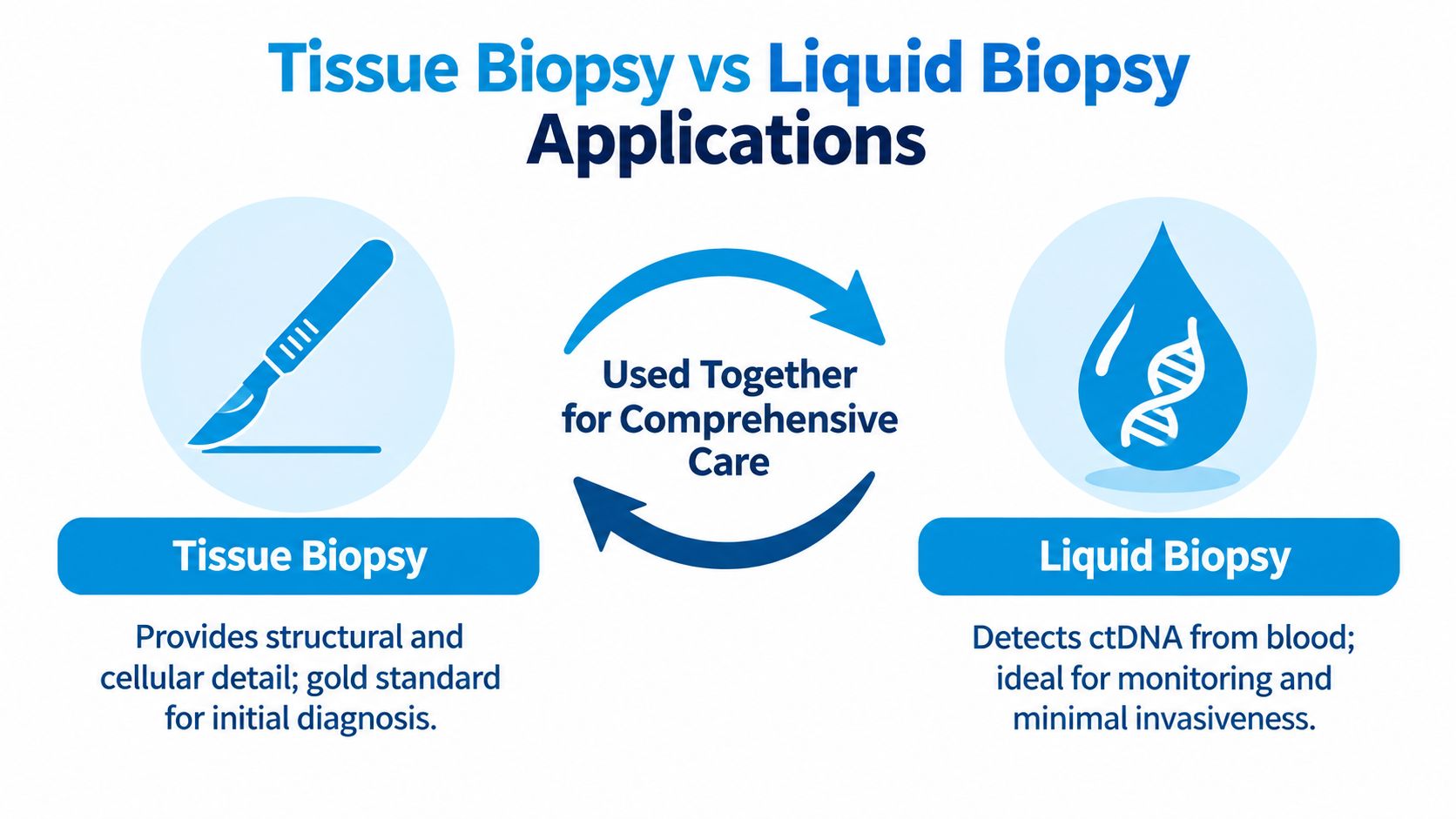
A blood test can be attractive when a tumor is difficult to access, when tissue is exhausted, or when serial sampling is being considered. It's still not automatically interchangeable with tissue. A negative plasma result may reflect insufficient tumor fraction rather than the absence of a clinically important alteration. Tissue may also be necessary to confirm histology, evaluate cellular architecture, or investigate a finding that requires more complete material.
How the two approaches differ
| Tissue biopsy | Liquid biopsy |
|---|---|
| Confirms histology and cellular context | Samples tumor-derived material circulating in blood |
| Supports immunohistochemistry and tissue-based molecular testing | Offers minimally invasive genomic profiling in selected solid cancers |
| May be required when blood testing is negative, insufficient, or discordant | May be useful when tissue is unavailable or repeat sampling is difficult |
| Can be limited by access, specimen quality, and tumor heterogeneity | Can be limited by low tumor fraction and assay scope |
The FDA approved FoundationOne Liquid CDx as a next-generation sequencing companion diagnostic using cell-free DNA from plasma. One approved use identifies BRCA1 or BRCA2 alterations in metastatic castration-resistant prostate cancer for patients who may be eligible for rucaparib. The National Cancer Institute explains that Guardant360 CDx and FoundationOne Liquid CDx are approved for people with solid cancers such as lung or prostate cancer, not blood cancers. The FDA information on FoundationOne Liquid CDx outlines the approved use and its limits.
Guardant360 CDx also received approval as a companion diagnostic for osimertinib in lung cancer, while both assays may be used for broader tumor profiling in solid cancers. Those approvals don't mean every detected alteration predicts a response. The NCI explanation of FDA-authorized liquid biopsies reinforces the need to interpret blood-based results within the specific treatment context.
For an accessible overview of the diagnostic relationship between tissue sampling and disease spread, patients can review biopsy and the spread of cancer.
A practical rule follows: a liquid biopsy can complement tissue, but it shouldn't be used to bypass a required histologic diagnosis or to make a major treatment change without reviewing the complete clinical picture. When tests disagree, the appropriate next step may involve repeat blood testing, tissue confirmation, imaging review, or multidisciplinary consultation.
Somatic Tumor Profiling Versus Germline Testing
A tumor can contain a genetic alteration that developed during cancer formation, or it can carry a change the patient inherited. Those are different biological questions, and confusing them can lead to incorrect assumptions about family risk.
Somatic testing examines alterations acquired by the tumor. It may identify a targetable mutation, resistance mechanism, diagnostic feature, or clinical-trial opportunity. Germline testing examines inherited DNA, usually from a blood or saliva sample, and can affect the patient's surveillance, treatment planning, and relatives' risk counseling.
A somatic result isn't automatically proof of hereditary cancer. It may suggest that inherited testing deserves consideration, especially when the gene and variant pattern fit a hereditary-risk pathway. The 2024 ASCO guideline states that when tumor testing identifies a pathogenic variant in a gene covered by the guideline, germline testing should be offered according to the guideline's criteria, even when the patient didn't initially meet standard germline-testing criteria. The ASCO guideline on germline genetic testing provides the clinical framework.
What patients should expect from each result
A tumor report may classify a finding as predictive, prognostic, diagnostic, or uncertain. A germline report may identify an inherited pathogenic variant, a negative result, or a variant whose significance remains unclear. Each category carries different implications, and a variant of uncertain significance shouldn't be treated as proof of inherited risk or used alone to guide major medical decisions.
Patients and clinicians should also ask:
- Was the finding identified in tumor tissue, blood, or both?
- Does the result require confirmatory germline testing?
- Could relatives benefit from genetic counseling or targeted testing?
- Does the finding affect treatment, surveillance, or only future risk assessment?
- Who will explain the result and document its limitations?
For readers evaluating the broader laboratory environment behind molecular testing, Labs USA PCR lab casework offers additional context about molecular diagnostic laboratory work. It doesn't replace genetic counseling or oncology interpretation, but understanding how laboratory methods support clinical reports can help patients ask more precise questions.
The safest workflow treats a potentially inherited tumor finding as a trigger for review, not a final hereditary diagnosis. Personal history, family history, the cancer type, variant classification, and confirmatory testing all matter.
Laboratory Quality and Governance Standards
A broad panel can produce a long report, but length doesn't guarantee clinical reliability. The laboratory must show that its assay detects the relevant alteration types with validated performance and that its quality system identifies errors, contamination, inadequate specimens, and limitations.
The College of American Pathologists requires laboratories to enroll in CAP-accepted proficiency-testing programs for analytes that require proficiency testing. For NGS testing of major oncology genes, including BRAF, EGFR, ERBB2/HER2, KIT, KRAS, NRAS, PDGFRA, and PIK3CA, CAP directs laboratories toward the applicable NGS proficiency-testing program. When no suitable program exists, CAP requires documented alternative assessment at least semiannually, such as split-sample comparison with a reference laboratory or an established in-house method. These requirements are described in the CAP molecular proficiency-testing recommendations.
A patient-level quality checklist
Before accepting a complex molecular report, the ordering team should be able to address:
- Laboratory status: Is the laboratory appropriately accredited for the testing performed?
- Assay validation: Has the method been validated for the specimen type and cancer context?
- Specimen adequacy: Was there enough tissue, and was the tumor content sufficient?
- Limit of detection: What is the smallest alteration level the assay can reliably identify?
- Variant scope: Does the panel detect single-nucleotide variants, insertions and deletions, copy-number changes, fusions, and structural rearrangements?
- Quality metrics: Does the report show coverage, tumor fraction, contamination controls, and other relevant performance measures?
- Interpretive boundaries: Does it explain germline limitations, excluded variant classes, and uncertain findings?
- Turnaround and review: Who will interpret the result, and can the timing support the treatment decision?
A report should identify specimen type, adequacy, assay scope, detected and excluded variant classes, quality metrics, and whether each finding is predictive, prognostic, diagnostic, or uncertain. Certification frameworks can also help patients understand laboratory quality systems, and this overview of why ISO 13485 certification matters provides useful background, although certification alone doesn't establish that a particular oncology assay is appropriate for a specific patient.
Clinical safeguard: A result is only as useful as the specimen, assay, interpretation, and treatment decision connected to it.
This governance prevents overinterpreting broad commercial panels. It also gives the oncology team a defensible basis for deciding whether a negative result is informative, whether a repeat specimen is needed, and whether a potentially actionable finding requires confirmation.
Sunridge Medical Integration Approach
A meaningful review begins with the records already available. Pathology, imaging, stage, treatment history, symptoms, laboratory findings, biomarker reports, and hereditary-risk information should be read together rather than interpreted as isolated documents.
At Sunridge Medical, an integrative medical clinic in Scottsdale, the diagnostic review can help organize those records and identify where specialized pathology, imaging, or laboratory coordination may be appropriate. The purpose isn't to replace the treating oncologist or assume that every abnormality requires an intervention. It's to clarify which findings are established, which are uncertain, and which could affect a conventional or complementary care decision.
Turning results into a coordinated plan
For a newly diagnosed patient, the focus may be confirming pathology, staging disease, and identifying treatment-linked biomarkers. For someone with recurrence, the priority may shift toward reassessing tissue, reviewing resistance mechanisms, considering blood-based testing, or determining whether an inherited-risk referral is appropriate.
Integrative care may include nutritional support, symptom management, medication review, and other adjunctive approaches alongside conventional oncology. These measures should be discussed in the context of the patient's diagnosis, current treatment, organ function, interactions, and goals. They shouldn't be presented as substitutes for proven cancer therapy or as guaranteed solutions when standard care has been insufficient.
Patients seeking a broader review can learn more about integrative cancer care in Scottsdale. A consultation is most productive when patients bring pathology reports, imaging discs or reports, molecular testing, medication lists, treatment summaries, and specific questions about what would change management.
Next Steps for Evaluating Your Care Options
An integrated oncology test menu is useful when it reduces uncertainty rather than multiplying it. The right review connects screening, pathology, biomarkers, molecular findings, inherited-risk questions, and monitoring results to decisions that make sense for the individual patient.
If you're in Scottsdale, Phoenix, Paradise Valley, Tempe, Mesa, Chandler, Gilbert, or elsewhere in the greater Phoenix metropolitan area, consider discussing your records with an experienced physician before ordering additional testing. A focused consultation can help determine whether you need diagnostic clarification, treatment-planning support, a second opinion, or coordination between conventional and integrative care.
Sunridge Medical offers individualized integrative oncology consultations that connect pathology, imaging, laboratory data, biomarkers, and treatment history to practical care planning. Visit Sunridge Medical to discuss whether a Scottsdale consultation is appropriate for your cancer diagnosis, recurrence, or complex health concerns.