


When symptoms persist or treatment hasn’t helped as hoped, it’s understandable to look for additional options while feeling cautious about conflicting advice, safety, and claims that sound too certain. Integrative medicine for hard to treat cases shouldn’t mean collecting therapies or setting conventional treatment aside. Its value lies in coordinated care that considers the whole person and connects conventional treatment with selected, research-based complementary approaches under medical oversight.
This article explains what integrative medicine can mean in complex cases and how an individualized evaluation can help weigh potential benefits, risks, interactions, and your priorities. You’ll find practical questions to bring to a medical evaluation, along with records that can help your care team understand your history and current treatment. The goal is a focused conversation about options, with coordination, safety, and your needs at the center.
Key Takeaways
- See how an individualized evaluation connects your health history, current care, symptoms, and priorities.
- Learn how medication details, prior test results, and a symptom timeline can make treatment discussions more informed.
- Understand how integrative medicine for hard to treat cases differs from uncoordinated care, including how options and potential interactions are reviewed.
- Use a practical checklist to organize records and identify the questions that matter most to you.
- Explore how Sunridge Medical develops individualized plans for cancer and complex chronic conditions, bringing conventional therapies and research-based alternative treatments into the discussion.
What Integrative Medicine Means in Hard-to-Treat Cases
Persistent symptoms or limited progress can leave you feeling stuck, especially when appointments address individual concerns but the overall picture remains unclear. A difficult course of illness calls for careful attention, not the assumption that every option has been exhausted. Integrative medicine provides a framework to review your situation and consider appropriate next steps in context.
Integrative medicine is coordinated care that considers a person’s health, circumstances, and priorities while bringing conventional medical treatment together with selected complementary approaches when appropriate. The central idea is coordination, not simply adding therapies. A general overview of Integrative Medicine describes its relationship with conventional and alternative medicine. In practice, an individual plan also requires medical judgment, attention to safety, and clear communication.
For example, someone managing a chronic condition—such as persistent back or disc pain being addressed by clinics like coralwaydisccenter.com—may be receiving conventional treatment and want to discuss complementary non-surgical approaches for symptom support or daily well-being. An integrative review considers how that option fits the person’s overall care, what evidence is available, and whether it could create risks or interactions. It doesn’t assume every approach is suitable or that adding one will change the course of a disease.
Why a case may be considered hard to treat
“Hard to treat” can describe different clinical situations. Symptoms may continue despite care, several diagnoses may affect one another, or a person may respond differently to a treatment than others do. These circumstances can make decisions more complex, but they don’t automatically mean no care options remain.
There is no single explanation or pathway for every difficult case. Medical history, current treatment, previous responses, daily functioning, and personal goals all shape the questions a care team needs to consider. Two people with the same diagnosis may have different symptoms, priorities, and clinical constraints. A careful evaluation starts with those differences rather than putting both people on an identical plan.
Integrative care is not the same as replacing conventional medicine
Integrative care can consider conventional treatment alongside complementary approaches, with decisions made within a coherent medical plan. It doesn’t mean stopping or delaying prescribed care. Whether exploring personalized hormone and energy optimization through telehealth resources like optimizewithsummit.com or adding supportive therapies, discuss any proposed treatment change with the medical team responsible for your care, particularly when multiple clinicians or therapies are involved.
- Supportive care may address symptoms, comfort, or well-being as part of an overall plan.
- Evidence review helps distinguish reasonable possibilities from claims that go beyond what is known.
- Coordination helps the care team consider safety, interactions, and continuity.
A complementary treatment shouldn’t be presented as a proven cure simply because it is described as natural or integrative. For integrative medicine for hard to treat cases, a thoughtful path forward starts with an honest discussion of what is known, what remains uncertain, and how each option fits the individual’s care.
How an Integrative Medical Evaluation Builds a More Complete Picture
A useful evaluation doesn’t begin with a predetermined treatment package. It starts by gathering the context needed to understand what has been tried, what matters to you, and which questions remain. In integrative medicine for hard to treat cases, this review helps clinicians consider possible next steps alongside your existing care, rather than treating each symptom or therapy as a separate decision.
A complete history helps clinicians interpret today’s symptoms in light of past treatments, test results, and the person experiencing them. That context can clarify which questions deserve attention and where information is missing. It can also help distinguish a treatment that didn’t help from one that was stopped early or whose effects were difficult to assess because other changes occurred at the same time.
What clinicians review before discussing treatment options
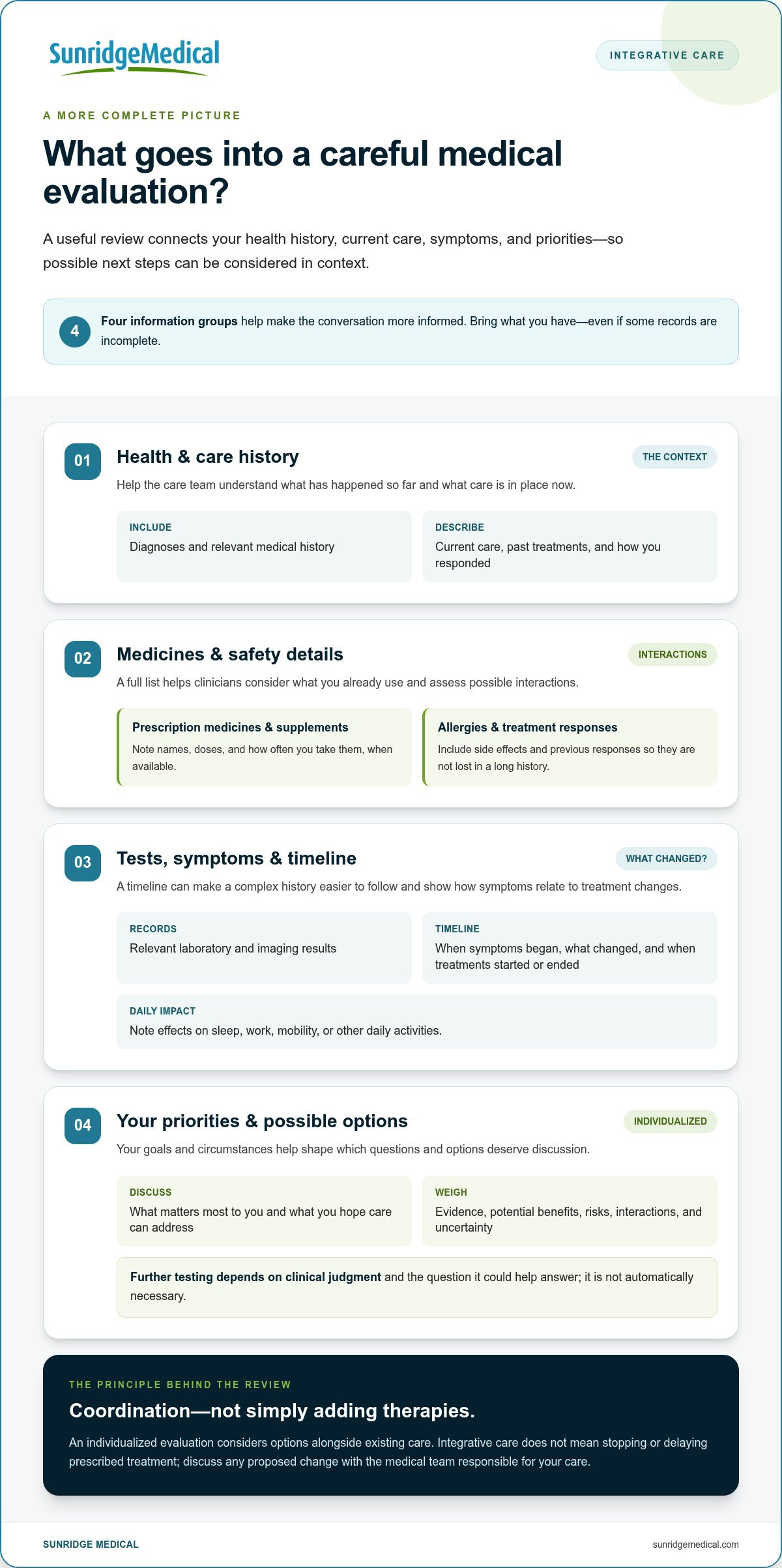
Bring the records you have, even if they’re incomplete. A clinician may review diagnoses, previous treatments and responses, prescription medications, supplements, allergies, and relevant laboratory or imaging results. A timeline makes the history easier to follow: note when symptoms began, what changed, when treatments started or ended, and how symptoms affected sleep, work, mobility, or other daily activities. The evaluation can identify missing records and which information may be useful to obtain.
Include medication and supplement names, doses, and how often you take them when available. These details help the care team assess possible interactions and understand what you’re already using. Note side effects or previous treatment responses too, so they don’t get lost in a long history.
How an individualized plan is developed and monitored
After reviewing your history and current care, the discussion can turn to your goals and the options that may fit your situation. A clinician considers the evidence for each approach alongside possible benefits, risks, interactions, and uncertainty. The National Center for Complementary and Integrative Health provides research-based information about complementary and integrative health approaches. Evidence varies by therapy and condition, so a general finding isn’t proof that an approach is right for every person.
Further testing depends on clinical judgment and the question it could help answer. It isn’t automatically necessary to repeat every prior test or order a standard set of investigations. Likewise, any additional therapy should have a clear rationale and be considered in relation to current treatment and individual priorities.
A plan is not a guarantee of improvement or a universal protocol. Follow-up creates an opportunity to review tolerability, symptoms, daily function, and new information, then consider whether the plan needs adjustment. Keep your regular medical team informed about changes so care remains coordinated. Sunridge Medical’s evaluation and treatment planning provides a starting point for discussing a complex health history through an individualized physician evaluation.
Integrative Medicine vs. Uncoordinated Alternative Treatment
Integrative care and conventional medicine aren’t opposing camps. Conventional care can be part of an integrative plan. The distinction is whether options are considered together, with communication and clinical oversight. Uncoordinated alternative treatment may be pursued without the medical team knowing what is being used. The appropriate approach depends on your diagnosis, goals, potential risks, and guidance from clinicians familiar with your case.
More therapies don’t automatically mean better care. An additional treatment may be unsuitable, interact with medication, or make it harder to tell what is helping. The Mayo Clinic on Integrative Medicine discusses combining conventional and complementary approaches with attention to evidence. The comparison below highlights practical differences; coordination and oversight depend on the care setting.
| Care model | Oversight and communication | Evidence and interactions | Continuity |
|---|---|---|---|
| Coordinated integrative care | Conventional and complementary options are considered in relation to the overall plan, with relevant information shared among clinicians. | Options are reviewed for supporting evidence, uncertainty, risks, and possible interactions with medications or other therapies. | Follow-up can assess tolerability and inform decisions about continuing or adjusting the plan. |
| Conventional care alone | Care is guided by conventional medical practice. Communication depends on the clinicians and services involved. | Conventional treatments are assessed within their clinical context; complementary options may not be part of the discussion unless raised. | Continuity depends on the care team’s follow-up and communication. |
| Uncoordinated alternative care | An approach may be pursued without regular communication with the clinicians overseeing other treatment. | Evidence and interactions may not be reviewed alongside the full medical picture. | Changes may be difficult to track if treatment information isn’t shared across care. |
Questions that help assess evidence and safety
Before starting an option, ask what evidence supports its use for your condition, what remains uncertain, and what risks are known. Share a complete list of prescriptions, supplements, and other therapies so potential interactions can be assessed. Clarify what symptoms or effects should be monitored, who will review them, and what would prompt pausing or stopping the approach. Specific answers help you make an informed decision without relying on broad promises.
How coordination protects continuity of care
When clinicians know which treatments you’re using, they can make decisions with a fuller view of your care. Share relevant recommendations and changes with the medical team responsible for your treatment. Don’t independently stop or alter prescribed care; discuss proposed changes with that team. Clarify who will monitor each approach and handle follow-up questions to reduce gaps and keep decisions accountable.
How to Prepare for an Integrative Medicine Consultation
A little preparation can make a complex health discussion more focused. You don’t need a perfect medical file or a treatment decision before the appointment. Aim to give the clinician a clear picture of what you’ve experienced, what care you’re receiving, and what you hope to address. Preparation supports a useful conversation, but it doesn’t predetermine the evaluation or plan.
Records and details to bring
Gather the information you can access, even if some pieces are missing. Organize it in a folder or a single digital document so you can find key details during the appointment. A concise overview is often easier to use than a large, unorganized collection of records.
- Health history: Current diagnoses, relevant test results, imaging reports, and summaries of prior treatments, including how you remember responding.
- Current products: Prescription medicines, over-the-counter products, supplements, and known allergies or sensitivities. Include dose and frequency when you know them.
- Symptom timeline: Approximate start dates, how often symptoms occur, their severity, what has changed, and how they affect daily activities.
- Personal priorities: The concerns you most want addressed, the activities or functions you hope to support, and any practical limits that shape your decisions.
Brief notes are enough for a symptom timeline. You might record that a symptom appears after a particular activity or changed in frequency after a treatment began, without assuming those events are connected. If records aren’t available, note what’s missing and where they may be held. The evaluation can help identify which information would be useful to obtain next.
Questions to ask about a proposed care plan
Write down your most important questions before the appointment. Start with the issue that matters most, then use the remaining time to clarify the reasoning, safety considerations, and next steps. This can help you leave with a clearer understanding of what is being considered and what remains unresolved.
- What is the purpose of this option, and what evidence supports its use for my situation?
- What is uncertain, and what potential risks or interactions should we consider?
- How would this fit with my current treatment and communication among my clinicians?
- What would be monitored, who would review it, and when would follow-up take place?
- What changes or concerns should prompt me to contact the responsible medical team?
It’s reasonable to ask how a decision would be revisited if an approach isn’t tolerated or doesn’t meet agreed goals. Clear monitoring and follow-up allow the care team to review what happens without assuming a particular result. Don’t change prescribed treatment on your own; discuss proposed changes with the clinicians responsible for your care.
Explore Sunridge Medical’s evaluation and treatment planning as a starting point for organizing your questions and health history.
How Sunridge Medical Approaches Integrative Care for Complex Cases
Sunridge Medical approaches complex cases through individualized physician evaluations and treatment planning. Its care plans bring conventional therapies together with selected, research-based alternative treatments, considered in relation to a person’s health history and current care. The aim is a coordinated clinical discussion, not a one-size-fits-all protocol or a promise of a particular result.
For people exploring integrative medicine for hard to treat cases, this distinction matters. A thoughtful plan considers why an option is being discussed, how it relates to existing treatment, and what ongoing medical oversight is appropriate. Conventional care remains part of that picture. Decisions about changes belong in discussion with the clinicians responsible for treatment.
A broader clinical lens for complex conditions
Sunridge Medical focuses on cancer and complex chronic conditions, including chronic Lyme disease, autoimmune disorders, and neurologic conditions. Each presents different clinical questions, and a person’s history shapes what is relevant to evaluate. For cancer-specific context, the alternative cancer treatment clinical guide discusses integrative oncology considerations without replacing individualized medical advice.
Chronic symptoms can involve layered histories and care needs. A chronic Lyme disease care guide offers condition-specific context, while an integrative chronic illness guide addresses broader considerations for complex chronic conditions. These resources can help frame questions, but they don’t determine which therapies are appropriate for an individual.
Physician evaluation provides a foundation for considering how a person’s history, current therapies, and priorities fit together. Ongoing monitoring keeps the care plan under review as circumstances and clinical information evolve. Each additional approach should be considered on its own merits, with attention to evidence, potential risks, and how it fits alongside existing care. Alternative or investigational approaches shouldn’t be treated as established standard care or as a cure.
Taking a measured next step
A useful first conversation begins with what you’ve experienced, what care you’re receiving, and what matters most to you. Bring relevant records and a short list of questions, including what is known about proposed options, what remains uncertain, and how follow-up will be handled. You don’t need to arrive with a treatment decision already made. The purpose is to understand how an individualized evaluation and coordinated plan can address your needs.
Explore Sunridge Medical to learn more about individualized evaluation and integrative care planning.
Take a Thoughtful Next Step
A complex health journey can make every decision feel consequential. You don’t need to arrive with a complete answer. A focused conversation can help clarify which questions matter now, how your priorities fit into care decisions, and what information could support a careful next step. Integrative medicine for hard to treat cases is best approached as a process of considered decisions, not a promise that one approach will resolve everything.
Led by Medical Director Dr. Steven S. Isaacman, Sunridge Medical provides individualized physician evaluations and treatment planning. Its approach brings conventional therapies and research-based alternative treatments into the discussion in light of each person’s clinical context. The goal is a clear, medically guided conversation, with decisions about current care made alongside the clinicians responsible for it.
If you’re ready to explore whether an individualized evaluation fits your needs, explore Sunridge Medical’s individualized approach to complex care.
Frequently Asked Questions
What is integrative medicine for hard-to-treat cases?
Integrative medicine for hard-to-treat cases is a coordinated way to consider conventional medical care alongside selected complementary approaches, based on the individual’s condition and circumstances. It may be relevant when symptoms persist, diagnoses overlap, or treatment decisions involve several factors. The term doesn’t mean every available therapy should be used. Each option needs a clear purpose, and claims about disease treatment should be weighed against the evidence and clinical context.
Can integrative medicine be used alongside conventional treatment?
Yes. Integrative care can include conventional treatment while clinicians consider whether complementary approaches may fit alongside it. For example, a patient receiving prescribed treatment may want to discuss a supportive therapy or supplement. The care team needs to know about it to consider possible interactions and whether it could affect ongoing care. Discuss proposed additions or changes with the clinicians responsible for your treatment before acting on them.
Is integrative medicine evidence-based?
Evidence varies by therapy, condition, and the outcome being considered. Some approaches have been studied for particular uses, while others have limited or uncertain evidence. A finding for one condition doesn’t establish benefit for another. Ask what research supports a proposed option, how closely it applies to your situation, and what is not yet known. Be cautious of claims that promise a cure or treat preliminary findings as established medical practice.
How does an integrative medical evaluation work?
An integrative evaluation connects your concerns with relevant medical and treatment history, then considers which questions or options warrant further discussion. The clinician may clarify how symptoms affect daily activities, what you hope to address, and whether additional information is needed. For instance, a change in symptoms after starting a therapy may prompt a closer review, but timing alone doesn’t prove cause. Testing or treatment recommendations depend on clinical judgment.
What should I bring to an integrative medicine consultation?
Bring a current medication and supplement list, including doses if known, allergy information, and records relevant to your concerns. A short note about the main questions you want answered can help you use appointment time well. If you’re unsure whether a report matters, include it or note where it can be found. Avoid changing your routine just to prepare unless your medical team has advised you to do so.
Can supplements interact with prescription medications or cancer treatment?
Yes. Supplements can affect how prescription medicines work, and potential interactions deserve particular attention during cancer treatment. “Natural” doesn’t automatically mean risk-free, and product ingredients may not be obvious from a brand name alone. Share the exact product label, dose, and frequency with your oncology or prescribing team before starting, stopping, or changing a supplement. If you’ve already taken one, tell the team what you used and when.
Does integrative medicine replace standard medical treatment?
No. Integrative medicine is not a reason to abandon, delay, or independently alter standard medical treatment. Complementary approaches may be considered as part of a broader plan, but they shouldn’t be presented as proven cures or substitutes for established care. If you’re considering a change, discuss it with the clinician overseeing that treatment so the decision accounts for your diagnosis, current therapies, and safety needs.