


When symptoms shift across body systems and flare unpredictably, it can be hard to know what to try next. The safest first step is often to clarify what may be driving them, rather than adding supplements or making several changes at once. Integrative treatment for mast cell activation syndrome should support careful evaluation and appropriate medical care, not replace them.
Assessing MCAS can be complex. A clinician considers the symptom pattern, relevant test results, response to treatment, and other possible explanations. Medication or supplement sensitivities can also make self-directed changes risky, so a measured, individualized approach helps keep safety and diagnostic accuracy in view.
This article explains how MCAS is evaluated and commonly managed, and where practical measures such as symptom tracking, dietary adjustments, or complementary therapies may fit. It also covers why changes to medications or supplements need clinical oversight, and how to prepare for a more coordinated conversation with your care team. The goal is a clearer next step that considers your full health picture and keeps appropriate medical care at its foundation.
Key Takeaways
- MCAS evaluation considers recurring symptoms across body systems alongside clinical findings, since similar symptoms can have other explanations.
- Integrative treatment for mast cell activation syndrome coordinates supportive strategies with appropriate medical care rather than replacing it.
- “Natural” doesn’t automatically mean safe or suitable. Discuss supplements and other treatment options with a clinician before making changes.
- Prepare for care conversations by noting symptom timing, possible exposures, effects on daily function, treatment changes, and relevant medical records.
- Sunridge Medical combines conventional therapies with research-based alternative treatments in individualized care plans for complex chronic conditions.
Mast Cell Activation Syndrome: Definition and Evaluation
Mast cell activation syndrome (MCAS) describes recurrent episodes of symptoms associated with the release of mast-cell mediators, chemicals that can affect different tissues and organ systems. MCAS is a clinical syndrome involving recurrent, systemic mast-cell activation. Mastocytosis is a separate disorder involving an abnormal increase or growth of mast cells. An isolated allergic reaction is a single event and does not, by itself, establish MCAS. For an overview of the syndrome and its features, see Mast Cell Activation Syndrome.
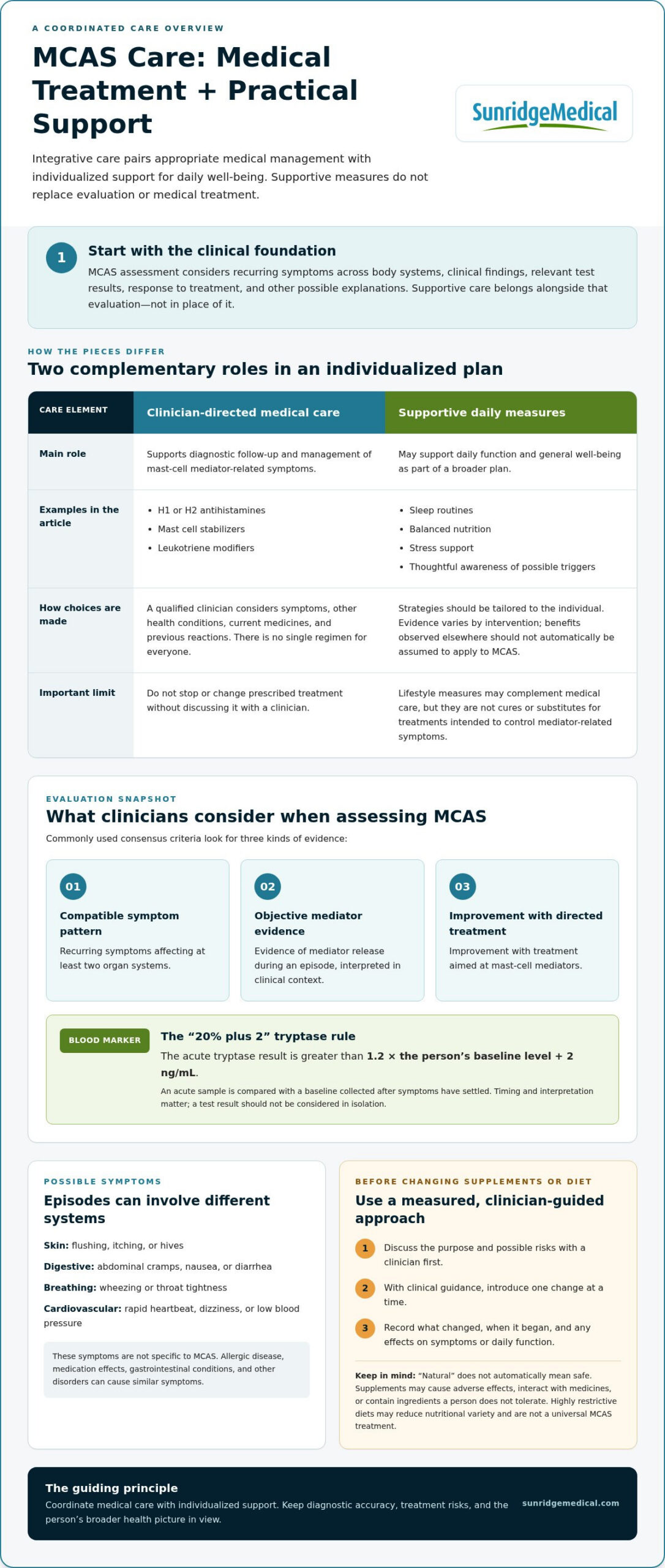
Diagnosis requires more than a symptom checklist. In commonly used consensus criteria, clinicians look for a compatible pattern affecting at least two organ systems, objective evidence of mediator release during an episode, and improvement with treatment directed at mast-cell mediators. The best-established blood marker is an acute tryptase increase meeting the “20% plus 2” rule: the result is greater than 1.2 times the person’s baseline level plus 2 ng/mL. Broader clinical frameworks also consider other mediator tests, but results need careful interpretation.
Which symptoms can lead clinicians to consider MCAS?
Possible symptoms include flushing, itching, or hives; abdominal cramps, nausea, or diarrhea; wheezing or throat tightness; and cardiovascular symptoms such as a rapid heartbeat, dizziness, or low blood pressure. Episodes may come and go, and the pattern can vary between people or from one flare to another. None of these symptoms is specific to MCAS. Allergic disease, medication effects, gastrointestinal conditions, and other disorders can cause similar symptoms, so a symptom list alone cannot confirm the diagnosis.
What does an MCAS evaluation usually consider?
A clinician reviews the episode history: what happens, when it begins, how long it lasts, which body systems are involved, and whether the pattern recurs. Symptoms involving several systems at once may guide the evaluation, but they still need to be considered alongside other possible explanations and the person’s broader health history.
Testing is selected and timed in relation to symptoms. Tryptase is most useful when an acute sample can be compared with a baseline collected after symptoms have settled. Clinicians may also consider urinary mediator tests, although the markers used and their interpretation can vary. A normal result, a sample taken at the wrong time, or one abnormal test should not be interpreted in isolation. Diagnostic standards and approaches to mediator testing continue to be discussed, so test results need to be considered with the clinical pattern.
This distinction is foundational to integrative treatment for mast cell activation syndrome: supportive care should be considered in the context of diagnostic accuracy and appropriate medical treatment.
What Does Integrative Treatment for MCAS Include?
Integrative care brings appropriate medical treatment together with individualized support for daily well-being. It does not replace diagnostic evaluation or therapies selected to manage mast-cell mediator-related symptoms. Instead, it considers how symptoms, medical history, treatment risks, and personal priorities fit together. The International Society for Mast Cell Activation Syndromes offers a multidisciplinary perspective on education and care for these complex conditions.
Clinician-directed symptom management may include established medicines such as H1 or H2 antihistamines, mast cell stabilizers, or leukotriene modifiers. Which options are appropriate depends on a person’s symptoms, other health conditions, current medicines, and previous reactions. There isn’t one regimen that suits everyone. Discuss medication decisions with a qualified clinician.
Supportive lifestyle measures may help with daily function, but they are not equivalent to treatments intended to control mediator-related symptoms. Sleep routines, balanced nutrition, stress support, and thoughtful awareness of possible triggers can complement medical care, but they aren’t cures for MCAS. Evidence varies by intervention, and benefits observed in other settings shouldn’t automatically be assumed to apply to MCAS.
How can conventional and supportive care work together?
Coordinated care connects diagnostic follow-up and symptom management with practical strategies for everyday life. For example, a symptom record can help a clinician assess whether a treatment change is useful, while attention to sleep or meal patterns may support general well-being. The plan should be tailored to the individual, not assembled from a standard checklist. Don’t stop or change prescribed treatment without discussing it with your clinician.
How should supplements and dietary changes be approached?
“Natural” doesn’t mean risk-free. Supplements can cause adverse effects, interact with medicines, or contain ingredients a person doesn’t tolerate. Dietary changes also have trade-offs: a highly restrictive diet may reduce nutritional variety and isn’t a universal MCAS treatment. Discuss the purpose and risks of a supplement or food adjustment with a clinician before making a change.
Make changes deliberately and keep track of them. With clinical guidance, introduce one change at a time and note what changed, when it began, and any effects on symptoms or daily function. This makes patterns easier to discuss without assuming that every exposure is a trigger. That measured approach is central to integrative treatment for mast cell activation syndrome: support the whole person while keeping safety and appropriate medical care in view.
Sunridge Medical develops individualized care plans for complex chronic conditions, combining conventional therapies with research-based alternative treatments. Explore Sunridge Medical’s integrative approach to learn how broader health context can inform care planning.
How Can You Judge MCAS Treatment Options and Common Claims?
To assess an MCAS treatment option, ask what it is intended to do, what evidence supports it, and what oversight it requires. Clinician-guided medicines may target mediator-related symptoms, while supportive measures may help with daily routines or general well-being. A positive response or lack of response to one option does not, on its own, confirm or rule out MCAS.
Evidence varies across treatments, and results may not apply equally to every person. Use this comparison as a starting point for discussion, not as a treatment ranking or personal medical advice.
| Option type | Purpose | Evidence and uncertainty | Oversight |
|---|---|---|---|
| Clinician-guided symptom management | Address symptoms associated with mast-cell mediators | Established medicines are used in clinical care; suitability and benefit vary by individual | Discuss selection, effects, and changes with a clinician |
| Supportive measures | Support daily function, such as through sleep routines or practical trigger awareness | Potential value depends on the measure; MCAS-specific benefit shouldn’t be assumed | Tailor changes to health needs and monitor their effects |
| Supplements or restrictive diets | Proposed for symptom support | Evidence and safety can be uncertain; “natural” doesn’t mean risk-free | Review potential interactions, adverse effects, and nutritional impact with a clinician |
Which treatment claims deserve careful scrutiny?
Be cautious of claims promising a cure, guaranteed improvement, or one protocol that works for everyone. Testimonials describe individual experiences, but they can’t establish that a treatment caused a change, will work for others, or is safe for someone with a different medical history. Advice to abandon conventional care or avoid diagnostic evaluation is another warning sign. A credible discussion should acknowledge uncertainty and explain the purpose and limits of a proposed approach.
When considering integrative treatment for mast cell activation syndrome, look for a clear goal, a reasonable explanation of the evidence, and a plan for monitoring effects. Discuss claims you encounter with a qualified clinician and consider them in light of your symptoms, history, medicines, and risks.
How can patients reduce treatment-related risks?
Share a complete list of prescription medicines, over-the-counter products, supplements, and previous treatment reactions. Check with your clinician before starting, stopping, or changing a therapy, since even familiar products may cause adverse effects or interact. If you experience severe breathing difficulty, fainting, or signs of suspected anaphylaxis, seek emergency medical care immediately.
How Can You Prepare a Practical, Individualized MCAS Care Plan?
Variable symptoms can make it difficult to recall useful details during an appointment. A concise record helps you and your clinician identify patterns, assess treatment effects, and decide what needs follow-up. It doesn’t need to be perfect. Consistent notes are more useful than trying to document everything.
What should an MCAS symptom journal include?
For each episode, note when symptoms began, how long they lasted, which body systems were affected, and how they changed your ability to work, sleep, eat, or complete daily activities. Record relevant details such as medicines, supplements, meals, and possible exposures. Treat these as observations, not proof that a particular item caused a reaction.
Bring the journal, relevant laboratory results, and records of prior evaluations to appointments. A short, organized timeline can be easier to review than extensive, unstructured notes.
Which questions can make a clinical visit more useful?
Write down questions beforehand so the conversation covers both diagnostic reasoning and practical next steps. Consider asking:
- Which diagnostic criteria are being considered, and what other explanations fit my symptoms?
- What are the goals of each recommended treatment, and how will we assess whether it’s helping?
- Could a proposed treatment interact with my current medicines or supplements, or carry risks based on my history?
- What should I track, when should we follow up, and which symptoms require urgent care?
Share any changes in symptoms, daily function, or treatment since the last visit. If autoimmune concerns are also part of your health history, discuss how they may affect the overall assessment and care priorities.
How can you keep the plan practical as circumstances change?
Work with your clinician to keep the written plan specific to your symptoms, medical history, priorities, and response to treatment. It can record agreed next steps, monitoring, and follow-up questions. Revisit it when symptoms shift or a treatment changes, rather than assuming an old plan still fits. This makes integrative treatment for mast cell activation syndrome a coordinated process, not a fixed checklist.
Sunridge Medical combines conventional therapies with research-based alternative treatments in individualized plans for complex chronic conditions. Read its overview of integrative medicine for chronic illness to see how broader health context can inform care planning.
To learn more about Sunridge Medical’s approach to individualized care, explore its website.
How Sunridge Medical’s Integrative Approach Fits Into Complex-Care Planning
Complex symptoms rarely fit neatly into one part of a person’s health history. Sunridge Medical combines conventional therapies with research-based alternative treatments in individualized care plans for complex chronic conditions. This approach considers the broader clinical picture while keeping appropriate diagnostic evaluation and conventional treatment in view. It does not mean that an alternative therapy can establish an MCAS diagnosis or replace care directed at the condition.
What does individualized care mean in a complex health journey?
An individualized discussion can take account of a person’s history, current symptoms, previous evaluations, treatments, and priorities. Considering that context can help clarify which concerns need attention, how proposed options align with personal goals, and which safety factors deserve consideration. A plan should also include a way to review the response and adjust decisions as circumstances change.
There’s no single approach that fits everyone with suspected MCAS. Symptoms may have different causes, and treatment suitability depends on clinical assessment. Integrative treatment for mast cell activation syndrome should complement appropriate evaluation and care, with each proposed measure considered for its purpose, evidence, risks, and relevance to the individual.
What are sensible next steps for readers exploring care?
Before a consultation, gather a concise symptom timeline, records of relevant evaluations and test results, and a current list of prescriptions, over-the-counter medicines, and supplements. Note what matters most to you, such as improving daily function or understanding recurring episodes. These details can help focus the conversation without presuming a diagnosis or cause.
Use the visit to discuss how your clinical history informs the assessment, what the goals of care are, and how proposed treatments will be monitored. Ask how decisions will account for safety and how the plan may be revisited if symptoms or priorities change. This provides a clearer basis for coordinated care and shared decision-making.
Sunridge Medical’s broader approach centers on individualized planning for complex chronic disease, combining conventional therapies with research-based alternative treatments. Learn about Sunridge Medical and its approach to complex-care planning.
Take the Next Step Toward More Coordinated Care
MCAS symptoms can be complex, but a thoughtful plan can make the next conversation more focused. Careful evaluation helps distinguish a clinical pattern from symptoms that may have other explanations. Treatment choices should reflect your history and safety needs, while symptom records and clear questions can help you and your clinician assess what may be useful.
Integrative treatment for mast cell activation syndrome should complement appropriate diagnostic evaluation and medical care, not replace them. Supportive measures may have a role, but they aren’t a cure, and claims of guaranteed results deserve caution.
Sunridge Medical combines conventional therapies with research-based alternative treatments and develops individualized care plans for complex chronic diseases. Its approach considers the full clinical context rather than relying on a one-size-fits-all plan. Explore Sunridge Medical’s individualized integrative approach.
You deserve a care conversation that takes your experience seriously and gives you a practical way forward. Preparing clear notes and questions can help you move toward care with greater clarity and confidence.
Frequently Asked Questions
What is the most effective treatment for mast cell activation syndrome?
There isn’t one treatment that works best for everyone with MCAS. Clinicians tailor symptom management to a person’s symptoms, medical history, other medicines, and response to care. Options may include H1 or H2 antihistamines, mast cell stabilizers, or leukotriene modifiers, with other therapies considered when appropriate. The aim is to manage symptoms and support quality of life while a clinician monitors benefits and risks.
Can integrative treatment help with MCAS symptoms?
Integrative care may support MCAS management when coordinated with appropriate medical evaluation and treatment. Integrative treatment for mast cell activation syndrome can include clinician-guided symptom management alongside practical support for sleep, nutrition, stress, and awareness of possible triggers. These measures may support daily well-being, but they aren’t cures, and their MCAS-specific benefits can vary. Discuss proposed changes with a clinician, especially if you take medications or have had treatment reactions.
How is mast cell activation syndrome diagnosed?
MCAS diagnosis involves a clinician assessing recurrent, compatible symptoms that affect at least two organ systems, objective evidence of mast-cell mediator release, and improvement with treatment directed at mast-cell mediators. A commonly used tryptase criterion is an increase during a flare exceeding 20% above baseline plus 2 ng/mL. Testing needs to be interpreted in context, including its timing, symptoms, and medical history. Symptoms or a single test alone don’t establish MCAS.
Can diet or supplements treat MCAS?
Dietary changes or supplements may be considered as supportive measures, but they aren’t established cures for MCAS and shouldn’t replace medical care. A restrictive diet isn’t appropriate for everyone and may reduce nutritional variety. Supplements can also cause adverse effects or interact with medications, even if described as natural. Discuss a change with your clinician, consider one change at a time, and track what you take and any symptoms or effects.
Is MCAS the same as mastocytosis?
No. MCAS is a clinical syndrome involving recurrent symptoms associated with mast-cell mediator release. Mastocytosis is a distinct disorder characterized by an abnormal increase or accumulation of mast cells in tissues. The conditions may share some symptoms, but one doesn’t automatically mean the other is present. A clinician considers the symptom pattern, test results, and relevant medical history to assess which diagnosis, if any, best explains a person’s health concerns.
When should someone with possible MCAS seek urgent care?
Seek emergency medical care for severe breathing difficulty, fainting, or symptoms suggesting anaphylaxis, particularly if symptoms are rapidly worsening or affect multiple body systems. Follow any emergency plan provided by your clinician, including using prescribed emergency medication as directed. Don’t wait for a routine appointment or try a new supplement or home measure to manage a severe reaction. For less severe but recurring symptoms, arrange clinical evaluation and document what happened.